The modern workplace is characterized by relentless change, a constant flux of new technologies, shifting market demands, and evolving employee expectations. This pervasive disruption, while often a catalyst for innovation, is increasingly cited as a significant drain on the very individuals tasked with steering their organizations through it: leaders. As artificial intelligence and other transformative technologies reshape how we work, the imperative to nurture and sustain human leadership capabilities has never been more critical. Experts are increasingly highlighting "psychological capital" (PsyCap) as the vital, yet often overlooked, resource that empowers leaders to not only survive but thrive amidst complexity, driving growth for themselves, their teams, and their organizations.
PsyCap, a concept rooted in positive psychology, represents an individual’s positive psychological state of development, defined by four key components: hope, efficacy, resilience, and optimism (HERO). It functions as an internal reservoir of motivation and capability, enabling leaders to navigate challenges, adapt to uncertainty, and maintain forward momentum. Far from being a static personality trait, PsyCap is a dynamic and developable asset, crucial for sustained leadership effectiveness.
The Evolving Landscape of Leadership Demands
The past decade has witnessed an unprecedented acceleration of change. The rapid integration of digital technologies, the rise of remote and hybrid work models, and the increasing societal and environmental pressures have created a complex operating environment for businesses globally. This constant state of flux demands more from leaders than ever before. They are expected to be strategic visionaries, empathetic coaches, agile decision-makers, and resilient role models, all while managing the day-to-day operational demands of their roles.
This multifaceted pressure can lead to what many leaders describe as a profound sense of depletion. The energy required to consistently innovate, motivate teams, and steer through ambiguity can become exhausted, impacting not only their personal well-being but also their capacity to lead effectively. This is where the concept of psychological capital emerges as a critical differentiator.
Understanding Psychological Capital: The Four Pillars of Strength
Psychological capital is not merely a feel-good notion; it is a scientifically validated construct with demonstrable impact on individual and organizational performance. Researchers have identified four core elements that constitute PsyCap:
- Hope: This refers to the motivational capacity to set and achieve goals, coupled with the ability to generate pathways to reach those goals. Leaders with high hope are proactive and resourceful in overcoming obstacles.
- Efficacy (Self-Efficacy): This is the belief in one’s own ability to successfully execute specific tasks or achieve desired outcomes. Leaders with high efficacy are confident in their capabilities, even in the face of difficult challenges.
- Resilience: This is the capacity to bounce back from adversity, setbacks, and failures, learning from these experiences and continuing to strive for success. Resilient leaders can withstand pressure and maintain performance under duress.
- Optimism: This is a positive attributional style, where individuals tend to expect good outcomes and attribute positive events to internal, stable, and global causes, while viewing negative events as external, temporary, and specific. Optimistic leaders maintain a positive outlook, fostering a sense of possibility and encouraging their teams.
Studies consistently show a strong correlation between higher levels of PsyCap and desirable workplace outcomes. Employees and leaders with robust psychological capital tend to exhibit greater commitment to their roles, higher performance levels, enhanced well-being, and a reduced likelihood of experiencing burnout. For instance, research published in the Journal of Organizational Behavior has indicated that individuals with higher PsyCap are more likely to engage in proactive behaviors, seek out developmental opportunities, and adapt effectively to organizational changes.
The Indispensable Role of PsyCap in Leadership
The demands of leadership, by their very nature, require a deep well of psychological fortitude. Leaders are the primary drivers of organizational success, tasked with setting direction, inspiring action, and fostering environments where teams can flourish. This inherently human-centric role is profoundly influenced by a leader’s internal psychological state.
Leaders with high PsyCap often demonstrate stronger authentic leadership behaviors. They possess greater self-awareness, exhibit transparency in their relationships, and maintain a clear moral perspective. These qualities are directly linked to increased trust from their teams, leading to improved collaboration, higher engagement, and ultimately, better organizational performance.
Leadership itself, defined as a dynamic social process, relies heavily on human energy, motivation, and psychological capacity. Sustaining this energy, especially amidst the complexities of today’s business landscape, requires more than just technical skills or strategic acumen. It necessitates a foundational level of inner strength and a positive psychological orientation. This is precisely where psychological capital proves essential.

Decades of research have solidified PsyCap’s predictive power for key organizational success indicators, including performance, employee engagement, and retention rates. It encapsulates the uniquely human strengths that equip leaders to not only navigate the inevitable disruptions but to leverage them as opportunities for growth and innovation.
Cultivating PsyCap: A Developable Asset
A crucial aspect of psychological capital is its developable nature. It is not an immutable characteristic but a resource that can be intentionally cultivated and strengthened over time. Through targeted interventions, such as leadership coaching, reflective practices, and supportive organizational environments, leaders can build and sustain their PsyCap, enhancing their long-term effectiveness.
The impact of leadership development programs on PsyCap is a significant area of study. Research conducted by organizations specializing in leadership development, such as the Center for Creative Leadership, has revealed that participants in their flagship programs often show significant increases in PsyCap. This growth is not merely a byproduct of acquiring new skills; it is intrinsically linked to the program’s ability to foster inner resources.
For example, a longitudinal study examining participants in a comprehensive Leadership Development Program (LDP) found that those who reported higher levels of hope and optimism post-program also demonstrated stronger goal attainment and greater team engagement. This suggests that enhancing a leader’s psychological capital is a fundamental objective of effective leadership development, moving beyond skill acquisition to cultivate the inner resilience needed for sustained impact.
The Transformative Power of Leadership Development on PsyCap
The process of leadership development often involves stepping back from daily pressures to engage in reflection, receive candid feedback, and explore new approaches. This immersive experience can be a powerful catalyst for PsyCap growth. Leaders do not just gain new tools; they acquire the internal fortitude to effectively deploy those tools when faced with adversity.
Data from numerous leadership development initiatives consistently demonstrates this phenomenon. In one observed cohort of education leaders undergoing a custom development program, the percentage of leaders reporting "high PsyCap" more than doubled, rising from 36% before the program to 79% afterward. This substantial increase underscores the tangible impact of structured development on leaders’ inner resources.
Understanding why this growth occurs is key. Interestingly, data collected during intensive leadership programs often reveals a temporary dip in PsyCap during the program’s mid-point. This dip typically occurs when leaders receive challenging, yet constructive, feedback, often through 360-degree assessments, which can momentarily shake their confidence or optimism. However, this temporary wobble is a critical precursor to growth. As leaders process this feedback, develop strategies to address identified areas for improvement, and gain new skills, their PsyCap rebounds, often surpassing their initial levels. This process highlights that true growth often involves confronting discomfort and learning to navigate it effectively.
The Unique Benefits of Coaching in Boosting Leader PsyCap
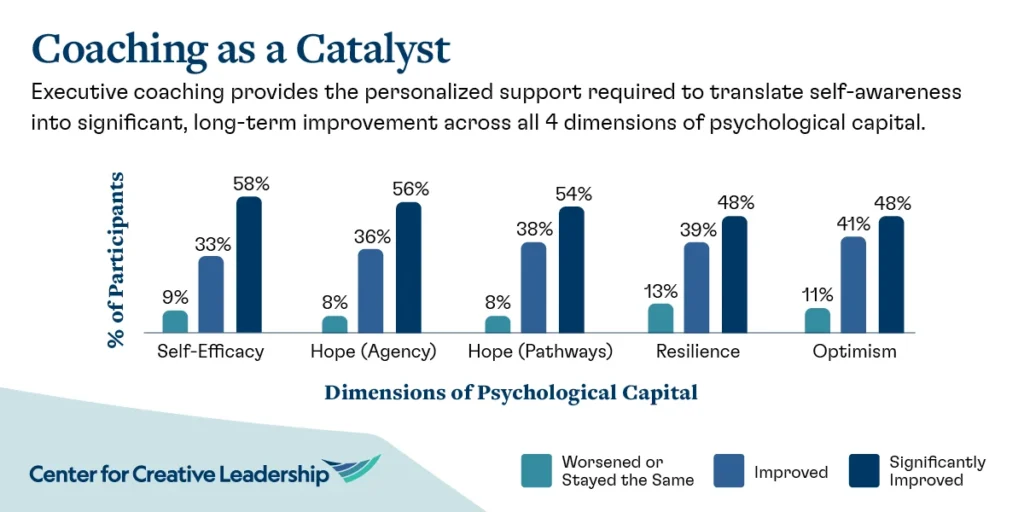
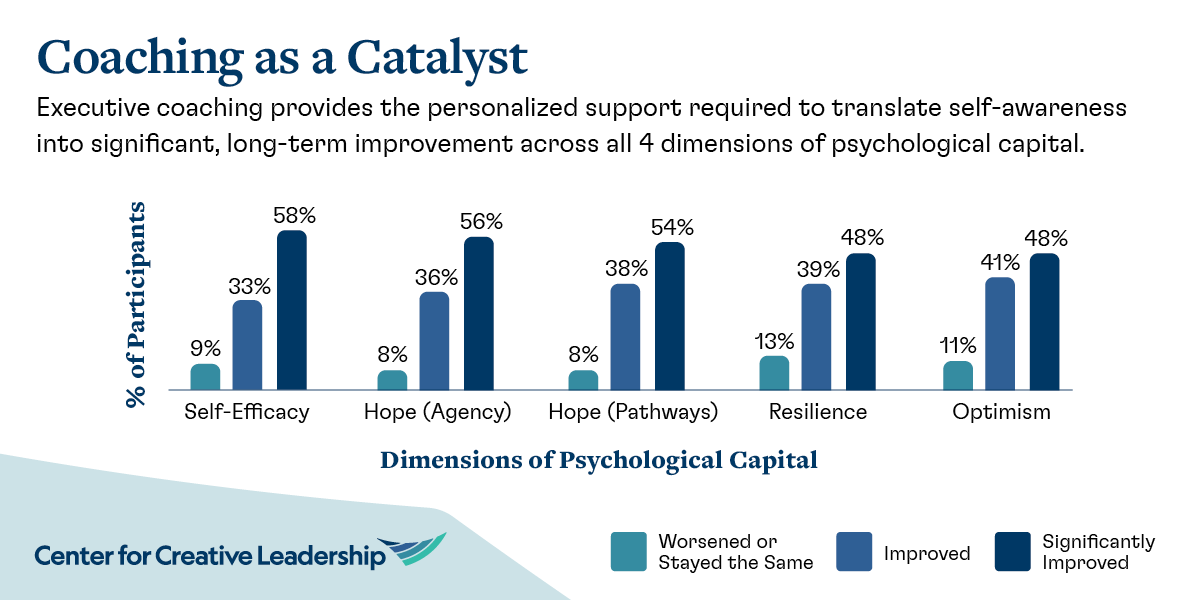
Coaching emerges as a particularly effective modality for providing leaders with the intentional support needed to cultivate and sustain their psychological capital. Executive coaching offers a personalized, one-on-one environment where leaders can delve into their challenges, develop self-awareness, and engage in goal-achieving behaviors that directly bolster their PsyCap.
Evaluations of coaching interventions have found that even highly experienced leaders report significant positive improvements in their PsyCap after engaging in executive coaching services. This aligns with the core purpose of coaching: to move beyond skill-building and foster the internal work – the self-awareness, mindset shifts, and emotional regulation – necessary for more effective and sustainable leadership. Coaching acts as a powerful catalyst, replenishing the energy of leaders who are consistently practicing these behaviors in their demanding roles.
An infographic illustrating "Coaching as a Catalyst for Psychological Capital" visually represents this synergy, demonstrating how tailored guidance can translate into enhanced hope, efficacy, resilience, and optimism for leaders.
The Value of Bite-Sized Interventions in Strengthening PsyCap
While immersive, in-person leadership development programs are highly effective, the benefits of psychological capital are not limited to such intensive experiences. Emerging evidence suggests that shorter, more targeted interventions, including online leadership training, can also significantly strengthen PsyCap, particularly when learning is directly tied to a real-world work challenge.
Pilot programs for self-paced online courses focused on building leader PsyCap have yielded encouraging results. Participants in one such course reported a statistically significant increase in their overall psychological capital, with an average increase of nearly a full point on a 1-to-5 scale (+0.74). Notably, 86% of leaders participating in the online course indicated experiencing overall improvement. The efficacy of this format is amplified when the learning is anchored in the leader’s "key leadership challenge," ensuring that reflections and practice are relevant and actionable in their daily work.
Neurodiverse Leaders and the Nuances of PsyCap
The growing recognition of neurodiversity in the workplace brings to light important considerations regarding psychological capital. While organizations increasingly benefit from neurodiverse leadership teams, research indicates that leaders who identify as neurodivergent (e.g., with ADHD or autism) tend to report lower overall levels of PsyCap when compared to their neurotypical counterparts.
It is crucial to interpret these findings with nuance. This does not signify a deficit in leadership potential. Instead, it highlights that neurodivergent leaders may bring unique strengths and require different types of support to optimize their psychological resources. For organizations, this underscores the imperative to create inclusive environments that foster the psychological conditions necessary for all leaders, regardless of their neurotype, to sustain their impact and thrive. An infographic on "PsyCap Among Neurodiverse Leaders" often illustrates these comparative findings, emphasizing the need for tailored support systems.
Psychological Capital: The Essential Fuel for Navigating Disruption
In an era defined by relentless disruption, leadership development must transcend the mere acquisition of skills. It must actively cultivate the psychological fuel that enables leaders to remain effective in ambiguous, demanding, and rapidly evolving environments. Psychological capital is that fuel, and the data clearly demonstrates its capacity to grow through deliberate development.
Across various modalities – from intensive programs and one-on-one coaching to digital learning experiences – PsyCap flourishes when leaders engage in a balanced interplay of enhanced self-awareness, meaningful challenges, and supportive conditions that facilitate the translation of insight into action. This growth journey is rarely linear. It often involves a temporary setback, a dip in confidence or optimism, as leaders grapple with difficult feedback. However, with appropriate support, this challenging phase becomes a pivotal turning point, empowering leaders to regain agency, clarity, and the confidence to innovate and lead in new ways.
The impact of PsyCap extends beyond the individual leader. Leadership sets the tone, but organizational culture acts as the system that amplifies or stifles this energy. When organizations cultivate cultures that actively support PsyCap – by normalizing feedback, celebrating progress, and valuing recovery as much as performance – the positive effects multiply. High-performing organizations foster environments where hope, self-efficacy, resilience, and realistic optimism gain momentum, radiating from leaders to their teams and throughout the wider organization.
However, it is essential to recognize that developing psychological capital is not a panacea for systemic issues. It is not about encouraging individuals to "muscle through" unhealthy workloads or toxic organizational cultures. Leadership resilience and optimism are most potent when complemented by robust systemic support, a culture of psychological safety, and thoughtfully established boundaries. The ultimate aim is not to create leaders who can merely endure adversity, but to cultivate the inner resources that empower them to confront hard realities, identify viable solutions, and inspire a future that benefits all stakeholders.
Charting the Path Forward: Investing in Leader PsyCap
The evidence is compelling: in a world of constant disruption, psychological capital is not a luxury but a necessity for effective leadership. Organizations that prioritize the development of their leaders’ PsyCap are investing in their long-term resilience, innovation, and overall success.
For individuals seeking to enhance their own leadership capabilities and for organizations committed to nurturing their leadership pipeline, taking the next step is crucial. Programs like the Leadership Development Program (LDP) and executive coaching services are specifically designed to cultivate the psychological capital and inner resources that leaders require to perform at their peak, especially when faced with the inevitable challenges of a dynamic world. By focusing on the human element of leadership, organizations can build a more resilient, adaptive, and ultimately, more successful future.