
The moment arrives with a quiet gravity. A colleague, a team member, confides a profound personal loss – the death of a significant loved one. In the ensuing wave of empathy, many leaders face an unexpected internal jolt: a quiet panic, a stark uncertainty about how to respond effectively. This universal human experience, while deeply personal, intersects with the professional sphere in ways that often leave organizations unprepared. The word "bereaved" itself, rooted in a sense of being "robbed," hints at the profound disruption that grief brings, a force that cannot simply be compartmentalized or managed away. Yet, in many corporate environments, this is precisely the expectation placed upon grieving employees.
Despite the near-ubiquity of bereavement in the lives of working adults, with many experiencing it multiple times, formal leadership training rarely equips managers to navigate these sensitive situations. While good intentions abound, effective support often falls short. Research from the Center for Creative Leadership (CCL) reveals a significant disconnect between leaders’ intentions and the actual needs of grieving employees, highlighting a critical opportunity for leadership development. This is not about transforming managers into grief counselors, but rather about equipping them with the essential human skills to be present, honest, and willing to acknowledge what cannot be fixed.
Bereavement at Work: The Unseen Toll on Individuals and Organizations
The intersection of personal loss and professional demands creates a unique challenge. Bereavement in the workplace occurs when the profound experience of death confronts the structured realities of professional life. Grief, by its very nature, does not adhere to schedules or respect organizational boundaries; it infiltrates the workspace, impacting individuals and, by extension, the teams and organizations they are part of.
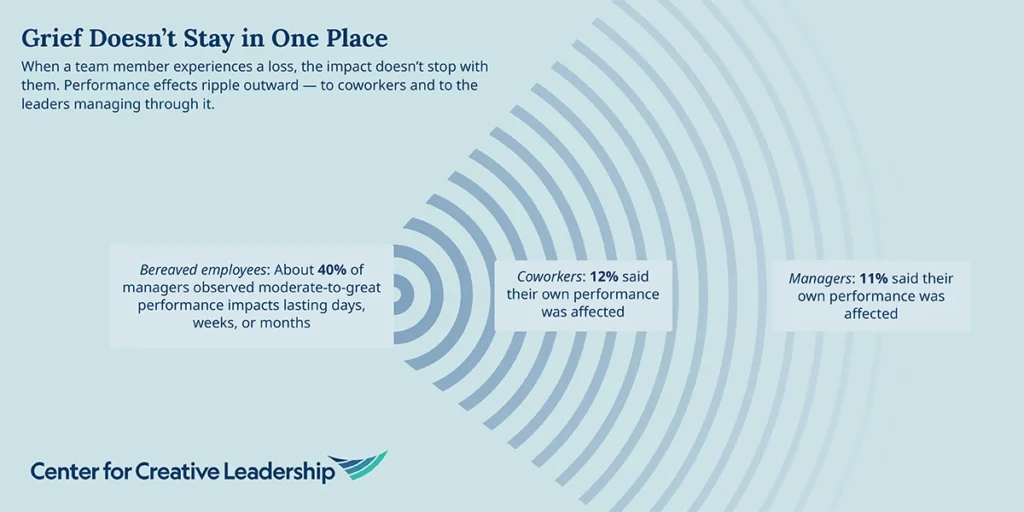
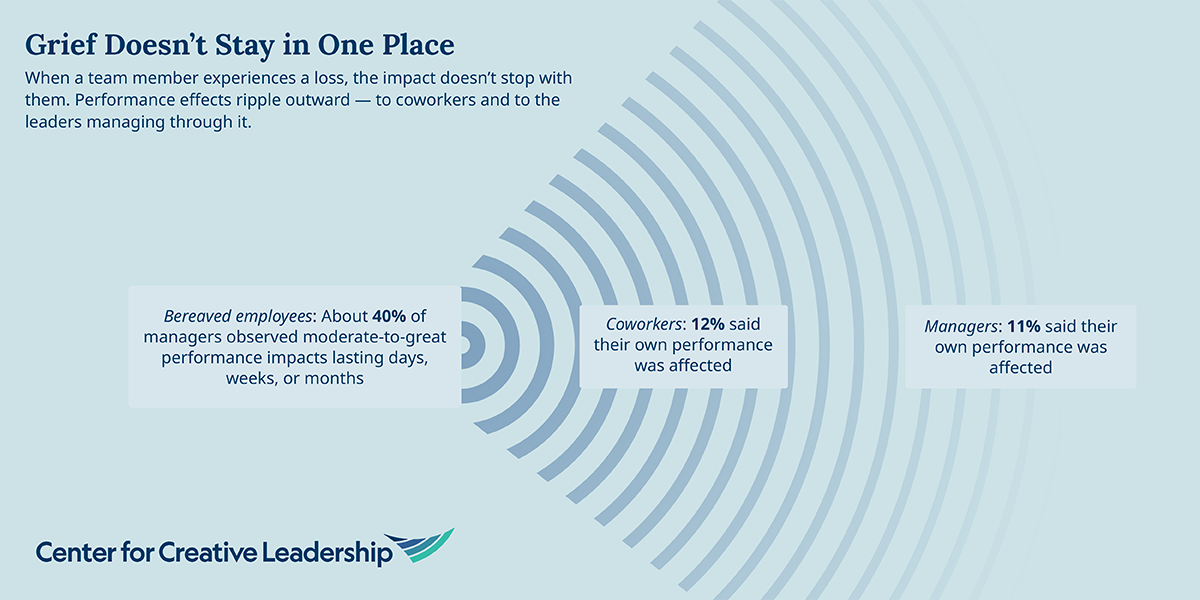
A comprehensive three-perspective study by CCL, surveying managers, coworkers, and bereaved employees, sheds light on this complex dynamic. The findings underscore that the impact of bereavement extends beyond the individual experiencing the loss. Data indicates that a staggering 90% of managers observed some level of performance impact in a bereaved employee. Alarmingly, approximately 40% of these managers noted moderate to significant performance dips, which could persist for days, weeks, or even months. The ripple effect is further illuminated by the fact that 11% of managers reported their own performance being affected, and 12% of coworkers experienced similar impacts. This demonstrates that bereavement is not an isolated event but a force that disrupts the equilibrium of teams and the broader organizational environment.
The existing framework of bereavement leave policies often exacerbates these challenges. The CCL research found that a substantial 73% of bereaved employees felt they did not receive adequate time off to grieve. Compounding this, 28% of employees had no access to any form of bereavement leave whatsoever. This forces individuals to return to work before they are emotionally prepared, attempting to manage the arduous process of grief while simultaneously fulfilling professional responsibilities. This emotional burden is often compounded by the practical demands of funeral arrangements, estate management, and supporting other grieving family members. These statistics are not merely metrics of productivity; they are stark indicators of the unspoken burdens carried by employees, often without sufficient organizational support.
Supporting Grieving Employees: Where Good Intentions Fall Short
The desire to offer support during times of grief is a common human trait among leaders. However, the ability to translate that desire into effective action is frequently hindered by a lack of preparation. CCL’s research indicates that while 60% of bereaved employees reported their managers treated them with a great deal of compassion, a concerning 20% – one in five individuals – felt they received little to no support during one of life’s most challenging experiences. This gap leaves employees feeling isolated and unsupported by those in leadership positions.
It is crucial to delineate what is not expected of leaders in supporting grieving employees. Managers are not tasked with finding the perfect words, an often-impossible endeavor. They are not expected to "fix" grief, which is an inherently personal and often lengthy process, nor are they tasked with accelerating an employee’s healing journey. The role is not that of a therapist. Instead, the research points to a simpler, yet profoundly impactful approach: showing up, paying attention, offering choices, and deferring to the employee’s lead.

Subtle Signals, Significant Impact: The Importance of Observational Leadership
A critical insight from the research is the necessity for leaders to actively observe and respond to subtle cues. Managers often default to reacting to overt signs of distress, such as emotional breakdowns or missed deadlines. However, grief in the workplace rarely announces itself so dramatically. More commonly, it manifests in quieter, less obvious changes in an employee’s demeanor and behavior. These can include a decrease in proactive engagement, a loss of enthusiasm for formerly enjoyable tasks, increased irritability or withdrawal, or a decline in attention to detail. These are not immediate red flags but subtle signals that, if missed, represent a lost opportunity for timely and effective support.
Conversely, certain leader actions can inadvertently worsen the situation. These include downplaying the loss, offering platitudes that minimize the employee’s pain, pressuring the employee to return to full productivity too quickly, or making assumptions about how the employee should be feeling or coping. The act of checking in, even without having the perfect words, requires attunement and a willingness to notice.
Small Gestures, Lasting Impressions: The Power of Consistent Presence
The impact of support during bereavement is often measured not by grand gestures, but by consistent, understated presence. Small acts of kindness, such as a simple signed card, a quietly offered cup of coffee, or a brief check-in that does not demand the employee perform normalcy, can leave a lasting positive impression. These gestures signal recognition of the employee as a whole person, beyond their professional role.
In contrast, employees recalled unhelpful interactions that often involved being subjected to intrusive questioning about their grief, receiving unsolicited advice, or being subjected to a perceived lack of empathy. The core message conveyed by helpful gestures is one of acknowledgment and understanding.
One Size Does Not Fit Grief: The Necessity of Personalized Support
Perhaps one of the most significant findings is the inherent individuality of the grieving process. Not everyone requires the same response or support. Some employees may need space and solitude, while others may find solace in talking. Some may wish to immerse themselves in work as a coping mechanism, while others may need their responsibilities adjusted. However, many leaders tend to adopt a one-size-fits-all approach, often defaulting to avoidance or overly frequent check-ins, rather than engaging in a dialogue to understand individual needs.
The solution is remarkably straightforward and hinges on a fundamental leadership skill: asking. Inquiries such as, "How can I support you right now?" or "Would you prefer to ease back in, or jump in?" can be transformative. These questions not only acknowledge the employee’s experience but also alleviate the guesswork that often leads to mismatched support. It is important for leaders to recognize that employees may not always know what they need. Offering options, allowing them time to adjust, and revisiting these conversations periodically are crucial components of effective support.
When Leaders Get It Right: The Impact of Empathy and Flexibility
Bereaved employees vividly remember the leaders who offered genuine support. The most impactful responses, as highlighted in the research, often involved simple yet profound acts of flexibility, consistent presence, and protective advocacy. Leaders who get it right are characterized by their ability to notice changes in their employees and act on those observations. They advocate for additional time off when necessary, maintain consistent but not excessive check-ins, allow employees to dictate their own pace, and actively listen to their needs. Crucially, they acknowledge the loss, a factor that research indicates holds more significance than many leaders realize.
Bereavement at Work: A Crucial Leadership Development Opportunity
Even the most robust leadership development programs often overlook the critical need for skills in navigating unscripted, emotionally charged human moments. An employee’s bereavement is precisely such a moment, and most leaders find themselves unprepared. The CCL research reveals that a substantial 73% of managers expressed a need for training on how to support bereaved employees, indicating a widespread call for fundamental human skills to effectively support their teams.
The competencies required to effectively support a grieving employee are not novel; they are foundational to exceptional leadership. These include emotional intelligence, self-awareness, empathy, the ability to engage in difficult conversations, and coaching presence. Bereavement in the workplace serves as a high-stakes crucible for these skills, one for which many leaders have historically lacked dedicated preparation.
The solution lies not in creating isolated bereavement programs, but in integrating these essential human skills into existing leadership development frameworks. Every module on emotional intelligence can inherently address how a leader might navigate grief in the workplace and offer solace to someone experiencing loss. Similarly, coaching skills training can prepare leaders to ask sensitive yet direct questions like, "How are you really doing?" and "What else do you need to feel supported?" This approach reframes bereavement not as an add-on, but as a vital lens through which to view and enhance existing leadership development initiatives.
The Path Forward: Embracing Human-First Leadership
Bereavement is an inevitable reality that will touch every workplace and every team. The critical question is whether leaders will be equipped to respond when that moment arrives. Readiness in this context transcends having the perfect words; it is about possessing the skills to notice, to inquire, and to follow the lead of those who are grieving. It is, as one research participant eloquently put it, about being "human first."
Therefore, organizations and leaders must consider: Where in their leadership development curriculum is there dedicated space for learning how to sit with another person’s pain? Where do leaders practice the vulnerable yet essential acknowledgment, "I don’t know what to say, but I am here"? Engaging with these questions and proactively developing leaders who can show up for their people in the ways they truly need is work that is not only worthwhile but essential for fostering resilient, compassionate, and supportive work environments.
The ongoing research into bereavement in the workplace by the Center for Creative Leadership continues to provide invaluable insights. Staying updated on these findings through newsletter subscriptions can empower organizations to proactively address this critical aspect of employee well-being and leadership effectiveness.








