The landscape of corporate communication has undergone a fundamental transformation, moving from a peripheral support function to a central pillar of business strategy. For decades, public relations (PR) was narrowly defined by its ability to issue press releases, secure media interviews, and mitigate damage during occasional crises. However, as the digital economy evolves and consumer trust in traditional advertising continues to wane, the role of a modern PR team has expanded significantly. Today, PR is the primary driver of corporate credibility, responsible for navigating a complex ecosystem that includes news publications, podcasts, industry-specific digital platforms, and the burgeoning field of AI-powered search experiences.
The Evolution of Public Relations: From Publicity to Authority
The history of public relations can be viewed through a chronological shift in how information is disseminated and consumed. In the mid-20th century, the "broadcast era" allowed PR teams to control narratives through a few major media gatekeepers. By the early 2000s, the "digital era" introduced the democratization of information, where social media and blogs forced PR to become a two-way dialogue. In the current "AI and Trust era," the challenge has shifted again. Visibility alone is no longer the metric of success; the new gold standard is authority.
Modern buyers—whether they are enterprise software procurement officers or individual consumers—rarely make decisions based on a single touchpoint. Industry data suggests that a majority of B2B buyers engage with at least three to five pieces of content before ever speaking to a sales representative. This research-heavy journey involves scrutinizing independent articles, listening to expert-led podcasts, and analyzing original research. Consequently, by the time a prospect enters the sales funnel, their perception of a company’s credibility has already been solidified by the efforts of the PR team.

Strategic Core: The Modern PR Team Structure
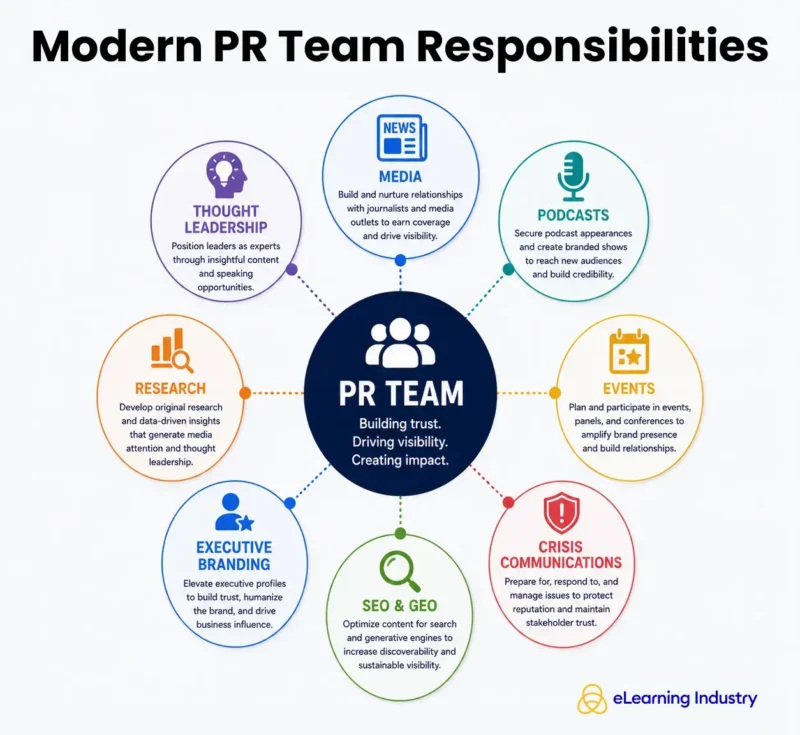
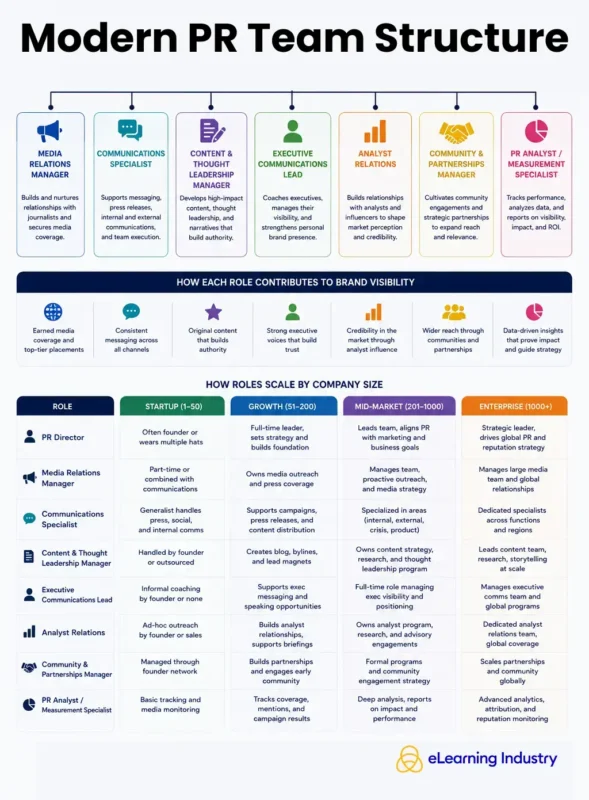
As the scope of PR has widened, the structure of the teams managing it has become increasingly specialized. While a startup might rely on a single communications generalist, mid-to-large enterprises now deploy sophisticated departments designed to cover every facet of reputation management.
The PR Director and Strategic Alignment
At the helm, the PR Director functions as a bridge between communication tactics and business objectives. Their role is to ensure that every media win or speaking engagement serves a broader goal, such as entering a new market or supporting a valuation increase. They are responsible for high-level crisis planning and ensuring that the organization’s "voice" remains consistent across global jurisdictions.
Media Relations and the Shift to "Earning" Trust
The Media Relations Manager remains a foundational role, but the methodology has changed. Rather than "blasting" press releases to generic lists, these professionals now act as information brokers. They build long-term, mutually beneficial relationships with journalists and editors. In an era of shrinking newsrooms, PR teams that provide high-quality data, reliable sources, and timely commentary become indispensable partners to the media, thereby securing high-authority "earned" coverage that carries more weight than any paid advertisement.
Specialist Roles: Analysts, Content, and Community
The modern team also includes specialized leads for Analyst Relations (AR), particularly in the B2B and technology sectors. These professionals manage relationships with firms like Gartner or Forrester, ensuring that the company’s products are accurately represented in influential market reports. Simultaneously, Content and Thought Leadership Managers work to transform internal expertise into external authority by producing white papers, guest articles, and research reports that serve as the "intellectual currency" of the brand.
The Business Impact: Quantifying Credibility
The shift toward a PR-centric growth model is backed by compelling data regarding consumer behavior and brand equity. According to recent trust barometers, "earned media"—content that is independently published by third parties—is viewed as significantly more trustworthy than "owned media" (company websites) or "paid media" (advertising).
Strengthening Share of Voice
PR directly impacts a company’s "Share of Voice" (SOV), a metric that compares a brand’s visibility against its competitors. A high SOV in earned media creates a "halo effect," where a company is perceived as a market leader simply because it is the most frequently cited authority in industry discussions. This perception reduces friction in the sales process; prospects are more likely to trust a vendor they have seen quoted in a reputable publication.
Investor and Recruitment Advantages
Beyond customer acquisition, PR plays a vital role in institutional stability. For public companies, consistent and transparent communication fosters investor confidence, often stabilizing stock prices during market volatility. For private firms, a strong media presence is often a prerequisite for successful funding rounds. Furthermore, in the "war for talent," a robust employer brand—built through PR stories highlighting culture and leadership—acts as a powerful recruitment tool, attracting high-caliber candidates who want to work for recognized industry leaders.
PR in the Age of AI and Generative Search
One of the most significant emerging frontiers for PR teams is the rise of Generative Engine Optimization (GEO). As search engines like Google evolve into AI-driven conversational interfaces (such as Gemini and ChatGPT), the way brands are discovered is changing. These AI models do not just look for keywords; they look for authoritative mentions across the web to synthesize answers for users.
A PR team’s work in securing mentions in high-authority news sites, academic journals, and reputable podcasts provides the "training data" that AI models use to recommend brands. If a PR team successfully positions an executive as a thought leader on a specific topic, AI assistants are more likely to cite that executive—and their company—when a user asks a related question. This creates a new necessity for PR: ensuring that the brand is part of the "knowledge graph" that powers the future of search.
Integrated Growth: The Synergy of PR and Marketing
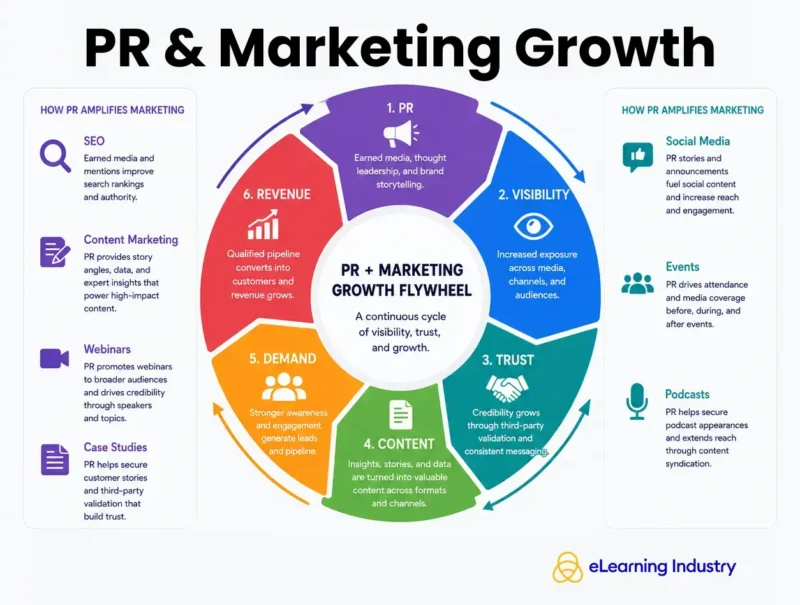
A recurring theme in modern corporate analysis is the necessity of breaking down the silos between PR and marketing. While marketing focuses on direct demand generation and lead capture, PR creates the "environment of trust" in which those marketing seeds can grow.
When these functions are aligned, the results are exponential. For example, a successful media interview secured by the PR team can be repurposed by the marketing team into social media snippets, email newsletter content, and paid "amplification" campaigns. Conversely, original data gathered by marketing can be packaged by PR as a "State of the Industry" report, generating widespread media coverage and backlinks that boost the company’s overall search engine optimization (SEO) performance.
Common Pitfalls in Reputation Management
Despite the clear advantages of a strategic PR team, many organizations continue to make critical errors. The most prevalent mistake is "episodic PR"—only engaging with the public during major announcements. This creates a vacuum of information during the intervening months, allowing competitors to seize the narrative.
Another common failure is the over-reliance on automated press release distribution services. In a world of information overload, generic, non-targeted releases are often ignored by both journalists and search engines. True PR success requires a "human-centric" approach based on tailored storytelling and genuine expertise. Finally, many companies fail to invest in executive visibility, forgetting that in the digital age, people trust people more than they trust logos. A CEO with no public profile is a missed opportunity for brand validation.
Measuring Success in a Multi-Channel World
The methodology for measuring PR success has moved beyond simple "clip counts." Modern KPIs (Key Performance Indicators) are now data-driven and linked to business outcomes. These include:
- Branded Search Volume: Measuring how many people are searching for the company by name following a major PR campaign.
- Backlink Quality: Tracking links from high-authority media domains that improve the company’s SEO.
- Sentiment Analysis: Utilizing AI tools to determine if the public conversation around the brand is positive, neutral, or negative.
- Message Resonance: Evaluating how often the company’s key strategic messages appear in independent media coverage.
- AI Citation Frequency: An emerging metric tracking how often a brand is mentioned in generative AI responses.
The Future of Public Relations
Looking ahead, the PR profession is set to become even more data-reliant and technologically integrated. Predictive analytics will soon allow PR teams to identify emerging trends before they hit the mainstream, enabling brands to "own" a conversation before their competitors even enter it. Additionally, as deepfakes and misinformation become more prevalent, the PR team’s role as the "guardian of truth" and the official source of verified information will be more critical than ever.
In conclusion, the modern PR team is no longer a luxury for large corporations or a "fixer" for companies in trouble. It is a fundamental growth engine that builds the most valuable asset any business can own: a credible reputation. By strategically managing visibility across traditional, digital, and AI-driven channels, PR professionals ensure that when a buyer, investor, or employee looks for a leader, they find a brand that has earned its place at the center of the conversation. Companies that recognize this shift and invest in a sophisticated, integrated PR strategy will be the ones that define the future of their respective industries.