The modern workplace is experiencing an unprecedented pace of evolution, rendering many traditional job descriptions obsolete almost as quickly as they are written. In this dynamic environment, the imperative for organizations to invest in their human capital’s continuous growth is no longer a strategic option but a critical survival mechanism. The alternative – failing to equip employees with future-ready capabilities – risks significant talent drain and a rapidly diminishing competitive edge. This pressing need for skill adaptation is underscored by stark projections from leading global bodies. The World Economic Forum, for instance, has cautioned that an alarming 44% of workers’ core skills are anticipated to be substantially disrupted within the next five years. Furthermore, by 2027, a staggering six out of ten employees will require either significant upskilling or comprehensive reskilling to remain relevant and productive. This isn’t a distant future scenario; the era of pervasive skill disruption is already a present reality, knocking on the doors of businesses worldwide.
The Accelerating Pace of Skill Disruption: A Global Challenge
The drivers behind this rapid transformation are multifaceted and powerful, rooted primarily in technological advancements, shifting economic paradigms, and evolving societal expectations. The proliferation of Artificial Intelligence (AI), machine learning, automation, and advanced data analytics is fundamentally reshaping job roles across every industry. Tasks once performed by humans are increasingly being augmented or replaced by intelligent systems, necessitating a profound shift in the human skillset towards areas like critical thinking, complex problem-solving, creativity, emotional intelligence, and digital literacy. Beyond technology, globalization continues to introduce new competitive pressures, requiring workforces to be more adaptable, cross-culturally fluent, and agile in response to market fluctuations. Demographic shifts, including an aging workforce in many developed nations and a younger generation entering with different expectations, also contribute to the evolving skill landscape.
This environment creates a significant "skills gap"—the disparity between the skills employers need and the skills available in the workforce. Left unaddressed, this gap can stifle innovation, hinder productivity, and ultimately impact economic growth at both organizational and national levels. Companies that proactively tackle this challenge by fostering a culture of continuous learning are better positioned to navigate uncertainty, maintain agility, and attract top talent who value professional development.
Upskilling vs. Reskilling: Navigating the Dual Pathways to Proficiency
In response to this skill imperative, two distinct yet complementary strategies have emerged as cornerstones of talent development: upskilling and reskilling. While both aim to enhance an employee’s capabilities, they serve different strategic objectives and necessitate unique approaches. Understanding their distinctions is crucial for crafting effective, targeted development programs.
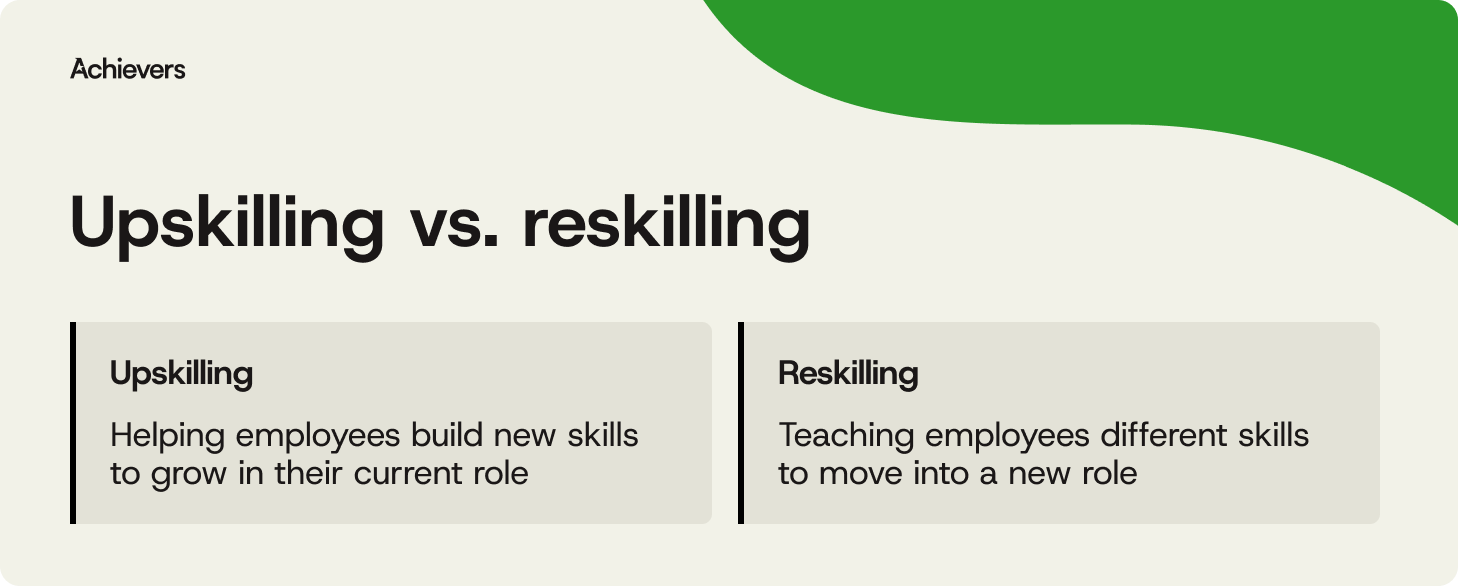
Upskilling focuses on enhancing an employee’s existing skillset to improve performance in their current role or to prepare them for more advanced responsibilities within the same career trajectory. It’s about deepening expertise, adopting new tools, or learning advanced techniques that build upon existing foundations. For example, a marketing specialist might upskill by learning advanced AI-driven analytics tools, a software developer might learn a new programming language to optimize current projects, or a project manager might gain certification in agile methodologies.
- What it means: Expanding and deepening an employee’s current competencies.
- Why you use it: To keep employees current, increase efficiency, prepare for internal promotions, and leverage new technologies within existing functions. It’s often used to maintain relevance in a rapidly changing field.
- Type of learning: Incremental, often focused on specific tools, techniques, or advanced concepts directly applicable to the current role. It can involve short courses, certifications, workshops, or mentorship within their domain.
- Employee mindset: A desire for mastery, professional growth, and staying competitive within their chosen field. They often feel a sense of alignment with their career path.
Reskilling, conversely, involves teaching employees entirely new skills to enable them to transition into different roles or career paths, often within the same organization. This strategy is vital when an employee’s current role is at high risk of automation or obsolescence, or when the organization identifies critical new functions for which it lacks internal talent. For instance, a manufacturing line worker whose job is being automated might be reskilled to become a robotics technician, or an administrative assistant might be reskilled into a data entry specialist or customer success manager.
- What it means: Equipping an employee with a completely new set of skills for a different role or function.
- Why you use it: To address significant skill gaps, fill newly created roles, mitigate the impact of automation, and retain valuable institutional knowledge by redeploying employees. It’s a proactive measure against workforce displacement.
- Type of learning: Transformative, often requiring comprehensive training programs, apprenticeships, or even formal educational pathways that lead to a new professional identity.
- Employee mindset: Often involves a willingness to embrace significant change, adapt to new challenges, and potentially redefine their career identity. They may experience initial apprehension but are driven by long-term career security and new opportunities.
Both strategies are crucial for building a future-proof workforce, but their effective implementation requires careful planning, robust support systems, and, crucially, a culture that actively celebrates and reinforces learning.
Crafting Strategies That Stick: Beyond Basic Training Programs
Simply offering online courses or training modules is insufficient. For upskilling and reskilling initiatives to truly succeed and yield lasting impact, they must be embedded within a holistic talent development strategy that aligns with both organizational objectives and individual aspirations.

-
Start with a Data-Driven Plan: Effective skill development begins with a clear understanding of current and future skill requirements. This involves conducting thorough skill audits, utilizing AI-driven analytics to predict future needs, and aligning learning pathways with strategic business goals. Organizations should identify critical roles, pinpoint existing skill gaps, and project future competencies required to achieve business objectives. This foresight allows for proactive investment in the right areas, preventing reactive, costly interventions.
-
Diverse and Accessible Learning Modalities: Recognize that people learn in different ways and at different paces. A comprehensive strategy incorporates a variety of learning formats, including:
- Formal Courses and Certifications: Structured programs, often online or in-person, leading to recognized qualifications.
- Experiential Learning: On-the-job training, stretch assignments, rotations, and project-based learning that allow employees to apply new skills in real-world contexts.
- Mentorship and Coaching: Pairing learners with experienced professionals for guidance, feedback, and knowledge transfer.
- Micro-learning: Bite-sized content delivery that allows for continuous learning integrated into daily workflows.
- Peer-to-Peer Learning: Fostering communities of practice, internal workshops, and knowledge-sharing sessions. Accessibility is key, meaning flexible scheduling and integration into daily work.
-
Personalized and Relevant Pathways: One-size-fits-all approaches rarely yield optimal results. Tailoring learning paths to individual employee goals, existing capabilities, and learning styles significantly boosts engagement and effectiveness. This requires managers to act as coaches, helping employees identify their development needs and connect them to career aspirations and organizational opportunities. A robust learning management system (LMS) can support personalized recommendations and track progress.
The Indispensable Role of Recognition: Fueling Sustained Growth
Regardless of whether an employee is upskilling or reskilling, the journey demands considerable effort, resilience, and a willingness to step outside one’s comfort zone. This effort, if left unnoticed and unappreciated, tends to wane. This is where strategic recognition emerges as an absolutely critical component, acting as the primary fuel that sustains motivation and ensures learning translates into tangible, lasting behavioral change. Recognition isn’t merely a polite acknowledgement; it’s a powerful psychological reinforce that validates effort, builds confidence, and fosters a sense of belonging and purpose.
The Measurable Impact of Meaningful Recognition:
The effects of recognition on professional growth are profound and quantifiable. It transforms learning from an abstract task into an emotionally resonant experience, reinforcing behaviors that drive continuous improvement:
- Boosts Motivation: Acknowledgment validates the hard work involved in learning new skills, encouraging employees to persist through challenges.
- Increases Engagement: Employees who feel seen and appreciated for their development efforts are more likely to be actively involved in their roles and committed to organizational goals. Original research from the Achievers Workforce Institute demonstrates that employees who receive meaningful recognition at least monthly are a remarkable 91% more engaged. This directly correlates with improved retention rates and reduced turnover costs.
- Builds Confidence and Self-Efficacy: Public recognition for learning milestones instills confidence, making employees more willing to tackle new challenges and apply their freshly acquired skills.
- Fosters a Learning Culture: When recognition is visibly tied to learning and development, it signals to the entire organization that continuous growth is valued, expected, and rewarded, encouraging others to embark on their own learning journeys.
- Reinforces Desired Behaviors: Specific recognition highlights exactly what was done well, making those behaviors more likely to be repeated and adopted by others.
Recognition, therefore, communicates more than a simple "good job." It conveys, "We see your dedication, we value your effort to grow, and we are fully invested in your success."
Integrating Recognition into Your Development Strategy:
To harness the full power of recognition, it must be intentionally woven into the fabric of your learning and development initiatives:
-
Recognize Learning Progress Immediately: Acknowledge efforts as soon as they occur. Whether an employee completes a course, attempts a new skill in a project, or makes measurable progress towards a certification, immediate recognition reinforces the positive behavior and encourages further engagement. This real-time feedback loop is far more impactful than delayed or generalized praise.
-
Be Specific About the Skill or Behavior: Generic praise like "good work" falls short. Instead, pinpoint exactly what was learned or applied. For example, "Sarah, your initiative in mastering the new CRM system dramatically improved our client tracking efficiency," or "John, your successful application of agile methodologies in the Q3 project has significantly streamlined our development cycle." Specificity makes the learning concrete, repeatable, and clearly links it to organizational value.
-
Prioritize Real-World Application: The true value of learning lies in its application. Recognize employees not just for completing training, but for using their new skills to solve problems, innovate processes, adapt to changes, or mentor peers. This reinforces the practical utility of their development and demonstrates how learning directly contributes to business outcomes.
-
Ensure Visibility of Learning Milestones: Make learning achievements visible across the organization. Utilize internal newsfeeds, team meetings, company-wide announcements, or dedicated recognition platforms to share success stories. When peers and leaders see others being recognized for learning and development, it creates a positive feedback loop, inspiring a collective commitment to growth and signaling that these behaviors are highly valued. The Achievers’ 2026 State of Recognition Report, based on a global survey of 3,000 employees, revealed that 45% of employees believe growth opportunities exist but could be stronger, underscoring the need for visible recognition to validate the effort.
-
Tie Rewards to Business-Critical Skills and Values: While intrinsic recognition is powerful, tangible rewards can further amplify impact. Use points systems, incentive programs, or career advancement opportunities to reinforce the acquisition of skills most critical to your organization’s strategic objectives—such as adaptability, collaboration, data literacy, or AI proficiency. Aligning rewards with company values ensures that development efforts are directed towards capabilities that drive both individual and organizational success.
Leadership as the Cornerstone of a Learning Culture
No matter how well-designed a learning program is, its success ultimately hinges on the active involvement and commitment of leadership. Managers are not just approvers of budgets or assigners of courses; they are the architects of development, the coaches who guide employees, and the primary drivers of a learning-centric culture. Their role extends to:
- Spotting Opportunities: Effective leaders proactively identify skill gaps within their teams and recognize potential in individuals. They can connect employees with relevant upskilling or reskilling pathways that align with both individual career aspirations and organizational needs. This requires foresight and an understanding of future trends.
- Integrating Learning into Daily Work: Leaders must normalize learning as an ongoing part of the job, not an extracurricular activity. This means allocating time for development, encouraging experimentation, and creating psychological safety for employees to try new things and learn from mistakes.
- Coaching Through Change: Navigating new skill acquisition or a career pivot can be challenging. Leaders provide crucial guidance, emotional support, and constructive feedback, helping employees overcome learning plateaus and "new role nerves" without experiencing burnout. They act as mentors, offering personalized advice and advocating for their team members’ growth.
- Modeling Desired Behavior: Leaders who actively pursue their own development, openly discuss their learning journeys, and demonstrate curiosity about new technologies and methodologies inspire their teams to do the same. They lead by example, making continuous learning a cultural norm.
- Championing Recognition: Leaders are instrumental in providing consistent, specific, and visible recognition for learning efforts and achievements. Their praise carries significant weight, reinforcing desired behaviors and motivating employees more than any company-wide announcement.
Broader Implications: Organizational Resilience and Economic Competitiveness
The systematic implementation of upskilling, reskilling, and a robust recognition framework transcends individual employee benefits; it fundamentally strengthens the organization’s resilience and competitive standing. Companies that actively cultivate a learning culture are better equipped to:
- Innovate Faster: A skilled and adaptable workforce can quickly adopt new technologies and processes, accelerating innovation cycles.
- Reduce Recruitment Costs: By developing internal talent, organizations reduce their reliance on external hiring, which can be costly and time-consuming.
- Enhance Employee Retention and Attraction: Employees are more likely to stay with companies that invest in their professional growth. A strong learning culture also serves as a powerful magnet for top talent seeking career advancement.
- Improve Agility and Adaptability: A workforce with diverse and continually updated skills can pivot quickly in response to market shifts, economic downturns, or unforeseen challenges.
- Boost Employee Morale and Productivity: Feeling valued and seeing a clear path for growth significantly boosts morale, leading to higher job satisfaction and increased productivity.
Ultimately, investing in skill development and integrating meaningful recognition transforms an organization into a "learning organization"—a dynamic entity capable of continuous adaptation and growth. This isn’t just about equipping employees for the next technological wave; it’s about fostering a human-centric approach to work that empowers individuals, strengthens teams, and secures a prosperous future for the entire enterprise.
Conclusion: Investing in People, Securing the Future
In an era defined by rapid technological advancement and unprecedented change, upskilling and reskilling are the strategic pathways companies must embrace to remain competitive and relevant. These initiatives ensure that workforces are not just keeping pace, but actively shaping the future. However, the true alchemy that transforms mere training programs into sustained, impactful growth is the consistent and meaningful application of recognition. Recognition is the psychological fuel that ignites motivation, reinforces effort, builds a sense of belonging, and validates the hard work inherent in personal and professional transformation.
Learning is not a passive consumption of information; it is an active, often challenging, process that thrives on encouragement and acknowledgement. When employees feel seen, supported, and celebrated for their commitment to growth—whether they are leveling up existing expertise or embarking on an entirely new career path—they don’t just complete a course; they commit to a journey of lifelong learning. Recognition makes growth visible, turns individual effort into collective momentum, and acts as the crucial adhesive that binds an organization’s skill strategy together, from ambitious stretch projects to significant career pivots. Therefore, to truly prepare a workforce for the future, businesses must move beyond simply investing in learning tools and actively cultivate a robust culture of recognition that makes learning stick, ensuring both human potential and organizational resilience for years to come.