
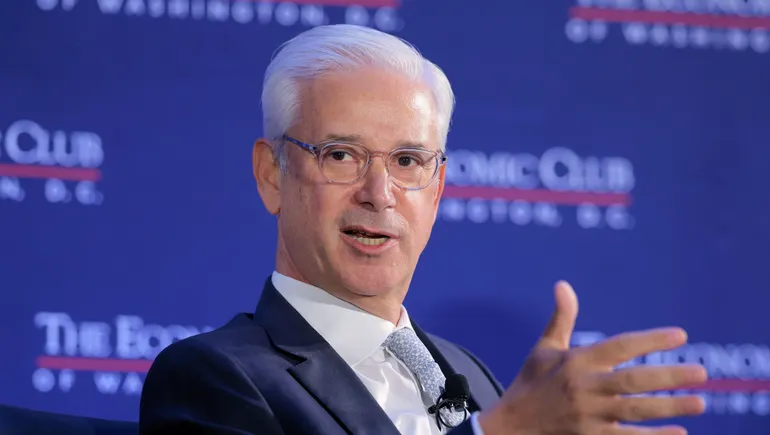
Wells Fargo CEO Charlie Scharf articulated a sophisticated perspective on the transformative power of artificial intelligence, asserting that its impact on employment is far more intricate and multifaceted than often portrayed in public discourse. Speaking at a Bernstein investor conference on Wednesday, Scharf challenged the prevailing binary viewpoints, stating, "I find it very surprising when really smart people take one side or the other. They sit there and they say, ‘it’s not a threat to employment,’ or they sit there and say, ‘it’s a huge threat to employment.’" From his vantage point overseeing a major financial institution, Scharf underscored the reality that AI embodies both aspects simultaneously, posing both opportunities for growth and potential risks for the workforce.
The Dual Nature of AI’s Impact on the Workforce
Scharf elaborated on his assessment, drawn from the internal integration of AI within Wells Fargo. "It’s so obvious to me, looking at the way we’re using AI inside the company, it is both of those things," he explained. The primary concern, according to the head of the San Francisco-based banking giant, lies in the potential misalignment of these forces: "The risk is that they’re not totally aligned, in terms of the same people and the timing of it." This statement highlights a critical challenge facing industries worldwide as AI adoption accelerates – the need to manage the transition for employees whose roles may evolve or be displaced, while simultaneously creating new roles that demand different skill sets.
The CEO’s remarks come at a time when the financial services industry is aggressively exploring and implementing AI technologies. Banks globally are investing heavily in AI to streamline operations, enhance customer service, improve risk management, and gain a competitive edge. However, this technological push inevitably raises questions about job security and the future of work within a sector traditionally known for its vast human capital.
Wells Fargo’s Proactive AI Integration Strategy
Wells Fargo has not been a bystander in this technological revolution. In April, Scharf revealed that the bank had already provided basic AI tools to the majority of its employees, signaling a widespread organizational embrace of the technology. This initial deployment marks a crucial step in the bank’s broader strategy to leverage AI for operational excellence and enhanced client offerings.
Executives at Wells Fargo are currently engaged in a comprehensive assessment of how these AI tools can be utilized to drive greater efficiency across the organization and deliver superior products and services to its vast customer base. This involves a deep dive into various operational silos, from back-office functions to client-facing interactions. Beyond internal processes, the bank is also meticulously examining the broader implications of AI on its customer base, particularly given its extensive lending exposure. Scharf emphasized a proactive approach to risk management in this evolving landscape, stating, "we’re very actively thinking about what that means for the risk that we take, and also where we should be doing more, not just where we should be doing less." This indicates a strategic balance between mitigating new risks introduced by AI and identifying new opportunities for growth and service expansion.
Perhaps the "most complicated" AI-related issue, as Scharf described it, is the potential for the technology to fundamentally transform Wells Fargo’s core business model. The bank is grappling with the profound question of whether this transformation will ultimately be "a plus or a minus in terms of how we react to that." This strategic introspection underscores the recognition that AI is not merely an incremental improvement tool but a disruptive force capable of reshaping entire industries.
Operational Efficiency and Specific AI Applications
The implementation of AI-powered tools is unequivocally expected to result in more efficient operations for the $2.2 trillion-asset bank. "We know that, we see that, we’re planning for it every step of the way," Scharf affirmed, signaling a clear roadmap for technological integration. The CEO specifically identified several key areas across the company where executives foresee significant improvements through AI:
- Auditing and Testing: Automating routine checks and identifying anomalies more rapidly.
- Legal and Contracts: Streamlining document review, compliance checks, and contract generation.
- Patent Filings: Expediting the complex process of intellectual property documentation.
- Pitchbooks in Investment Banking: Enhancing the creation and customization of client presentations.
- Credit Memos: Improving the speed and accuracy of credit analysis and reporting.
While these applications promise substantial efficiency gains, Scharf acknowledged the competitive nature of the industry. "How much of that actually results in pure margin or return expansion is to be seen," he remarked, recognizing that competitors will likely be pursuing similar AI-driven objectives. Nevertheless, he expressed confidence that AI adoption would be "a net positive" for the company’s future expense base, contributing to long-term cost savings and operational leverage.
The Broader Context: AI in the Financial Sector
The banking industry, characterized by its reliance on data and complex processes, is a fertile ground for AI innovation. Large banks globally have been in a fierce race to weave AI into their operations, seeking to capitalize on benefits ranging from enhanced fraud detection and personalized customer experiences to sophisticated algorithmic trading and predictive analytics.
Industry analysts have been tracking these developments closely. Wells Fargo analyst Mike Mayo, a prominent voice in financial sector analysis, has previously estimated that up to one-third of bank jobs, or significant portions thereof, could eventually be handled more effectively by AI. This projection, while significant, aligns with the nuanced view expressed by Scharf, suggesting a shift in job functions rather than outright elimination for many roles. The World Economic Forum, in its "Future of Jobs Report," has also highlighted that while AI may displace certain routine tasks, it simultaneously creates new job categories and augments existing roles, emphasizing the need for reskilling and upskilling initiatives across industries.
Wells Fargo’s Journey Towards Efficiency and Transformation
Scharf’s strategic push for AI integration is deeply rooted in Wells Fargo’s recent history and its imperative to overcome past challenges. Unlike some of its rivals who have relentlessly driven towards greater efficiency over the past decade, Wells Fargo "wasn’t good at expense discipline for a long period of time," Scharf candidly admitted. This historical context is crucial for understanding the intensity of the bank’s current transformation efforts.
A major inflection point for Wells Fargo was the infamous 2016 fake-accounts scandal, which triggered a cascade of regulatory scrutiny and financial penalties. In the wake of this crisis, the bank was compelled to undertake extensive regulatory work and remediation efforts. Scharf pointed to the enormous financial burden of these corrective measures: "Then we had all of these issues where we were forced to spend a lot of money – gigantic amounts of money, over $2.5 billion a year – to actually fix a lot of these things." This substantial expenditure diverted resources that could otherwise have been allocated to innovation or growth, placing Wells Fargo at a disadvantage compared to its more agile competitors.
A significant outcome of the regulatory fallout was the imposition of a $1.95 trillion asset cap by the Federal Reserve, severely restricting the bank’s ability to grow its balance sheet. This punitive measure, in place for seven years, was finally lifted in June 2025, marking a critical milestone in the bank’s recovery journey. Throughout this period of intense regulatory oversight, Wells Fargo concurrently focused on "unpacking a lot of the processes" and eliminating redundancies across its vast organizational structure.
Since Charlie Scharf assumed the CEO role in late 2019, he has spearheaded a comprehensive overhaul aimed at streamlining operations and restoring the bank’s reputation and financial health. Under his leadership, Wells Fargo has significantly reduced its headcount, shrinking from approximately 275,000 employees to 205,000, with first-quarter earnings materials for 2026 putting the current headcount at about 201,000. Beyond workforce reductions, the bank has also strategically divested several non-core businesses to sharpen its focus.
These rigorous efficiency drives have translated into substantial cost savings. Scharf reported that Wells Fargo has cut approximately $15 billion in expenses. Crucially, these savings have not been simply pocketed but have been strategically reinvested, with about $9 billion allocated to new growth initiatives, including hiring bankers and increasing marketing efforts. These efforts, he asserted, have tangibly improved the bank’s performance and led to better customer service, primarily "because we’re just eliminating all of the wasteful things that have happened inside the company." Despite the progress, Scharf made it clear that the transformation is far from complete: "We want to do as much through normal attrition as we can, and we would say just on that journey, we’re far from done. Not even close."
Financial Outlook and Continued Cost Optimization
Looking ahead, Wells Fargo projects its non-interest expenses for the current year to total $55.7 billion. This represents a modest increase of approximately 1.5% over the previous year’s $54.8 billion, following $54.6 billion in 2024. Scharf emphasized a deliberate strategy of "restraint on the overall expense base," which serves as a powerful incentive to continuously identify and eliminate inefficiencies. "That just forces us to become even more diligent about freeing up resources so we can invest more," he explained. This disciplined approach ensures that every dollar spent is scrutinized for its contribution to strategic objectives and long-term value creation.
When pressed by Autonomous Research analyst Ken Usdin for specific areas targeted for further cost reduction, Scharf highlighted examples of lingering redundancies within the vast organization. He pointed to the existence of "multiple call center platforms" and "multiple testing functions" as ripe for consolidation and optimization. These examples underscore the sheer scale of the historical organizational bloat that Scharf’s administration is systematically dismantling. "Given the scope of the company and the amount of redundancy that existed, there’s still things just like that," he noted, indicating that the quest for efficiency remains an ongoing, deeply embedded aspect of Wells Fargo’s corporate culture.
Workforce Transformation and Societal Imperatives
Crucially, Scharf reiterated that the adoption of AI does not signify an end to human involvement. "People don’t go away in this," he affirmed. Instead, the bank plans to hire more individuals skilled in building sophisticated AI models and those capable of effectively utilizing these new tools to better serve customers. This highlights a shift in the nature of work, requiring a re-evaluation of skill sets and a focus on human-machine collaboration.
However, Scharf acknowledged a broader societal challenge that extends beyond the confines of Wells Fargo: "We’ve got this mismatch, that, as a country, we’re going to have to deal with." This "mismatch" refers to the gap between the skills currently possessed by a significant portion of the workforce and the evolving demands of an AI-driven economy. Recognizing this national challenge, Wells Fargo is actively contemplating strategies to get ahead of it, including robust employee retraining programs. This proactive stance on workforce development underscores the bank’s commitment not only to its own operational future but also to the well-being and adaptability of its human capital.
Conclusion: A Balanced Vision for the Future
Charlie Scharf’s discourse on AI presents a pragmatic and balanced vision for Wells Fargo’s future. It acknowledges the undeniable power of artificial intelligence to revolutionize banking operations, enhance efficiency, and create new opportunities for growth. Simultaneously, it confronts the complex implications for employment, advocating for a nuanced understanding that recognizes both potential displacement and significant job creation, albeit often requiring new skills.
By strategically integrating AI, rigorously pursuing operational efficiencies, and proactively addressing workforce transformation, Wells Fargo aims to shed the legacy of its past challenges and emerge as a leaner, more innovative, and more competitive institution in the rapidly evolving financial landscape. The journey, as Scharf candidly admitted, is far from over, but the direction is clear: a strategic embrace of technology, underpinned by disciplined management and a forward-looking approach to human capital, to drive sustainable success.






