A growing body of research suggests that the intangible force of "leadership energy" is a critical, yet often overlooked, determinant of organizational success. Far from being a mere buzzword, leadership energy, defined as the collective capacity of leaders to motivate, inspire, and foster a positive environment, is emerging as a powerful predictor of employee engagement, team cohesion, and ultimately, bottom-line performance. Organizations that fail to cultivate and sustain this vital resource risk seeing their initiatives falter, their best talent diminish, and their performance targets slip, even when individual problems are addressed in isolation.
The scenario often plays out subtly. A senior executive might observe a high-performing director becoming unusually withdrawn in team meetings, their usual sharp insights dulled by an unseen fatigue. Simultaneously, a critical handoff between two departments, once seamless, begins to fracture, marked by miscommunication, a lack of trust, and a palpable sense of disconnect. As the quarter concludes, multiple departments report missed objectives, each convinced their struggles are unique and unrelated to the others. While these issues might be superficially treated with targeted interventions—a one-on-one coaching session for the director, a cross-functional team-building exercise, or a departmental performance audit—the underlying cause may be far more systemic: a deficit in leadership energy.
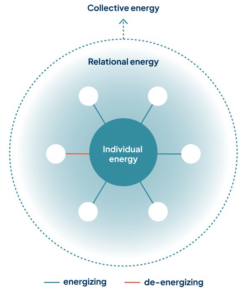
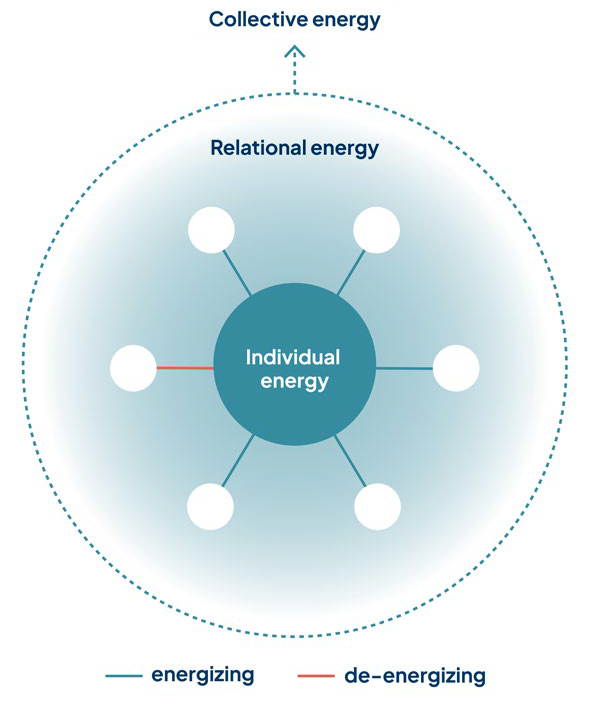
This pervasive challenge underscores a fundamental truth: energy at work operates on multiple, interconnected levels. At its core is the individual energy a leader brings to their role. This then propagates through the relational energy generated in interactions between leaders and their teams, and among colleagues. When these exchanges are consistently positive and constructive, they compound to create a powerful collective energy that permeates the entire organization. Conversely, a deficit at any of these levels can have a cascading negative effect, draining motivation, eroding morale, and hindering overall performance before any tangible results begin to falter.
Understanding and actively managing leadership energy is therefore not merely an HR initiative, but a strategic imperative for resilient organizations. It requires a shift in perspective, recognizing that while individual leaders play a crucial role in cultivating their own energy and that of their immediate teams, the organization itself must provide a supportive ecosystem that sustains, rather than depletes, this vital resource.
The Three Levels of Leadership Energy
Leadership energy can be best understood by examining its manifestation across three distinct but interdependent levels:
-
Individual Energy: This refers to the personal reservoir of enthusiasm, resilience, focus, and drive that a leader possesses. It is influenced by factors such as their well-being, their sense of purpose, their clarity of vision, and their ability to manage their own stress and emotions. A leader with high individual energy is more likely to be an inspiring presence, capable of tackling challenges with optimism and a proactive mindset.

-
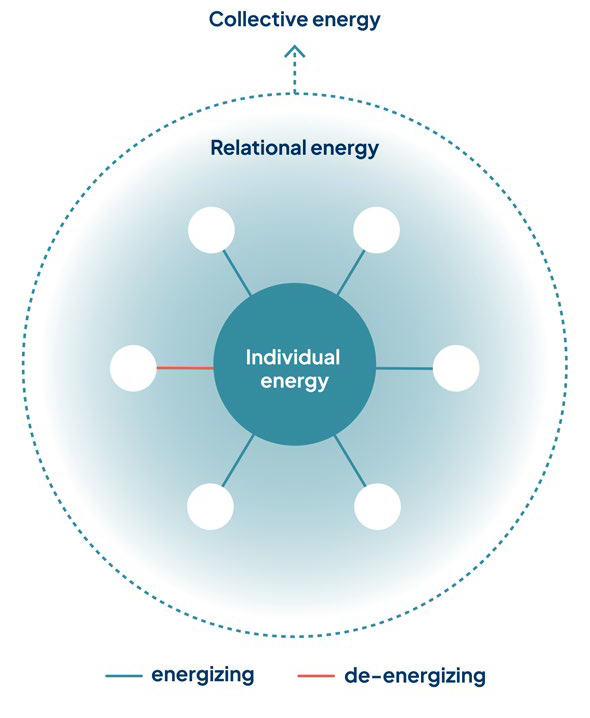
Relational Energy: This is the energy generated or depleted through interactions between individuals. It is the dynamic that occurs in meetings, one-on-one discussions, and collaborative projects. Energizing relationships are characterized by mutual respect, active listening, constructive feedback, and a sense of shared purpose. De-energizing relationships, conversely, are marked by conflict, negativity, a lack of psychological safety, or a persistent feeling of being drained or undervalued. Research from the Center for Creative Leadership (CCL) has highlighted the significant impact of relational energy, indicating that even a single de-energizing relationship can disproportionately erode team cohesion and performance.
-
Collective Energy: This is the aggregate energy of the entire organization, built from the compounding effects of countless individual and relational exchanges. A high collective energy fosters a sense of shared mission, innovation, and agility. It creates an environment where employees feel motivated to go the extra mile, and where organizational goals are pursued with unified purpose. Conversely, low collective energy can lead to widespread disengagement, resistance to change, and a general lack of momentum.
The research from CCL, drawing on assessment data from over 600 leadership teams, reveals a stark reality: the imbalance of negative energy within relationships significantly impacts team outcomes. For instance, psychological safety, a well-established predictor of team performance, can be severely undermined by just one de-energizing relationship. Neutralizing the impact of such a relationship on psychological safety requires the presence of four strongly energizing relationships, and even then, the team only returns to a neutral state. This mathematical imbalance underscores how quickly negative energy can cap an organization’s potential.
Energy Management: A Shared Responsibility
While individual leaders are instrumental in managing their personal energy and fostering positive interactions, the burden of energy management cannot rest solely on their shoulders. Organizations play a critical role in creating an environment that either supports or hinders leadership energy. This involves establishing systems, processes, and cultural norms that either replenish or drain the energy of their leaders and employees.
Consider the case of a director who, upon receiving 360-degree feedback, realizes their team meetings have become a source of frustration and exhaustion due to their unstructured nature and lack of clear outcomes. They implement changes, restructuring their meetings to be more focused and results-oriented, leading to an immediate positive response from their team. However, if other departments continue to operate with inefficient meeting practices, the director’s efforts may be undermined. Six months later, despite the director’s successful intervention, their team may find themselves re-energized in their own meetings but still drained by the pervasive inefficiency of cross-departmental interactions and organizational processes. This scenario illustrates the cost of treating energy as a purely personal responsibility. Even the most well-intentioned individual fixes can be negated by an organizational system that works against sustained energy.
The implications are significant: organizations must move beyond individual development plans and consider the broader "leadership ecosystem." This ecosystem encompasses the structures, policies, and cultural values that either facilitate or impede the flow of positive energy. When individual leadership development is integrated with the creation of a healthy, energy-sustaining ecosystem, the synergistic effect can lead to substantially stronger organizational performance.
The Outsized Impact of De-Energizing Relationships
The research on relational energy further quantifies the impact of negative interactions. It reveals that not all relationships carry the same weight, and a single de-energizing relationship can have a disproportionately negative effect, often experienced unilaterally by one party. This imbalance is not contained; it ripples outward, shaping team dynamics and influencing critical performance indicators.
The erosion of psychological safety is a prime example. A robust study involving over 600 leadership teams demonstrated that the detrimental effect of one de-energizing relationship on psychological safety outweighed the positive impact of one energizing relationship. To merely restore the team to a baseline level of psychological safety, four strongly energizing relationships were needed to counteract the damage of a single negative one. This mathematical disparity highlights a critical vulnerability within organizations. A few unaddressed negative relationships, when multiplied across numerous teams, can effectively place a ceiling on the collective energy and, consequently, the overall performance potential of the entire enterprise.
This phenomenon can manifest in various familiar organizational challenges that leadership development programs often aim to address. These can include:
- Decreased Innovation and Creativity: When leaders and teams are drained, their capacity for novel thinking and risk-taking diminishes. The fear of negative repercussions, amplified by de-energizing relationships, can stifle the free flow of ideas.
- Increased Turnover and Disengagement: Employees are more likely to leave organizations where they feel constantly drained, undervalued, or unsupported. Low energy levels contribute to disengagement, absenteeism, and a general lack of commitment.
- Poor Decision-Making: Fatigue and stress, hallmarks of low energy, can impair cognitive function, leading to rushed, suboptimal, or even detrimental decisions.
- Resistance to Change: When individuals and teams lack the energy to adapt, they become more resistant to new initiatives, even if those initiatives are strategically sound.
- Strained Interpersonal Dynamics: Low energy exacerbates existing tensions and can create new conflicts, leading to a toxic work environment.
The unifying thread across these challenges is a deficit in leadership energy that is either not being preserved, renewed, or effectively guided. By adopting leadership energy as a lens through which to view these issues, organizations can develop more holistic and impactful solutions. The opportunity lies in identifying the precise points where an individual leader’s energy intersects with the organizational systems around them and then implementing targeted interventions at the individual, relational, or collective level.
Leadership Energy as a Leading Indicator
The compounding nature of energy—individual, relational, and collective—means that shifts at one level often manifest at another before becoming a fully recognized problem. This makes leadership energy an exceptionally valuable leading indicator of organizational performance. By observing the subtle signs of energy shifts, leaders can proactively address issues before they escalate into significant performance dips, manifest in declining engagement scores, or appear in costly exit interviews.
The "Energy Equation," a framework developed by CCL, provides the language and diagnostic tools to identify where energy is being generated, shared, or lost within an organization. This understanding allows for the development of targeted interventions that address energy at its source. Such interventions can focus on:

- Individual Leader Development: Equipping leaders with strategies for self-awareness, resilience, stress management, and proactive energy cultivation. This might involve personalized coaching, mindfulness training, or executive education programs focused on well-being.
- Relational Dynamics: Facilitating healthier communication, conflict resolution, and collaboration skills within teams and between departments. This could involve team coaching, mediation, or workshops on active listening and empathetic engagement.
- Organizational Systems and Culture: Re-evaluating and redesigning processes, policies, and cultural norms that may inadvertently drain energy. This might include optimizing meeting structures, clarifying roles and responsibilities, promoting work-life balance, and fostering a culture of recognition and psychological safety.
By understanding and actively managing leadership energy, organizations can move beyond reactive problem-solving and adopt a proactive approach to performance enhancement. This involves not only developing individual leaders but also ensuring that the organizational environment actively supports and sustains the energy required for sustained success.
The ongoing research and practical application of leadership energy principles offer a powerful pathway for organizations to build greater resilience, foster higher levels of engagement, and ultimately achieve superior performance in an increasingly complex and dynamic business landscape. The ability to diagnose and influence this intangible yet potent force is rapidly becoming a hallmark of truly effective and enduring leadership.
Related Webinars and Expert Insights
The growing recognition of leadership energy’s importance is reflected in ongoing discourse and research. Experts continue to explore its multifaceted impact, offering further insights through various platforms. For instance, discussions around "How Leader Resilience Impacts Energy Dynamics at Work" delve into the personal attributes of leaders that fortify their capacity to maintain and project energy, even in the face of adversity. Similarly, webinars focusing on "How Collective Energy Shapes Performance" explore the macro-level implications, illustrating how an organization’s overall energy can be a powerful driver of its ability to innovate, adapt, and achieve strategic objectives. These ongoing conversations underscore a commitment from leadership development institutions to unraveling the complexities of energy and providing actionable strategies for its cultivation.
Frequently Asked Questions About Leadership Energy
The concept of leadership energy, while increasingly prominent, naturally gives rise to several common inquiries. A fundamental question often revolves around how to practically measure something as seemingly abstract as energy. While direct quantification can be challenging, organizations are increasingly employing a combination of qualitative assessments, such as employee surveys focused on engagement and morale, and observable metrics, including team productivity, turnover rates, and the prevalence of collaborative versus siloed behaviors. Another frequent query concerns the distinction between burnout and low energy. While related, burnout is typically a more severe, chronic state of exhaustion, whereas low energy can be a more transient condition stemming from specific organizational or relational factors that can be addressed with targeted interventions. The question of scalability also arises: how can energy management strategies be effectively implemented across large, dispersed organizations? This often points to the need for leadership development programs that are cascaded through different levels of management, coupled with the establishment of clear organizational values and communication channels that reinforce the importance of energy cultivation. Finally, there is the perennial question of ROI: what is the tangible return on investment for prioritizing leadership energy? The evidence, as outlined in research and case studies, suggests that improvements in employee retention, productivity, innovation, and overall organizational agility translate directly into financial benefits, making the investment in leadership energy a strategic imperative with demonstrable returns.