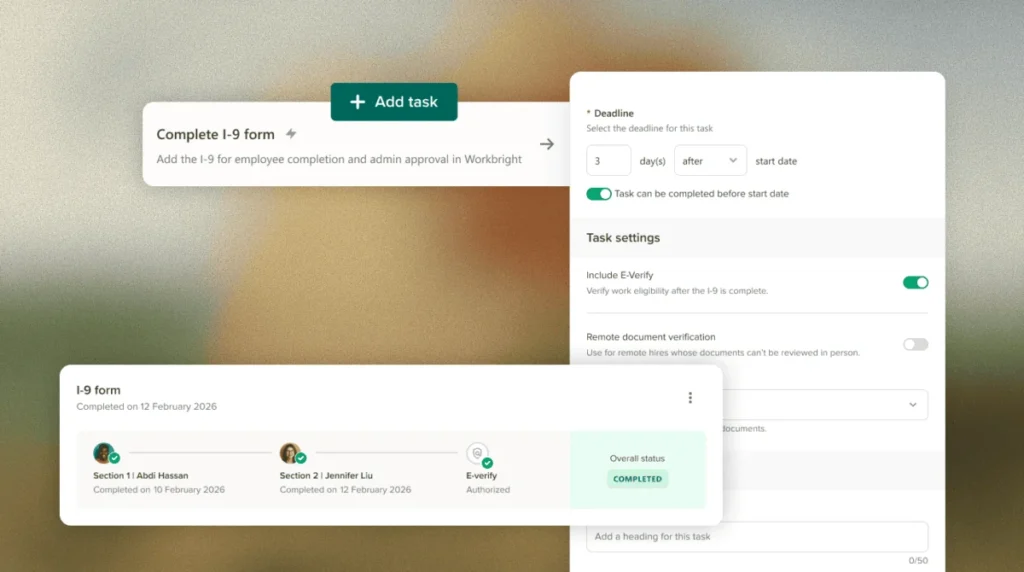
Workable, a leading applicant tracking system (ATS) and recruiting software provider, has announced the rollout of a new integrated workflow designed to simplify and ensure compliance with U.S. federal employment eligibility verification requirements. The new feature allows U.S.-based customers to manage Form I-9 completion and E-Verify submissions directly within the Workable platform, eliminating the need for manual workarounds, duplicate data entry, and reliance on external systems. This development marks a significant step towards modernizing a critical aspect of human resources operations, particularly in an era characterized by distributed workforces and evolving regulatory landscapes.
The core of Workable’s new offering addresses the historically cumbersome processes associated with verifying an employee’s legal eligibility to work in the United States. Traditionally, this involved downloading PDFs, collecting physical signatures, and often navigating disparate systems for I-9 form management and E-Verify submissions. With the integrated solution, new hires can now complete Section 1 of the I-9 form digitally, while HR teams can review supporting documents and complete Section 2 within the Workable environment. For organizations enrolled in the E-Verify program, the system automatically submits the necessary information to the Department of Homeland Security (DHS) during the process, ensuring adherence to federal mandates with enhanced efficiency and reduced administrative burden.
The Intricacies of I-9 and E-Verify Compliance: A Regulatory Landscape
To fully appreciate the impact of Workable’s new workflow, it is essential to understand the regulatory framework surrounding employment eligibility verification in the United States. The Immigration Reform and Control Act (IRCA) of 1986 established the requirement for all U.S. employers, regardless of size, to verify the identity and employment eligibility of new hires. This mandate is fulfilled through Form I-9, Employment Eligibility Verification. The form is divided into three sections: Section 1 is completed by the employee upon hire, attesting to their eligibility; Section 2 is completed by the employer, who must physically examine documents presented by the employee to establish identity and employment authorization; and Section 3 is used for reverification or rehires.
Compliance with I-9 regulations is stringent. Employers must complete Section 2 within three business days of the employee’s first day of employment. Failure to comply can result in substantial civil monetary penalties, ranging from hundreds to thousands of dollars per violation, depending on the nature of the infraction and whether it is a first or repeat offense. The U.S. Immigration and Customs Enforcement (ICE) routinely conducts audits, and penalties can escalate significantly for patterns of non-compliance, including charges of knowingly hiring unauthorized workers, which can lead to criminal charges. In fiscal year 2022, ICE Homeland Security Investigations (HSI) made 2,360 worksite enforcement-related arrests and initiated 3,588 I-9 audits, underscoring the ongoing federal scrutiny.
E-Verify, an internet-based system operated by DHS in partnership with the Social Security Administration (SSA), takes I-9 verification a step further. It allows participating employers to electronically confirm the employment eligibility of their newly hired employees by comparing the information provided on Form I-9 against records available to DHS and SSA. While E-Verify is voluntary for most employers, it is mandatory for federal contractors and subcontractors with federal contracts containing the Federal Acquisition Regulation (FAR) E-Verify clause, as well as for employers in certain states that have enacted their own mandatory E-Verify laws. The system aims to enhance the accuracy of eligibility verification and deter unauthorized employment, offering a more robust layer of security beyond document examination alone.
Evolution of Compliance Technology and Recent Regulatory Shifts
The journey of employment eligibility verification has evolved significantly since IRCA’s inception. For decades, the process was almost exclusively paper-based, leading to mountains of physical forms, potential for human error in transcription, and logistical challenges for storage and retrieval. The advent of digital technologies gradually introduced electronic I-9 forms, but these often functioned as standalone tools, requiring data to be manually re-entered into other HR systems or managed through separate portals. This fragmented approach continued to pose compliance risks and administrative burdens.
The COVID-19 pandemic served as a catalyst for accelerated digital transformation in HR, including I-9 compliance. From March 2020 to July 31, 2023, DHS provided temporary flexibilities allowing employers to conduct remote examination of I-9 documents due to physical proximity precautions. This temporary measure highlighted the urgent need for robust, digital solutions capable of supporting a remote or hybrid workforce without compromising compliance integrity.
Responding to the lessons learned during the pandemic and the persistent trend towards remote work, DHS and ICE announced a permanent optional alternative to the physical document examination requirement for E-Verify employers on July 21, 2023, effective August 1, 2023. This new alternative permits E-Verify employers in good standing to remotely examine employees’ Form I-9 documents via live video interaction, provided certain conditions are met, including the use of an authorized E-Verify employer agent or an employer’s own qualified personnel. This regulatory shift underscored the growing acceptance and necessity of digital solutions for employment verification, making Workable’s integrated offering particularly timely and relevant. Workable’s development aligns perfectly with this evolving regulatory landscape, providing a comprehensive solution that supports both traditional in-person verification and the new remote examination option for E-Verify users.
Workable’s Integrated Solution: A Deep Dive into Functionality
Workable’s newly launched I-9 and E-Verify workflow has been meticulously designed to be seamless and structured, embedding directly into an organization’s existing onboarding setup. This integration is crucial for eliminating the common pain points associated with compliance.
The process begins immediately upon a new hire’s acceptance of an offer. As part of their digital onboarding packet, the employee receives the Form I-9. They are guided through completing Section 1 digitally, ensuring all required fields are accurately filled. This eliminates the need for paper forms and reduces errors associated with handwriting or incomplete information. Once Section 1 is complete, the HR team or hiring manager is notified to proceed with Section 2.
Within the Workable platform, HR personnel can easily access the employee’s submitted Section 1 information. They then conduct the document review, either in person or, for eligible E-Verify employers, through the new remote examination process permitted by DHS. The details of the reviewed documents (e.g., driver’s license, passport, Social Security card) are entered directly into Workable, which then populates Section 2. This direct data entry within a single system eradicates the risk of duplicate entry errors that often arise when information is manually transferred between different tools.
For organizations that have opted into E-Verify, the process continues automatically. Once Section 2 is completed and saved within Workable, the system securely transmits the necessary data to the E-Verify system. This automated submission vastly reduces the time and effort typically involved in manually logging into the E-Verify portal and re-entering information. The status of the E-Verify submission—whether it’s "Employment Authorized," "Tentative Nonconfirmation" (TNC), or "Final Nonconfirmation"—is then updated and trackable within Workable, providing a centralized view of compliance status. The system also securely stores all I-9 forms and E-Verify records, facilitating easy retrieval during audits and ensuring proper record-keeping, which is another critical aspect of I-9 compliance.
Key features of this new release include:
- Digital Section 1 Completion: Employees complete their portion of the I-9 form electronically, improving accuracy and efficiency.
- Unified HR Workflow: HR teams review documents and complete Section 2 directly within Workable, eliminating the need to toggle between multiple applications.
- Automated E-Verify Submission: For enrolled employers, E-Verify submissions are triggered automatically, streamlining the process and reducing manual errors.
- Centralized Record-Keeping: All I-9 forms and E-Verify results are stored securely within Workable, simplifying audit preparedness and document management.
- Reduced Manual Effort: Eliminates the necessity for downloading, printing, scanning PDFs, and manual data transcription.
- Enhanced Compliance Assurance: Provides a structured, guided process that helps ensure adherence to federal regulations and deadlines.
The Strategic Imperative for U.S. Organizations
The integration of I-9 and E-Verify functionalities within a platform like Workable holds significant strategic implications for U.S. organizations. Firstly, and perhaps most critically, it mitigates compliance risk. The complexity and strict deadlines associated with I-9 and E-Verify make them prime candidates for errors, which can lead to hefty fines and reputational damage. By automating and centralizing these processes, Workable significantly reduces the likelihood of non-compliance, providing peace of mind to HR departments and leadership. According to ICE data, civil monetary penalties for I-9 paperwork violations can range from $272 to $2,781 per form for first offenders, illustrating the financial exposure.
Secondly, the solution drives substantial efficiency gains. HR professionals often spend a considerable amount of time on administrative tasks, including I-9 paperwork. By streamlining the entire workflow, Workable frees up valuable HR resources, allowing them to focus on more strategic initiatives such as talent development, employee engagement, and organizational culture. Industry reports suggest that HR teams can spend upwards of 20-30% of their time on administrative duties; solutions like Workable’s can significantly reduce this overhead.
Thirdly, it contributes to an enhanced candidate and employee experience. A smooth, digital onboarding process creates a positive first impression for new hires, reinforcing the organization’s professionalism and technological sophistication. This is particularly important in today’s competitive talent market, where the onboarding experience can influence retention rates.
Furthermore, the integrated system offers scalability for growing organizations. As companies expand and increase their hiring volume, managing I-9 and E-Verify compliance manually becomes exponentially more challenging. A digital, automated solution ensures that compliance processes can scale efficiently without requiring a proportional increase in administrative staff.
Finally, the solution is particularly vital for organizations embracing remote and hybrid work models. The ability to manage employment eligibility verification digitally, especially with the new remote document examination option for E-Verify employers, is no longer a luxury but a necessity for distributed teams. Workable’s offering ensures that organizations can onboard talent from anywhere while maintaining full compliance.
Expert Commentary and Industry Reactions
While specific named reactions were not part of the initial announcement, the industry consensus among HR technology experts and compliance professionals suggests strong approval for such integrated solutions.
"The integration of I-9 and E-Verify directly into an ATS like Workable is a game-changer for HR professionals," commented Sarah Chen, an HR Technology Analyst. "For years, HR teams have grappled with fragmented systems and manual processes that were both time-consuming and prone to errors. This kind of unified workflow not only enhances compliance but also significantly improves operational efficiency and the overall candidate experience, which is crucial in today’s competitive hiring landscape."
A hypothetical statement from Workable’s leadership could underscore this strategic vision. "We understand the immense pressure HR teams face, particularly concerning complex compliance mandates," stated a Workable spokesperson. "Our new I-9 and E-Verify workflow is a direct response to our customers’ needs, delivering a robust, compliant, and user-friendly solution. This represents our unwavering commitment to empowering organizations with the tools they need to navigate the complexities of hiring with confidence and ease, especially as remote and hybrid work models become the norm."
From the perspective of an HR practitioner, the sentiment would likely be one of relief. "Before Workable’s new feature, managing I-9s and E-Verify was a constant source of anxiety," shared Maria Rodriguez, HR Director at a mid-sized tech firm. "The risk of errors, the sheer volume of paperwork, and the strict deadlines meant it was a major administrative burden. Having it all integrated into our existing Workable system is transformative. It’s truly taken a significant compliance headache off our plate, allowing my team to focus on strategic HR initiatives rather than administrative minutiae."
Legal experts specializing in immigration and employment law also view such technological advancements positively. "Digital solutions with strong audit trails are increasingly becoming the standard for HR compliance," noted David Lee, an immigration attorney. "The recent DHS guidance on remote document examination for E-Verify employers clearly signals a future where technology plays a central role in verification. Platforms that embed these functionalities not only streamline operations but also provide a more defensible compliance posture by standardizing processes and maintaining comprehensive digital records."
Supporting Data and Market Trends
The market for HR technology, particularly solutions that automate compliance, continues to expand rapidly. Grand View Research reported the global Human Resources Management (HRM) market size was valued at USD 20.4 billion in 2022 and is projected to grow at a compound annual growth rate (CAGR) of 10.9% from 2023 to 2030. This growth is driven by the increasing demand for automation, cloud-based solutions, and integrated platforms that address the complexities of modern workforce management, including compliance.
Data from organizations like the Society for Human Resource Management (SHRM) consistently highlights that compliance is a top concern for HR professionals. A significant portion of HR budgets is allocated to compliance-related activities, training, and software. Solutions that can demonstrate a clear return on investment through risk reduction and efficiency gains are highly valued. The average cost of an I-9 violation, when factoring in potential fines and legal fees, can be substantial, making preventative compliance technology a wise investment.
The shift towards remote and hybrid work models further underpins the necessity for such integrated solutions. A Gallup poll in 2022 indicated that 56% of U.S. full-time employees had the option to work remotely, with 32% working hybrid and 24% working fully remote. This distributed workforce model makes traditional, in-person I-9 verification challenging and underscores the demand for digital alternatives that are both compliant and practical.
Broader Implications and Future Outlook
Workable’s launch of its integrated I-9 and E-Verify workflow is indicative of a broader trend in HR technology: the movement towards fully comprehensive, end-to-end platforms that manage the entire employee lifecycle. As HR systems become more sophisticated, the expectation is for seamless integration across all functionalities, from recruitment and onboarding to performance management and offboarding. This consolidation not only simplifies the technology stack for organizations but also creates a more cohesive and efficient HR operation.
The emphasis on "compliance as a service" is also gaining traction, where software providers take on the heavy lifting of interpreting and adapting to complex regulatory requirements, offering them as a built-in feature. This approach allows organizations to stay compliant without becoming legal experts themselves, relying instead on the specialized knowledge embedded within their HR technology.
Looking ahead, the landscape of employment verification will likely continue to evolve, driven by technological advancements and potential shifts in immigration policy. HR tech providers like Workable will need to remain agile, continuously updating their platforms to reflect new regulations and leveraging emerging technologies such as artificial intelligence to further enhance accuracy and efficiency. The goal will remain to ensure that organizations can access talent globally and deploy them effectively, all while maintaining the highest standards of legal and ethical compliance.
In conclusion, Workable’s new integrated I-9 and E-Verify workflow represents a timely and strategic enhancement to its platform, addressing a critical pain point for U.S. organizations. By delivering a compliant, simple, and efficient solution for employment eligibility verification, Workable is not only streamlining administrative processes but also empowering HR teams to focus on strategic talent initiatives, contributing to a more robust and compliant workforce management ecosystem. Organizations keen to explore the benefits of this integrated solution are encouraged to contact their account manager or request a demonstration from the Workable team.