
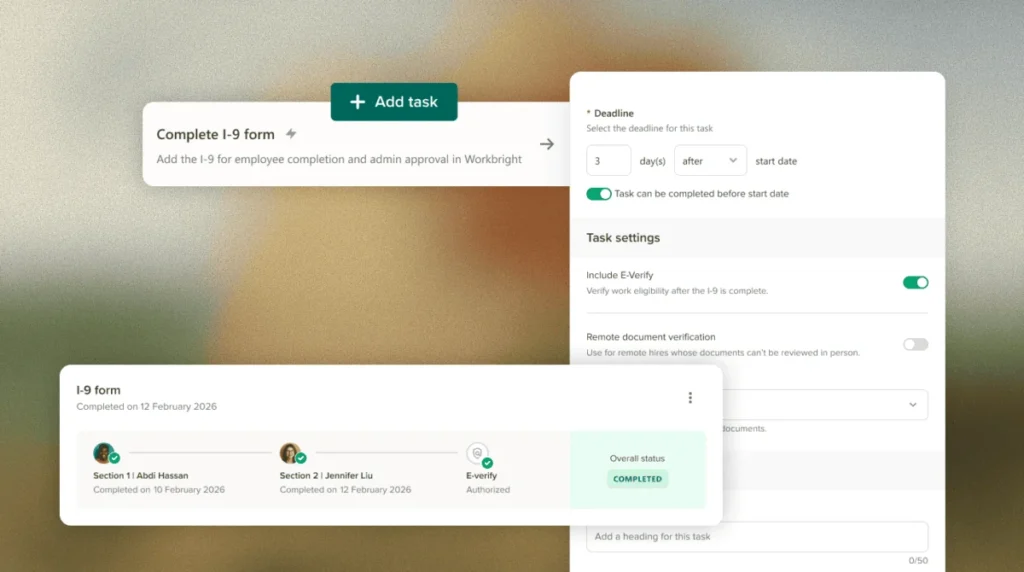
Workable, a leading provider of recruiting software, has announced a significant enhancement to its platform with the introduction of an integrated I-9 and E-Verify workflow, designed to simplify and ensure compliance for U.S. employers verifying employee work eligibility. This new functionality eliminates the need for manual workarounds, external systems, and duplicate data entry, centralizing a critical HR process directly within the Workable ecosystem. The update allows employees to digitally complete Section 1 of the I-9 form, while HR teams can review documents and complete Section 2 within the same platform, with automatic E-Verify submission for those employers opting for electronic verification. This development addresses long-standing challenges faced by U.S. organizations in maintaining federal compliance with employment eligibility requirements.
The Crucial Landscape of I-9 and E-Verify Compliance
The process of verifying employment eligibility in the United States is governed by stringent federal regulations, primarily mandated by the Immigration Reform and Control Act (IRCA) of 1986. This act requires all U.S. employers, regardless of size, to verify the identity and employment authorization of every person they hire. The primary instrument for this verification is Form I-9, Employment Eligibility Verification, issued by U.S. Citizenship and Immigration Services (USCIS). Employers must ensure that employees accurately complete Section 1 of Form I-9 upon hire, and subsequently, employers or their authorized representatives must physically examine specific documents from the List of Acceptable Documents (List A, or a combination of List B and List C) to complete Section 2. The form must be completed within three business days of the employee’s first day of employment.
Complementing Form I-9, E-Verify is an internet-based system operated by USCIS in partnership with the Social Security Administration (SSA) that allows enrolled employers to electronically verify the employment eligibility of their newly hired employees. While voluntary for most employers, E-Verify is mandatory for certain federal contractors and employers in a growing number of states that have enacted legislation requiring its use. The system compares information from an employee’s Form I-9 with data from U.S. Department of Homeland Security (DHS) and SSA records to confirm employment eligibility. The consequences of non-compliance with I-9 and E-Verify regulations are severe, ranging from substantial civil monetary penalties for paperwork violations (which can exceed $2,500 per form for first offenses) and knowingly hiring unauthorized workers (up to $25,000 per worker for first offenses), to potential criminal charges and reputational damage. These risks underscore the critical need for accurate, efficient, and compliant verification processes.
Evolution of Compliance and the Digital Imperative
Since its inception, the I-9 process has undergone various revisions, with the most recent version of the form (edition date 08/01/23) effective from November 1, 2023. The E-Verify program, initially a pilot in the mid-1990s, has expanded significantly, reflecting a broader governmental push towards electronic verification and data integrity.
The COVID-19 pandemic further accelerated the demand for digital solutions. During the public health emergency, DHS introduced temporary flexibilities, allowing employers to remotely examine I-9 documents. This temporary measure highlighted the feasibility and benefits of remote verification, particularly for distributed and remote workforces. In response to this evolving landscape and the demonstrated success of remote verification, DHS issued a final rule, effective August 1, 2023, establishing an optional alternative procedure for E-Verify enrolled employers to remotely examine I-9 documents. This pivotal change legitimizes and encourages the use of secure digital solutions for document review, provided the employer is enrolled in E-Verify and follows specific guidelines, including retaining clear copies of documents. This regulatory shift has created an urgent need for HR technology providers to integrate these capabilities seamlessly into their platforms, moving beyond manual, paper-based, or disparate system approaches.
Historically, managing I-9 and E-Verify compliance has often been a cumbersome, multi-step process for HR departments. It typically involved downloading PDF forms, printing them, having employees manually complete Section 1, physically examining documents (which became challenging with remote hiring), manually completing Section 2, storing physical or scanned copies, and then manually entering data into an E-Verify system if applicable. This fragmented approach increased the likelihood of errors, created data security vulnerabilities, consumed significant HR time, and made audit preparation a daunting task. The demand for integrated, intuitive, and compliant digital tools has therefore been growing steadily, reflecting a broader trend in HR technology towards end-to-end solutions that streamline talent acquisition and management.
Workable’s Integrated Solution: Functionality and Benefits
Workable’s new I-9 and E-Verify workflow represents a direct response to these evolving compliance needs and technological demands. By embedding these critical functions into its existing onboarding setup, Workable aims to provide a seamless and structured experience for both new hires and HR teams.
For the Employee:
Upon receiving a job offer and initiating the onboarding process in Workable, new hires are guided through the digital completion of Section 1 of Form I-9. This eliminates the need for paper forms or external portals, providing a user-friendly and intuitive experience. The digital interface helps reduce common errors associated with manual data entry, ensuring higher accuracy from the outset.
For HR Teams:
Once Section 1 is completed by the employee, HR teams gain a centralized view within Workable to manage the subsequent steps. The platform facilitates:
- Document Review: HR personnel can review the employee’s identity and employment authorization documents directly within Workable. For E-Verify enrolled employers utilizing the DHS alternative procedure, this can be done remotely by examining clear copies of the documents submitted by the employee via video call.
- Section 2 Completion: HR can then digitally complete Section 2 of the I-9 form, entering the document information and certification details directly into the system. This eliminates duplicate data entry and ensures consistency across records.
- Automated E-Verify Submission: For organizations opted into E-Verify, the system automatically submits the necessary information to the E-Verify system upon completion of Section 2. This automation drastically reduces the manual effort and potential for error in the E-Verify process, and Workable directly receives and displays the E-Verify case results, including Tentative Non-Confirmation (TNC) notifications, allowing HR to manage these cases efficiently within the platform.
- Centralized Record Keeping: All I-9 forms, associated documents, and E-Verify case details are securely stored within Workable, creating a single source of truth for compliance records. This greatly simplifies audit preparation and ensures data integrity.
- Audit Readiness: The integrated system maintains a clear audit trail of all actions, submissions, and approvals, providing comprehensive documentation for compliance audits.
- Seamless Onboarding Integration: The I-9 and E-Verify steps are incorporated directly into Workable’s existing onboarding workflows, ensuring a cohesive experience from offer acceptance through to full employment eligibility verification.
This integrated approach offers significant advantages over previous methods. It directly addresses the pain points of fragmented workflows, manual data input, and the inherent risks of non-compliance. By consolidating these functions, Workable allows HR teams to operate with greater efficiency, accuracy, and peace of mind, freeing them from administrative burdens to focus on more strategic talent initiatives.
Industry Impact and Expert Commentary
The introduction of Workable’s enhanced I-9 and E-Verify workflow arrives at a crucial time for U.S. employers. Statistics consistently show that I-9 forms are among the most frequently audited documents by federal agencies, with a significant percentage of forms containing errors. Common mistakes include incorrect dates, missing signatures, improper document recording, or failure to re-verify expiring work authorizations. Each error carries the potential for hefty fines, making robust compliance solutions indispensable. A study by the National Immigration Law Center indicated that even minor technical errors on Form I-9 could lead to substantial penalties.
The broader HR technology market, valued in the hundreds of billions globally and growing, is seeing a strong trend towards platform consolidation and specialized compliance modules. This is particularly true in the U.S., where the complexity of labor laws necessitates sophisticated software solutions. The increasing prevalence of remote and hybrid work models, accelerated by recent global events, has further underscored the need for digital I-9 verification capabilities that can accommodate a geographically dispersed workforce while remaining fully compliant with DHS regulations.
While Workable has not released official statements from specific clients regarding this new feature, the market response from HR professionals is anticipated to be overwhelmingly positive. An HR Manager at a mid-sized tech company, speaking hypothetically about such a solution, might express: "Managing I-9 and E-Verify has always been a significant administrative burden, especially as we scale our remote hiring. The idea of having a single, integrated platform that handles everything from Section 1 completion to automated E-Verify submissions, all while maintaining compliance, is a game-changer. It would undoubtedly save us countless hours and provide immense peace of mind."
From Workable’s perspective, a spokesperson might emphasize: "Our commitment at Workable is to empower HR teams with intuitive tools that simplify complex processes. This new I-9 and E-Verify workflow directly addresses a critical pain point for U.S. employers, ensuring they can verify employment eligibility in a compliant, simple, and secure manner. By eliminating manual steps and integrating directly with E-Verify, we’re not just offering a feature; we’re delivering a solution that mitigates risk, enhances efficiency, and allows HR professionals to focus on their most valuable asset: people."
Industry analysts are likely to view this development as a strategic move by Workable, aligning with the growing demand for comprehensive HR platforms. "The future of HR tech is integrated and intelligent," commented a hypothetical industry analyst. "Solutions like Workable’s I-9 and E-Verify workflow are essential for modern businesses navigating complex regulatory environments. They not only ensure compliance but also contribute significantly to operational efficiency and an enhanced onboarding experience, setting a new benchmark for what HR platforms should offer."
Broader Impact and Future Implications
The implications of Workable’s integrated I-9 and E-Verify workflow extend across several critical areas for U.S. organizations:
- Risk Mitigation: The most immediate impact is the significant reduction in compliance risk. By automating processes, minimizing manual data entry, and centralizing records, organizations are far less susceptible to errors that could lead to costly fines and legal repercussions during audits.
- Operational Efficiency: HR teams can reclaim valuable time previously spent on manual processing, follow-ups, and troubleshooting compliance issues. This reclaimed time can be redirected towards strategic initiatives such as talent development, employee engagement, and workforce planning, thereby increasing HR’s strategic value within the organization.
- Enhanced Employee Experience: A streamlined and digital onboarding process, including I-9 verification, contributes to a positive first impression for new hires. It demonstrates organizational efficiency and technological sophistication, which can boost employee morale and engagement from day one.
- Scalability and Growth: For growing companies, maintaining compliance across an expanding workforce becomes exponentially more challenging with manual systems. Workable’s solution provides a scalable framework that allows organizations to onboard new employees compliantly, regardless of volume or geographic distribution.
- Data Integrity and Security: Centralizing sensitive employee and compliance data within a secure platform like Workable enhances data integrity and security, reducing the risk of data breaches or loss associated with paper-based records or disparate systems.
- Adaptability to Regulatory Changes: By aligning with the Department of Homeland Security’s recent alternative procedure for I-9 document examination, Workable demonstrates its commitment to adapting to evolving regulations, providing employers with a future-proof solution.
Looking ahead, the trend toward further automation and intelligence in HR compliance is likely to continue. Future enhancements might include AI-driven insights to flag potential compliance issues proactively, deeper integrations with other government databases (where legally permissible), and even more intuitive user experiences for remote document examination. Workable’s move positions it strongly within this evolving landscape, catering to the immediate needs of its U.S. customer base while laying the groundwork for future advancements in HR compliance technology.
Workable customers in the U.S. can now leverage this new feature to simplify their employment eligibility verification. Organizations curious to see the I-9 and E-Verify workflow in action are encouraged to contact their account manager or request a demonstration from the Workable team to understand how this integrated solution can benefit their specific compliance needs.






