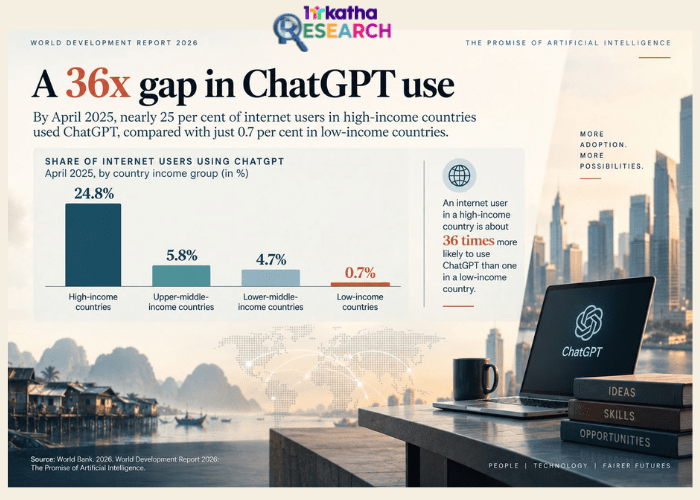
The burgeoning era of artificial intelligence, heralded as a transformative force, is paradoxically exacerbating existing global inequalities, with a stark "readiness gap" separating high-income nations from their developing counterparts. According to the World Bank’s comprehensive ‘World Development Report 2026: The Promise of Artificial Intelligence,’ released to address the profound implications of this technology, the adoption of generative AI tools like ChatGPT presents a deeply uneven landscape, threatening to widen economic disparities and create a two-tiered digital future. Data compiled by April 2025 reveals that nearly 25 percent of internet users in high-income countries had embraced ChatGPT, a staggering contrast to the mere 0.7 percent in low-income countries. This disparity signifies that ChatGPT usage among internet users in the wealthiest nations was approximately 36 times greater than in the poorest, a chasm that extends far beyond simple access.
The report, a cornerstone publication in the World Bank’s ongoing efforts to understand and shape global development, meticulously details how this technological divide is rooted not merely in exposure to AI-amenable jobs, but in a complex interplay of pre-existing digital infrastructure, management capabilities, productivity levels, workforce skills, and prior technological investments. This nuanced understanding challenges the simplistic notion that AI’s impact is solely determined by the types of jobs available in a given economy.
The Stark Reality of Uneven AI Adoption
The quantitative evidence presented in the World Development Report 2026 paints a vivid picture of the global AI divide. Beyond the 25 percent adoption rate in high-income countries and 0.7 percent in low-income countries, the report notes intermediate rates in other income brackets: 5.8 percent in upper-middle-income countries and 4.7 percent in lower-middle-income countries. These figures, captured less than two and a half years after ChatGPT’s public launch in November 2022, underscore the rapid pace of AI integration in digitally mature economies and the comparative stagnation elsewhere.
This uneven adoption is not a reflection of a fundamental difference in the potential for AI to influence job roles. The report estimates that 14.2 percent of jobs in high-income countries are amenable to automation by generative AI. While this figure is higher than the 4.5 percent across low- and middle-income countries susceptible to automation, an additional 16.2 percent of jobs in these developing economies are amenable to being complemented by AI. This distinction is crucial; it implies that a substantial portion of the workforce in low- and middle-income countries could benefit from AI tools to enhance productivity and create new opportunities, yet they are largely missing out on these advantages. The report unequivocally states that lower exposure explains only a fraction of the adoption gap; the predominant factors lie in the broader ecosystem surrounding the technology.
Deep Roots: The Pre-Existing "Readiness Gap"
The World Bank’s analysis asserts that the global AI divide is fundamentally a symptom of a deeper "readiness gap" that existed long before generative AI entered the mainstream. AI is not landing on a blank economic slate; it is building upon decades of accumulated capabilities and disparities. Countries with robust digital infrastructure, high levels of digital literacy, and established technological ecosystems are inherently better positioned to integrate and leverage AI.
- Digital Infrastructure: This encompasses reliable, high-speed internet access, cloud computing services, secure data storage facilities, and widespread access to affordable smart devices. Many low-income countries still grapple with basic internet penetration challenges, let alone the advanced infrastructure required to run and scale AI applications effectively. The cost of data, electricity, and hardware remains a significant barrier.
- Management Capability and Organizational Structure: The report highlights that firms with structured management practices are 17 percent more likely to adopt AI than those without. This indicates that effective leadership, strategic planning, and an organizational culture that embraces innovation are critical prerequisites. In many developing economies, businesses may lack the managerial expertise or flexibility to reconfigure processes for AI integration.
- Productivity and Skills: A direct correlation exists between pre-existing labour productivity and AI adoption. A mere 1 percent increase in labour productivity is associated with a 1.2 percent increase in the likelihood of AI adoption. This suggests a virtuous cycle where productive firms are better equipped to adopt AI, which in turn boosts productivity further. The availability of a skilled workforce proficient in data science, AI development, and digital literacy is also paramount. Many developing nations face significant skill gaps, making it challenging to implement and manage sophisticated AI systems.
- Prior Technological Adoption and Innovation: The compounding effect of digital readiness is a central theme. Firms that were already technologically sophisticated, having adopted complementary technologies such as cloud computing, enterprise resource planning (ERP) systems, or advanced analytics, have subsequently adopted generative AI at much higher rates. This means that organizations that have already invested in "less glamorous" foundational digital transformation are now reaping the benefits of advanced AI, further widening the gap with those still struggling with basic digitalization. Better market access and a history of product or process innovation also correlate with higher AI adoption and more sophisticated use.
Nuances in Firm-Level Adoption: Beyond the Surface
While the headline numbers paint a stark picture, the report’s firm-level surveys across diverse economies like India, Jordan, Kenya, Mexico, Nigeria, and Thailand reveal important nuances. For simpler AI applications, such as AI chatbots, the adoption gap appears surprisingly modest. On average, about one in five firms in these developing economies already use AI chatbots, only slightly below the 34 percent share observed in the United States. This suggests that basic AI tools are relatively accessible and are finding a foothold even in less digitally advanced environments.
However, this apparent proximity quickly dissipates as firms attempt to integrate more sophisticated AI applications into their core business processes. The report indicates that the distance between firms in developing economies and their counterparts in the US grows substantially when moving beyond rudimentary AI tools to complex, integrated solutions that demand deeper technological expertise, data infrastructure, and organizational change.
Furthermore, the report uncovers a counter-intuitive finding regarding firm size. While one might expect larger firms in developing economies to possess more resources and capabilities to bridge the AI gap, the study found that gaps in AI adoption and sophistication between surveyed developing economies and the US are wider among medium and large firms than among small ones. This suggests that scale alone does not automatically erase the disadvantage; even businesses with significant resources can face substantial capability gaps in leveraging advanced AI, perhaps due to entrenched legacy systems or a lack of agile management practices.
Labour Market Implications: A Double-Edged Sword
The uneven AI adoption has immediate and profound consequences for global labour markets. The World Bank report highlights an uncomfortable asymmetry: countries that adopt AI fastest experience more immediate disruption, particularly in white-collar work, while those that adopt it slowly currently experience less disruption. However, this "protection through non-adoption" is clearly not an economic advantage.
Evidence from South Asia after ChatGPT’s release in November 2022 illustrates this dynamic. Job postings in the region declined by 1.6 percent, with a more pronounced slowdown among globally connected firms (multinational affiliates, global-value-chain suppliers) that have greater flexibility to relocate or substitute tasks across borders. Local firms experienced a smaller effect, a pattern that the report attributes, in part, to their slower AI adoption rates.
In India specifically, the arrival of generative AI reduced monthly job postings for white-collar occupations most amenable to automation and least likely to be complemented by AI. This impact disproportionately affected entry-level workers, with job listings in some of the most exposed white-collar occupations reportedly falling by about 20 percent in South Asia. Internationally, across 84 economies between 2021 and 2025, ChatGPT’s estimated effect on job postings was considerably stronger in high-income countries than elsewhere.
While this means that low- and middle-income economies are currently experiencing less immediate job displacement, the report cautions that this evidence remains incomplete. As adoption inevitably spreads, displacement could intensify. The ultimate paradox is that countries slower to adopt AI are, for now, less disrupted by it, but simultaneously risk missing out on the productivity gains and new opportunities that accompany technological integration.
The Productivity Divide: Fueling Economic Disparity

The core promise of AI lies in its potential to dramatically enhance productivity. Studies reviewed by the report indicate task-level improvements ranging from approximately 6 percent to an astonishing 88 percent, with some of the most significant effects observed in coding and other knowledge-intensive tasks. Furthermore, the report cites evidence that AI adoption increased average labour productivity by 4 percent across 12,000 European firms between 2019 and 2024.
This direct link between AI adoption and productivity underscores the gravity of the global divide. Economies that are less exposed to AI, and whose firms are less able to adopt the technology, inherently capture less of these critical productivity improvements. The same readiness gap that governs the extent of AI-induced disruption also dictates the amount of economic value a country can create from it.
World Bank officials, while not directly quoted in the provided text, implicitly highlight the urgent need to address this "readiness gap." Experts familiar with the report’s findings would likely emphasize that allowing this uneven pattern of adoption to persist risks widening productivity differences not only between countries but also between firms within them. This could entrench existing economic hierarchies and make it even harder for developing nations to catch up.
Policy Imperatives and the Path Forward
The World Bank’s ‘World Development Report 2026’ serves as a critical call to action. The insights gleaned from its comprehensive analysis point towards a complex challenge that demands multi-faceted solutions. Bridging the AI divide is not merely about providing access to AI models; it is about cultivating the foundational capabilities required to extract value from them.
Policymakers in developing countries, supported by international organizations, must prioritize investments in digital public infrastructure, ensuring widespread access to affordable and reliable internet, cloud services, and digital literacy programs. Furthermore, there must be a concerted effort to foster an environment conducive to technological adoption, including supporting the digital transformation of small and medium-sized enterprises (SMEs) and encouraging innovation.
The report implicitly advocates for significant investments in human capital development, including upskilling and reskilling initiatives to equip workforces with the digital and AI-specific skills needed for the future. This includes not just technical proficiencies but also critical thinking, problem-solving, and adaptability – skills that complement AI rather than being replaced by it.
Beyond domestic efforts, international cooperation will be vital. High-income countries and global technology leaders have a role to play in facilitating knowledge transfer, providing technical assistance, and potentially developing AI solutions that are more tailored and accessible for low-resource environments. Establishing robust data governance and ethical AI frameworks will also be crucial to build trust and ensure that AI development benefits all segments of society, rather than exacerbating existing inequalities.
In conclusion, the World Bank’s findings paint a sobering picture of an AI future that, without deliberate intervention, risks reinforcing and deepening existing global economic disparities. The countries least disrupted by AI today are not necessarily the best protected; they are often the least prepared to harness its transformative potential tomorrow. The challenge is immense, but the report underscores the imperative for concerted action to ensure that the promise of artificial intelligence is realized for all, not just a privileged few.