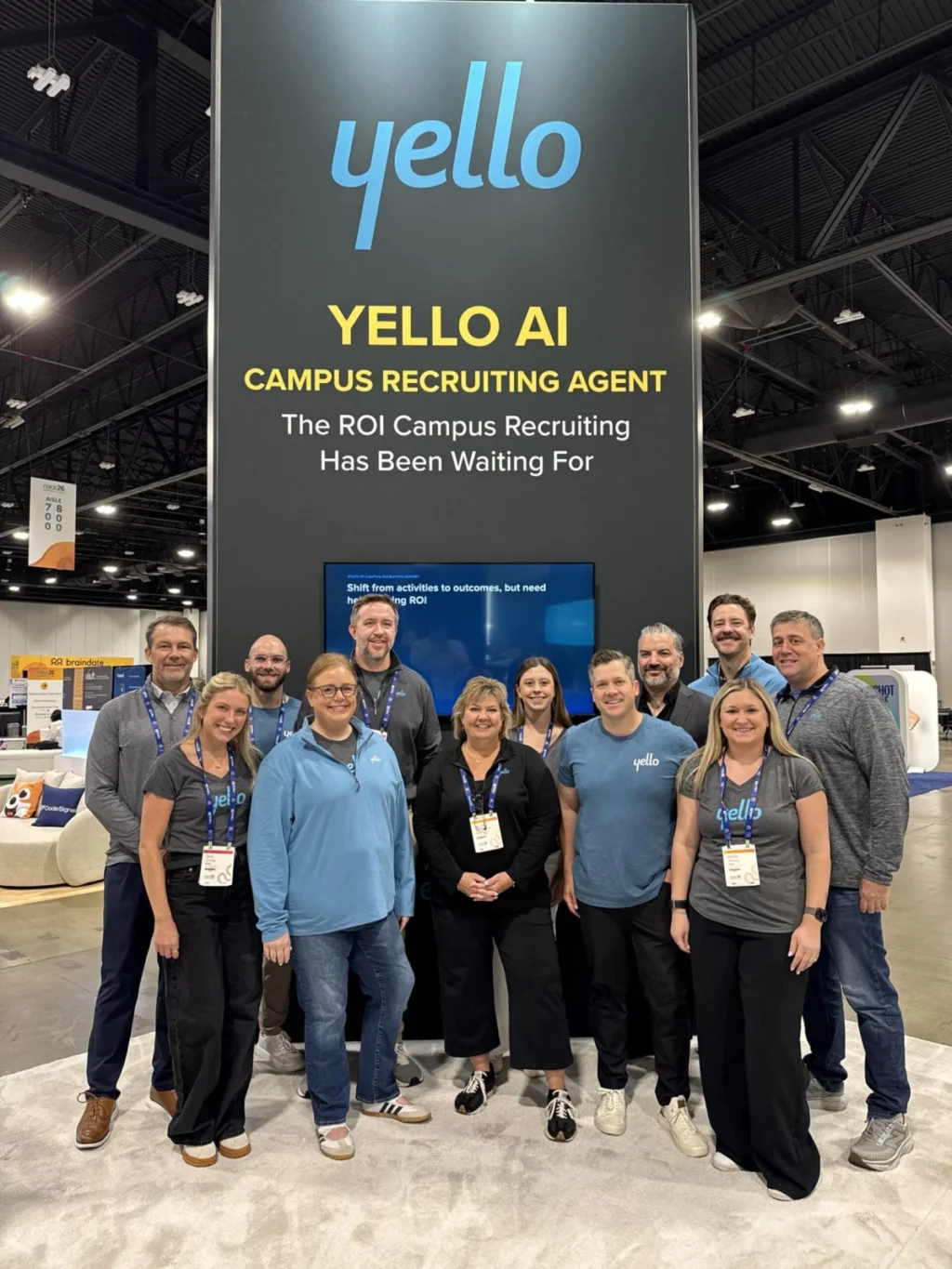
The National Association of Colleges and Employers (NACE) 26th annual conference, held recently in Denver, Colorado, served as a pivotal forum for discussing the dynamic shifts occurring within early talent acquisition. Attended by leading organizations and educational institutions, the conference saw Yello, a prominent talent acquisition software provider, participating as a platinum sponsor. Beyond hosting insightful speaking sessions and engaging discussions at their exhibition booth, Yello utilized NACE26 as a platform to introduce two significant developments: the debut of their AI Campus Recruiting Agent and the announcement of a strategic partnership with Symplicity, a global leader in student success and engagement technology. These announcements underscore a broader industry movement towards leveraging advanced technology to navigate the complexities of modern campus recruitment, which is increasingly characterized by the dual challenges of high application volumes and the imperative for genuine candidate engagement.
Background and Significance of NACE26
The National Association of Colleges and Employers (NACE) stands as a cornerstone institution connecting higher education career services professionals and employers nationwide. Its annual conference, NACE26, is widely recognized as a premier event for sharing best practices, discussing emerging trends, and fostering collaborations aimed at optimizing the transition from academia to the professional world. Typically drawing thousands of attendees, including university career counselors, corporate recruiters, and HR technology providers, NACE conferences are critical barometers for the health and direction of the early talent market. The 2024 iteration in Denver provided a timely opportunity to address pressing concerns such as the integration of artificial intelligence, the efficacy of traditional recruitment events, and the persistent challenge of offer reneges in a competitive talent landscape. The backdrop of NACE26 highlights a period of significant transformation, where recruiters are grappling with evolving candidate expectations, the impact of generative AI, and the need for more strategic, data-driven approaches to identify and secure top-tier emerging talent.
AI’s Transformative, Yet Nuanced, Role in Recruiting
One of the most intensely debated topics at NACE26 was the burgeoning influence of artificial intelligence on recruitment processes. While a significant majority of campus teams are already integrating AI into their workflows, Yello’s recent State of Campus Recruiting report indicates a concentrated usage primarily in top-of-funnel activities. Specifically, 26% of current AI application is directed towards sourcing candidates, and another 25% is dedicated to candidate communications. This prevalence in initial outreach and identification phases contrasts sharply with AI’s limited deployment in areas where it could yield substantial strategic benefits, such as in-depth data analysis and the quantification of recruitment ROI. This gap emerged as a recurring theme throughout the Denver conference.
Recruiters, as evidenced by discussions and audience sentiment, are not seeking AI solutions that autonomously make hiring decisions. Instead, their preference leans heavily towards AI tools that can effectively manage administrative burdens and automate repetitive tasks. This desire stems from a fundamental need to free up valuable recruiter time, enabling them to focus on high-value interactions, personalized engagement, and strategic relationship building with candidates.
A session titled "Can Campus Recruiting Be Autonomous? The Answer Is Complicated," featuring Tamara Welch from LPL Financial, Matthew Brink from NACE, and Dan Bartfield from Yello, directly confronted this dichotomy. The panelists explored whether the ultimate objective of AI integration should be fully autonomous recruiting or, more practically, empowering recruiters to dedicate more time to critical, human-centric aspects of their roles. The audience’s overwhelming consensus favored the latter, underscoring a collective belief that for AI to be truly effective, it must be purpose-built to address the unique challenges and requirements of campus recruiting. By automating manual, routine work, AI can grant recruiters the bandwidth to concentrate on the most impactful elements of their hiring processes, particularly direct candidate engagement.
However, the discussion also highlighted critical considerations regarding candidate perceptions. Matthew Brink from NACE emphasized that students often express wariness towards employers who rely excessively on AI in their hiring processes, particularly when the use of such technology is not transparently disclosed. A recruitment experience perceived as impersonal or overly automated can deter highly qualified candidates and subtly erode an employer’s brand reputation, making authenticity and disclosure paramount in AI integration strategies. The implications suggest a need for a balanced approach where AI enhances efficiency without compromising the human element essential for attracting and retaining top talent.
Rethinking Event Strategies for Enhanced ROI
The evolving landscape of early talent acquisition also necessitates a fundamental reevaluation of traditional event strategies. A panel discussion titled "Purpose Over Presence: Rethinking Your Event Strategy for Better ROI," featuring Vincent Bond from Synchrony, Kristin Leek from Boeing, and Christopher Cantu from Marathon Petroleum, illuminated a shared challenge among campus teams: a continuous rise in application volumes paradoxically coinciding with increased difficulty in identifying genuinely qualified candidates. This phenomenon is partly attributed to the proliferation of AI-assisted resume tools, which, as Vince Bond articulated, has led to a homogenization of resumes, creating a scenario where "AI is fighting AI." Candidates leverage AI to optimize their applications, while employers use AI to screen them, creating a complex arms race.
In response, these industry leaders are advocating for a more intentional and earlier investment in relationship building, predominantly through targeted in-person events. The very purpose of in-person events has shifted from high-volume career fairs designed for broad candidate outreach to more strategic engagements focused on deep relationship cultivation and measurable outcomes. The traditional model of attending numerous career fairs, meeting a vast number of candidates, and hoping to stumble upon a few good fits is giving way to an outcomes-based approach. Recruiters are now meticulously evaluating which events yield the best return on investment, translating into high-quality hires rather than merely high activity metrics.
Christopher Cantu’s analogy of career fairs as the "end zone"—the point of closure rather than initiation—encapsulates this strategic pivot. The critical groundwork, including relationship building and talent identification, now commences months, or even years, prior to the final recruitment stages, often through highly targeted events and consistent, personalized touchpoints. This concept of "relationship equity" has emerged as a crucial competitive differentiator in contemporary campus recruiting. It provides a robust defense against escalating application volumes, the challenges of candidate fraud, and the overall noise in the talent market, allowing employers to forge genuine connections that precede formal applications.
Addressing the Persistent Challenge of Offer Reneges
Complementing the emphasis on relationship building in event strategies, the issue of offer reneges—candidates accepting an offer only to withdraw later—was another dominant topic at NACE26. Industry data consistently indicates that renege rates can significantly impact recruitment costs, estimated to range from thousands to tens of thousands of dollars per reneged offer, factoring in lost productivity, administrative overhead, and the necessity of reopening the recruitment process. The conference discussions highlighted that an offer acceptance no longer guarantees a closed deal; instead, the period between offer extension and the start date must be treated as an active recruiting phase.
Organizations effectively mitigating renege rates are those that prioritize consistent, personalized communication throughout this critical post-offer interval. Maintaining engagement, providing clear expectations, and fostering a sense of belonging are deemed essential to retaining top talent. Panelists reiterated that the proactive relationship-building efforts initiated during events often play a significant role in keeping renege rates low, underscoring the interconnectedness of recruitment strategies.
In a virtual session titled "Designing the Complete Journey: From Pre-Boarding to Off-Boarding," Yello’s Ahva Sadeghi introduced the KEEP framework, a structured approach designed to maintain candidate engagement across the entire journey. KEEP, an acronym for Kick Off, Engage, Enable, and Perform, outlines four pillars that guide a candidate from the moment of offer acceptance through to their first day on the job. Sadeghi also shared valuable insights into the primary reasons candidates renege, the true financial and operational costs incurred by employers, and demonstrated how Symba customers have achieved remarkable reductions in their renege rates, exceeding 55%, by implementing robust engagement strategies. This highlights the critical need for comprehensive, technology-supported engagement platforms to solidify candidate commitments.
Yello’s Transformative Announcements at NACE26
NACE26 served as a landmark occasion for Yello to unveil two significant advancements aimed at revolutionizing early talent acquisition. These announcements directly address the challenges and trends discussed throughout the conference, offering tangible solutions for recruiters navigating the complex modern landscape.
The first major announcement was the launch of the Yello Campus Recruiting Agent. This innovative AI-powered agent is designed to automate extensive manual tasks inherent in campus recruiting, thereby streamlining event management, candidate sourcing, campaign execution, and interview scheduling. The core objective is to liberate recruiting teams from administrative burdens, allowing them to redirect their focus towards meaningful candidate engagement. Historically, campus recruiting has often revolved around attending events and hoping the right candidates would visit a booth. Yello’s new AI agent fundamentally flips this model. It proactively identifies best-fit candidates and pre-schedules interviews even before an event commences. This automation handles the heavy lifting of event creation and management, precise candidate matching and prioritization, targeted outreach, and intricate interview scheduling. Consequently, recruiters arrive at events with a pre-populated interview schedule comprising candidates who are genuinely aligned with their roles, transforming a historically reactive process into a highly proactive and efficient one.
The second pivotal announcement was Yello’s new strategic partnership with Symplicity. This collaboration significantly expands candidate access for Yello customers by integrating Symplicity’s extensive network of over 600,000 early talent candidates. Employers leveraging the Yello Campus Recruiting Agent can now cross-reference and match against active candidates within the Symplicity database, augmenting their existing talent pools drawn from their Applicant Tracking Systems (ATS), their proprietary Yello databases, WayUp, and more than 35 other diverse online sources. This partnership dramatically enhances the AI agent’s capability to identify and engage a broader, yet highly relevant, pool of prospective hires, providing a competitive edge in sourcing quality talent.
Broader Impact and Implications
The confluence of insights and innovations presented at NACE26, particularly Yello’s strategic announcements, heralds a new era for early talent recruitment. The industry is clearly moving beyond rudimentary digital tools towards sophisticated AI-driven platforms that are purpose-built to address specific pain points. The emphasis on freeing recruiters from administrative tasks to foster genuine human connection signifies a critical paradigm shift: from transactional recruiting to relational recruiting. This shift is not merely about efficiency but about cultivating a superior candidate experience and building lasting relationships that translate into higher retention and stronger employer brands.
The integration of AI, as exemplified by the Yello Campus Recruiting Agent, is poised to democratize access to top talent by enabling smaller teams to operate with the efficiency of larger ones. By providing data-driven insights and automating the initial matching and scheduling, it empowers recruiters to be more strategic and less tactical. Furthermore, the partnership with Symplicity underscores the growing importance of integrated ecosystems in talent acquisition. Connecting disparate talent pools and leveraging comprehensive data analytics allows employers to cast a wider yet more targeted net, ensuring that they are not only reaching more candidates but reaching the right candidates.
The discussions around event strategy and renege mitigation collectively point towards a future where early talent recruitment is characterized by proactive engagement, personalized communication, and a continuous focus on the candidate journey from initial touchpoint to post-offer acceptance. Technology, when thoughtfully applied, acts as a powerful enabler for these human-centric strategies, allowing recruiters to focus on what truly matters: building connections and securing the future workforce. NACE26 thus underscored that the future of early talent acquisition lies in a harmonious blend of cutting-edge technology and authentic human interaction, a balance that Yello’s latest offerings are designed to facilitate.