The landscape of business operations is undergoing a profound and rapid transformation, driven by the pervasive integration of Artificial Intelligence (AI). Recent extensive travel across Europe, Asia, and the Middle East, encompassing consultations with hundreds of companies, reveals a clear consensus: AI has transitioned from a theoretical concept to a tangible and increasingly indispensable business tool. The maturity of AI adoption varies significantly across organizations, but the overarching trend is undeniable, with a continuous expansion of practical use cases.
Key Findings from Recent Research
A comprehensive survey conducted by Wharton underscores this burgeoning adoption. The report indicates that 46% of business leaders are now utilizing Generative AI (Gen AI) on a daily basis, with an additional 80% employing it weekly. Crucially, among these active users, a significant majority are focused on tangible outcomes: 72% are actively measuring the Return on Investment (ROI) of their AI initiatives, and an impressive 74% report a positive return. This widespread adoption is not confined to specific departments; Human Resources (HR) is emerging as a significant user, ranking third in adoption rates for AI use cases, trailing only Information Technology (IT) and Finance.
The financial commitment to AI is also escalating. The Wharton survey reveals that 23% of large companies are allocating $20 million or more annually to AI, while 43% are investing over $10 million per year. This substantial investment is yielding measurable benefits, primarily in the realm of productivity. The most prevalent use case, often termed "stage 1" usage, centers on enhancing individual productivity. AI is proving instrumental in tasks such as summarizing meetings, analyzing vast datasets, efficiently retrieving information, and assisting in the creation and review of documents. While these personal productivity gains are substantial and immediate, they represent only the initial phase of AI integration.
The Generative AI Revolution: Reshaping Business Processes
The current wave of AI adoption bears striking resemblances to the early days of transformative technologies like word processing, spreadsheets, and internet search engines. These foundational tools primarily offered "individual productivity" benefits, empowering users to perform tasks more efficiently. Microsoft’s Copilot is increasingly embodying this paradigm, evolving into what can be considered the "New Microsoft Office Suite," seamlessly integrating AI assistance into everyday workflows.
However, the capabilities of AI extend far beyond individual task enhancement. Approximately 12% of companies are now deploying "corporate agents" – sophisticated AI systems designed for knowledge and information management. Examples like IBM’s "Ask HR" demonstrate the potential of these agents to streamline internal processes. These AI-powered chatbots can effectively replace complex internal portals and SharePoint sites, while also serving as scalable customer support solutions. The expectation is that nearly every organization will eventually integrate such agents.
A notable case study involves a large healthcare company that has been utilizing an employee-facing chatbot for four years. The success of this initiative has led to the integration of virtually all HR applications behind the chatbot. Employees can now access assistance with a wide range of queries, including pay, benefits, work schedules, and even training opportunities, through a single, intuitive interface.
AI in Talent Acquisition and Development
The recruitment process is another area where AI is demonstrating proven value. Job candidates can engage with AI-powered agents to initiate applications, complete AI-driven assessments, and even undergo initial interviews conducted by AI avatars. This 24/7 accessibility eliminates the need for candidates and hiring teams to coordinate schedules, significantly accelerating the initial stages of the hiring funnel.
While highly sophisticated, multi-functional agents capable of delivering the highest ROI are still in development (corresponding to "stage 3" in AI adoption models), organizations are actively deploying AI-based coaching and learning tools. Many large enterprises are implementing AI-native learning systems, reporting reductions in staff required for training delivery by 30-40%, alongside substantial improvements in workforce enablement. The demand for specialized HR and learning AI agents, such as those offered by Galileo, has surged as companies seek to equip their staff and managers with advanced AI-driven support. Galileo is positioning itself as a comprehensive digital HR business partner and "Supertutor."
Crossing the Rubicon: The Point of No Return for AI Adoption
The current phase of AI integration can be aptly described as "crossing the Rubicon" – a point of no return. Despite prevailing narratives that often focus on the potential negative impacts of AI on careers and society, the reality on the ground is one of pragmatic and accessible utility. While AI is not infallible, with documented instances of errors, particularly from large language models, the development of effective usage strategies and the creation of trusted data sets are mitigating these challenges.
The initial fears surrounding AI, such as those amplified by sensationalized media reports two years ago, are receding. Significant capital investment, exceeding trillions of dollars, has fueled advancements in AI infrastructure, engineering, and power generation, contributing to a more stable and secure AI ecosystem. While the potential for AI to generate incorrect information or poorly written content remains, users are increasingly developing a critical approach, learning to "check" AI outputs and becoming more comfortable with its probabilistic nature.
Emerging challenges, however, are coming to the forefront. The energy demands of AI, particularly the substantial water consumption associated with AI queries, are raising new environmental and geopolitical concerns. For instance, reports from the UAE indicate that each ChatGPT query consumes approximately four liters of water, highlighting a significant and growing challenge for sustainable AI development.

The Future Trajectory: From Single-Function to Multi-Functional Agents
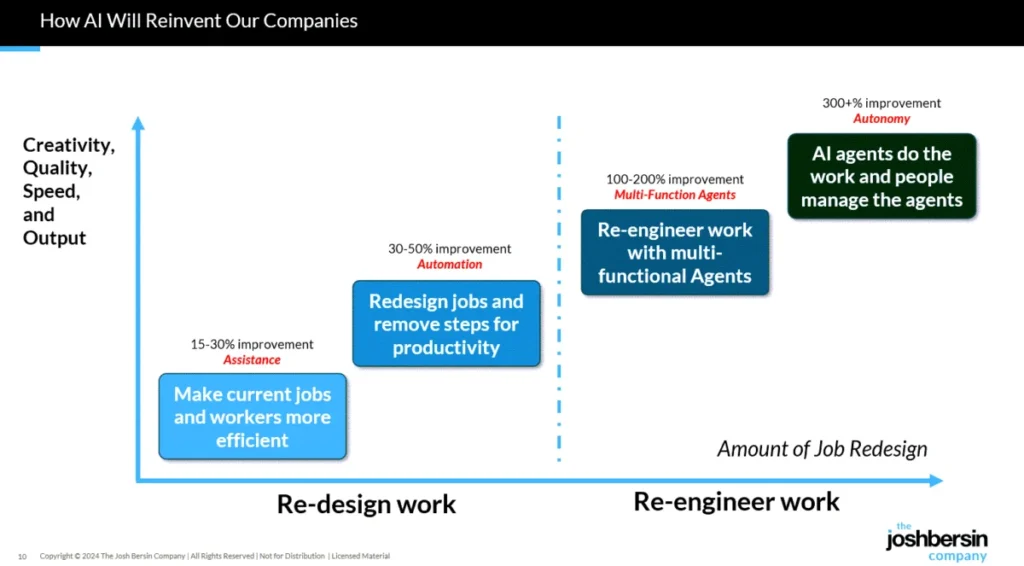
The true transformative potential of AI lies in the development and deployment of "multi-functional agents." Current AI tools, while beneficial for individual productivity, are akin to power steering in a vehicle – they assist with specific tasks but do not fully automate the journey. The next evolution will see AI agents capable of managing entire end-to-end business processes.
This transition is already underway in areas like recruiting and training, where agents are being developed to handle a comprehensive suite of tasks, from drafting job requisitions and engaging with candidates to scheduling interviews and screening resumes. Future iterations will likely integrate these capabilities with onboarding and performance review processes, creating a cohesive "hiring and career" agent. The development of these integrated agents, often driven by internal IT departments rather than solely by external vendors, signifies a shift towards AI managing entire workflows, such as "design to build to distribute to sell," or "position to target to market to close a sale," followed by "bill to collect to renew and support."
As these multi-functional agents become more sophisticated, they will necessitate a fundamental re-evaluation of job roles. Positions focused on repetitive, "steering wheel" tasks, such as interview scheduling or appointment setting, may become obsolete as AI agents assume these responsibilities within broader workflows. This evolution is already evident in platforms like Galileo, which has expanded from a simple HR assistant to an integrated solution capable of answering complex queries, developing training courses, and providing actionable solutions to business problems.
The Rise of Agents with Memory and Personality
A second significant development on the horizon is the emergence of AI agents that possess "memory" and can "learn" from user interactions and business data. This personalization allows agents to provide more autonomous, context-aware, and valuable assistance. For example, an HR agent like Galileo might not only facilitate a new hire requisition but also proactively suggest internal candidates based on prior interactions and company benchmarks, or even recommend development plans for existing teams before adding new personnel. This evolving capability suggests a future where AI agents can strategically guide business operations based on historical data and learned behaviors.
Data Management: The Critical Foundation for AI Success
Organizations that have successfully implemented AI consistently highlight the critical importance of robust data management, data labeling, and data governance. The performance and accuracy of AI systems are directly contingent on the quality of the data they are trained on. AI models operate based on probabilistic calculations and vector calculus, meaning even minor data inaccuracies can lead to significant errors in outputs. A notable finding from a BBC report indicated that 45% of AI queries can produce erroneous answers, underscoring the need for meticulous data hygiene. Consequently, data ownership and maintenance have become mission-critical disciplines, with companies like IBM assigning specific owners to manage and update thousands of HR policies within their AI agents. This ensures that AI systems remain accurate and responsive to evolving regulations and internal procedures.
Inter-Agent Communication: The Next Frontier
The maturation of AI adoption necessitates the development of agent-to-agent communication protocols. While these protocols are still in their nascent stages, significant progress is being made. Integrations, such as Galileo’s connection with SAP’s Joule, are paving the way for seamless collaboration between different AI systems. Organizations are advised to approach the deployment of numerous individual AI agents with caution, prioritizing those that can integrate and work cohesively. A strategic approach, guided by frameworks like an "Agentic AI Blueprint for HR," will be essential to avoid fragmented systems and ensure that AI agents function as a coordinated unit, much like a well-orchestrated autonomous vehicle.
Vendor Landscape and Emerging Risks
The AI vendor landscape is dynamic and presents both opportunities and risks. The future of major AI players like OpenAI remains subject to various factors, and established tech giants like Microsoft are navigating complex integration strategies. The competitive environment, with emerging players and potential market consolidation, necessitates careful vendor selection. Companies that focus on pragmatic business applications, such as Galileo, Paradox, and Eightfold, are well-positioned. Major Human Capital Management (HCM) vendors, including SAP, Workday, and ServiceNow, are actively integrating AI agents into their platforms, aiming to become comprehensive, end-to-end AI solution providers.
Addressing Fears of Job Displacement and Skill Degradation
Concerns about job displacement and the "dumbing down" of the workforce are prevalent. However, the perspective offered is one of opportunity and evolution. Organizations that fail to embrace AI risk being left behind. This era presents a unique chance to re-engineer business processes and enhance human capabilities. Rather than fearing AI, individuals are encouraged to engage with these tools to cultivate new skills and identify innovative applications.
The notion of AI completely replacing human jobs is widely considered improbable. Historical parallels, such as the impact of spreadsheets on accounting, demonstrate how technology can augment rather than eliminate professions, leading to increased efficiency and a shift towards higher-value tasks. For creative professionals, AI can serve as a powerful "personal supercomputer," enabling the creation of more sophisticated and impactful work.
The advent of AI marks a new era where individuals can become "Superworkers," leveraging AI to drive organizational learning, application, and innovation. The focus will shift from performing routine tasks to becoming strategic thinkers, problem-solvers, and innovators, guiding the development and application of this transformative technology. The path forward involves embracing AI not as a replacement for human ingenuity, but as a powerful catalyst for human potential.