Digital performance management systems have fundamentally transformed how organizations perceive, quantify, and manage employee performance. These sophisticated software solutions streamline the entire performance management lifecycle, offering unprecedented ease for administrators, managers, and employees. As the landscape of work continues to evolve, understanding how to select and implement the right performance management software has become a critical strategic imperative for businesses aiming to foster employee success and achieve sustainable growth.
The contemporary workplace demands a departure from antiquated annual review processes. The shift towards continuous performance management is not merely a trend but a necessity for organizations seeking to cultivate high-performing teams, boost employee engagement, and drive tangible business outcomes. This comprehensive guide delves into the essential considerations for evaluating and selecting a performance management system that aligns with your organization’s unique needs and aspirations.
What Constitutes a Performance Management System?
At its core, a performance management system encompasses the processes and tools designed to facilitate employee growth, gather feedback, and ultimately improve overall business performance. A robust system not only enhances employee engagement and impact but also empowers managers with the insights and capabilities needed for effective coaching and continuous dialogue. The primary objectives of such systems are multifaceted, aiming to:

- Align individual efforts with organizational goals: Ensuring every employee understands how their contributions fit into the larger strategic picture.
- Foster continuous feedback and communication: Creating an environment where constructive dialogue is regular and expected.
- Identify and address skill gaps: Providing opportunities for targeted development and growth.
- Recognize and reward performance: Acknowledging achievements to boost morale and motivation.
- Drive employee development and career progression: Creating clear pathways for advancement within the organization.
By integrating these elements, performance management systems move beyond mere evaluation to become a strategic engine for organizational development and employee success.
The Imperative for Performance Management Software
In today’s competitive business environment, achieving and sustaining employee success is a paramount concern for organizations. This success extends beyond task completion to encompass the cultivation of highly effective teams. Companies still relying solely on traditional, annual performance reviews are likely missing significant opportunities to engage their workforce and drive performance. The modern approach necessitates a transition from a perfunctory, check-the-box exercise to a streamlined, engaging, and actionable process.
A continuous performance management strategy fosters:
- Enhanced Employee Engagement: Regular feedback and development conversations keep employees connected and motivated.
- Improved Productivity: Clear goals and timely support help employees perform at their best.
- Increased Agility: The ability to adapt to changing business needs and provide real-time course correction.
- Stronger Manager-Employee Relationships: Consistent communication builds trust and rapport.
- Proactive Talent Development: Identifying potential and nurturing growth pathways for all employees.
A cutting-edge performance management system serves as the bedrock for human resources professionals and their organizations, enabling adaptation and improvement at every level. It is the foundation upon which sustained performance is built.
Key Drivers for Adopting Performance Management Systems
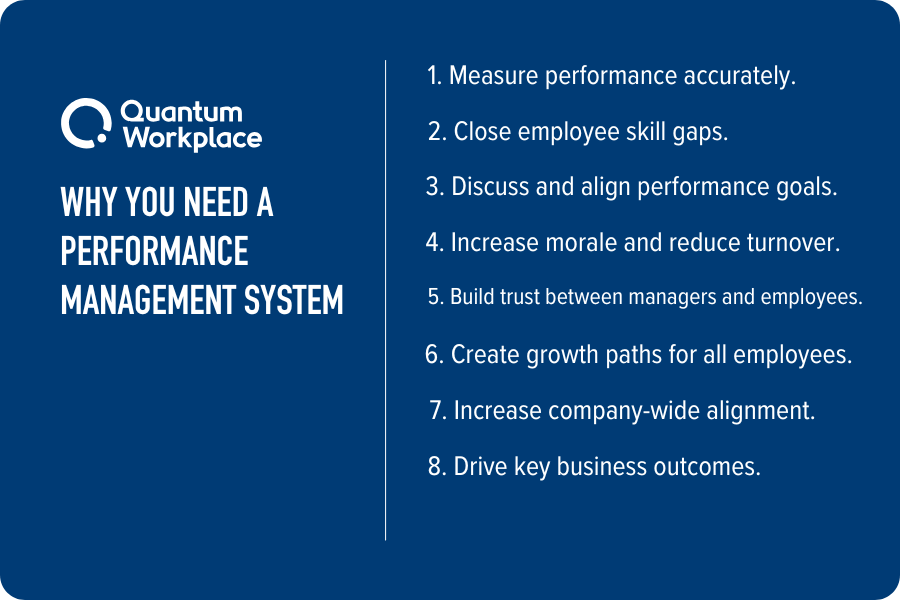
Leaders are increasingly recognizing the strategic value of performance management systems. Here are the top reasons driving their adoption:
-
Accurate Performance Measurement: Establishing clear benchmarks for performance is fundamental. However, research from Lighthouse Research & Advisory indicates that only 36% of employees fully grasp their job responsibilities and performance expectations. A well-implemented performance management system provides this crucial clarity, ensuring employee efforts are directly aligned with overarching organizational objectives, which is vital for effective business performance.
-
Bridging Employee Skill Gaps: A significant portion of the workforce desires more frequent feedback and coaching. According to Quantum Workplace’s research, 50% of employees seek additional feedback. Performance management systems empower leaders to identify and address skill deficits, facilitating the creation of thoughtful employee development plans and equipping individuals with the tools necessary for professional growth and success.
-
Goal Alignment and Achievement: Clearly defined performance goals are powerful drivers of engagement. Quantum Workplace’s research highlights that employees with individual goals are twice as likely to be engaged. Performance management systems facilitate the discussion and alignment of personal aspirations with organizational objectives, fostering a sense of shared purpose.
-
Boosting Morale and Reducing Turnover: Recognition and appreciation are deeply valued by employees. Unfortunately, only 20% of employees feel adequately recognized and appreciated for their contributions, with half of all employees desiring more recognition. A performance management system enables effective employee recognition strategies, which in turn elevate morale and significantly reduce costly employee turnover.
-
Cultivating Trust: Trust is the cornerstone of any successful workplace. Effective performance management fosters transparency and fairness, thereby building a robust foundation of trust essential for strong working relationships. Organizations must prioritize providing employees with consistent feedback, meaningful manager connection, and clear visibility into performance metrics.
-
Establishing Growth Pathways: Every employee should have a discernible path for growth and career advancement within their organization. Performance management systems are instrumental in bringing talent development plans to fruition, transforming talent development from an aspiration into a structured, actionable process.
-
Enhancing Company-Wide Alignment: Research by Quantum Workplace indicates that performance management has a profound impact on organizational culture. Effective systems ensure that team members are aligned with the company’s mission, purpose, and strategic goals.
-
Driving Business Outcomes: Ultimately, a performance management system is a strategic lever. Brandon Hall Group research reveals that a staggering 62% of organizations believe their current performance management processes do not effectively enhance performance. Modern systems are designed to drive the critical outcomes and key results that are paramount to business success.
Essential Elements of High-Performing Performance Management Software
An effective performance management system should support the entire performance lifecycle: planning, monitoring, reviewing, and recognizing.
1. Planning
The foundation of effective performance management lies in meticulous planning. The software should facilitate the definition and alignment of employee goals with organizational objectives. Transparent and clearly communicated goals contribute to:
- Strategic Clarity: Ensuring everyone understands what success looks like.
- Focused Efforts: Directing individual and team energy towards key priorities.
- Accountability: Establishing clear ownership for desired outcomes.
- Motivation: Providing a sense of purpose and direction.
2. Monitoring
Real-time data and actionable insights are crucial for effective performance monitoring. The right system enables tracking of key performance indicators (KPIs) and progress toward goals. A continuous monitoring approach helps teams:
- Identify Bottlenecks Early: Addressing issues before they escalate.
- Provide Timely Support: Offering guidance and resources as needed.
- Sustain Productivity: Encouraging consistent effort and output.
- Celebrate Milestones: Acknowledging progress along the way.
The overarching goal is to promptly address performance challenges and foster sustained productivity.
3. Reviewing
The review phase is pivotal for employee development. An effective system should facilitate efficient and meaningful performance reviews. These reviews transcend simple appraisals, serving as platforms for constructive dialogue. This includes:
- Two-Way Conversations: Encouraging open discussion between managers and employees.
- Actionable Feedback: Providing specific guidance for improvement.
- Development Planning: Identifying areas for growth and skill enhancement.
- Recognition of Achievements: Acknowledging contributions and successes.
Furthermore, the system should support 360-degree feedback, offering a comprehensive view of an employee’s performance from multiple perspectives. The system must simplify the feedback and review process, enabling open and productive conversations while ensuring meaningful documentation of discussions for easy retrieval.
4. Recognizing
Employee recognition is a powerful motivator and a critical component of performance management. The system should equip leaders to acknowledge and celebrate employees’ efforts. Effective employee recognition:
- Boosts Morale: Making employees feel valued and appreciated.
- Reinforces Desired Behaviors: Encouraging repetition of positive actions.
- Fosters a Positive Culture: Creating an environment of appreciation and acknowledgment.
- Increases Retention: Employees who feel recognized are more likely to stay.
Public acknowledgment of outstanding contributions cultivates a culture of excellence and continuous improvement.
Key Features for Performance Management Tools
When evaluating performance management software, consider these essential features:
1. Goal Setting, Tracking, and Collaboration
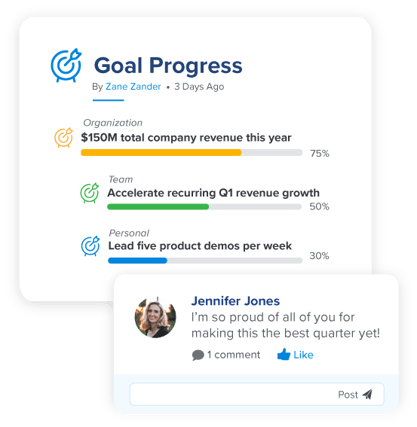
Performance goals are critical for achieving organizational objectives efficiently. Clear, aligned, and shared goals provide direction, foster accountability, and ensure work remains synchronized with organizational strategy. Look for goal management features such as:
- Goal Cascading: Aligning individual goals with team and company objectives.
- Progress Tracking: Visual indicators of goal achievement.
- Collaboration Tools: Enabling shared ownership and team goal setting.
- Performance Metrics Integration: Linking goals to measurable outcomes.
2. Ongoing 1-on-1s and Performance Reviews
Regular, documented performance conversations offer a comprehensive view of employee performance and significantly boost engagement.
.png?width=900&height=600&name=Essential-elements-of-employee-engagement-software_blog-image%20(2).png)
One-on-One Meetings
Managers require support to drive performance in ways that actively engage their teams. Employee-manager one-on-one meetings are ideal for discussing performance. Look for one-on-one meeting software that facilitates future-focused, transparent, two-way conversations with:
- Agendas and Notes: Structured discussions with clear takeaways.
- Action Item Tracking: Ensuring follow-through on commitments.
- Feedback Capture: Documenting ongoing performance insights.
- Development Discussions: Focusing on growth and career aspirations.
Performance Reviews
Performance evaluations should provide valuable context, focusing on engagement and growth. One in three employees consider actionable advice the most beneficial aspect of a review. Look for performance review software that powers accurate, easy, and actionable reviews with:
- Customizable Templates: Adapting to different roles and departments.
- Multi-Rater Feedback: Incorporating input from peers and stakeholders.
- Self-Assessments: Allowing employees to reflect on their own performance.
- Calibration Tools: Ensuring fairness and consistency in evaluations.
3. Real-Time Employee Recognition
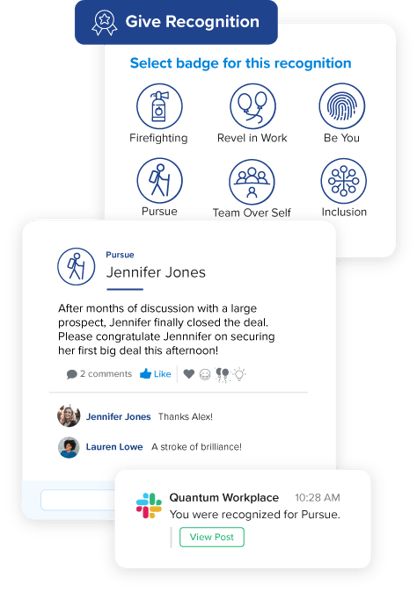
A significant majority of employees (69%) would work harder if recognized more effectively. Publicly acknowledging employees offers numerous benefits:
- Boosted Morale: Creating a positive and appreciative work environment.
- Reinforced Behaviors: Encouraging continued high performance.
- Increased Engagement: Making employees feel valued and connected.
- Improved Teamwork: Fostering a culture of mutual support.
However, only 37% of employees nationwide are satisfied with recognition and appreciation at work. Recognition software can help celebrate successes and engage teams across the organization. Look for employee recognition software that includes:

- Public Praise: Allowing colleagues to share appreciation.
- Peer-to-Peer Recognition: Empowering everyone to acknowledge contributions.
- Customizable Awards: Tailoring recognition to company values.
- Integration with Communication Channels: Seamlessly sharing recognition.
4. Feedback Collection and Sharing
Strong companies are built on trust, and trusting cultures are cultivated through feedback. A robust feedback culture correlates with a highly engaged workplace. The right software ensures teams receive the necessary feedback for success. Continuous feedback should be individualized, constructive, and unbiased. Choose a feedback tool that helps foster an organization-wide feedback culture, looking for:
- Continuous Feedback Capture: Enabling real-time input.
- 360-Degree Feedback: Gathering diverse perspectives.
- Sentiment Analysis: Understanding the tone and impact of feedback.
- Anonymity Options: Encouraging candid responses.
5. Vital Talent Metrics Tracking
Talent reviews enable informed, data-driven talent decisions by utilizing essential data points. These reviews should be frequent, unbiased, and data-rooted, allowing leaders to identify top performers, those ready for promotion, and individuals at risk of departure. Talent reviews help:
- Identify High Potentials: Recognizing employees with leadership capabilities.
- Assess Skill Gaps: Understanding development needs across the workforce.
- Inform Succession Planning: Building a pipeline for critical roles.
- Improve Retention Strategies: Proactively addressing flight risks.
Talent review tools can track these metrics and streamline the process. Look for features that simplify and streamline talent reviews, such as:
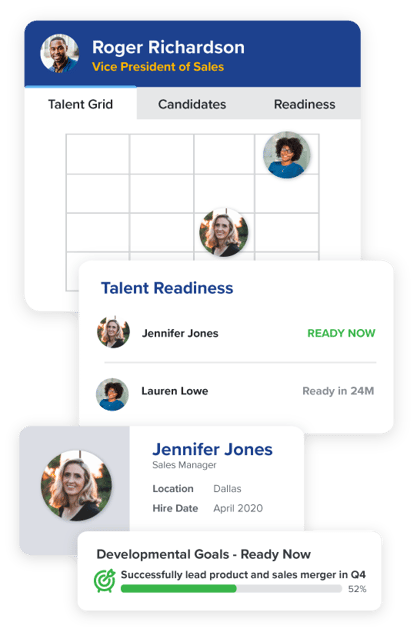
- Talent Matrix Visualization: Graphical representation of employee performance and potential.
- Data Dashboards: Consolidated views of key talent indicators.
- Skills Inventory Management: Tracking employee competencies.
- Development Plan Tracking: Monitoring progress on growth initiatives.
6. Identifying Top Talent and Developing Successors
Proactively identifying talent gaps minimizes business disruption and fosters a culture of growth. Visibility into critical roles and talent is the first step toward a robust succession planning strategy. This involves outlining the most important roles within the business, not just the C-suite, but also specialized or critical operational positions. Once visibility is established, targeted development pathways for talent can be created. Succession planning tools provide actionable reports on talent pipeline, readiness, and risk. If the performance management system is fully integrated, it allows for a quick understanding of:

- Talent Bench Strength: The pool of ready candidates for key roles.
- Development Needs: Areas where individuals require further training.
- Flight Risk Assessment: Identifying employees likely to leave.
- Diversity and Inclusion Metrics: Ensuring a balanced talent pipeline.
Look for succession planning software that offers:
- Talent Pipeline Visualization: Mapping out potential successors for key positions.
- Readiness Assessments: Evaluating the preparedness of individuals.
- Development Plan Integration: Linking succession needs to individual growth.
- Risk Analysis: Identifying potential leadership gaps.
Evaluating Performance Management Solutions: Key Questions
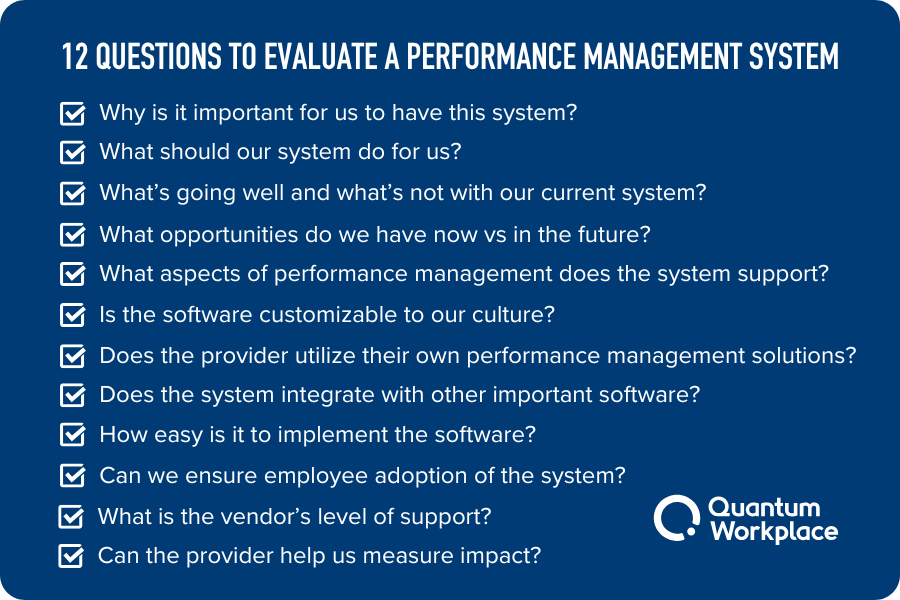
When selecting a performance management system, a thorough evaluation is crucial. Consider these questions to ensure the chosen solution meets your organization’s unique needs:
Big-Picture Evaluation Questions
- Why is staff performance management software essential for us? Understanding the core rationale behind adopting such a system is paramount. It helps articulate the business case and guide decision-making.
- What specific outcomes should our performance management system deliver? Identifying desired features and capabilities ensures the software aligns with your performance improvement goals, rather than just adding complexity.
- What is currently working well, and what are the key areas for improvement in our existing processes? Assessing current strengths and weaknesses helps in selecting a solution that addresses gaps and enhances existing successes. Employee engagement surveys can provide valuable insights here.
- What are our immediate and future opportunities for improvement through performance management? Look for solutions that address short-term needs (e.g., transitioning to continuous feedback) and support long-term strategic goals (e.g., leadership development, succession planning).
Software Evaluation Questions
- What specific aspects of performance management does the system support? Inquire about the system’s capabilities in goal setting, feedback, reviews, recognition, and development. Manager input is invaluable in identifying pain points and opportunities.
- Is the performance management software customizable to our culture? While structure is beneficial, flexibility is key. The software should accommodate your company’s unique culture and evolving needs. Look for personalization options like:
- Branding and design customization.
- Configurable workflows and templates.
- Customizable feedback prompts and review criteria.
- Does the developer utilize their own performance management software? A provider that uses its own tools demonstrates confidence in their product’s efficacy.
- Does the performance management software integrate with other systems? Seamless integration with existing HRIS and other relevant platforms minimizes administrative burden and ensures data consistency.
Service Evaluation Questions
- How easy is the implementation process for the performance management system? A straightforward implementation process facilitates buy-in from managers and employees. Look for strong customer support and resources to aid in adoption.
- Can we ensure manager and employee adoption of the system? Inquire about the vendor’s strategies for driving user adoption. The best systems are intuitive and provide inherent value, earning adoption organically. Consider free trials to assess user experience.
- What level of support does the vendor provide? Seek a vendor committed to ongoing support, from initial setup and implementation to ongoing coaching and problem-solving.
- Can the software provider help us measure impact? A high-quality performance management system should demonstrate its value through measurable improvements in key business metrics.
Comparing Performance Management Solutions
When choosing a performance management solution, it’s essential to understand the different types available:
- HRIS Solutions: While offering broad HR functionalities, HRIS platforms often have limited performance management features, making them less ideal for comprehensive strategies.
- Point Solutions: These are specialized tools designed specifically for performance management, offering advanced features and deep functionality.
- Basic Office/Google Tools: Free and accessible, these tools lack the sophistication, automation, and analytical capabilities required for effective, long-term performance management.
- Manual Spreadsheets: While low-cost, spreadsheets are time-consuming, prone to errors, and difficult to scale or analyze for actionable insights.
Leading Performance Management Systems for 2026
The market offers a range of robust performance management solutions. Here’s a look at some prominent platforms:

Quantum Workplace
Quantum Workplace is a talent management platform dedicated to empowering people leaders with the insights and tools needed to build thriving teams. It centralizes critical talent signals, enabling leaders to quickly identify and address gaps in the employee experience. Quantum Workplace’s performance management tools focus on building effective managers and teams, offering features like:
- Goal Management: Setting, tracking, and aligning individual and team objectives.
- Continuous Feedback: Facilitating ongoing dialogue and recognition.
- Performance Reviews: Streamlining the evaluation process.
- 1-on-1 Meetings: Supporting structured manager-employee conversations.
- Employee Recognition: Acknowledging contributions and achievements.
The company also provides comprehensive employee engagement and development tools. With over two decades of experience and a strong reputation for customer satisfaction, Quantum Workplace is a leading choice for organizations seeking to enhance their performance management strategies.
Lattice
Lattice is an AI-powered people platform designed to enhance manager effectiveness, streamline HR operations, and leverage workforce insights for business success. Users commend its intuitive interface, goal-tracking capabilities, and seamless integrations. However, some have noted limitations in customization and occasional complexities within features like OKRs.
Culture Amp
Culture Amp offers a platform for collecting and analyzing employee feedback, developing high-performing teams, recognizing success, driving development, and retaining talent. While praised for its user-friendly interface and feedback analysis capabilities, some users report challenges with navigation, limited customization, and a steep learning curve.

15Five
15Five’s performance management platform combines generative AI, custom analytics, and human-centered principles to help businesses and employees thrive. It offers tools for 360 reviews, engagement surveys, goal tracking, and manager development. While effective, some users have found customer support could be more responsive, and the platform can be extensive to set up.
PerformYard
PerformYard is a performance management tool geared towards small businesses, focusing on professional development and social empowerment. It serves as a centralized hub for managing review documents and processes. Reviewers appreciate its intuitive interface and customizable options, though some have noted navigation challenges and a potential for being too generic.
Leapsome
Leapsome is a people enablement platform that connects performance management, employee engagement, and learning. It provides tools for goals, performance reviews, development, surveys, and more. Users value its user-friendly interface and robust feedback mechanisms. However, some report a steep learning curve and limited reporting customization.
Transitioning to Continuous Performance Management
Performance management typically falls into two categories: traditional and continuous. While traditional methods often involve annual or semi-annual reviews focused on past performance, continuous performance management emphasizes regular feedback and positions managers as coaches. The ideal approach often involves striking a balance between the two.
Organizations looking to adopt a more continuous performance management strategy should:
- Prioritize Regular Check-ins: Schedule frequent, informal conversations.
- Emphasize Ongoing Feedback: Encourage real-time input from managers and peers.
- Focus on Development: Integrate growth opportunities into regular discussions.
- Leverage Technology: Utilize performance management software to streamline processes.
This evolution is an ongoing journey, and organizations should continually iterate and build upon successful practices.
Quantum Workplace’s Performance Pathways
Recognizing that a one-size-fits-all approach to performance management is ineffective, Quantum Workplace offers customizable "Performance Pathways." These frameworks are designed to help organizations launch effective programs without starting from scratch, catering to unique organizational characteristics and maturity levels in performance management.
By embracing modern performance management systems and adopting a continuous approach, organizations can transform their employee development strategies, foster a more engaged workforce, and ultimately drive greater business success.