Gloat, a recognized leader in skills intelligence and talent marketplace solutions, has made a significant strategic move this week, launching a comprehensive suite of AI Agents specifically designed for Human Resources. This bold entry signals a burgeoning competition for dominance in the core HR technology landscape, as established players and innovative newcomers alike race to harness the power of artificial intelligence to transform workforce management. Gloat’s offering, branded as Gloat Agentic HR, aims to empower organizations to rapidly develop AI agents that seamlessly integrate with existing enterprise systems and popular communication platforms.
The core of Gloat’s new platform is a toolset designed to leverage the intricate business rules and robust security protocols already in place within major HR systems such as Oracle, Workday, and SuccessFactors. By abstracting these foundational elements, Gloat enables the swift creation of AI agents capable of operating across a variety of environments, including Microsoft Copilot, Teams, Slack, and other emerging AI applications. This approach addresses a critical bottleneck in the adoption of AI within HR: the challenge of integrating intelligent automation with established, often complex, operational frameworks.
Understanding the Layers of Agentic AI in the Enterprise
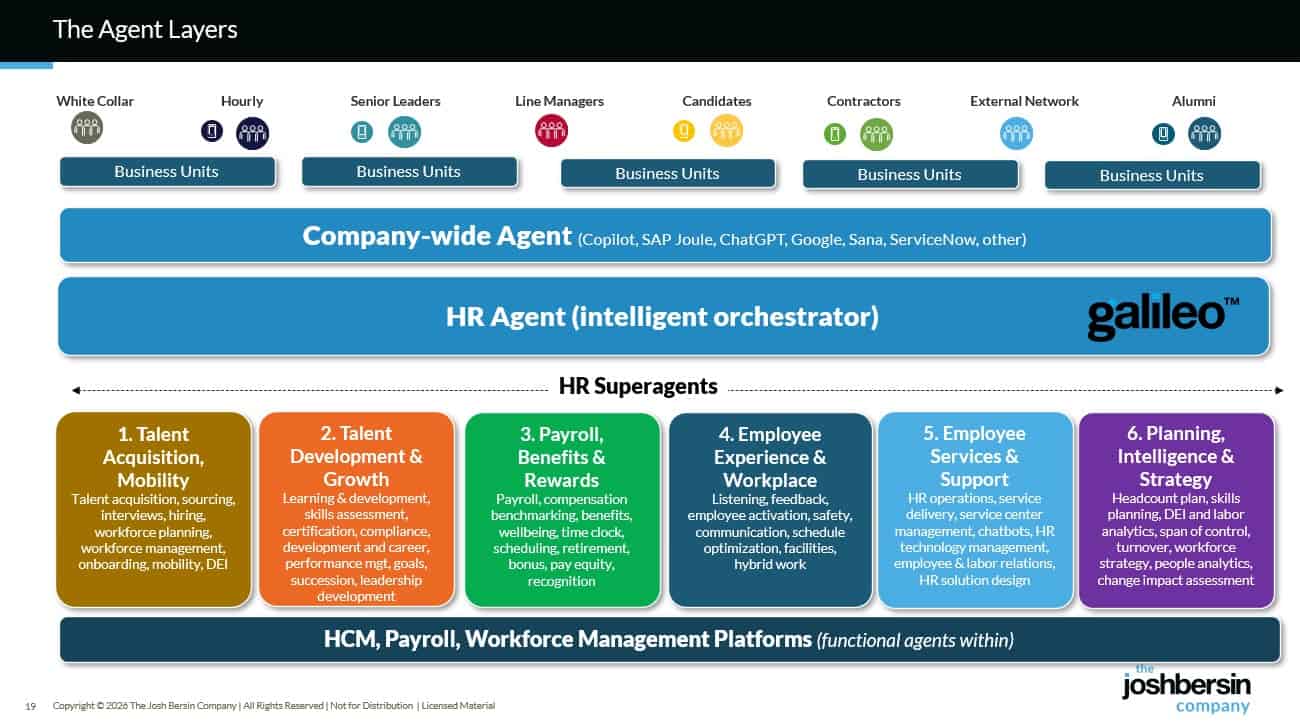
To fully grasp the significance of Gloat’s offering, it’s essential to understand the evolving architectural landscape of AI agents within the enterprise. This model can be broadly categorized into five distinct layers, each building upon the one below.
Systems of Record: The Foundation of Enterprise Data
At the base of this architecture lie the "systems of record"—the foundational applications that store, update, and maintain an organization’s critical data. These typically include Human Capital Management (HCM) systems like Workday, SAP, Oracle, and UKG, as well as broader Enterprise Resource Planning (ERP) systems. These platforms are built upon complex databases that house information encompassing financials, customer data, employee records, inventory, and product details. For decades, these systems have served as the single source of truth for core business operations.
Cross-System Applications and Employee Experience Platforms
The second layer comprises a vast array of cross-system applications. Recognizing that no single vendor can cater to every business need, organizations have historically developed or adopted numerous specialized applications. These range from time-tracking systems and Learning Management Systems (LMS) to Applicant Tracking Systems (ATS) and IT provisioning tools. The average large enterprise, it is estimated, utilizes over 400 such applications, with more than 100 directly impacting employee interactions.
In response to this complexity, particularly as systems migrated from on-premises to the cloud over the past two decades, a rich ecosystem of solutions has emerged. Companies like ServiceNow, a multi-billion dollar enterprise software provider, have carved out significant market share by offering platforms that manage and orchestrate these disparate systems for global organizations. Furthermore, the rise of employee experience platforms, including Microsoft Viva, Teams, Workvivo (Zoom), Firstup, and Staffbase, along with tools built on Google and Slack, has aimed to consolidate and enhance the employee journey. However, many of these platforms were not initially designed with the "agentic" capabilities that are now becoming paramount.
The Emergence of AI Agents
The third layer represents the new generation of AI agents. These are far more than mere portals or automated workflows; they possess an inherent intelligence about the user and can proactively perform tasks on their behalf. The HR technology space is now witnessing an influx of hundreds of agent tools, from agile startups to features embedded within enterprise systems, all focused on enabling the creation of cross-functional solutions for managing people.
Superagents: Orchestrating Intelligent Interactions
Crowning this architecture are "Superagents." These advanced tools are designed to stitch together and access various functional agents, creating a highly intuitive and seamless "walk-up-and-use" experience for employees and HR professionals alike. This layered approach is now seeing a rapid proliferation of development tools, including Sana (integrated with Workday), Oracle Agent Studio, Microsoft Copilot Studio, Leena.ai, and new agent capabilities from ServiceNow following its acquisition of MoveWorks. SAP is also entering the fray with Joule Studio, alongside foundational AI providers like Anthropic, OpenAI, and Google.
The Operational Realities of Agentic HR
While the potential of agentic AI in HR is undeniable, its practical implementation is fraught with complexities. The successful deployment of AI agents hinges on their ability to navigate and adhere to an organization’s intricate business rules, security protocols, and often legacy system constraints.
Consider a payroll reconciliation agent. While a vendor like Workday, SAP, or Oracle might offer such a tool designed to monitor payroll transactions and reconcile tax, time-card, employee movements, terminations, new hires, and pay adjustments, its effectiveness is contingent upon its "training" with a company’s specific rules and security parameters. Moreover, to perform more sophisticated tasks like monitoring pay equity or adjusting for performance, the agent must be able to interact seamlessly with other relevant agents and systems. This underscores the critical importance of a well-defined "agent architecture."
A compelling use case illustrates this complexity: imagine an organization aiming to redeploy 5,000 employees from existing roles to new positions within a rapidly evolving business landscape. An agent tasked with identifying suitable candidates would need to assess job fit, identify skill gaps, and evaluate redeployment potential before initiating large-scale layoffs or new hiring initiatives. Such an agent would necessitate communication with numerous other agents to gather and process information related to skills, job requirements, available training, geographical constraints, licensing, union agreements, and compensation bands. This intricate web of dependencies highlights the challenges and opportunities inherent in building sophisticated, context-aware AI agents.
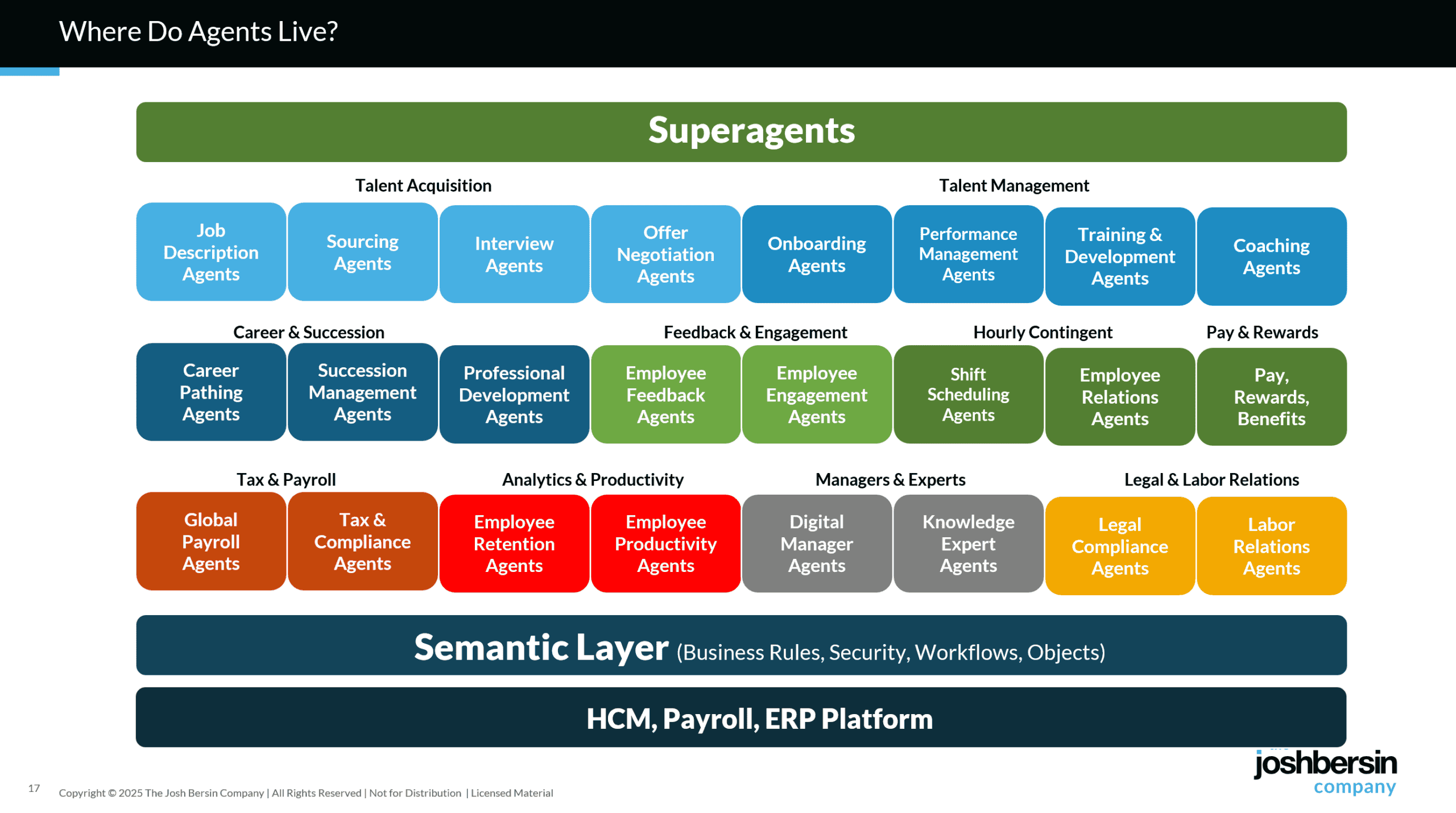
Common applications for these advanced agents extend to global onboarding, promotion processes, annual performance reviews and compensation cycles, talent acquisition, employee certification management, and time and schedule optimization, among many other HR functions.
The Competitive Landscape: The Battle for Enterprise Agent Dominance
The race to develop and deploy AI agents for HR is intensifying, with every major HR technology vendor actively participating. While some offerings are focused on simpler coaching tools, others are venturing into more complex, multi-functional capabilities. The larger vendors, particularly Workday, Oracle, SAP, and ServiceNow, are investing heavily in "AI Studios" to simplify the development and deployment of these agents.
However, the core battleground is not solely about acquiring or building individual agents. It is fundamentally about how these agents will be interconnected and orchestrated. This orchestration is inextricably linked to the management of an organization’s unique business rules, security frameworks, existing workflows, and critical business "objects." These objects, such as a company’s specific career framework or performance review model, represent the codified logic that drives its business and its value. As companies evolve, these rules and objects must adapt, and the ideal agent architecture should avoid hard-coding them. Instead, agents should dynamically access a "semantic layer" that maintains and updates this vital information.
The established HCM vendors already possess sophisticated semantic layers, such as Workday’s Business Process Framework, and are integrating them into their agent development tools. This integration is a crucial factor, as any HR agent or agent development tool will seek to leverage this rich repository of organizational logic. This development may even challenge predictions of a widespread "SaaSpocalypse," suggesting a future where integrated, intelligent platforms become even more valuable.
Gloat’s Strategic Intervention: Introducing Loomra and Agentic HR
Gloat’s entry into this competitive arena with Gloat Agentic HR is positioned as a way to liberate organizations from the constraints of legacy approaches. The company has developed an "agent-driven auto-discovery ‘injector’" named Loomra. This technology is designed to intelligently mine an organization’s existing HCM systems, extracting entities, workflows, and business rules. Crucially, Loomra continuously monitors these systems for changes, ensuring that the replicated rules and objects remain synchronized. This capability allows for the creation of applications and agents that are built upon a deep, up-to-date understanding of the organization’s operational DNA.
Gloat further enhances this offering with an intuitive agent builder. This visual tool enables users to construct custom agents that can be deployed directly into familiar environments like Microsoft Teams, Copilot, and Slack. Building on its existing expertise, Gloat has already developed pre-built agents for critical areas such as Workforce Redeployment, Career Development, Internal Talent Sourcing, Succession Planning, and Learning & Reskilling.
Workforce Context as a Differentiating Factor
A key differentiator for Gloat’s Agentic HR platform is the robust workforce context layer provided by Loomra. This engine is underpinned by nearly a decade of experience in analyzing enterprise-scale workforce data. It models skill adjacencies, career trajectories, organizational patterns, and inter-employee relationships across millions of individuals globally.
This deep contextual understanding allows Gloat’s agents to transcend simple information retrieval. Instead of merely answering queries like "show me employees who know Python," these agents can intelligently reason about which employees are best positioned to transition into AI engineering roles within the year, which teams face the most significant future skill gaps, and where talent can be most effectively redeployed as business priorities shift. This proactive, strategic capability is a significant leap forward from more basic AI functionalities.
Comparative Analysis: Gloat’s Position in a Crowded Market
Gloat’s approach presents a compelling proposition: organizations can bypass the often lengthy development cycles of their core HCM vendors and begin building sophisticated AI-driven HR solutions immediately. The open nature of the Gloat platform facilitates integration with other internal systems, and its context engine, powered by Loomra, appears to be a unique asset not yet replicated by most HCM vendors.
However, the market for agent tools is exceptionally competitive. Organizations deeply invested in specific ecosystems will likely lean towards solutions native to their platforms. ServiceNow users will gravitate towards ServiceNow’s agent capabilities, Workday customers towards Sana, Oracle users towards Oracle AI Studio, and SAP customers towards Joule Studio. Gloat faces the challenge of convincing potential clients that its tools offer superior ease of use, deeper integration, and more advanced context-awareness compared to their existing vendor options. As the enterprise landscape shifts from "systems of record" to "systems of context," Gloat’s ability to demonstrate the superiority of its contextual engine could prove pivotal.
Future Outlook and Industry Implications
The evolution of application development tools has historically followed patterns where companies adopt platforms that align with their existing infrastructure. Gloat’s new platform represents an innovative step forward in the agent industry, pushing the boundaries of what is possible with AI in HR. The success of Gloat’s strategy will likely depend on its ability to demonstrate tangible value and seamless integration to a broad range of enterprise clients, particularly those seeking to move beyond the limitations of traditional HR systems. As early customer adoption unfolds, detailed case studies and performance metrics will be crucial in shaping the narrative around Gloat’s impact on the future of work and HR technology. The company’s ability to bridge the gap between complex legacy systems and the promise of intelligent, agent-driven HR will be a key determinant of its long-term success.