
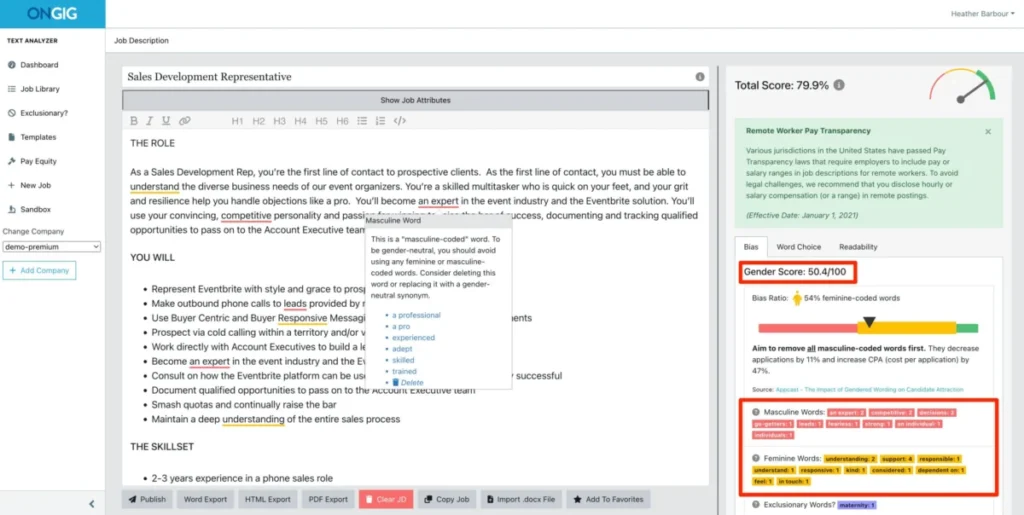
The ongoing effort to dismantle gender bias in the workplace has revealed a persistent challenge within the very first point of contact for many prospective employees: the job description. A recent analysis by Ongig’s Text Analyzer, covering data from January 1 to July 13, 2026, has identified a consistent pattern of masculine-coded language that inadvertently deters female candidates. This critical insight underscores the pervasive nature of unconscious bias and highlights actionable steps employers can take to foster more inclusive hiring practices.
The Pervasive Nature of Implicit Bias in Recruitment
Job descriptions, often seen as straightforward listings of responsibilities and qualifications, frequently harbor subtle biases that can significantly impact the diversity of applicant pools. These biases are rarely intentional; rather, they stem from ingrained language patterns and cultural associations that unconsciously favor certain demographics. Ongig’s Text Analyzer, an AI-powered tool designed to detect and suggest gender-neutral alternatives for biased language, has meticulously tracked user-accepted word swaps, providing a unique, real-time snapshot of the most problematic terms.
The data from the first half of 2026 unequivocally points to a handful of repeat offenders. The word "strong" led the list with 42 recorded swaps, indicative of its widespread use and masculine connotation when applied to skills or attributes. Following closely were "lead" (26 swaps) and "independently" (13 swaps), both terms that, while seemingly innocuous, contribute to an overall linguistic environment that can feel less welcoming to women. This phenomenon, often referred to as implicit or unconscious bias, means that recruiters and hiring managers, despite their best intentions, may inadvertently be repelling a significant portion of the talent pool.
Methodology: Unveiling Bias Through Real-Time Edits
The robustness of Ongig’s findings lies in its methodology. The data is not derived from a speculative sample or a third-party scrape but directly from the interactive use of the Text Analyzer. Every instance where a user accepted a suggested swap for a masculine-coded word was logged, creating a verifiable record of real edits made to actual job postings. This approach provides a dynamic and authentic representation of the language employers are actively working to remove from their recruitment materials in 2026.
This real-time data collection highlights a crucial point: employers are becoming increasingly aware of the subtle yet significant impact of language on diversity. The ability to identify and correct these biases through an automated tool empowers organizations to refine their job postings proactively, making them more appealing to a broader range of candidates, particularly women.
The "80/20 Rule" of Inclusive Language
Remarkably, the effort required to make a substantial difference in attracting more female candidates is not as daunting as it might seem. Experts suggest that focusing on a small number of frequently used masculine-coded words can yield significant results. In fact, Ongig’s analysis indicates that approximately 70% of job description gender bias can be mitigated by addressing just the top 10 most commonly used masculine terms. This "almost 80/20 rule" suggests that strategic, targeted interventions can have a disproportionately positive impact on diversity initiatives.
The implication is clear: simply by modifying a few key words, organizations can dramatically improve their appeal to women, opening up their talent funnels and fostering a more equitable hiring landscape. This is often described as the "easiest lever to pull" for organizations committed to increasing female representation.
The Top 10 Masculine-Biased Words in 2026 and Their Gender-Neutral Alternatives
Below is a detailed breakdown of the top 10 masculine-coded words most frequently swapped by Ongig Text Analyzer users between January and July 2026, along with suggested gender-neutral alternatives that can help create more inclusive job descriptions.
1. "Strong" (42 swaps)
This adjective is frequently used to describe desired skills or qualities, such as "strong communication," "strong written skills," or a "strong desire" for something. Its masculine coding often relates to physical prowess or unyielding determination.
- Gender-Neutral Alternatives: Effective, capable, proficient, robust, solid, impactful, excellent, well-developed.
2. "Lead" (26 swaps)
Commonly employed as a verb or noun to describe management, direction, or a primary role ("Lead sales," "Lead projects," "Project Lead," "Lead Developer"). This term can imply dominance or a solitary leadership style, which may resonate less with candidates who prioritize collaborative environments.
- Gender-Neutral Alternatives: Guide, manage, oversee, direct, coordinate, facilitate, spearhead, guide, principal, senior.
3. "Independently" (13 swaps)
Used to convey a candidate’s ability to work without constant supervision ("Must be able to work independently," "Manages priorities independently"). This term, like "independent," often emphasizes solo achievement over teamwork, which research suggests can be less appealing to female candidates.
- Gender-Neutral Alternatives: Autonomously, self-reliant, self-directed, with initiative, individually, proactively, resourcefully.
4. "Strengthen" (12 swaps)
A verb used to describe improving processes, teams, or outcomes ("Strengthen our client relationships," "Strengthen internal reporting processes"). It carries the same masculine-coded root as "strong."
- Gender-Neutral Alternatives: Enhance, improve, bolster, reinforce, optimize, build upon, fortify, consolidate.
5. "Competitive" (10 swaps)
Often used in the context of compensation or the caliber of candidates sought. Examples include "competitive salary" or "seeking a highly competitive individual." This word often invokes a win-lose dynamic that can be off-putting.
- Gender-Neutral Alternatives: Excellent, attractive, compelling, robust (for compensation), high-achieving, ambitious, driven, impactful, market-leading.
6. "Leaders" (10 swaps)
Used to describe desired hires or team structures ("We’re looking for future leaders," "Join a team of industry leaders"). Similar to "lead," it can subtly project an image of hierarchical, often male-dominated, structures.
- Gender-Neutral Alternatives: Innovators, strategists, key contributors, visionaries, principal roles, senior personnel, impactful individuals, trailblazers.
7. "Analyze" (9 swaps)
The verb form of "analysis," frequently appearing in job descriptions ("Analyze quarterly performance data," "Analyze customer feedback trends"). While seemingly neutral, its consistent appearance alongside other masculine-coded terms can contribute to a skewed perception.
- Gender-Neutral Alternatives: Evaluate, assess, examine, review, interpret, scrutinize, investigate, study, appraise.
8. "Champion" (8 swaps)
Used as a verb to describe advocating for initiatives or best practices ("Champion our DEI initiatives," "Champion change management efforts"). This word carries a competition-coded nuance, evoking a sense of fighting for a cause, which can be perceived as masculine.
- Gender-Neutral Alternatives: Advocate, promote, support, uphold, foster, drive, endorse, advance, facilitate.
9. "Analysis" (7 swaps)
The noun form, used in various contexts ("Make recommendations based on detailed analysis," "Provide qualitative analysis," "Conduct data analysis"). Its inclusion here reflects a broader pattern with its verb counterpart.
- Gender-Neutral Alternatives: Evaluation, assessment, examination, review, interpretation, scrutiny, investigation, study, appraisal.
10. "Independent" (7 swaps)
Similar to "independently," this adjective describes a candidate who works well alone or without supervision ("Seeking an independent, driven individual," "Be comfortable working independently"). It implies solo achievement over collaboration, which some research links to lower appeal for female candidates.
- Gender-Neutral Alternatives: Self-sufficient, autonomous, self-starter, proactive, resourceful, individual contributor, self-motivated, diligent.
The Broader Context of Gender Inequality in Hiring
Eliminating gender bias from job descriptions is a crucial step, but it operates within a larger ecosystem of gender inequality in employment. This inequality manifests at every stage, from initial recruitment to career progression, parental leave policies, and leadership opportunities. While employers cannot single-handedly dismantle systemic gender inequality, they bear a significant responsibility to eliminate prejudice, bias, and discrimination within their own hiring processes.
Even if an HR team receives extensive training in gender bias, individual hiring managers, who may lack similar training or buy-in, can inadvertently undermine these efforts. This highlights the need for consistent, organization-wide commitment and the deployment of tools that provide immediate, actionable feedback. Job descriptions, as the initial point of contact, serve as a critical gatekeeper, subtly communicating an organization’s values and culture. An imbalance of gendered language, particularly a preponderance of masculine-coded terms, can send unintended signals that an inclusive workplace is not a priority.
Academic and Industry Research Reinforce the Imperative
The impact of gender-coded language is not merely anecdotal; it is substantiated by robust academic and industry research. Lightcast, a prominent labor market data provider, in partnership with UNESCO, conducted an extensive analysis of job postings across six countries. Their findings revealed a direct correlation between masculine-coded language and lower female employment rates, particularly in senior and STEM roles. Significantly, two terms flagged by Lightcast as highly problematic – "lead" and "independent" – also feature prominently in Ongig’s 2026 top swap list, reinforcing the consistency of these biases across different analytical frameworks.
Further underscoring this point, a seminal 2025 study published in PNAS, which examined nearly 38,000 applicants across four separate studies, provided compelling empirical evidence. The study demonstrated that the deliberate substitution of masculine-coded words with gender-neutral alternatives measurably increased application rates among women. Moreover, this inclusive language also attracted more male applicants who did not strongly identify with traditional masculine traits, suggesting a broader appeal to diverse personality types.
These studies collectively highlight the dual benefit of bias-free language: it not only attracts a more diverse pool of candidates but also enhances the overall quality and fit of applicants by appealing to a wider spectrum of talent.
Implications for Employers: Building a Diverse and High-Performing Workforce
For employers, the implications of these findings are profound. Investing in inclusive language is not merely an ethical imperative; it makes sound business sense. By removing biased language, organizations can:
- Expand Talent Pools: Attract a greater number of qualified female candidates, who might otherwise self-select out due to unconsciously biased language.
- Enhance Diversity: Foster more diverse teams, which are consistently linked to increased innovation, improved problem-solving, and better financial performance.
- Streamline Hiring: Reduce the time and resources spent on recruitment by attracting a larger, more relevant applicant pool from the outset.
- Boost Employer Brand: Project an image of an inclusive, forward-thinking organization committed to equity, which is increasingly vital in attracting top talent.
- Improve Employee Engagement: An inclusive hiring process often signals an inclusive workplace culture, leading to higher retention and engagement among all employees.
The financial and operational benefits of a diverse workforce are well-documented. Companies with greater gender diversity on executive teams are significantly more likely to outperform their less diverse counterparts. Job descriptions are the first gateway to achieving this diversity.
The Indispensable Role of AI in DEI Efforts
The complexity and sheer volume of job postings across organizations make manual review for unconscious bias a daunting, if not impossible, task. This is where AI-powered tools like Ongig’s Text Analyzer become indispensable. By automatically flagging problematic language and suggesting gender-neutral alternatives, these tools offer an efficient, consistent, and scalable solution for ensuring inclusive job descriptions.
Such technology democratizes the process of creating bias-free content, enabling every recruiter and hiring manager to contribute to diversity, equity, and inclusion (DEI) goals, regardless of their personal expertise in linguistic bias. It provides immediate feedback, allowing for real-time corrections and continuous improvement in recruitment communications.
Conclusion: A Continuous Journey Towards Equity
The 2026 data from Ongig’s Text Analyzer serves as a crucial reminder that the journey towards gender equity in the workplace requires continuous vigilance and proactive measures. While systemic issues demand broader societal changes, employers hold the power to eliminate prejudice and discrimination within their immediate spheres of influence, starting with the very first words candidates read.
Promoting job titles and listings written with inclusive language is more than just a gesture; it is a tangible commitment to dismantling gender stereotypes and demonstrating a readiness to hire qualified women. By embracing tools and practices that identify and correct unconscious biases, organizations can unlock a vast reservoir of talent, foster innovation, and build truly equitable and high-performing teams for the future. The simple act of swapping a few words can have a profound and lasting impact on the diversity and success of any organization.






