

The Strategic Imperative: Navigating the Rise of AI Strategy Consulting in the Modern Enterprise has become a focal point for global organizations as they transition from experimental pilot programs to full-scale digital transformation. As Artificial Intelligence (AI) matures from a speculative technology into a boardroom priority, a significant gap has emerged between corporate ambition and operational readiness. This disconnect has fueled a surge in the AI strategy consulting market, a sector now tasked with helping leadership teams prioritize multi-million dollar investments while navigating a landscape fraught with technical complexity and regulatory risk.
According to recent industry benchmarks, while over 80% of CEOs believe AI will significantly impact their industry, fewer than 25% report having a clear, actionable strategy for deployment. This discrepancy has moved the conversation away from simple tool acquisition toward comprehensive advisory services. Organizations are no longer looking for "AI developers" in isolation; they are seeking strategic partners who can align technological capabilities with measurable business outcomes, such as productivity gains, cost reduction, and the discovery of new revenue streams.
The Evolution of the AI Advisory Market
The current demand for AI strategy consulting is a direct response to what many analysts call "pilot purgatory"—a state where companies launch numerous small-scale AI projects that fail to scale or deliver significant return on investment (ROI). In the early 2020s, the focus was primarily on generative AI and large language models (LLMs). However, by 2024, the market shifted toward "Industrialized AI," where the emphasis is on integration, data governance, and organizational change.

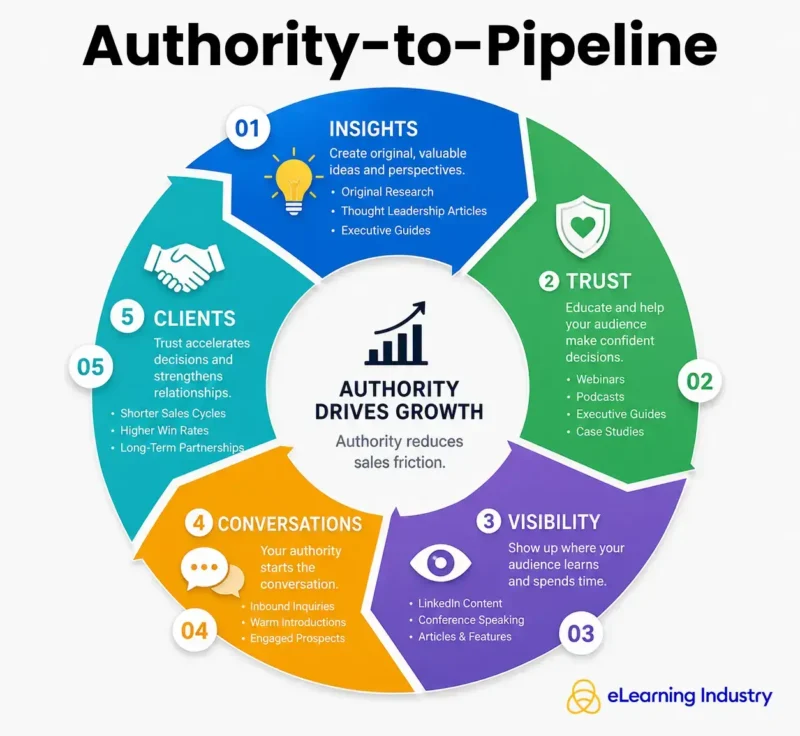
Consulting firms that are successfully capturing this market share are those moving beyond technical jargon. Market data suggests that executive buyers are increasingly skeptical of firms that lead with technology. Instead, the most successful engagements are built on three pillars: business-centric positioning, repeatable methodologies, and established authority. The role of the consultant has evolved from a technical implementation partner to a strategic architect who must balance the "art of the possible" with the "reality of the profitable."
A Chronological Framework for AI Integration: The ALIGN Methodology
To bring order to the chaotic pace of AI development, leading consultancies have adopted structured frameworks to guide organizations through the transformation lifecycle. One such approach, the ALIGN framework, illustrates the typical chronology of a strategic engagement:
Phase 1: Assessment of Business Maturity
The process begins with an objective evaluation of an organization’s current state. This includes auditing data quality, technology infrastructure, and leadership commitment. Analysts note that technical infrastructure is rarely the primary bottleneck; rather, it is often organizational culture and a lack of clear ownership that stall progress.
Phase 2: Locating High-Value Use Cases
In this stage, consultants work to separate "hype" from "utility." While departments like marketing may push for content automation, finance may require predictive forecasting. Strategy consultants act as arbiters, evaluating these competing interests based on implementation feasibility and potential business impact.
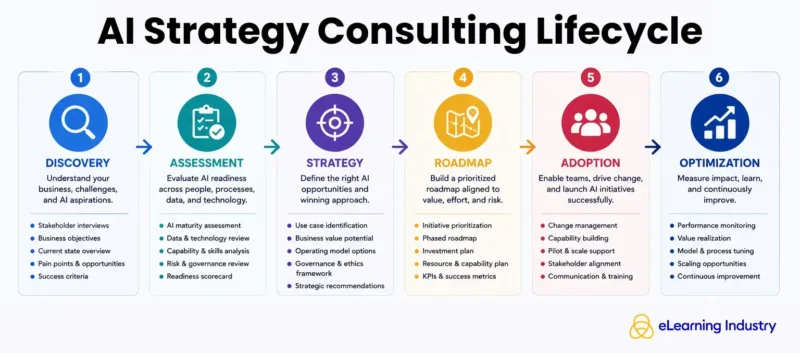
Phase 3: Identifying Risk and Governance Needs
As global regulations, such as the EU AI Act, begin to take effect, governance has moved to the forefront of the strategy. This phase involves establishing protocols for data privacy, security, and ethical decision-making. Consultants are now required to provide legal and compliance frameworks that ensure AI adoption does not result in reputational or financial liability.
Phase 4: Generating the Strategic Roadmap
The roadmap serves as a multi-year blueprint, sequencing initiatives to ensure early wins build momentum for larger transformations. This prevents "resource exhaustion" and allows organizations to measure progress against defined milestones.
Phase 5: Navigating Implementation and Adoption
The final stage focuses on the human element. Industry reports consistently show that the greatest barrier to AI success is employee resistance. Strategy consultants are increasingly providing change management services, including AI literacy programs and executive coaching, to ensure the workforce is prepared to collaborate with new technologies.
Supporting Data: The Economic Impact of Strategic AI
The financial stakes of AI strategy are substantial. IDC reports that global spending on AI, including software, hardware, and services, is expected to surpass $300 billion by 2026. Furthermore, McKinsey & Company estimates that generative AI could add the equivalent of $2.6 trillion to $4.4 trillion annually to the global economy.
However, the "cost of failure" is equally significant. Research indicates that organizations without a centralized AI strategy spend up to 40% more on fragmented technology stacks and redundant vendor contracts. By centralizing the strategy through expert consulting, firms can reduce these inefficiencies while accelerating their time-to-market.
Shift in Service Packaging and Pricing Models
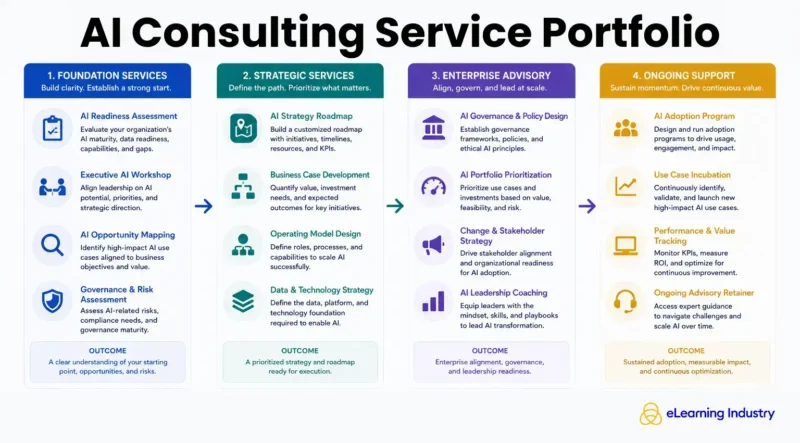
The consulting industry itself is undergoing a transformation in how it sells and prices AI expertise. The traditional model of open-ended, hourly billing is being replaced by fixed-scope, outcome-based engagements. Common service packages now include:
- AI Readiness Assessments: Fixed-fee audits that provide a "maturity score" and a gap analysis.
- Executive Workshops: High-impact, short-term sessions designed to educate the C-suite on strategic implications.
- Advisory Retainers: Monthly subscriptions that provide leadership teams with ongoing access to a "Fractional Chief AI Officer."
- Value-Based Pricing: A model where consulting fees are tied directly to the cost savings or revenue growth generated by the AI initiatives.
This shift toward transparency and accountability reflects a maturing market where buyers are more sophisticated and demand clear evidence of value before committing to long-term partnerships.
Official Responses and Industry Sentiment
The prevailing sentiment among industry leaders is one of cautious optimism tempered by the need for discipline. In various white papers and executive forums, CEOs of major consulting firms have emphasized that AI is not a "plug-and-play" solution.
"The challenge for most companies isn’t the technology itself; it’s the integration of that technology into a legacy business model," noted one senior partner at a Tier-1 global advisory firm. "Strategy consulting is the bridge that allows a company to move from a 20th-century operating model to a 21st-century AI-driven enterprise."
Similarly, technology providers are increasingly partnering with strategy firms. Platforms like Microsoft, Google, and AWS have recognized that their software is only as effective as the strategy behind its deployment. These "strategic alliances" are becoming a hallmark of the industry, creating a specialized ecosystem where software and strategy are sold as a unified solution.
Broader Impact and Future Implications
Looking ahead to the 2025-2030 period, AI strategy consulting is expected to move into specialized verticals. While the current market is dominated by generalist firms, the future belongs to "Industry-Specific AI Advisors" who understand the unique data constraints and regulatory environments of sectors like healthcare, aerospace, and global finance.
The implications for the global workforce are also profound. AI strategy is no longer just about automation; it is about "augmentation." Consultants are increasingly tasked with redesigning job roles and organizational structures to accommodate a hybrid workforce of humans and machines. This shift will likely lead to a massive re-skilling effort, with AI literacy becoming a foundational requirement for all corporate roles.
Furthermore, the rise of "Responsible AI" will likely see consultants taking on a role similar to environmental, social, and governance (ESG) auditors. As consumers and regulators demand transparency in how AI models are trained and deployed, strategy firms will be responsible for certifying that a company’s AI initiatives are ethical, unbiased, and sustainable.
Conclusion
The emergence of AI strategy consulting represents a critical maturation point for the digital economy. As organizations move past the initial excitement of generative AI, the focus has turned to the hard work of structural transformation. By prioritizing business outcomes over technical novelty, following repeatable methodologies, and addressing the critical pillars of governance and adoption, these consulting services are providing the roadmap for the next era of global business.
For the modern enterprise, the question is no longer whether to adopt AI, but how to do so in a way that is strategic, responsible, and economically viable. In this high-stakes environment, the AI strategy consultant has become an indispensable navigator for the boardroom, turning the potential of artificial intelligence into the reality of business performance.






