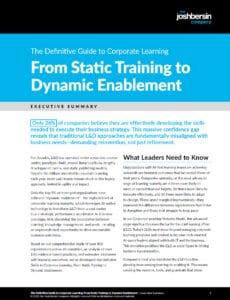
The corporate learning landscape is undergoing a seismic shift, moving away from traditional, static training models towards dynamic, AI-powered content and enablement solutions. This transformation, detailed in the recent release of "The Definitive Guide to Corporate Learning," signals a rapid evolution in how organizations approach employee development. The vendor market is responding with unprecedented speed, introducing a wave of innovative tools designed to harness the power of artificial intelligence. For HR leaders and Chief Learning Officers (CLOs), understanding this burgeoning ecosystem is crucial for navigating the future of workforce development.
The core promise of AI in corporate learning lies in its ability to personalize, automate, and enhance the learning experience. Key use cases emerging include: dynamic content generation that adapts to individual needs, AI-powered coaches and simulation scenarios offering realistic practice environments, AI-fueled needs analysis to pinpoint skill gaps precisely, and the creation of AI-generated skills models and assessments. Furthermore, AI is enabling entirely new learning paradigms through "Supertutors," sophisticated chatbots, conversational interfaces, and personalized AI-generated learning journeys.
The inherent adaptability and data-processing capabilities of AI make learning and enablement a particularly fertile ground for its application. The vision of a personal AI agent—one that possesses a deep understanding of an individual’s role, experience level, and career aspirations, continuously updated with relevant information—is no longer a distant concept; it is becoming a present reality. This signifies a move towards a proactive, always-on learning environment, fundamentally changing the way employees acquire and apply knowledge.
However, this technological revolution is unfolding against a backdrop of significant legacy investment. An estimated $4 billion has been invested in traditional Learning Management Systems (LMS), extensive content libraries, and established content development tools. Millions of professionals are skilled in delivering training within the pre-AI framework. The challenge for many organizations lies in bridging this gap, integrating new AI capabilities with existing infrastructure and upskilling their workforce and leadership to embrace these changes.
Navigating the Evolving Vendor Landscape: End-to-End Learning Platforms
The Learning Management System (LMS) sector, long the cornerstone of corporate training delivery, is at the forefront of this AI integration. Several vendors are spearheading this transition, offering platforms designed for the AI-driven era.
Sana, a partner with Galileo and Galileo Learn, is emerging as a key player, focusing on AI-native solutions. Docebo has undertaken a comprehensive AI integration across its entire suite, encompassing content development, coaching, simulations, and administrative functions. Cornerstone OnDemand has launched "Galaxy," an AI-fueled system designed for skills-based learning and talent management, with further AI enhancements anticipated. Arist, a rapidly growing vendor, leverages AI for needs assessment and content generation. Uplimit offers an AI-native platform specifically designed for high-stakes technical training, incorporating numerous scalable AI features. 360Learning is integrating AI for content generation, an AI companion, automated assessments, and adaptive learning pathways. Disprz positions itself as an AI-native, end-to-end learning platform with advanced dynamic content development capabilities. These companies, alongside many others, are pushing the boundaries of what traditional LMS platforms can offer.
The critical architectural shift for LMS vendors is the move towards dynamic content models, moving beyond the limitations of the SCORM standard. Organizations with existing LMS solutions are being urged to evaluate their vendors’ commitment and capability to make this transition. While smaller vendors may face challenges in undertaking such a significant architectural overhaul, the pace of innovation is relentless. The user experience offered by AI-native platforms is often so compelling that a return to older systems becomes highly improbable. While large players like Coursera are exploring integrations with AI powerhouses such as OpenAI, their primary focus remains broader than the specific needs of a dedicated corporate learning platform.

The Revolution in AI-Powered Content Creation and Delivery
Beyond the platform itself, the nature of learning content is also being redefined. The traditional approach of developing static courses is giving way to dynamic, intelligent content that can be personalized and accessed contextually.
Major content providers, including LinkedIn Learning, Coursera-Udemy, Skillsoft, Pluralsight, and Degreed, are actively incorporating AI. These platforms are using AI to summarize existing courses, provide live Q&A capabilities integrated with their content libraries, and offer a "CoPilot" experience that enhances access, learning, and ease of use. This integration allows for "Learning in the Flow of Work," ensuring that employees can access relevant information and training precisely when and where they need it, even if their entire course library has not yet been converted to AI-generated content.
The future of the content market is expected to evolve into "content intelligence platforms." Providers like Galileo are at the forefront of this shift. Users will access this vast repository of knowledge through vendor-specific AI agents, their own personalized agents, or even a "super-agent" orchestrating multiple AI assistants. The laborious process of course building is increasingly being automated by AI, allowing vendors to focus on curating world-class content, meticulous labeling, and the development of robust competency models. Companies that previously focused on "course building" are now positioning themselves as "expertise curators," unlocking the potential of their content through AI-driven platforms.
Emerging players like Attensi are offering end-to-end AI-assisted training and content creation. Furthermore, AI-powered avatars, such as those provided by Colossyan, and core AI tools from companies like HeyGen, which specialize in image, video, and audio generation, are finding significant applications within the Learning and Development (L&D) market.
AI-Driven Assessments: Redefining Proficiency Measurement
A third significant area of innovation lies in AI-fueled assessment methodologies. Traditional testing and certification models are being challenged by dynamic, adaptive assessment tools that can accurately measure skills and guide targeted learning.
CodeSignal exemplifies this trend by using AI to create dynamic assessments for skills evaluation, personalized learning, and recruitment. This burgeoning market is poised to disrupt conventional test-based certifications and pre-hire assessments. These AI systems can be trained on specific organizational needs, products, or company knowledge, generating comprehensive experiences that include tests, exercises, simulations, and feedback to foster proficiency. Pluralsight is enhancing its "Skill IQ" assessments, and Skillable, a leader in learning labs, is also adopting similar approaches. Platforms like HackerRank are moving in this direction, and the inherent capabilities of Large Language Models (LLMs) further facilitate this evolution.
Leading assessment providers like SHL, which has a long-standing reputation in pre-hire and developmental assessments, are well-positioned to capitalize on L&D opportunities. Their existing testing models can be leveraged by AI to understand and reuse for learning purposes. SHL’s partnership with Galileo, utilizing their Universal Competency Framework, underscores this synergistic potential.

Galileo itself, trained on extensive research and maturity models, can engage users with "agentic prompts" to assess individual or organizational maturity, generate development plans, and benchmark skills against a vast corpus of job, skills, and HR-related information. This represents a significant leap forward in personalized developmental feedback and planning.
AI-Powered Skills Intelligence: Mapping and Developing Workforce Capabilities
The complex domain of skills intelligence is also being revolutionized by AI. While numerous vendors offer skills-related solutions, the market is consolidating around platforms that can granularly assess employee skills. Companies such as Eightfold, Findem, Maki People, Seekout, Lightcast, and Draup, primarily known for their recruiting and internal mobility solutions, are now applying their AI capabilities to L&D. This has spurred the development of comprehensive solutions from vendors like Gloat, Fuel50, and 365 Talents.
Vendors like Skyhive (now integrated into Cornerstone Galaxy) and Techwolf are using AI to infer skills by analyzing both external and internal data sources. Increasingly, these platforms are integrating with learning systems to create a seamless link between skills identification and development opportunities. Docebo’s acquisition of 365 Talents highlights this trend, enabling large enterprises like SNCF and Airbus to assess organizational skill gaps and immediately identify relevant learning resources. Cornerstone’s integration with Skyhive and Sana’s AI-native approach, which tracks user activity to gauge skill proficiency, further illustrate this convergence.
AI-powered career development platforms are also leveraging static career models to create AI-enabled pathways. Guild, with its recent launch of "Guild Navigator," is a notable leader in this space. Gloat, Fuel50, SAP, Workday, and Eightfold offer capabilities that infer skills from resumes and present employees with AI-updated career opportunities. The development of dedicated "Career Navigator" tools for HR departments signifies the growing importance of AI in guiding employee career progression.
The Rise of Dynamic Enablement and AI-Powered Search
Perhaps one of the most impactful applications of AI in corporate learning is the emergence of dynamic enablement, often powered by sophisticated AI-driven search capabilities. The traditional challenge of finding immediate answers to novel problems in real-time is being addressed by systems that can provide instant, contextual support.
Imagine a customer service representative encountering an unprecedented issue. Instead of searching through a vast library of static courses, they can simply ask a question and receive an immediate, accurate answer, potentially accompanied by a relevant video. This "dynamic enablement" is becoming readily achievable with AI-native platforms and well-designed AI copilots. By indexing diverse content such as videos, call recordings, and internal documentation, organizations can enable employees to learn from real-world problem-solving scenarios dynamically. This capability is particularly transformative for sales training, new company rollouts, product launches, and the constant stream of real-time information updates that employees need to stay abreast of.
Employee enablement has historically fallen outside the purview of L&D, often residing within IT, Sales, or Support departments. However, AI-powered learning platforms are now enabling L&D to take ownership of this critical function. By storing company documents, business-relevant recordings, and other information, these platforms empower local business teams to manage their own enablement resources. This decentralization frees L&D from providing constant local support and contributes to the development of what could be termed a "digital twin" of the organization—where the collective knowledge of individuals is accessible to others.
The concept of the "digital twin" in this context refers to an organizational intelligence layer built upon the company’s digital footprint, including emails, internal documents, meeting recordings, sales calls, and customer interactions. By feeding this data into an AI platform, employees can query it for information, receiving answers derived from the organization’s collective experience. While this category is still emerging and may require a more defined nomenclature, solutions like Glean are already demonstrating its power in the IT sector. L&D leaders are likely to leverage platforms like Sana or Docebo to build similar organizational intelligence capabilities.
The traditional pace of creating new training materials—podcasts, courses, or videos—in response to evolving business needs is often too slow. AI-powered enablement promises to make knowledge and information immediately accessible, transforming how quickly organizations can disseminate critical updates and best practices. Major technology companies like Microsoft and Google are actively investing in these areas, indicating a significant shift in the enablement paradigm.
Enduring Fundamentals in a New Era
Despite the rapid advancements in AI, certain fundamental principles of employee development remain critical. Compliance training, onboarding for new hires, leadership development programs, and foundational "new to the job" instruction will continue to require structured, formal learning experiences. The expertise in learning design developed over years remains valuable.
However, the tools available for delivering these foundational elements are becoming spectacular. The ability to create dynamic learning experiences, deliver personalized content, and implement robust enterprise search platforms represents a significant evolution. Organizations are strongly encouraged to engage with their existing L&D vendors to understand their AI roadmaps. If a vendor demonstrates a lack of speed or agility in adapting to these AI-driven changes, it may be time to explore alternative solutions.
For organizations embarking on this transformation, seeking expert guidance can accelerate the process. Many firms now offer services to help companies re-evaluate and redesign their L&D strategies for the AI era. Similarly, vendors seeking to refine their strategic direction or marketing approaches in this dynamic market can also find valuable support. The integration of AI into corporate learning is not merely an upgrade; it is a fundamental reinvention that promises to unlock unprecedented levels of employee performance and organizational agility.