The U.S. Equal Employment Opportunity Commission (EEOC) concluded its 2025 fiscal year on September 30 by recording its lowest level of litigation activity in a decade, a development that marks a dramatic departure from the aggressive enforcement posture seen in recent years. With only 93 merit lawsuits filed throughout the fiscal year, the Commission has signaled a significant cooling of its litigious engines, influenced heavily by unprecedented leadership changes, budgetary constraints, and a fundamental realignment of agency priorities under the Trump administration. This total represents not only a ten-year low but also one of the quietest periods for the agency in the last thirty years, standing in stark contrast to the 144 lawsuits filed as recently as fiscal year 2023.
A Turbulent Year for Agency Leadership and Structure
The trajectory of fiscal year 2025 was largely dictated by the political shifts following the 2024 presidential election. Upon taking office in January 2025, President Trump moved with unexpected speed to reshape the Commission’s top brass. In a move that tested the traditional constitutional limits of presidential power over independent agencies, the President terminated EEOC Commissioners Charlotte Burrows and Jocelyn Samuels, despite both having significant time remaining on their appointed terms. Simultaneously, General Counsel Karla Gilbride was removed from her post, and Commissioner Andrea Lucas was elevated to the position of Acting Chair.
These maneuvers left the EEOC without a quorum, a state of existence that has profound legal implications for the agency’s ability to initiate high-impact litigation. Under federal law, the absence of a quorum restricts the General Counsel’s authority to filing "routine" cases. The agency is generally barred from initiating systemic discrimination suits, pattern-or-practice litigation, or cases involving major expenditures of agency resources and unsettled areas of law without a full Commission vote. Consequently, the 93 filings of FY 2025 were characterized by a narrower scope, focusing largely on individual claims rather than the broad, industry-altering class actions that defined the Obama and early Biden eras.
Historical Context and the Fiscal Year 2025 Timeline
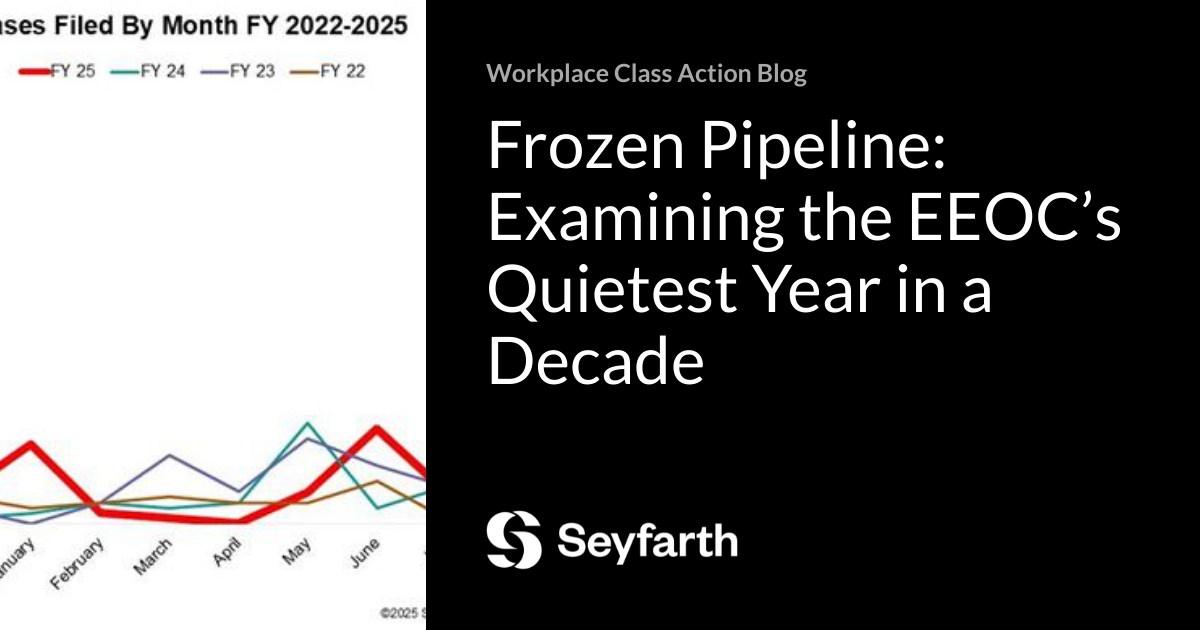
To understand the significance of the 93 filings in FY 2025, one must look at the fluctuations of the past five years. In FY 2020 and FY 2022, the Commission filed 94 merit lawsuits, numbers that were then considered low due to the impacts of the COVID-19 pandemic and the transition between administrations. However, FY 2023 saw a massive surge to 144 filings after the Biden administration secured a Democratic majority and a bolstered budget. While FY 2024 showed an initial dip to 96 filings, the drop to 93 in FY 2025 confirms a sustained downward trend in volume.
The timing of the filings within the 2025 fiscal year also tells a story of administrative transition. The Commission began the year with unusual speed, filing 24 lawsuits in the first four months. January 2025 alone saw 15 filings, a spike that legal analysts suggest was a "last-minute" push by outgoing enforcement personnel to get cases onto the docket before the change in administration on January 20. Following the leadership transition, activity leveled off until June, which saw a five-year high of 18 filings for that month. However, the traditional "September Surge"—where the EEOC typically files a massive portion of its annual cases to meet year-end goals—was noticeably muted. The 35 lawsuits filed in September 2025 pale in comparison to the 56 filed in September 2024 and the 71 filed in September 2023.
Geographic Shifts: The Rise of the Midwest and the Quiet West Coast
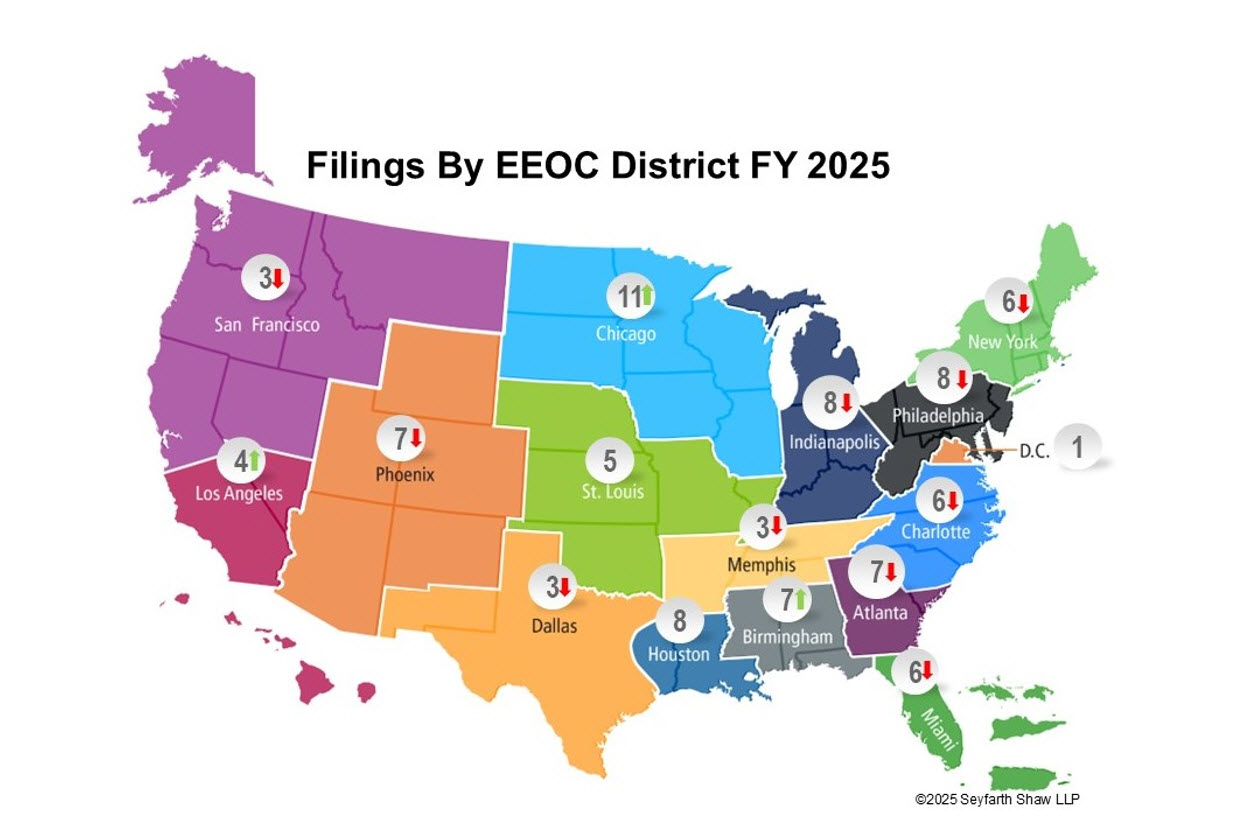
The geographic distribution of EEOC lawsuits in FY 2025 revealed a shifting map of enforcement priorities. The Chicago District Office emerged as the nation’s leader, filing 11 merit lawsuits. This return to form for the Chicago office was supported by active filing schedules in Philadelphia, Indianapolis, and Houston, each of which recorded 8 filings. These districts have consistently remained the most aggressive outposts for the Commission over the last several years.
In contrast, the West Coast offices, which were once the vanguard of EEOC litigation, remained uncharacteristically silent. The Los Angeles, New York, and San Francisco districts—offices that during the Obama administration would routinely file dozens of cases annually—filed only 4, 6, and 3 lawsuits, respectively. This decline in West Coast activity suggests a strategic withdrawal from regions that typically focus on complex, systemic cases, reflecting the current limitations imposed by the lack of a Commission quorum.

Priorities in Transition: From Gender Identity to Religious Freedom
Perhaps the most striking aspect of the FY 2025 data is the shift in the types of discrimination being targeted. While Title VII and the Americans with Disabilities Act (ADA) remain the primary vehicles for EEOC litigation, the underlying theories of these cases have evolved.
The ADA and Mental Health focus
The ADA remained a top priority with 34 filings. Even as total litigation volume fell, disability-related suits remained steady, actually outpacing the numbers from FY 2022. A notable trend within these filings is the focus on "invisible" disabilities. The EEOC increasingly targeted employers for failing to accommodate mental health conditions such as depression, anxiety, and PTSD, as well as hearing and vision impairments.
Pregnancy and the PWFA
The implementation of the Pregnant Workers Fairness Act (PWFA) has provided the EEOC with new teeth. In FY 2025, the Commission filed 10 lawsuits specifically related to pregnancy discrimination or failures to accommodate under the PWFA. When combined with general sex-based claims, this category accounted for 37 cases, making it a cornerstone of Acting Chair Lucas’s enforcement agenda.
The Pivot on LGBTQ+ Issues
Under the new leadership, the EEOC has performed a sharp U-turn regarding LGBTQ+ workplace protections. In early 2025, Acting Chair Lucas issued a statement asserting that "biological sex is real" and that the use of pronouns consistent with biological sex does not constitute harassment. Consequently, the EEOC moved to dismiss two high-profile lawsuits involving transgender workers that had been initiated during the Biden administration. Since January 2025, the Commission has filed zero new cases concerning gender identity or sexual orientation.

Religious Freedom and "Anti-American Bias"
The most significant growth area in EEOC litigation involves religious discrimination. Following a 600% increase in religious discrimination charges during the pandemic—largely tied to vaccine mandates—the EEOC filed 11 lawsuits in FY 2025 to protect religious freedom. Acting Chair Lucas has explicitly stated that religious protections will no longer take a "backseat to woke policies."
Furthermore, the Commission has pivoted toward what it terms the protection of American workers from "anti-American bias." This resulted in a historic low for traditional race and national origin filings (only 3 cases), two of which were grounded in theories of "reverse discrimination" against American or non-Japanese workers.
Industry Impact: Healthcare in the Crosshairs
Analysis of the FY 2025 defendants reveals that the healthcare industry remains the EEOC’s most frequent target. Nearly one out of every five merit lawsuits filed this year involved a healthcare provider, ranging from large hospital systems to small regional clinics. The issues in these cases frequently centered on ADA accommodations for medical staff and religious exemptions from workplace policies. This trend serves as a warning to healthcare administrators that despite the overall drop in EEOC activity, their industry remains under a microscope.
Implications for Employers and the Private Plaintiffs’ Bar
The record-low filing numbers of FY 2025 should not be interpreted by employers as a signal to relax compliance efforts. While the EEOC may be filing fewer cases, the "follow-the-leader" phenomenon remains a potent threat. The private plaintiffs’ bar closely monitors EEOC filings and policy statements to identify emerging vulnerabilities. The Commission’s focus on the PWFA and religious accommodations is likely to be mirrored by private class-action attorneys in the coming year.
Furthermore, the EEOC’s willingness to sue smaller, regional businesses and local government entities in FY 2025 suggests that no employer is "too small" to avoid scrutiny. As the Commission awaits the confirmation of new appointees to restore a quorum, the current period of "routine" litigation may simply be the calm before a new type of storm—one focused on a conservative interpretation of civil rights that emphasizes religious liberty and the protection of biological sex distinctions.
Looking Ahead to FY 2026
As the EEOC enters the 2026 fiscal year, the legal community anticipates a gradual increase in activity once a quorum is restored and a permanent General Counsel is confirmed. However, the strategic blueprint laid down in 2025—prioritizing religious freedom, pregnancy accommodations, and ADA mental health claims while retreating from gender identity litigation—is expected to define the Commission for the remainder of the current administration. Employers must stay vigilant, particularly those in the Midwest and the healthcare sector, as the EEOC continues to recalibrate its role in the American workplace.