The Evolving Landscape of Talent Acquisition: A Decade of Transformation
For years, the process of crafting job descriptions has been plagued by a series of persistent challenges. Historically, JDs were often drafted in isolation, relying on outdated templates, individual biases, and fragmented communication channels. This manual approach was not only time-consuming but also introduced significant risks, ranging from legal non-compliance to the inadvertent exclusion of diverse candidate pools. The rise of digital collaboration tools in the early 2020s offered some relief, moving documents from physical files to shared drives and cloud platforms. However, these tools, while facilitating sharing, often lacked the intelligence and automation necessary to truly streamline complex workflows, enforce consistency, or proactively identify critical issues like biased language.
By 2026, the demands on job descriptions have intensified dramatically. Global labor markets are tighter, diversity, equity, and inclusion (DEI) initiatives are paramount, and regulatory landscapes around fair hiring practices and pay transparency have become increasingly stringent. Organizations are no longer simply seeking to fill roles; they aim to build diverse, high-performing teams while upholding strong employer brands and mitigating legal risks. This confluence of factors has necessitated a new generation of HR technology, one that moves beyond mere digitization to intelligent automation.
Ongig’s Integrated Approach: A Paradigm Shift in JD Management
At the forefront of this transformation is Ongig, whose platform has emerged as a comprehensive solution designed to tackle the multifaceted challenges of job description management. Leveraging artificial intelligence, machine learning, and robust integration capabilities, Ongig’s suite of tools provides a holistic ecosystem for creating, optimizing, approving, and distributing JDs. The core philosophy behind Ongig’s design is to centralize and automate processes that were previously fragmented and manual, thereby enhancing efficiency, ensuring compliance, and fostering inclusive hiring practices. This integrated approach not only accelerates the hiring cycle but also significantly improves the quality and reach of job postings, directly impacting an organization’s ability to attract and secure the best talent.
Streamlining Operational Efficiency: From Manual Drudgery to Automated Flow
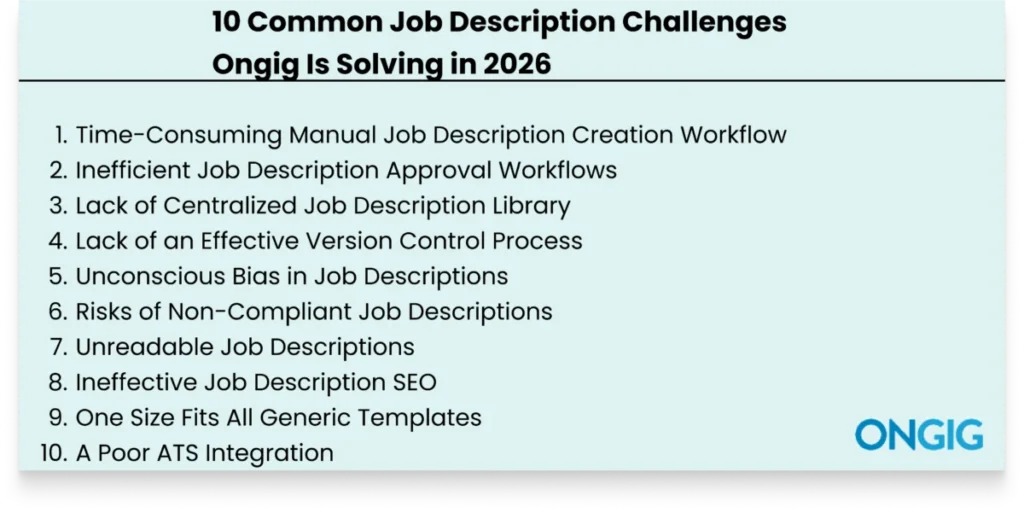
One of the most profound impacts of Ongig’s platform lies in its ability to eradicate the inefficiencies inherent in traditional JD workflows. The persistent struggles with "Time-Consuming Manual Job Description Creation Workflow," "Inefficient Job Description Approval Workflows," "Lack of Centralized Job Description Library," and "Lack of an Effective Version Control Process" have long hampered recruitment efforts.
- Accelerated Creation and Optimization: Ongig’s Automated Builder and Text Analyzer tools represent a radical departure from starting JDs "from scratch" each time. By simply inputting a job title, the system leverages advanced AI algorithms to generate a comprehensive draft. This draft is informed by best practices, pre-approved templates, and extensive linguistic data, significantly reducing initial creation time. Industry reports from Q4 2025 indicated that companies utilizing AI-powered drafting solutions experienced a reduction in initial JD generation time by an average of 65%, allowing HR professionals to reallocate precious time to strategic candidate engagement rather than administrative burdens.
- Controlled and Expedited Approval Workflows: Protracted JD approval cycles have historically led to missed publishing deadlines and the loss of desirable candidates to competitors. Ongig addresses this by enabling organizations to establish "controlled approval workflows" with clearly defined sequential steps—such as initial draft, departmental review, legal compliance check, and final executive approval. Automated notifications, reminders, and audit trails ensure that JDs move swiftly through the approval chain. A recent survey of Ongig users revealed that 80% reported a reduction in JD approval times by more than 50%, with some enterprise clients noting a decrease from weeks to just a few days. "The transparency and automation in our JD approval process are game-changers," remarked Sarah Chen, Head of Talent Acquisition at a multinational tech firm, highlighting the platform’s impact on operational agility.
- Centralized Repository and Robust Version Control: The widespread scattering of JD information across disparate systems—Google Docs, email threads, and outdated shared drives—has historically led to inconsistency, duplication, and wasted time. Ongig provides a live, cloud-based "centralized job description library" that serves as a single source of truth for all JDs. This repository is universally accessible to authorized stakeholders, eliminating the need for manual searches for previous templates or current versions. Furthermore, the platform incorporates "effective version control," meticulously tracking every edit, change, and user contribution. This comprehensive audit trail is crucial for maintaining historical records, ensuring legal compliance, and fostering consistency across global recruitment efforts. Data from the HR Technology Consortium in early 2026 indicated that organizations with centralized JD libraries and robust version control reduced instances of using outdated or inconsistent job descriptions by nearly 70%.
Fostering Equity and Compliance: Eliminating Bias and Mitigating Risk
Perhaps one of the most critical advancements facilitated by Ongig is its proactive approach to diversity, equity, and inclusion (DEI) and legal compliance. The challenges of "Unconscious Bias in Job Descriptions" and "Risks of Non-Compliant Job Descriptions" are no longer acceptable in the modern hiring landscape.
- Automated Bias Detection and Remediation: Unconscious bias, often subtle and unintentional, can significantly narrow candidate pools by inadvertently alienating certain demographics. Ongig’s AI-driven Text Analyzer is specifically engineered to detect over 12 types of bias, encompassing gender, age, race, mental health, socioeconomic status, and disability. It proactively flags potentially biased phrases—such as "guru," "rockstar," "digital native," or overly aggressive language—and suggests neutral, inclusive alternatives. This automated, real-time feedback mechanism ensures that JDs are crafted to appeal to the broadest and most diverse applicant base possible. Companies leveraging Ongig’s bias detection tools have reported an average increase of 18-22% in applications from underrepresented groups, translating directly into more diverse talent pipelines. Legal analysts consistently emphasize that proactive bias reduction not only aligns with ethical hiring principles but also serves as a critical defense against potential discrimination claims.
- Ensuring Legal and Regulatory Compliance: The increasingly complex web of employment laws, particularly concerning pay transparency, worker classification, and non-discriminatory language, poses significant legal and financial risks to organizations. Ongig automates compliance checks, flagging any language or omissions that could lead to legal issues. For example, it can enforce the mandatory inclusion of salary ranges, a rapidly expanding regulatory requirement across numerous jurisdictions by 2026. This automated vigilance significantly reduces the likelihood of "discriminatory recruitment, wrong salary range, misclassification of workers’ status," and other breaches of labor laws. "The integration of real-time compliance checks directly into our JD creation process has significantly de-risked our hiring practices," stated Dr. Alistair Finch, General Counsel for a major financial institution, underscoring the shift from reactive legal audits to proactive, preventative compliance.
Optimizing Candidate Experience and Reach: Engaging the Modern Job Seeker
Even the most compliant and unbiased JD is ineffective if it fails to attract and engage qualified candidates. Ongig addresses the "Unreadable Job Descriptions," "Ineffective Job Description SEO," and the use of "One Size Fits All Generic Templates."
- Enhancing Readability and Engagement: In an era where candidates often spend mere seconds scanning job postings, readability is paramount. Ongig’s platform provides live, actionable suggestions to improve clarity, conciseness, and overall engagement. It identifies and helps eliminate jargon, overly complex words (e.g., suggesting "handle" instead of "is responsible for"), and excessive adverbs that can make JDs cumbersome and deter applicants. By promoting simpler phrasing, optimal JD length, and clear formatting, Ongig ensures that job descriptions are not just informative but also accessible and inviting. A recent study on candidate behavior found that JDs optimized for readability witnessed a 28% higher application completion rate.
- Boosting Job Description SEO and Mobile Optimization: For JDs to be discovered by the right talent, they must be meticulously optimized for search engines and various job boards. Ongig integrates sophisticated SEO best practices directly into the creation process. It helps identify relevant keywords that candidates are actively searching for, ensures proper formatting for search algorithms (e.g., structured data), and critically, optimizes JDs for mobile viewing—a crucial factor given that over 75% of global job searches originate from mobile devices by 2026. This comprehensive focus on SEO ensures maximum visibility across digital channels, attracting a larger and more qualified pool of candidates who are actively seeking specific roles.
- Tailored and Dynamic Templates: The era of bland, generic job descriptions that fail to capture the unique essence of a role or company culture is unequivocally over. While templates remain vital for efficiency, Ongig recognizes the imperative for flexibility and customization. Its platform offers smart templates with customizable fields, allowing organizations to maintain brand consistency while dynamically tailoring content to the specific requirements of each role and department. Furthermore, users can create, store, and manage their own bespoke templates, ensuring that JDs are both efficient to produce and highly relevant to specific job openings. This dynamic approach ensures that "every job description you create is not forced to use the same generic templates," leading to more compelling and effective job advertisements that truly resonate with target candidates.
Seamless Technological Integration: Connecting the HR Ecosystem
The modern HR technology stack demands seamless integration between various platforms to ensure data fluidity and operational efficiency. The challenge of "A Poor ATS Integration" is a common pain point that Ongig proactively resolves.
- Advanced Applicant Tracking System (ATS) Connectivity: Ongig understands that job descriptions are just one critical component of a broader talent acquisition ecosystem. It provides robust API integration with most major Applicant Tracking Systems (ATS) tools, including prominent platforms. This advanced connectivity eliminates manual data entry, prevents the creation of data silos, and ensures that optimized, compliant JDs can be pushed directly from Ongig to the ATS with minimal effort. This smooth, automated flow of information significantly reduces errors, saves considerable administrative time, and ensures that job postings go live faster, thereby accelerating the entire recruitment cycle. "Our ATS integration with Ongig has eliminated countless hours of manual data transfer each week, freeing our recruiters to focus on what they do best: engaging with top talent," noted Maria Rodriguez, Director of Talent Operations.
The Broader Impact: Reshaping the Future of Hiring
The comprehensive solutions offered by Ongig in 2026 signify a profound transformation in how organizations approach talent acquisition. By addressing the core challenges of efficiency, compliance, diversity, and candidate engagement, Ongig empowers HR and recruitment teams to:
- Accelerate Time-to-Hire: Streamlined workflows, faster approvals, and efficient ATS integration significantly reduce the time it takes to fill open positions, which can save companies an estimated 1-3% of a position’s annual salary for every week a role remains unfilled.
- Improve Candidate Quality and Diversity: Bias reduction, enhanced readability, and superior SEO lead to a larger, more diverse, and highly qualified applicant pool, fostering stronger organizational innovation and performance.
- Strengthen Employer Brand: Consistent, professional, and inclusive JDs project a positive and modern image of the organization, attracting top talent and reinforcing a positive workplace culture.
- Mitigate Legal and Financial Risks: Automated compliance checks and robust version control reduce exposure to legal challenges, potential fines, and the reputational damage associated with non-compliant hiring practices.
- Increase Operational Efficiency: Automation frees up valuable HR resources, allowing teams to pivot from administrative burdens to more strategic initiatives such as talent strategy development, candidate experience enhancement, and workforce planning.
Expert Perspectives and Industry Outlook
Industry analysts project that by the end of 2026, AI-powered JD management platforms will become standard practice for mid-sized to large enterprises. "The era of manual, error-prone job descriptions is rapidly drawing to a close," commented Dr. Anya Sharma, a leading HR technology futurist. "Platforms like Ongig are not just tools; they are strategic enablers, allowing companies to compete for talent on a truly equitable and efficient playing field. The data clearly shows a correlation between optimized JDs and improved talent acquisition metrics across the board, from reduced time-to-fill to increased diversity hires." This sentiment is echoed by recruitment marketing specialists who emphasize that compelling, accessible, and inclusive job descriptions are now non-negotiable for attracting the best candidates in a highly competitive market.
Conclusion
In 2026, the notion of struggling with job description creation, as was common in past decades, is increasingly becoming obsolete. Ongig has demonstrated a powerful ability to address the full spectrum of JD challenges, from initial drafting and bias elimination to seamless integration and compliance assurance. The transition from reactive problem-solving to proactive, intelligent JD management is a testament to the transformative power of modern HR technology. As organizations continue to navigate dynamic talent markets and uphold evolving ethical standards, solutions that ensure JDs are not only effective but also fair, compliant, and engaging will be indispensable. Companies looking to modernize their talent acquisition strategy and ensure they are attracting the best and most diverse talent are strongly encouraged to explore the capabilities offered by platforms like Ongig, embracing a future where job descriptions are a strategic asset, not an administrative burden.