Strategic human resource management (SHRM) is not merely an academic concept; it represents a fundamental shift towards people-first leadership that is vital for modern organizations. This approach empowers HR departments to move from a reactive problem-solving model to one that proactively shapes company culture and builds agile teams capable of navigating future challenges. As research from SHRM indicates, nearly half of HR professionals now identify improving the employee experience as a top priority, underscoring the critical link between a positive employee experience and overall organizational success, including engagement, retention, and performance.
At its core, SHRM is about intentionality. It’s HR with a clear, actionable plan that directly connects every people-related decision to overarching business objectives. Unlike traditional HR, which often focuses on administrative tasks such as policy adherence, compliance, and record-keeping, SHRM is geared towards propelling the business forward. This represents a significant evolution from simply filling vacancies to actively cultivating a workforce that demonstrably contributes to achieving critical business outcomes. SHRM views employees not just as a cost center, but as invaluable assets, and therefore invests in programs like talent development, strategic workforce planning, and robust recognition initiatives designed to foster an environment where employees can perform at their best.
The Four Pillars of Strategic Human Resource Management
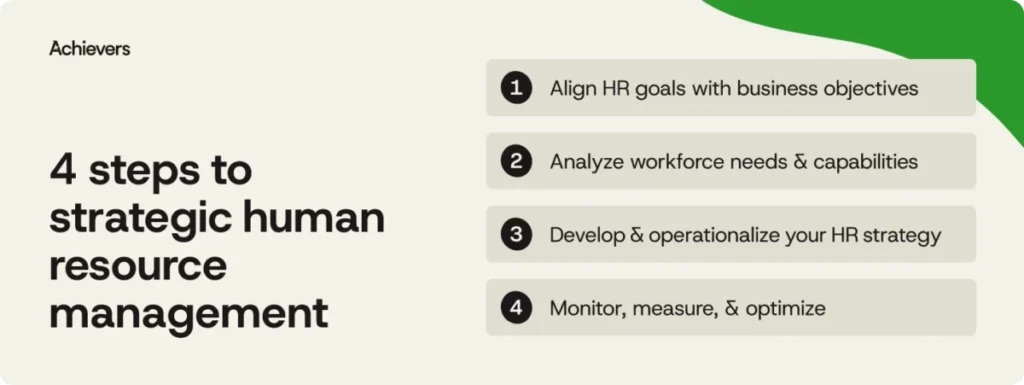
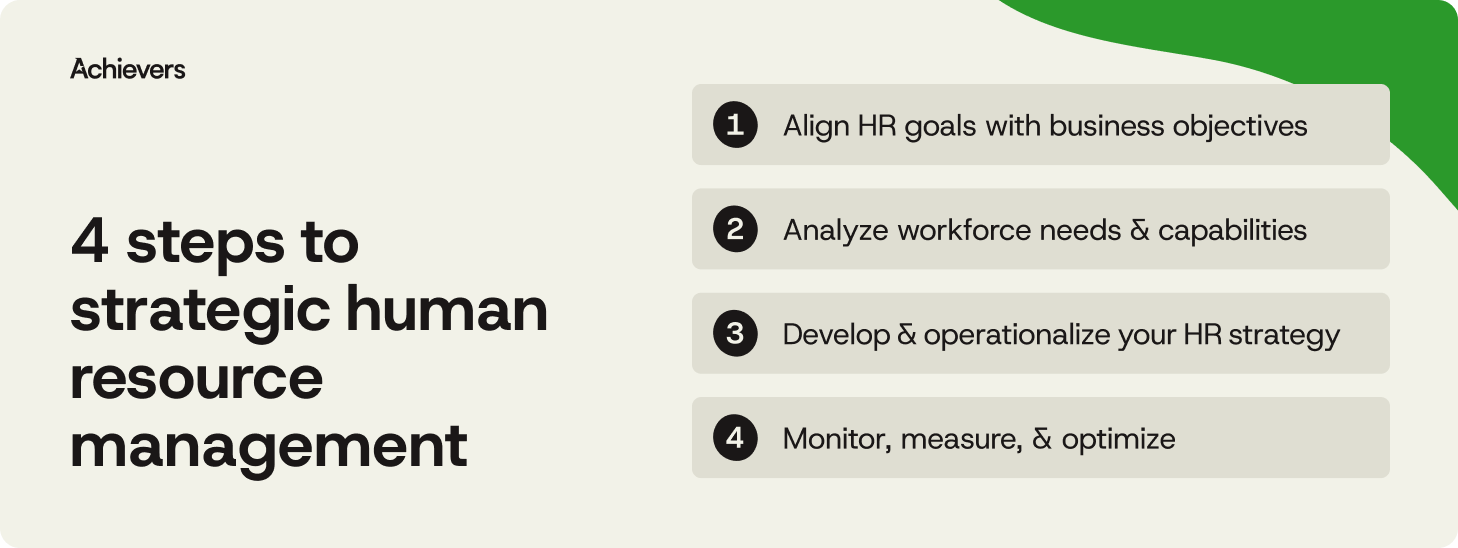
Implementing a strategic HR approach does not have to be an insurmountable task. It requires a deliberate and methodical process. For organizations aiming to ensure their people strategies directly contribute to business results, rather than existing in isolation, the following four steps are essential:
Step 1: Align HR Goals with Business Objectives
The initial and most crucial step in strategic HR is ensuring that all people-related initiatives are in lockstep with the broader goals of the organization. If current HR programs are not demonstrably contributing to what the business aims to achieve, a fundamental re-evaluation is necessary. This alignment means that every HR project, policy, and program must have a clear line of sight to the company’s strategic imperatives. For instance, if a company’s objective is to increase market share in a new demographic, HR’s strategy might focus on recruiting diverse talent with specific market knowledge and developing training programs to enhance cultural competency.
Step 2: Analyze Workforce Needs and Capabilities
A well-defined strategy is impossible to construct without a comprehensive understanding of the existing talent pool and the skills required for future success. This analytical phase involves a deep dive into the current workforce’s capabilities, identifying any skill gaps, and forecasting future talent demands based on evolving business needs and market trends. This might involve skills assessments, performance reviews, and analyzing historical data on employee performance and retention. For example, a tech company looking to pivot towards AI development would need to assess its current engineering talent’s AI proficiency and identify the need for upskilling or external hiring.
Step 3: Develop and Operationalize Your HR Strategy
Once business objectives are aligned and workforce needs are clearly understood, the next phase is to translate these insights into tangible, actionable programs and initiatives. This is where the strategic vision begins to permeate the daily operations of the HR department and the organization as a whole. This could involve designing new recruitment strategies, implementing leadership development programs, creating robust employee onboarding processes, or refining performance management systems. For example, a retail company aiming to improve customer service might operationalize its strategy by developing a comprehensive customer service training program for all frontline staff.

Step 4: Monitor, Measure, and Optimize
The most effective strategies are not static; they are dynamic and adaptable. After implementing HR programs, continuous monitoring and measurement are critical to assess their effectiveness and identify areas for improvement. This involves establishing key performance indicators (KPIs) that directly relate to the strategic HR goals and business objectives. Regularly analyzing data on employee engagement, turnover rates, productivity, and the ROI of HR initiatives allows organizations to make informed adjustments and optimize their strategies over time. For instance, if a new recognition program is not leading to increased employee motivation as measured by engagement surveys, the program’s design or implementation might need to be revisited.
The Cornerstone of Strategic HR: Recognition
While all aspects of strategic HR are important, the role of employee recognition cannot be overstated. It serves as a powerful lever for driving business impact. Data from Achievers’ 2024 State of Employee Recognition Report highlights a significant difference in perceived business impact between organizations using internal recognition programs versus those leveraging online solutions. While only 30% of HR leaders with internal recognition programs reported seeing business impact, this figure nearly doubles to 60% for those utilizing an online recognition platform.
This disparity can be attributed to several factors. Online recognition platforms offer greater accessibility, visibility, and scalability, allowing for more consistent and timely acknowledgment of employee contributions. They can be integrated with company values, making it easier to reinforce desired behaviors and foster a culture of appreciation. The impact of effective recognition manifests in various ways:
- Increased Employee Engagement: When employees feel valued and appreciated, their commitment to their work and the organization naturally increases. This leads to higher levels of discretionary effort and a more positive work environment.
- Improved Retention Rates: Acknowledging and rewarding employees’ contributions significantly boosts morale and job satisfaction, making them less likely to seek opportunities elsewhere. This is particularly crucial in today’s competitive talent market where retaining experienced staff is a significant advantage.
- Enhanced Productivity and Performance: Recognition can serve as a powerful motivator, encouraging employees to strive for excellence and exceed expectations. When performance is acknowledged, it reinforces desired behaviors and sets a benchmark for others.
- Stronger Company Culture: A culture that regularly celebrates achievements, both big and small, fosters a sense of community and shared purpose. Recognition programs that are aligned with company values help to embed those values into the daily fabric of the organization.
- Greater Return on Investment (ROI): By improving engagement, retention, and performance, effective recognition programs directly contribute to the bottom line, leading to increased profitability and a stronger competitive position.
How Achievers Empowers Strategic HR
Translating a strategic HR vision into everyday actions and ensuring its long-term success is where specialized solutions become invaluable. Achievers offers a comprehensive platform designed to bridge the gap between strategic intent and tangible organizational impact. Whether an organization is implementing a new employee recognition program or scaling its people strategy across diverse teams and geographical locations, Achievers provides the tools to transform strategic objectives into consistent, daily practices.
The Achievers recognition platform is engineered to support SHRM in practice by:
- Reinforcing Company Values: The platform allows organizations to link recognition to specific company values, ensuring that employees are celebrated for behaviors that align with the desired culture. This reinforces what matters most to the business.
- Driving Measurable Results: By providing robust analytics and reporting capabilities, Achievers enables HR leaders to track the effectiveness of their recognition programs, measure their impact on key business metrics, and demonstrate ROI. This data-driven approach allows for continuous optimization.
- Fostering a Culture of Appreciation: The platform facilitates peer-to-peer and manager-to-employee recognition, creating a pervasive sense of gratitude and acknowledgment throughout the organization. This can be tailored to different needs, from spot awards to service anniversaries and milestone achievements.
- Enhancing Employee Experience: A well-designed recognition program contributes significantly to a positive employee experience, making employees feel seen, heard, and valued. This, in turn, boosts engagement and loyalty.
- Global Scalability and Integration: Achievers’ platform is built to support organizations of all sizes, across multiple locations and time zones, ensuring that recognition initiatives are consistent and impactful regardless of where employees are based. It can also integrate with existing HR systems for seamless data flow.
The Broader Implications of Strategic HR
The shift towards strategic human resource management is more than a trend; it’s a necessary evolution for organizations seeking sustained success in a dynamic global economy. The implications of adopting a strategic approach are far-reaching, impacting not only HR departments but the entire organizational ecosystem.
Historically, HR departments were often viewed as administrative support functions, primarily responsible for transactional tasks. However, as the complexity of the business landscape has increased, so too has the demand for HR to act as a strategic partner. Companies that embrace SHRM are better equipped to:
- Navigate Economic Uncertainty: By proactively managing talent, identifying skill gaps, and fostering a resilient workforce, organizations can better weather economic downturns and adapt to changing market conditions.
- Attract and Retain Top Talent: In a competitive labor market, organizations that prioritize employee experience and demonstrate a clear commitment to their people through strategic initiatives are more attractive to high-caliber candidates and are better at retaining their existing workforce.
- Drive Innovation: A culture that encourages employee input, provides opportunities for development, and recognizes contributions is more conducive to innovation. When employees feel empowered and valued, they are more likely to share ideas and take calculated risks.
- Enhance Brand Reputation: Companies known for their positive work environments and strong employee-centric practices often enjoy a superior brand reputation, which can translate into increased customer loyalty and investor confidence.
- Achieve Sustainable Growth: Ultimately, strategic HR is about building a foundation for long-term, sustainable growth. By aligning people strategies with business objectives, organizations can ensure that their workforce is not just a component of success, but a primary driver of it.
The journey from traditional HR to strategic HR is an ongoing process. It requires continuous learning, adaptation, and a commitment to viewing employees as the most critical asset an organization possesses. As the business landscape continues to evolve, the organizations that will thrive are those that understand and effectively implement strategic human resource management, ensuring their people are not just participants in their success, but architects of it.
Strategic Human Resource Management FAQs
What is the primary difference between traditional HR and strategic HR?
Traditional HR focuses on administrative tasks, compliance, and operational efficiency, such as payroll, benefits administration, and policy enforcement. Strategic HR, on the other hand, is forward-looking and aligns people strategies directly with overarching business goals to drive organizational success, focusing on talent development, workforce planning, and culture shaping.
Why is employee experience a key focus in strategic HR?
A positive employee experience is directly linked to higher engagement, better retention, and improved performance. Strategic HR recognizes that by prioritizing the employee experience, organizations can create a more motivated, productive, and loyal workforce, which ultimately benefits the business.
How can organizations measure the success of their strategic HR initiatives?
Success can be measured through various Key Performance Indicators (KPIs) such as employee engagement scores, retention rates, productivity metrics, the ROI of talent development programs, and the achievement of specific business objectives that were tied to HR strategies.
What role does technology play in strategic HR?
Technology, particularly HR technology like recognition platforms and HRIS systems, plays a crucial role in enabling strategic HR. It automates administrative tasks, provides data for analysis, facilitates communication, and helps in implementing and managing complex people strategies across an organization.
Is strategic HR only for large corporations?
No, strategic HR principles are applicable to organizations of all sizes. While larger companies may have more resources, the core principles of aligning people strategies with business goals and focusing on employee development and experience are essential for any organization aiming for sustained success.