Every investment within an organization, particularly in the realm of human resources, must unequivocally demonstrate its value. Employee recognition is no exception to this imperative. The ability to measure the Return on Investment (ROI) of an employee recognition software transcends the traditional "feel-good" perception, establishing a fact-based narrative that precisely illustrates how genuine appreciation directly fuels engagement, bolsters retention, and elevates overall performance.
Despite the clear benefits, a significant challenge persists across the HR landscape. According to a Gartner study, a striking 51% of HR leaders report an inability to accurately measure the ROI of their HR technology investments. This gap is particularly perplexing given that data consistently underscores the power of recognition. For instance, the State of Recognition Report reveals that employees who receive weekly recognition are 2.6 times more likely to exhibit higher productivity. The evidence for recognition’s efficacy is robust, yet quantifying its financial impact remains an enigma for many. This article aims to unpack this conundrum, providing a comprehensive guide on how to measure recognition software ROI, detailing the critical business outcomes it drives, and illustrating its real-world application.
The Evolving Landscape of HR Metrics: From Cost Center to Strategic Imperative
Historically, Human Resources departments were often perceived primarily as administrative overheads or cost centers, managing compliance, payroll, and basic employee services. Strategic contributions were less frequently quantified in direct financial terms. However, the modern business environment demands a paradigm shift. With intense competition for talent, the rise of the knowledge economy, and the increasing recognition of human capital as a primary competitive advantage, HR has evolved into a strategic partner. This evolution necessitates that every HR initiative, especially those impacting employee experience and productivity, be justified with clear, measurable business outcomes. The advent of sophisticated HR technology and advanced analytics has made this level of scrutiny not only possible but expected.
The past decade, particularly catalyzed by events like the "Great Resignation" and the "Quiet Quitting" phenomenon, has intensified the focus on employee well-being, engagement, and retention. Organizations are grappling with unprecedented talent mobility and a shifting employee value proposition. In this context, strategies that foster a positive work environment, cultivate a sense of belonging, and genuinely appreciate contributions have moved from being "nice-to-haves" to essential business imperatives. Employee recognition, powered by dedicated software, stands at the forefront of these strategies, offering a scalable and impactful way to address these challenges. The ability to prove its ROI is no longer just good practice; it’s a strategic necessity for securing executive buy-in and optimizing resource allocation.
Calculating Employee Engagement ROI in 2026: A Modern Approach
Employee engagement ROI quantifies the tangible business value generated by improvements in workforce engagement, juxtaposed against the total cost of the programs, technologies, and resources invested to achieve those improvements. In the current and projected business climate of 2026, the most effective methodology involves establishing clear connections between enhanced engagement levels and a spectrum of measurable organizational outcomes, including retention rates, overall productivity, individual and team performance, and absenteeism figures. The "employee engagement equation wheel" framework underscores that demonstrating engagement ROI begins with meticulously tracking engagement metrics alongside critical business indicators like employee turnover and performance outcomes.
A straightforward formula encapsulates this calculation:
Employee engagement ROI = (Financial benefits from engagement improvements – Program costs) ÷ Program costs × 100
To meticulously calculate this, organizations must:
- Identify and quantify financial benefits: This involves assigning monetary values to improvements in retention (e.g., reduced turnover costs), productivity gains (e.g., increased output, efficiency), performance enhancements (e.g., higher sales, better quality), and decreased absenteeism (e.g., fewer sick days, higher attendance).
- Calculate total program costs: Sum all expenses related to the engagement initiatives, including software subscriptions, rewards budgets, administrative time, training, and communication efforts.
- Apply the formula: Substitute the calculated values into the ROI equation to derive a percentage.
Recognition, far from being a peripheral activity, must be integrated as a core component of this ROI calculation. Insights from various research, including those from the Achievers Workforce Institute (AWI), consistently demonstrate that robust recognition programs significantly strengthen employee engagement, foster a profound sense of belonging, and improve retention rates. These outcomes directly influence the organization’s bottom line. Employees who frequently receive recognition are inherently more likely to feel valued, appreciated, and deeply engaged. Consequently, organizations that strategically increase their recognition efforts typically observe corresponding improvements across engagement scores, productivity benchmarks, and employee retention metrics.
Consider a practical example: If an organization commits an annual investment of $100,000 in comprehensive employee engagement and recognition initiatives, and subsequently realizes $300,000 in quantifiable benefits—such as savings from reduced employee turnover, gains in productivity, and decreased recruitment and onboarding costs—its calculated engagement ROI would be a robust 200%. This figure not only justifies the initial investment but also highlights the significant financial leverage that well-executed recognition strategies provide.
The Multifaceted Impact: How Employee Recognition Drives Tangible ROI
The true power of recognition lies in its ability to profoundly influence how individuals perceive their work and contribute to the organization. When employees feel genuinely seen and appreciated, their approach to work transforms. Employee recognition doesn’t merely drive ROI; it cultivates and reinforces the positive behaviors and attitudes that propel a business forward. From enhancing retention to boosting engagement, and from supercharging productivity to shaping a thriving culture, the returns are readily identifiable for those who know where to look.
Retention: A Shield Against Talent Drain
Recognition serves as one of the most cost-effective strategies for retaining top talent. When appreciation is consistently visible and authentically expressed, it significantly reinforces an employee’s sense of "I belong here." This intrinsic feeling is a potent force that keeps turnover rates low and fosters enduring loyalty. Employees who regularly feel recognized are less likely to seek opportunities elsewhere; instead, they are deeply invested and committed to their current roles. The cost of employee turnover can be staggering, often estimated to be between 50% to 200% of an employee’s annual salary, encompassing recruitment, onboarding, training, and lost productivity. By reducing this attrition, recognition directly translates into substantial financial savings.
Engagement: Fueling Discretionary Effort
For engagement that directly impacts the bottom line, recognition is the critical starting point. It acts as the vital bridge connecting individual effort with profound meaning, transforming work from a mere obligation into a meaningful contribution. The State of Recognition Report further validates this, indicating that employees who receive weekly recognition are nine times more likely to report a strong sense of belonging. This robust sense of belonging is a key driver of discretionary effort—the willingness of employees to go above and beyond their basic job requirements. This is the authentic ROI of employee engagement: measurable, culturally transformative, and undeniably contagious.
Productivity: Reinforcing Excellence
Employees deliver their best work not simply because they are being watched, but because their efforts are noticed and valued. Recognition actively reinforces desired behaviors and clarifies what "great work" truly entails, transforming everyday successes into repeatable habits. The tangible outcomes include heightened focus, increased energy, and a reduction in workplace stress or "Sunday scaries." This is productivity infused with purpose, driven by intrinsic motivation rather than external pressure, leading to higher output, better quality, and greater innovation.
Culture: Embedding Values into Action
Organizational culture flourishes and strengthens with every act of recognition. When appreciation becomes an integral part of daily operations, core company values transition from abstract statements on a wall to tangible, observable actions. A strong recognition culture ensures that organizational values genuinely drive business goals, and a deep sense of belonging becomes the prevailing norm. It transforms the company’s purpose from a mere poster slogan into the lived experience of how people collaborate and contribute, fostering trust, psychological safety, and a shared identity.
HR Efficiency: Streamlining Operations, Maximizing Impact
Recognition software offers more than just a platform for celebration; it significantly enhances HR operational efficiency. By automating the recognition process, it eliminates tedious manual tasks, thereby freeing up valuable HR time. This allows HR professionals to shift their focus from administrative busywork to more strategic initiatives that drive talent development, organizational change, and business growth. Software integrations ensure seamless data flow across different HR systems, and robust analytics capabilities make it easy to track program effectiveness and demonstrate results, further solidifying HR’s strategic role.
Customer Satisfaction: The Ripple Effect of Internal Well-being
The internal well-being and engagement of employees directly correlate with the external experience of customers. Recognition creates a powerful ripple effect: motivated and appreciated employees are more likely to deliver superior service, exhibit greater empathy, and approach their work with a proactive, innovative mindset. This positive internal dynamic extends far beyond the organizational boundaries, impacting customer interactions, brand reputation, and ultimately, the bottom line through increased customer loyalty and satisfaction. Happy, engaged teams invariably create happy, loyal customers.
The Methodology: Measuring the ROI of Employee Recognition Software
Measuring ROI extends beyond merely proving impact; it involves precisely identifying the sources of that impact. For employee recognition software, this means meticulously connecting daily acts of appreciation to the overarching business outcomes they influence. A robust measurement framework is essential to transform qualitative observations into quantitative evidence.
Here’s a structured approach to understanding and measuring ROI across your recognition and engagement strategy:
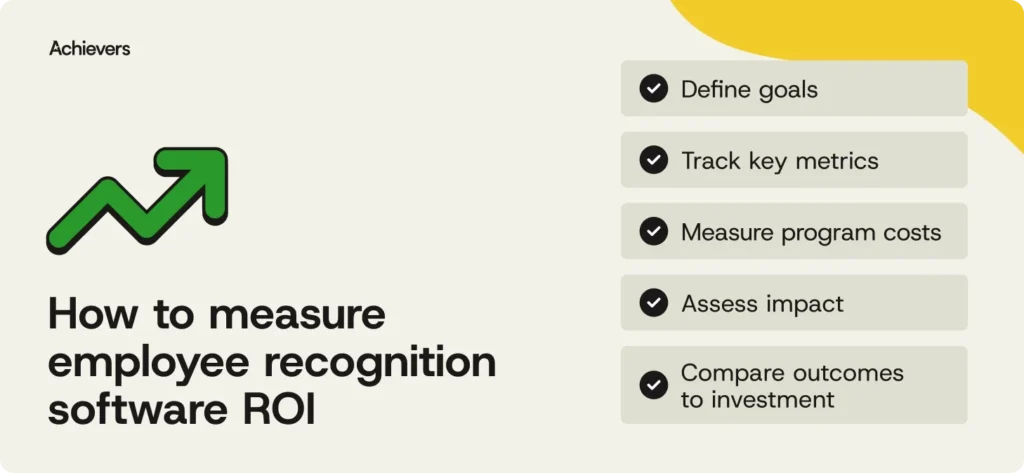
1. Define Your Goals with Precision
The journey begins by explicitly articulating the specific outcomes that hold the most significance for your organization. Are you aiming to reduce employee turnover by a specific percentage? Is the objective to elevate employee engagement scores by a certain margin? Or perhaps to boost departmental productivity by a measurable amount? Clearly defining these priorities at the outset ensures that your recognition strategy is intrinsically linked to quantifiable impact, moving beyond mere good intentions to deliberate, results-oriented action. These goals should be SMART: Specific, Measurable, Achievable, Relevant, and Time-bound. For instance, "Reduce voluntary turnover among high-performers by 15% within 12 months."
2. Track Key Metrics Systematically
Data is the storyteller of your recognition journey. Establish robust mechanisms to track changes in a comprehensive suite of metrics before and after the implementation of your recognition platform. These include:
- Recognition-Specific Metrics: Participation rates (both givers and receivers), frequency of recognition, types of recognition awarded, and alignment of recognition messages with organizational values.
- Engagement Metrics: Employee Net Promoter Score (eNPS), results from pulse surveys, annual engagement surveys, and sentiment analysis of employee feedback.
- Operational Metrics: Employee turnover rates (voluntary and involuntary), absenteeism rates, productivity metrics (e.g., sales figures, project completion rates, error reduction), and quality control data.
- Customer Metrics: Customer Satisfaction (CSAT) scores, Net Promoter Score (NPS) for customers, and customer churn rates.
Collecting baseline data before implementation is crucial for a valid pre-post comparison, allowing you to isolate the impact of the recognition program.
3. Measure Program Costs Comprehensively
Accurately calculate your total investment in the recognition program. This encompasses:
- Software Subscription Fees: Annual or monthly costs for the recognition platform.
- Rewards Budget: The financial allocation for incentives, gift cards, or other forms of tangible rewards.
- Administrative Time Saved: Quantify the reduction in manual work previously handled by HR or managers, translating this time saving into monetary value (e.g., hours saved * average hourly wage of HR/manager).
- Implementation and Training Costs: Expenses related to setting up the software, integrating it with existing systems, and training employees and managers on its use.
Recognition software often proves its worth rapidly by significantly cutting down on manual administrative tasks, thereby saving considerable HR time and making the results of your investment easily discernible.
4. Compare Outcomes Versus Investment
Translate your measured results into concrete, tangible business value. For example:

- Reduced Turnover: If your turnover rate decreases, calculate the direct cost savings by multiplying the number of avoided turnovers by the average cost of replacing an employee (which can range from 50% to 200% of an employee’s annual salary, depending on the role).
- Improved Engagement: Higher engagement scores often correlate with increased productivity. Quantify this by linking engagement increases to performance improvements (e.g., a 5% increase in engagement leading to a 2% increase in sales per employee).
- Better Morale and Performance: Attribute improvements in performance metrics directly to the positive shift in morale and motivation driven by recognition.
When recognition initiatives are rigorously measured against core business Key Performance Indicators (KPIs), the return on investment frequently speaks for itself in compelling financial terms.
5. Assess Cultural and People Impacts Qualitatively
While financial metrics are paramount, some of the most profound returns cannot be encapsulated solely in a spreadsheet, yet they are undeniably critical. It is imperative to track how recognition influences:
- Sense of Belonging: Qualitative feedback from surveys, focus groups, and interviews regarding employees’ feelings of inclusion and connection.
- Leadership Visibility: How often employees feel their leaders are actively recognizing contributions and embodying company values.
- Value Alignment: The degree to which employees perceive their daily work and recognized behaviors align with the organization’s stated values.
These qualitative insights are essential for balancing the quantitative data, providing a holistic view that explains not just what changed, but critically, why those changes occurred, offering a richer narrative of transformation.
Calculating the ROI for Employee Recognition:
A simple formula often used is:
ROI = (Benefits – Costs) / Costs
To estimate this:
- Identify and quantify benefits: Assign monetary values to improved retention (e.g., cost savings from reduced turnover), increased engagement (e.g., correlation to productivity gains), and enhanced performance (e.g., revenue increase, efficiency improvements).
- Sum all costs: Include software fees, reward budgets, and administrative overhead.
- Apply the formula.
Rather than isolating a single metric, organizations gain the clearest and most actionable picture by observing changes over time and drawing clear connections between recognition activity and a multitude of measurable business outcomes. When recognition is implemented frequently, strategically aligned with overarching business goals, and consistently measured, it evolves into a highly reliable and powerful driver of significant ROI.
Key Business Outcomes Driving Recognition Software’s ROI
Recognition software fundamentally drives ROI by influencing and shaping employee behavior—and it is behavior that ultimately drives organizational performance. It’s not simply about fostering a happier workforce; it’s about cultivating an environment where employees are intrinsically motivated to consistently deliver their best work.
Here’s how recognition ROI manifests in tangible action:
Increased Productivity: Recognition provides employees with undeniable clarity regarding what constitutes "great work" and instills the motivation to replicate it. A timely and sincere "thank you" can achieve what dozens of performance dashboards cannot: it reminds an individual that their effort is valued and impactful. Over time, this consistent validation and sense of visibility cultivate the kind of quiet, sustained momentum upon which every high-performing team thrives, leading to higher output and quality.
Improved Retention: Effective recognition is the critical mechanism to prevent valuable employees from contemplating opportunities elsewhere. The Engagement and Retention Report highlights that employees who feel genuinely appreciated at work are twice as likely to envision a long-term career trajectory within their current company. This directly translates into substantial savings on rehiring costs—which can be immense—and ensures the retention of an organization’s most valuable human capital.
Higher Engagement: Authentic engagement is not born from a survey; it originates from being truly seen and valued. When recognition is a regular and integral part of the workplace experience, employees transcend mere attendance; they become deeply invested and committed. This fosters greater trust in leadership, encourages more open and collaborative teamwork, and cultivates a deeper sense of ownership and care for organizational outcomes.
Enhanced Workplace Culture: The fabric of an organization’s culture strengthens with every single act of recognition. When appreciation becomes embedded in the daily rhythm of work life, core values are actively brought to life. A sense of belonging ceases to be an abstract concept and transforms into a tangible, shared experience. Recognition ensures that culture remains deeply rooted in its people and their interactions, rather than existing solely as corporate slogans or aspirational posters.
Greater HR Efficiency: Recognition software is not just a tool for celebrating achievements; it is a powerful instrument for saving valuable time. Automation within these platforms handles routine administrative tasks, while seamless software integrations ensure that recognition data flows smoothly across various HR systems. Furthermore, built-in analytics provide immediate insights into what strategies are working effectively. The net result is that HR teams spend less time on program management and more time on strategic initiatives that drive significant organizational impact.
Better Customer Satisfaction: The internal experience of employees profoundly shapes the external experience of customers. Recognition initiates a powerful ripple effect: motivated, valued employees are inherently more likely to deliver exceptional service, approach customer interactions with heightened empathy, and arrive at work prepared to innovate and solve problems. This positive internal dynamic extends far beyond the confines of the organization, ultimately resulting in a more satisfied customer base, stronger brand loyalty, and improved financial performance.
Strategic Application: Turning ROI Insights into Your Recognition Strategy
Recognition data, however comprehensive, is only as powerful as the strategic actions it informs. The true return on investment materializes when these insights are directly linked to the core priorities of the business: performance, retention, and measurable impact. This requires a deliberate and continuous process of analysis, communication, and adaptation.
Link Recognition to Core Business Goals: Begin by meticulously aligning both internal and external recognition metrics with the strategic outcomes that leadership prioritizes most—be it enhanced retention, elevated performance, improved engagement, or greater manager effectiveness. Recognition data possesses the unique capability to reveal which teams are excelling, where vital connections might be weakening, and precisely how appreciation influences critical results. When recognition data directly maps to overarching business goals, its return on investment becomes demonstrably clear and, crucially, far easier to sustain over the long term.
Pair Data with Compelling Storytelling: While numbers provide the necessary evidence, human narratives make that data resonate. Utilize recognition data to substantiate and enrich anecdotal evidence from employees, leaders, or teams who have experienced notable improvements in performance, morale, or collaboration after feeling genuinely seen and appreciated. This fusion transforms the ROI conversation from a dry spreadsheet review into a compelling narrative of organizational transformation and human impact, making it more persuasive to stakeholders.
Leverage AI-Powered Analytics to Fine-Tune Impact: Artificial Intelligence offers unprecedented capabilities to uncover intricate patterns that might elude traditional dashboards. AI can identify a specific department where consistent recognition is quietly driving exceptional retention rates, or conversely, flag a team at a heightened risk of burnout because appreciation isn’t being delivered effectively or meaningfully. By providing personalized insights, AI makes recognition significantly more intentional—ensuring the right message is delivered at the opportune moment, to the individuals who most deserve it, thereby maximizing its impact.
Showcase ROI with Outcomes that Truly Matter: When presenting your findings, move beyond simply displaying raw data. Instead, craft a narrative that tells the story behind the numbers. Illustrate how a targeted recognition program helped a team rebuild trust and cohesion following a significant organizational change, or demonstrate how a particular leader effectively leveraged recognition to sustain motivation and productivity during a challenging quarter. These concrete, real-world examples imbue the data with meaning and make the impact of recognition undeniably tangible and relatable.
Maintain Continuous Measurement and Evolution: Understanding the ROI of recognition, much like employee engagement itself, should be viewed as an ongoing, dynamic conversation rather than a one-time assessment. Continuously track evolving metrics such as recognition frequency, platform participation rates, engagement scores, and overall employee sentiment. This continuous feedback loop allows for agile adjustments and strategic growth, ensuring that your recognition program remains effective, relevant, and optimally aligned with evolving business needs and employee expectations.
Real-world Recognition ROI Examples: Appreciation in Action
The discussion of recognition and ROI gains significant weight when observed through the lens of real-world business success. The following organizations partnered with Achievers to strategically transform appreciation into measurable performance gains.
General Motors (GM): Unifying a Global Workforce
General Motors, a global automotive giant with a vast and diverse workforce of 160,000 employees, faced the challenge of fostering consistent appreciation and connection across its myriad divisions and geographies. Recognizing that genuine recognition was key to driving engagement, GM strategically partnered with Achievers to implement a single, unified global recognition platform. This initiative successfully embedded appreciation into the fabric of everyday work. The results were swift and impactful: within an impressive 30 days, 87% of employees were actively using the platform. Recognition quickly emerged as a leading driver of engagement across the entire company, significantly strengthening internal connections, mitigating attrition risks, and unequivocally proving the profound payoff of a well-executed recognition strategy. This high adoption rate underscored the platform’s user-friendliness and GM’s effective rollout, demonstrating a clear demand for structured appreciation.
Sobeys: Driving Operational Efficiency through Gamified Recognition
Sobeys, a prominent Canadian grocery retailer, sought to enhance both performance and connection across its extensive retail network. Their strategy began with a renewed focus on recognition. Collaborating with Achievers, Sobeys launched "Bring It!", an innovative, gamified recognition program. This initiative skillfully linked appreciation to specific business goals and fostered healthy competition among teams. The program’s success was evident in its tangible operational improvements: Sobeys boosted cube truck utilization from 77% to an impressive 86% across its retail support centers. This achievement powerfully demonstrated how a thoughtfully designed and strategically implemented recognition program can directly drive real, measurable improvements in operational efficiency and key business metrics, yielding significant cost savings and supply chain optimization.
From Employee Recognition Software to Real ROI: The Strategic Imperative
The evidence for the ROI of employee recognition is unequivocally clear: when organizations genuinely value their people, superior performance inevitably follows. Recognition serves as the catalyst that transforms mere connection into unwavering commitment, converts individual effort into collective impact, and elevates organizational culture into something not only vibrant but also quantifiably measurable.
The most significant victories are achieved when organizations transcend the superficial metrics of counting "clicks" or "kudos" and instead leverage recognition as a strategic tool to fundamentally reshape how people collaborate, innovate, and achieve goals together. This is the crucial intersection where robust data analytics meets the profound humanity of the workforce—and where the powerful ripple effects manifest as heightened engagement, improved retention, and outstanding business results.
At Achievers, this understanding forms the bedrock of our mission. Our innovative platform is engineered to make recognition both effortlessly scalable and remarkably easy to measure, consistently transforming everyday appreciation into enduring business impact. Because when recognition truly works, it sets the stage for everything else in the organization to flourish.