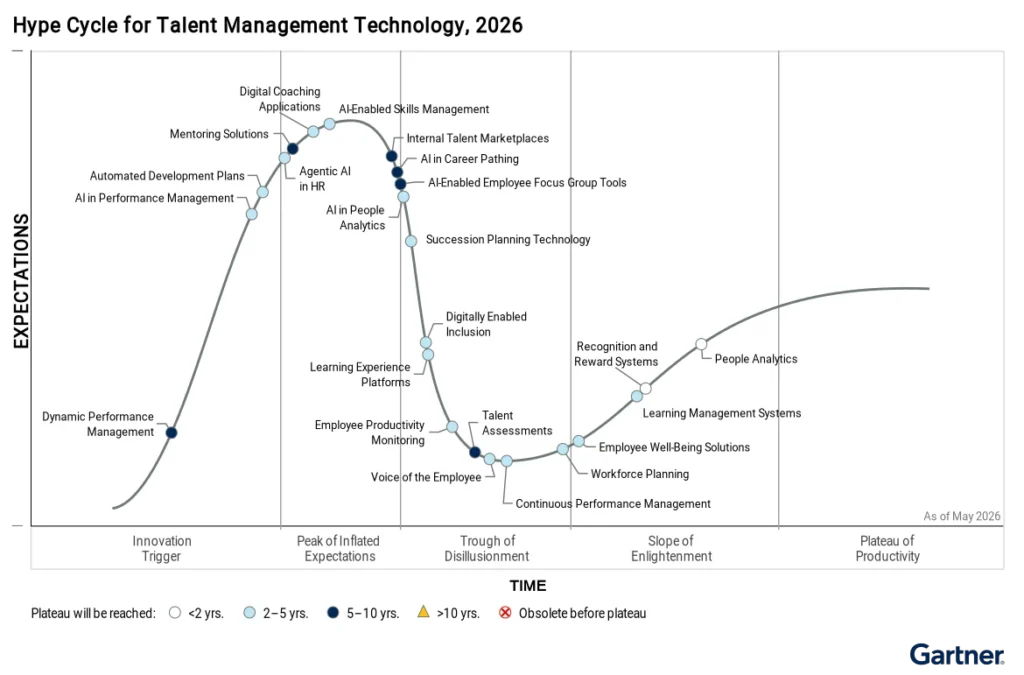
The global human resources technology landscape is at a critical juncture, according to Gartner’s latest "2026 Hype Cycle for Talent Management Technology." The renowned research and advisory firm’s annual report, a vital resource for HR leaders navigating technology investments, highlights a pervasive challenge: despite the proliferation of sophisticated talent management tools, many organizations are struggling to derive maximum value due to fundamental infrastructure deficiencies, particularly in data integration and quality.
Gartner’s analysis, which maps over 20 distinct talent technologies across their maturity lifecycles—from nascent innovations to established, productivity-driving solutions—reveals a striking concentration of these technologies within the "Trough of Disillusionment." This phase, characterized by unmet expectations and a struggle to realize the promised benefits, is not attributed to the inherent flaws of the technologies themselves, but rather to the absence of robust underlying systems necessary for their effective operation. The report specifically identifies limited interoperability between disparate HR tools and poor data accuracy as primary culprits behind executive dissatisfaction with their current talent management stacks.
In this year’s Hype Cycle, Quantum Workplace, a prominent player in employee success solutions, has been recognized across five key categories: AI in Performance Management, Continuous Performance Management, Voice of the Employee, Succession Planning Technology, and Recognition and Reward Systems. This broad recognition underscores the company’s comprehensive approach to addressing the multifaceted needs of modern HR departments. The breadth of Quantum Workplace’s inclusion in the report offers a crucial lens for organizations evaluating their own technology ecosystems and strategic investment priorities.
The Fragmented State of Modern HR Technology Stacks
A significant majority of HR departments currently operate with a collection of disconnected software solutions. This common scenario involves a core HR Information System (HRIS) for managing employee records, a separate survey tool for gauging engagement levels, an independent platform dedicated to performance management, and perhaps a standalone application for employee recognition acquired at some point in the past. The critical deficiency in these fragmented stacks is the lack of communication between these tools. Data becomes siloed, rendering it inaccessible or difficult to interpret for the very individuals who need it most: people managers and HR leaders. Consequently, actionable insights are often delayed or presented without the necessary context, hindering timely and effective decision-making.
Supporting data from industry surveys consistently reinforces this challenge. A recent report indicated that while HR leaders typically utilize between two to four HR solutions from different vendors, a mere 39% of these systems are reported to be usefully integrated with one another. This lack of integration directly contributes to the friction points identified by Gartner. HR leaders frequently cite the evolving demands of agile people management, coupled with restricted data integration and the presence of low-quality data, as significant impediments to leveraging their talent technologies effectively. This erodes trust in the outputs generated by these systems.
The strategic shift observed among forward-thinking HR teams is a move away from isolated data points towards a unified vision of connected insights and actionable strategies. The objective is to transform data residing in disparate silos into a cohesive and transparent picture that empowers leadership to make informed decisions.
AI in Performance Management: A Maturing Market Reality
Gartner has categorized "AI in Performance Management" as "early mainstream," signifying that the technology is functional and witnessing active adoption by organizations. This category encompasses artificial intelligence applications designed to enhance the quality and efficiency of performance-related processes, including goal setting, drafting feedback, summarizing performance check-ins, and preparing for calibration sessions.
The business imperative for AI in performance management is compelling. Gartner points out that managers are often overburdened, and performance management processes are inherently resource-intensive. Furthermore, the consistency and quality of feedback delivered across organizations can be highly variable. AI has the potential to bridge these gaps effectively. However, Gartner emphasizes a crucial prerequisite for successful implementation: organizations must invest in training for managers to ensure they can effectively utilize AI-generated feedback.
Quantum Workplace’s newly launched Insights Hub is engineered to address this challenge at scale. Instead of presenting HR with raw data dashboards, Insights Hub analyzes an organization’s engagement, performance, and development data to surface graded insights accompanied by confidence signals. These insights are delivered directly to leaders, framed in accessible coaching language rather than technical data jargon. By connecting these signals across diverse people data, Insights Hub progressively learns an organization’s unique priorities, equipping leaders with the clarity and context required for more astute business decisions.
Continuous Performance Management: A Solid Foundation Facing Adoption Hurdles
Continuous Performance Management (CPM) has officially entered the "Trough of Disillusionment" phase, according to Gartner’s Hype Cycle. CPM is defined as an ongoing, iterative process wherein managers and employees collaboratively track and update goals, capture both informal and evaluative feedback, and engage in regular check-ins throughout the year. The underlying technology for CPM is considered robust, the methodologies are well-established, and market penetration exceeds 50%.
The primary obstacle to realizing the full potential of CPM is not the technology itself, but rather its integration into the organizational culture. Gartner clearly articulates that a strong feedback culture is indispensable for supporting the continuous feedback loop inherent in CPM. Without this cultural underpinning, even the most sophisticated CPM platform risks becoming underutilized.
Quantum Workplace’s Performance Management software offers a comprehensive solution that supports the entire CPM lifecycle—from goal setting and check-ins to feedback and formal reviews—within a single, integrated experience. Because it operates on a unified platform, performance data is not compartmentalized. Goals directly inform one-on-one meetings, feedback seamlessly contributes to review processes, and all these elements are interconnected with engagement and development initiatives. This holistic approach provides managers with a complete perspective, rather than a fragmented one, enabling them to dedicate more time to coaching, alignment, and fostering their teams’ peak performance, rather than expending effort on data aggregation.
Recognition and Reward Systems: Rapid Maturation Amidst Underutilization as a Strategic Tool
Recognition and reward systems have also advanced to the "Slope of Enlightenment" on Gartner’s Hype Cycle. This category encompasses solutions that facilitate expressions of gratitude for achievements and behaviors that align with organizational goals and values, empowering employees, managers, and leaders. Modern systems leverage AI and analytics to deliver personalized and timely recognition, often integrated with collaboration tools.
Gartner’s strategic recommendation for organizations is to explore integrating recognition systems with performance management and voice-of-employee platforms to cultivate a more holistic view of employee contributions. A significant disconnect exists, however, as most organizations continue to view recognition primarily as a transactional gifting mechanism rather than a powerful engine for culture building. This underutilization represents a missed strategic opportunity.
Quantum Workplace’s recognition and rewards software, now enhanced by Assembly, directly links recognition events to key engagement and performance indicators that are critical for HR. When a manager acknowledges a team member’s contribution, that moment is incorporated into a connected talent narrative. This integrated view can subsequently inform retention decisions, shape performance conversations, and guide development planning, thereby transforming recognition into a strategic lever for talent management.
Voice of the Employee: Transitioning from Listening to Actionable Insights
Voice of the Employee (VoE) solutions are designed to collect and analyze employee sentiment through surveys, feedback mechanisms, and various data sources. They aim to deliver actionable guidance to improve employee engagement, experience, and overall performance.
A significant obstacle that resonates deeply with many HR leaders, and which Gartner highlights prominently, is the struggle organizations face in taking timely action based on VoE results. Data suggests that only about one-third of employees believe their organization effectively acts upon their feedback. This deficiency is often attributed to a lack of accountability among leaders and difficulties in identifying concrete solutions to the issues raised.
This "survey-to-action" gap is precisely what Quantum Workplace’s Employee Engagement software is built to address. By connecting engagement survey data with performance and development signals, the platform ensures that employee sentiment is never disconnected from managerial actions. A key feature, Action Planning, transforms guidance into tangible progress. Team reports provide managers with clear explanations of key terms and metrics. Preset focus areas ensure alignment with company-wide objectives, while AI-powered discussion starters and action ideas empower leaders to translate conversations into concrete, best-practice-grounded next steps. Built-in tracking and prompts help maintain momentum, ensuring that action does not falter once a survey concludes.
Succession Planning Technology: Scaling Beyond Elite Talent Pools
While succession planning should be a paramount priority for Chief Human Resource Officers (CHROs), the supporting technology often falls short of expectations. Only 57% of organizations report having a formal process for identifying high-potential talent. Gartner observes that many Human Capital Management (HCM) succession modules fail to meet user expectations regarding data visualization, process automation, and secure cross-functional data sharing. These modules often function as mere data repositories, lacking the ability to forge meaningful connections across HR silos.
The aspiration for most organizations is to extend succession planning beyond the top 5-7% of leadership positions. Gartner notes a growing interest in scaling and integrating succession planning with development and workforce management strategies to achieve this broader objective.
Quantum Workplace’s platform is architected to facilitate this critical shift. Moving beyond static, top-down spreadsheet exercises, its succession planning tools enable any leader to nominate potential successors, provide context on their strengths and skill gaps, and actively contribute to the talent pipeline. This decentralized approach allows planning to extend far beyond a select group of C-suite roles. Readiness tracking, integrated performance data, and visibility into diversity metrics ensure that succession plans are grounded in real-world indicators rather than conjecture. When it’s time to report on progress, board-ready insights are updated in real time, eliminating the need for last-minute data compilation. This approach delivers succession planning that evolves in sync with an organization’s growth.
Strategic Implications for HR Leaders in Technology Procurement
Gartner’s "2026 Hype Cycle for Talent Management Technology" delivers a clear strategic directive: the most valuable talent technologies are not necessarily the newest innovations. Instead, the greatest impact comes from solutions that effectively integrate data, gain widespread adoption by leadership, and instill confidence in the ability to execute strategic initiatives.
Before embarking on the evaluation of any new talent technology, HR leaders are encouraged to pose a series of candid questions regarding their current infrastructure and its ability to support new investments. These critical inquiries should focus on the extent to which existing systems are integrated, the quality and accessibility of data across the organization, and the practical usability of current tools for managers and employees. If the responses to these questions reveal significant shortcomings, it indicates not necessarily that the technology itself is obsolete, but rather that its interconnectedness and efficacy are compromised.
The findings presented in the Gartner 2026 Hype Cycle for Talent Management Technology underscore a fundamental truth in the evolving HR technology landscape: isolated point solutions are increasingly insufficient. The future of effective talent management lies in integrated, data-driven platforms that empower leaders with actionable insights, fostering a more engaged, productive, and strategically aligned workforce. Organizations that prioritize data integration and a holistic approach to talent management will be best positioned to navigate the complexities of the modern workplace and achieve sustained success.