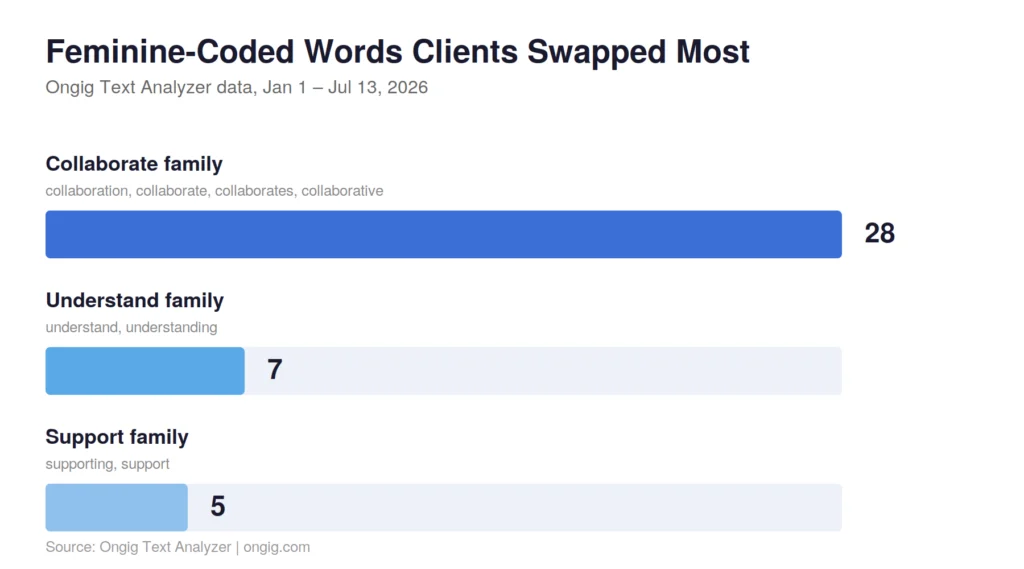
The landscape of inclusive language in talent acquisition continues to evolve, with new data from Ongig’s Text Analyzer revealing significant shifts in how recruiters actively address gender bias in job descriptions. For the first time, Ongig has moved beyond merely identifying frequently appearing feminine-biased words to tracking those specific terms that clients are consciously editing out of their job postings. This innovative approach, covering January through mid-July 2026, highlights the "collaborate" family of words as the most frequently swapped, followed closely by "understand" and "support." Notably, "committed," a word consistently flagged since 2019, has dropped off this year’s list of top-edited terms, suggesting a dynamic and responsive shift in linguistic awareness within the recruitment industry.
A New Lens on Linguistic Bias: Tracking Active Edits
Historically, analyses of gender-biased language in job descriptions have relied on frequency counts within vast datasets of job postings. Ongig’s previous reports in 2019 and 2024, for instance, identified prevalent feminine-coded terms by scanning random batches of job advertisements. However, the 2026 methodology marks a pivotal change. Leveraging its proprietary Text Analyzer tool, Ongig now tracks the actual behaviors of its clients – specifically, which feminine-biased words recruiters consciously choose to remove or replace. This shift from passive observation to active engagement data offers a more profound insight into what recruiters perceive as problematic and are actively working to correct.
Rob Kelly, a leading voice in inclusive hiring and author of the report, underscored the significance of this methodological evolution. "Knowing which words merely exist in job descriptions is one thing; understanding which words real recruiters flag and change is entirely another," Kelly explained. "This data tells us what truly matters to those on the front lines of talent acquisition, reflecting a tangible commitment to creating more inclusive language." The change in tracking, prompted by a Mixpanel update, provides a mid-year snapshot, with a more comprehensive year-end review anticipated to further solidify these emerging trends.
The Dominance of "Collaborate" and Its Kin
The 2026 data unequivocally points to the "collaborate" family of words—including "collaboration," "collaborate," "collaborative," and "collaborates"—as the most frequently edited cluster. This finding resonates with contemporary workplace trends that often emphasize teamwork and interconnectedness. While collaboration is a vital aspect of modern work, its overuse or uncritical application in job descriptions can inadvertently create a feminine-coded signal. Words associated with communal effort, support, and empathy are often subconsciously linked to traditionally feminine traits, potentially deterring candidates who might perceive the role as less challenging or impactful, or simply not aligning with their self-perception, particularly among male applicants.
Following "collaborate," the terms "understand" and "support" emerged as the next most frequently swapped words. These terms, while seemingly benign and universally positive, can also carry subtle gendered implications. "Understand" can sometimes imply a passive grasp rather than active mastery, while "support" often evokes a secondary or subordinate role, both of which can be perceived as less assertive or leadership-oriented. Recruiters, keenly aware of the need to attract a diverse pool of talent, are increasingly scrutinizing these terms, opting for more precise and action-oriented language.
The Curious Case of "Committed": A Shifting Linguistic Landscape
Perhaps one of the most intriguing findings of the 2026 report is the absence of "committed" from the list of top-swapped feminine-biased words. "Committed" had been a perennial fixture on Ongig’s lists since 2019, consistently identified as a term that disproportionately appeals to or is associated with female applicants. Its disappearance from the active swap list suggests a potential two-fold interpretation: either the word is being used less frequently in general job postings, or recruiters have become so adept at identifying and neutralizing its bias that it no longer ranks among the top terms requiring correction. This subtle but significant shift underscores the dynamic nature of language and the evolving awareness within the HR community.
Linguistic experts often point out that the perceived bias of words is not static; it changes with societal norms, cultural contexts, and increased awareness. The decline in "committed" swaps could reflect a broader internalization of inclusive language principles, where what was once a commonly overlooked bias is now more readily recognized and corrected at the initial drafting stage. This ongoing evolution highlights the continuous learning process required for truly unbiased communication in recruitment.
Global Context: The Weight of Words and the Glass Ceiling
Ongig’s micro-level data on word swaps aligns with broader global research on the profound impact of gendered language on labor force participation and career progression. A seminal study by Lightcast and UNESCO, analyzing job postings across six English-speaking countries, revealed a stark reality: women’s labor force participation is 25% lower than men’s worldwide. This disparity is particularly pronounced in industries like STEM (Science, Technology, Engineering, and Mathematics) and manufacturing, where male-coded language is significantly more prevalent in job descriptions.
The Lightcast and UNESCO research further demonstrated that linguistic bias extends beyond initial hiring. Manager-level job postings, for instance, consistently contain noticeably more masculine-coded language than non-managerial roles. This finding offers compelling linguistic evidence supporting the persistent "glass ceiling" phenomenon, where women face invisible barriers to advancement despite clearing initial hiring hurdles. The subtle reinforcement of traditionally masculine traits through job descriptions for leadership roles can inadvertently signal that these positions are better suited for men, perpetuating existing gender imbalances at the top.
The global study also identified "support" and "committed" among the top female-coded terms, echoing Ongig’s historical findings. While "committed" has seen a decline in active swaps in 2026, its previous prominence both in Ongig’s frequency analysis and the global study highlights its long-standing association with feminine-coded language. This confluence of data, from micro-level recruiter edits to macro-level linguistic analyses, underscores the pervasive influence of word choice on gender representation in the workforce.
The Imperative for Inclusive Language: Impact on Talent Acquisition
The implications of gender-coded language are far-reaching, impacting not only diversity metrics but also organizational performance and legal compliance. Companies that fail to address linguistic bias risk narrowing their applicant pools, missing out on qualified candidates, and undermining their diversity and inclusion (D&I) initiatives. Studies consistently show that job descriptions laden with masculine-coded terms deter female applicants, while those with feminine-coded terms can deter male applicants, although the impact on women tends to be more pronounced given historical systemic biases.
Beyond the ethical imperative, there’s a compelling business case for gender-neutral language. Diverse teams are repeatedly shown to be more innovative, productive, and financially successful. By unintentionally alienating segments of the talent pool, companies hamstring their ability to build high-performing teams and adapt to evolving market demands. Moreover, in an increasingly litigious and socially conscious environment, gender-coded language can pose significant reputational and even legal risks, depending on jurisdiction and public perception of a company’s hiring practices. Proactive mitigation of bias is therefore not just good practice but a strategic necessity.
Practical Strategies for Neutralizing Bias in Job Descriptions
Knowing which words are problematic is the first step; effectively neutralizing them is the crucial next. Ongig provides practical, actionable advice for recruiters looking to revise their job postings:
-
Deconstructing "Collaborate": Instead of repetitive phrases like "collaborative environment" or "collaborates cross-functionally," recruiters should pinpoint specific instances where teamwork is essential. For example, rather than stating "Requires strong collaboration skills," specify "Works closely with engineering and product teams to define project requirements." Substitute generic "collaborate" with more active and precise alternatives like "works with," "partners with," "coordinates with," or "integrates efforts with." This not only removes the potential bias but also provides candidates with a clearer understanding of the actual job function.
-
Clarifying "Understand": The word "understand" often signals a passive knowledge rather than demonstrated capability. A phrase like "Understanding of SQL" is vague and can be perceived as less demanding. Recruiters should replace it with action-oriented descriptions that articulate the expected skill level. For instance, "Comfortable writing complex SQL queries," "Proficient in SQL database management," or "Able to troubleshoot SQL-related issues" convey a much clearer and more objective requirement, appealing to all candidates regardless of gender perception.
-
Reframing "Support": While "support" can describe a legitimate job function, its frequent use can inadvertently imply a secondary or subservient role. Instead of "Supports the sales team," recruiters should elaborate on the specific responsibilities and contributions. For example, "Manages client onboarding processes and facilitates contract renewals for the sales department" or "Provides technical assistance and training to the sales force on product features." This approach transforms a passive description into a concrete outline of responsibilities, making the role more attractive and clearer to a broader audience.
The overarching principle behind these recommendations is specificity. Vague language is a common hiding place for subtle gender coding. By meticulously describing the actual tasks, responsibilities, and expected outcomes of a role, recruiters minimize the room for any single word to carry unintended gendered signals. This precision benefits all applicants, creating a more transparent and equitable hiring process.
The Role of Technology in Fostering Inclusive Hiring
The ongoing challenge of linguistic bias in recruitment has spurred the development and adoption of sophisticated HR technology solutions. Tools like Ongig’s Text Analyzer leverage artificial intelligence and natural language processing to identify and suggest alternatives for gender-coded language, as well as other forms of bias (e.g., age, race, ability). These platforms provide real-time feedback, empowering recruiters to craft job descriptions that are not only compliant but also genuinely inclusive and appealing to a diverse talent pool.
The shift in Ongig’s methodology – from identifying common words to tracking active client swaps – reflects the maturation of this technology and the growing sophistication of its users. It demonstrates that companies are moving beyond mere awareness to proactive intervention, integrating bias detection into their daily recruitment workflows. As D&I continues to be a top priority for organizations globally, the role of such technological aids will only grow in importance, acting as crucial enablers for systemic change.
Looking Ahead: The Evolving Pursuit of Equity
The 2026 data from Ongig underscores that the journey towards truly equitable hiring is continuous. Language is fluid, and societal perceptions of words evolve. What is considered neutral today may carry subtle biases tomorrow, necessitating ongoing vigilance and adaptation from recruiters and HR professionals. The proactive engagement of Ongig’s clients in actively editing biased terms is a positive indicator of an industry increasingly committed to dismantling barriers to diversity.
As organizations strive to build workforces that reflect the rich tapestry of society, the careful crafting of job descriptions remains a foundational element. By focusing on specificity, leveraging advanced technological tools, and staying attuned to the ever-shifting nuances of language, companies can create more welcoming and equitable entry points for all candidates, paving the way for a more diverse, innovative, and ultimately, more successful future.
July 16, 2026 by Rob Kelly in Writing Job Descriptions