The Evolution of the AI Expectation Gap
The rapid acceleration of AI adoption within the educational technology (EdTech) sector has created a unique market dynamic. In the wake of the 2023–2024 generative AI boom, learning technology providers pivoted their roadmaps to include automated content creation, AI-powered coaching, and predictive analytics. However, the data collected by eLearning Industry suggests that this "innovation-first" approach may be overlooking the immediate pain points of the workforce.
The "expectation gap" identified in the study highlights two distinct philosophies. On one side, vendors are designing for a future where AI handles the majority of administrative and pedagogical tasks. On the other, L&D buyers are increasingly selective, viewing AI not as a standalone solution but as a tool that must prove its worth within existing operational frameworks. This tension is not merely about the technology itself but about the "readiness" of organizations to absorb complex new features while they are still struggling with basic platform adoption and learner engagement.
Analysis of Buyer Priorities: Fundamentals Over Features
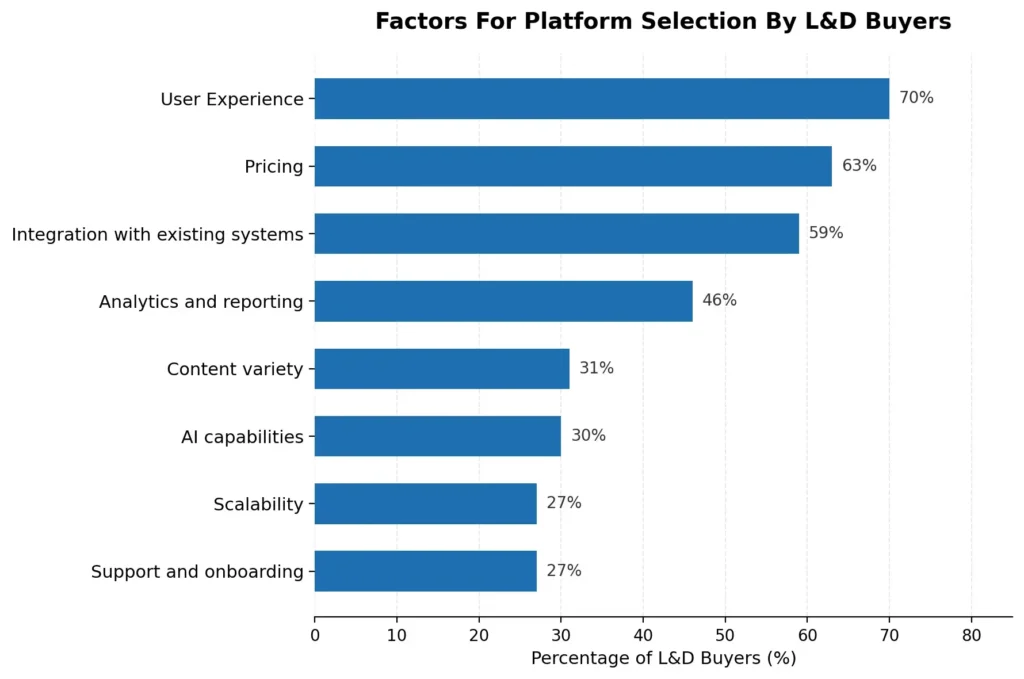
When examining the factors that influence platform selection, the report finds a stark preference for practical utility. Despite the marketing emphasis on cutting-edge AI, buyers prioritize the following:

- User Experience (UX): Cited by 70% of respondents as a top priority. In an era of "app fatigue," L&D leaders recognize that if a platform is not intuitive, learners will simply not use it, regardless of how advanced its AI capabilities are.
- Pricing and Value: At 63%, cost remains a critical barrier. As organizations face tightening budgets, every new technology investment must undergo rigorous Return on Investment (ROI) scrutiny.
- Integration Capabilities: 59% of buyers demand that new learning tech "plays well" with their existing ecosystem, such as Human Resources Information Systems (HRIS), Customer Relationship Management (CRM) tools, and communication platforms like Slack or Microsoft Teams.
- Analytics and Reporting: 46% of buyers focus on data-driven insights. They require tools that can prove the effectiveness of training programs to stakeholders.
- AI Features: Interestingly, AI features were cited as a primary selection factor by only 30% of buyers. This suggests that while AI is an influential force, it is currently viewed as a "nice-to-have" or a secondary enhancement rather than a foundational requirement.
The Satisfaction Disconnect: A Reality Check for Vendors
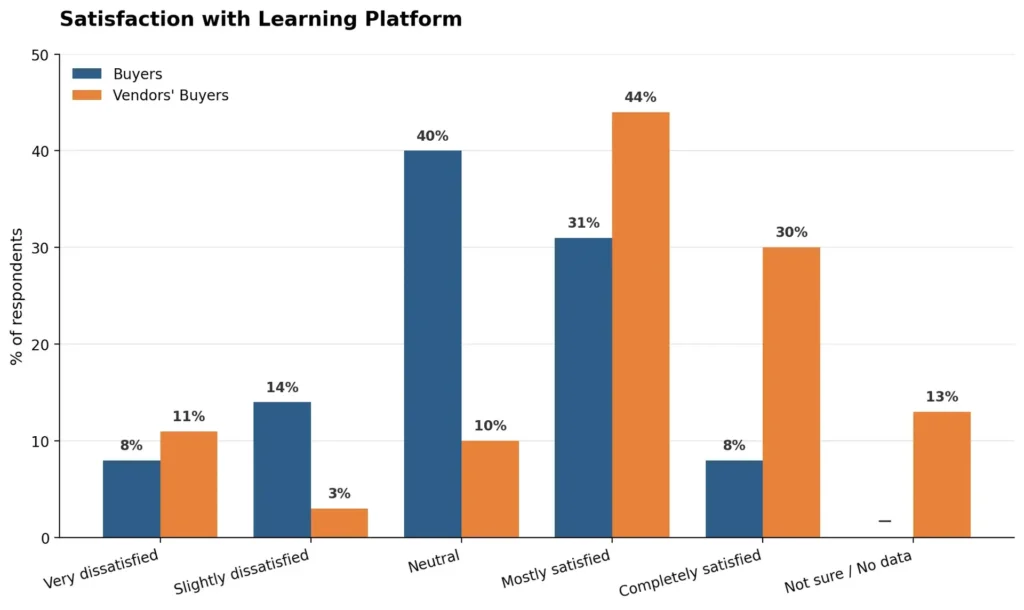
Perhaps the most jarring revelation in the report is the disparity between how vendors perceive their success and how buyers actually feel. This "perception gap" suggests that vendors may be operating in an echo chamber of their own innovation.
According to the survey, vendors are highly optimistic about their impact: 74% believe their customers are either "mostly satisfied" or "completely satisfied." Specifically, 30% of vendors claim their clients are completely satisfied, and 44% report high levels of satisfaction. Only a negligible 3% of vendors believe their customers are dissatisfied.
The buyer’s perspective tells a different story. Only 8% of L&D buyers describe themselves as "completely satisfied" with their current learning platforms. The largest segment, 40%, remains neutral, while 22% report varying degrees of dissatisfaction. This 22-point difference in "complete satisfaction" between vendors and buyers indicates that many providers are failing to address the day-to-day frustrations of administrators and learners. The neutrality of the 40% majority suggests a market of "passive users" who are using platforms out of necessity rather than preference, leaving them vulnerable to disruption by competitors who can better address their core needs.
Chronology of Market Shifts: From LMS to LXP and Back Again
To understand the current landscape, it is necessary to look at the timeline of platform evolution over the last decade.
- The LMS Era (Pre-2015): The Learning Management System was the undisputed king, focused on compliance, tracking, and management.
- The LXP Emergence (2015–2021): The Learning Experience Platform (LXP) was introduced to solve the "engagement" problem, focusing on content discovery and "Netflix-style" interfaces.
- The AI Integration Phase (2022–2024): Vendors began integrating Large Language Models (LLMs) to automate content creation and personalize pathways.
- The Pragmatic Realignment (2025–2026): The current phase, where buyers are returning to the LMS as a "source of truth" while demanding better virtual training tools.
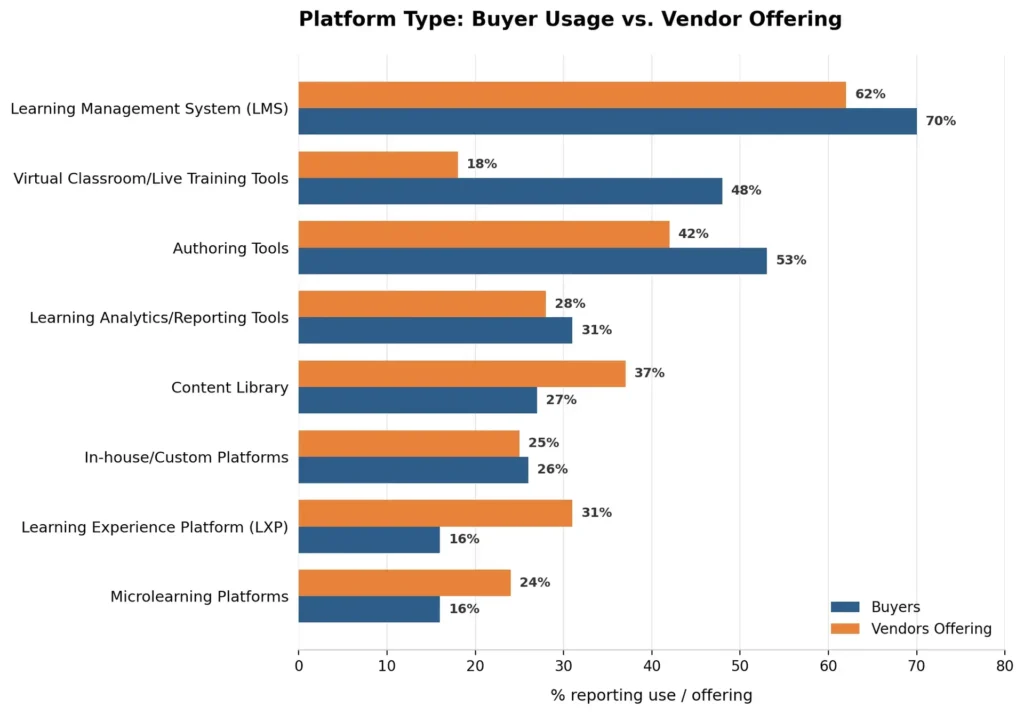
The report highlights a significant mismatch in platform types. While 31% of vendors are heavily promoting LXPs, only 16% of buyers report using them. Conversely, 48% of buyers are actively using virtual classrooms and live training tools, yet only 18% of vendors are currently emphasizing these in their development or marketing efforts. This suggests that while vendors are pushing for asynchronous, AI-driven experiences, the market still has a massive, unmet demand for high-quality, synchronous, human-led digital training.
The Impact of AI on Workforce Development at Scale
The implications of this report extend beyond procurement statistics; they touch on the very strategy of workforce development. As organizations attempt to upskill and reskill employees at scale, the "AI Expectation Gap" could lead to wasted investments.
If vendors continue to build AI features that do not integrate into workflows (the 59% priority) or improve the user experience (the 70% priority), the "neutrality" of buyers will likely turn into churn. For L&D leaders, the challenge is to avoid being swayed by "AI-washing"—the practice of vendors rebranding basic automation as advanced AI—and instead focus on tools that provide predictive analytics to identify skills gaps or workflow automation that saves time for overstretched HR teams.
Official Responses and Industry Sentiment
While individual companies were not named in the study to maintain the integrity of the benchmark, the aggregate sentiment from L&D practitioners suggests a "wait and see" approach. Many practitioners noted that while they are excited about the potential for AI to personalize training, they are concerned about data privacy and the accuracy of AI-generated content.
On the vendor side, the report suggests a need for a "humility pivot." Industry analysts participating in the review of the data suggest that providers who focus on "invisible AI"—features that work behind the scenes to improve the UI or simplify administrative tasks—will find more success than those marketing AI as a replacement for human instructors or complex management structures.
Broader Implications and the Path to 2026
The findings of the 2026 report serve as a roadmap for the next 18 months of development in the learning technology sector. For vendors, the message is clear: innovation must be grounded in the reality of the buyer’s environment. To bridge the satisfaction gap, providers must move beyond the "novelty" phase of AI and focus on:
- Empowering Administrators: Automating the "grunt work" of reporting and compliance so L&D leaders can focus on strategy.
- Human-Centric Design: Investing in virtual classroom technology that facilitates real human connection, which buyers clearly still crave.
- Transparent ROI: Providing clear data that links learning activities to business outcomes.
For buyers, the report reinforces the importance of being a "skeptical optimist." AI has the potential to revolutionize learning, but only if it is built on a foundation of solid UX and seamless integration. The "neutrality" currently felt by 40% of the market represents a significant opportunity for the industry to evolve.
As the learning tech market matures, the "Expectation Gap" will likely narrow as vendors realize that "advanced" does not always mean "better." The winners of the 2026 market will be those who use AI to make learning more human, more accessible, and more integrated into the daily flow of work, rather than those who use it to create more complexity in an already crowded digital landscape.
The full report, "The AI Expectation Gap In Learning Tech 2026," remains a vital benchmark for organizations looking to align their technology strategies with the actual needs of the modern workforce, ensuring that the future of learning is shaped not just by what is possible, but by what is purposeful.