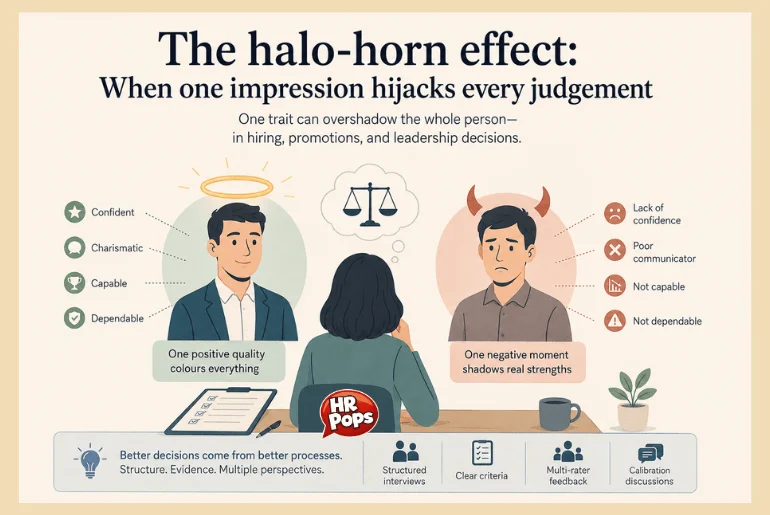
The halo effect, a deeply ingrained cognitive bias, describes the phenomenon where one positive quality influences how we judge every other aspect of a person. Whether it’s perceived confidence, charisma, fluency in communication, or even physical appearance, such a favourable initial impression can lead to the assumption of other, unrelated strengths. Conversely, the horn effect operates in the opposite direction: a single visible weakness, a poorly executed presentation, an awkward interview, or an isolated mistake, can colour every subsequent judgment, making genuine strengths significantly harder to recognise and appreciate. These terms, evocative in their simplicity, derive their names from familiar imagery – a halo symbolising virtue and horns suggesting the inverse – encapsulating the psychological tendency to allow one dominant characteristic to disproportionately sway our overall assessment of an individual.
These cognitive shortcuts are not aberrations but rather integral components of normal human thinking, serving to facilitate rapid decision-making in the complexities of everyday life. However, within organisational structures, these swift, often subconscious judgments frequently morph into pivotal career decisions, profoundly impacting individuals’ trajectories from hiring to promotion and beyond.
The Genesis of a Constant Error: Thorndike’s Groundbreaking Work
The intellectual bedrock of the halo effect traces back over a century to 1920, when American psychologist Edward Thorndike meticulously studied how military officers evaluated their soldiers. His pioneering research unveiled a consistent pattern: a single strong impression, such as a soldier’s physical bearing or perceived neatness, systematically influenced ratings across a spectrum of completely unrelated qualities. A soldier deemed physically impressive, for instance, was statistically more likely to be rated as intelligent, capable, and dependable, irrespective of any objective evidence supporting these additional attributes. Thorndike succinctly described this pervasive phenomenon as a "constant error in psychological ratings," highlighting its robust and persistent nature.
A century later, Thorndike’s "constant error" remains remarkably constant, though its operational setting has evolved dramatically. What once manifested within the confines of military barracks now permeates interview rooms, critical calibration meetings, succession planning discussions, and annual performance reviews across every sector of the global economy. This enduring relevance underscores the deeply entrenched nature of these biases in human cognition and their profound implications for fair and equitable assessment in professional environments.
The Pervasive Reach in HR: Why It Matters More Than Ever
Few business functions are as heavily reliant on nuanced human judgment as Human Resources. The decisions made by HR professionals and hiring managers—who to recruit, who to promote, how to evaluate performance, and who to invest in for leadership development—are fertile ground for the halo and horn effects.
Consider the hiring process: hiring managers frequently mistake outward confidence or a charming demeanour for genuine competence, overlooking equally or more qualified candidates who may present as more reserved. In performance management, employees with a single exceptional achievement might receive disproportionately strong overall ratings, overshadowing other areas where performance may have been average or even subpar. Conversely, an employee might carry the burden of a single, highly visible mistake or an awkward presentation, allowing that incident to overshadow years of consistent, strong performance long after its initial relevance has diminished.
Leadership decisions are similarly vulnerable. Charismatic individuals, often adept at self-promotion and networking, frequently receive greater visibility and opportunities for advancement. Meanwhile, quieter, consistently delivering contributors, whose impact might be more understated or collaborative, often struggle to be recognised for their substantial contributions. A 2019 study published in the Journal of Applied Psychology found that individuals perceived as more physically attractive were not only more likely to be hired but also received higher performance ratings and salaries, even when objective measures of productivity were controlled, illustrating the subtle yet powerful influence of the halo effect.
The impact is particularly pronounced in the critical domain of diversity, equity, and inclusion (DEI). Individuals who conform to existing leadership norms – often reflecting dominant cultural or demographic profiles – tend to accumulate "halos" more readily. Those who communicate differently, hail from unfamiliar backgrounds, or challenge conventional expectations are, regrettably, far more prone to encountering "horns." This dynamic perpetuates systemic inequalities, as established biases inadvertently favour homogeneity over diverse talent. Over time, these individual, subjective judgments coalesce into entrenched organisational patterns, shaping workforce demographics and leadership pipelines in ways that often hinder innovation and equity.
The Hybrid Workplace: An Amplifier, Not an Antidote
The seismic shift towards hybrid and remote work models, accelerated by recent global events, has fundamentally altered the mechanisms through which professional impressions are formed. In traditional physical workplaces, managers could observe employees across hundreds, if not thousands, of varied interactions – informal chats by the water cooler, spontaneous collaborations, or direct observations of problem-solving. In contrast, hybrid environments condense these observations into significantly fewer, often curated signals: performance on video calls, responsiveness to emails, perceived "camera confidence," or visibility during structured virtual meetings.
The psychological principle at play here is stark: the smaller the sample size of interactions, the greater the disproportionate influence of initial impressions. Employees who are naturally reserved or less adept at "performing" in digital environments may quietly lose visibility and opportunities, suffering from an inadvertent horn effect. Conversely, those who are comfortable and articulate in digital settings – perhaps naturally extroverted, or simply more skilled at virtual self-presentation – can accumulate disproportionate influence and perceived competence, benefiting from an amplified halo effect. A survey by Owl Labs in 2021 indicated that remote employees were 22% less likely to receive a promotion than their in-office counterparts, suggesting a "proximity bias" that could be heavily influenced by managers’ halo effects towards those they see regularly.
Far from eradicating the halo and horn effects, technology and the shift to hybrid work have, in many cases, inadvertently amplified them, creating new challenges for equitable talent management.
The Uncomfortable Reality: Beyond Awareness Training
Most organisations, recognising the pervasive nature of bias, respond by implementing training programs designed to raise managers’ awareness of unconscious biases. While undeniably necessary, this approach is rarely, if ever, sufficient on its own.
The uncomfortable truth is that simply knowing the halo effect exists does not magically prevent it from influencing decisions. Under the relentless pressures of time, demanding workloads, and complex decision-making, managers, like all humans, continue to rely on mental shortcuts. These heuristics are precisely how the human brain efficiently conserves cognitive effort, making them incredibly difficult to override through sheer willpower or awareness alone. Research by Professors Iris Bohnet and Max Bazerman from Harvard Business School has consistently shown that while bias awareness training can be helpful, its impact on actual behaviour change is often limited, especially when systemic factors remain unaddressed.
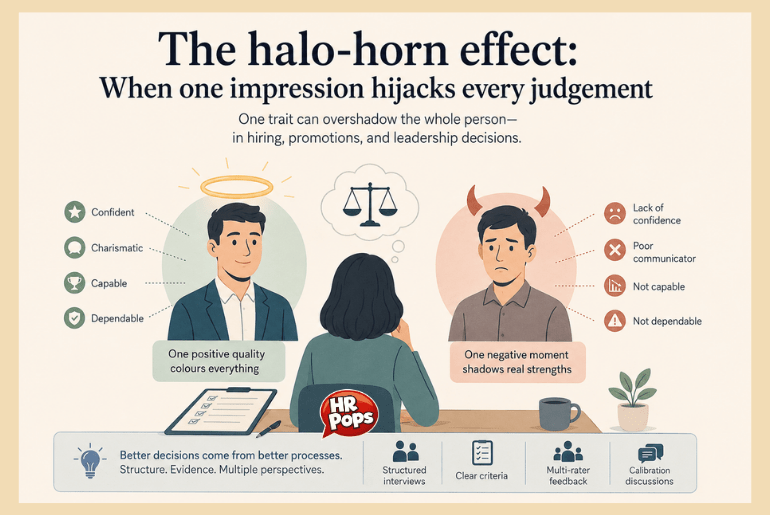
The more significant, and often overlooked, issue lies not just with individual managers but with the very HR systems and processes that organisations employ. Many of these systems inadvertently encourage and even embed these biases. Performance reviews that reduce an entire year’s worth of complex contributions to a single numerical rating, for example, implicitly invite managers to rely on overall impressions rather than granular, evidence-based assessment. Unstructured interviews, where questions vary and evaluation criteria are subjective, inherently reward superficial confidence and "likability" over demonstrable competence. Promotion decisions built largely on the subjective advocacy of a single manager often reinforce existing perceptions and biases rather than objectively challenging them based on a wider pool of evidence.
Therefore, the problem is not solely one of "biased managers." It is fundamentally a challenge of "systems that make biased decisions easier."
Strategic Interventions: Designing for Objectivity
The most effective and sustainable response to the halo and horn effects is not the quixotic quest to make people perfectly objective. Rather, it is the strategic design and implementation of HR processes that inherently reduce their dependence on subjective, impression-based judgments.
Several proven methodologies can significantly mitigate these biases:
-
Structured Interviews: These involve asking all candidates the same set of predetermined, job-relevant questions, often with a standardised scoring rubric. This approach minimises interviewer bias by focusing on comparable responses and reducing the influence of unrelated first impressions. A meta-analysis published in Personnel Psychology found that structured interviews are significantly more predictive of job performance than unstructured ones, largely due to their ability to reduce cognitive biases.
-
Behavior-Based Assessments: Moving beyond hypothetical questions, these assessments require candidates to demonstrate specific job-related skills or problem-solving approaches. Examples include work sample tests, technical challenges, or simulations. These provide objective data points about actual capabilities rather than relying on self-reported skills or perceived confidence.
-
Multi-Rater Feedback (360-Degree Feedback): Instead of relying on a single manager’s perspective, collecting feedback from peers, subordinates, and even external stakeholders provides a more comprehensive, multi-faceted view of an individual’s performance and capabilities. This aggregation of diverse perspectives helps to dilute the impact of any single person’s halo or horn bias.
-
Calibration Discussions: In performance reviews or talent discussions, these sessions bring together multiple managers to review and discuss ratings collectively. The process involves challenging assumptions, scrutinising justifications, and ensuring consistency across teams and departments. This peer-review mechanism helps to identify and correct individual biases before final decisions are made.
-
Clearly Defined Evaluation Criteria: Establishing transparent, measurable, and job-specific criteria for performance, promotion, and leadership potential shifts the focus from vague impressions to concrete achievements and demonstrated competencies. This provides an objective framework against which individuals can be assessed, reducing the ambiguity that biases thrive on.
-
Blind Reviews: Where feasible, implementing blind reviews for initial stages of recruitment (e.g., removing names, photos, and demographic information from resumes) or performance evaluations can help mitigate biases related to gender, ethnicity, or other non-job-related characteristics. The example of orchestras using blind auditions, which dramatically increased the proportion of female musicians, serves as a powerful testament to this approach.
While none of these interventions can entirely remove human bias – as bias is an inherent part of human cognition – each strategy makes it significantly harder for one isolated characteristic or initial impression to dominate every critical decision. Good HR systems, therefore, do not aim to eliminate human judgment altogether; instead, they are meticulously designed to prevent a single, potentially biased impression from becoming the sole determinant of an individual’s professional destiny.
Broader Impact and Strategic Implications
The implications of unaddressed halo and horn effects extend far beyond individual careers, impacting the strategic health and long-term success of organisations.
- Talent Loss and Underperformance: When decisions are skewed by bias, organisations risk overlooking high-potential individuals, promoting less capable ones, and failing to nurture diverse talent. This leads to a less effective workforce and a diminished talent pipeline.
- Reduced Innovation and Adaptability: Homogeneous leadership teams, often a byproduct of halo effects favouring "people like us," tend to lack diverse perspectives, leading to groupthink and reduced capacity for innovation and strategic adaptation in a rapidly changing market.
- Erosion of Trust and Engagement: Perceived unfairness in hiring, promotion, or performance evaluations can severely damage employee morale, trust in leadership, and overall engagement, leading to higher turnover rates and a disengaged workforce. A Gallup study in 2022 highlighted that only 32% of employees felt engaged in their work, with fairness and trust being significant contributing factors.
- Legal and Reputational Risks: Systemic biases, even if unintentional, can expose organisations to significant legal challenges related to discrimination. Furthermore, a reputation for unfair practices can severely hamper an organisation’s ability to attract top talent and maintain its social license to operate.
The Enduring Takeaway
The halo and horn effects serve as powerful reminders that organisations rarely judge people as objectively as they might imagine. A single moment – be it a strikingly positive first impression or a noticeable stumble – can quietly, yet profoundly, influence hiring outcomes, promotion decisions, leadership opportunities, and entire career trajectories for years.
For Human Resources professionals, the fundamental challenge is not to eradicate judgment from people decisions – judgment is, after all, essential for nuanced evaluation. Rather, the imperative is to diligently ensure that judgment is rigorously built upon a foundation of verifiable evidence, robust data, and structured processes, rather than on fleeting, often biased, impressions.
Because, all too frequently, invaluable talent is overlooked, not through a genuine lack of ability or potential, but simply because someone formed a premature opinion before the full spectrum of evidence had the chance to speak for itself. Crafting systems that champion evidence over impression is not just a matter of fairness; it is a strategic imperative for unlocking an organisation’s true potential.