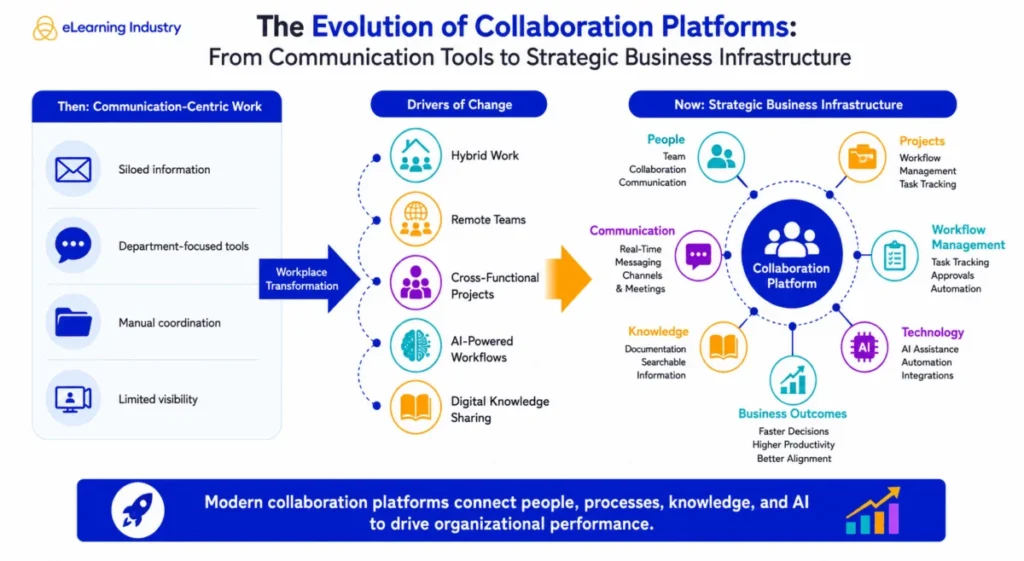
The modern corporate landscape is undergoing a fundamental transformation, shifting from physical-centric office models to dynamic, digital-first environments where collaboration platforms serve as the primary infrastructure for productivity. Once viewed as secondary tools for internal messaging, these platforms have evolved into comprehensive ecosystems that integrate communication, project management, and knowledge preservation. As organizations navigate the complexities of global operations and distributed workforces, the adoption of sophisticated collaboration technology has transitioned from a competitive advantage to an absolute operational necessity.
The Definition and Scope of Modern Collaboration Ecosystems
At its core, a collaboration platform is a centralized digital workspace designed to facilitate seamless interaction, information sharing, and goal alignment among team members. Unlike standalone tools that address specific, isolated tasks—such as a basic email client for messaging or a cloud drive for file storage—a true collaboration platform synthesizes these functions into a unified environment. This integration allows for the fluid movement of data and context across different work streams, ensuring that a conversation about a project is directly linked to the documents and tasks associated with it.
Industry experts distinguish between "communication" and "collaboration," noting that while communication is the act of exchanging information, collaboration is the act of working together toward a shared outcome. Modern platforms support this distinction by offering tools for coordination (task assignment and scheduling), cooperation (joint document editing), and cognition (knowledge management and institutional memory). This multi-layered approach ensures that employees, regardless of their physical location, can operate with the same level of synchronicity as if they were sharing a physical office.
A Chronological Perspective: From Intranets to Unified Digital Workspaces
The trajectory of collaboration technology reflects the broader history of the internet and workplace culture. In the late 1990s and early 2000s, collaboration was largely synonymous with email and basic internal websites, often referred to as intranets. These systems were static and unidirectional, primarily used by management to push information down to employees.
The mid-2000s saw the rise of "Enterprise 2.0," characterized by the introduction of wikis and early project management software like Basecamp. This era marked the beginning of user-generated content within the workplace. However, the true revolution began in the early 2010s with the emergence of "chat-first" platforms such as Slack, which challenged the dominance of email by prioritizing real-time, channel-based communication.
The pivotal turning point arrived in 2020 with the global COVID-19 pandemic. According to industry data, the adoption of collaboration platforms accelerated by an estimated five to seven years within a single twelve-month period. Organizations that had previously hesitated to embrace remote work were forced to deploy comprehensive digital suites, such as Microsoft Teams or Zoom, to maintain continuity. Today, the market has entered a phase of consolidation and advanced integration, where artificial intelligence (AI) and automation are being embedded into these platforms to further streamline workflows.
The Socio-Economic Drivers of Platform Adoption
Several macro-economic and cultural factors have converged to make collaboration platforms the backbone of modern business.
The Rise of the Hybrid and Asynchronous Work Model
The traditional 9-to-5 office model has been replaced by a hybrid paradigm. Recent labor statistics indicate that over 40% of the U.S. knowledge workforce operates in a hybrid or fully remote capacity. This shift has necessitated "asynchronous work," where team members contribute to projects at different times across various time zones. Collaboration platforms bridge these temporal gaps, providing a persistent record of progress that allows a developer in Bangalore to seamlessly pick up where a designer in San Francisco left off.
Escalating Organizational Complexity
Modern enterprises are increasingly matrixed, requiring frequent cross-functional collaboration. A single product launch may involve stakeholders from Marketing, Engineering, Legal, and Customer Success. Without a centralized platform, these departments often fall into "operational silos," where information is guarded or lost. Collaboration software breaks these barriers by creating transparent, cross-departmental workspaces that ensure everyone is aligned with the same Key Performance Indicators (KPIs).
Knowledge as a Strategic Asset
In an era of high employee turnover—often referred to as the "Great Resignation" or "Great Reshuffle"—preserving institutional knowledge is a critical challenge. When an employee leaves, their expertise often departs with them unless it has been captured within a shared system. Collaboration platforms act as a digital repository, archiving discussions, decision logs, and document versions. This creates an "organizational memory" that allows new hires to onboard faster and prevents the company from repeating past mistakes.

Quantifiable Benefits: Productivity, Engagement, and ROI
The implementation of robust collaboration tools yields measurable improvements across several business dimensions. A study by McKinsey & Company found that social collaboration tools can increase the productivity of highly skilled office workers by 20% to 25%.
Accelerated Decision-Making
By reducing the reliance on "ping-pong" email threads, platforms allow for real-time consensus building. Instant messaging and presence indicators enable employees to get immediate answers to urgent questions, significantly shortening project lifecycles. Data suggests that companies utilizing integrated platforms see a 30% reduction in time spent on internal meetings.
Enhanced Employee Engagement
Isolation is a primary risk factor in remote work. Collaboration platforms provide social features—such as "likes," emojis, and non-work channels—that help maintain company culture and peer-to-peer connections. High levels of digital connectivity are strongly correlated with employee retention; workers who feel they have the tools to collaborate effectively are 50% more likely to report being satisfied with their jobs.
Accountability and Transparency
Project-focused modules within these platforms provide clear visibility into "who is doing what by when." Dashboards and automated status updates replace manual reporting, reducing the "work about work" that often bogs down middle management. This transparency fosters a culture of accountability, as task ownership is documented and visible to the entire team.
Essential Features of High-Performing Platforms
When evaluating collaboration technology, decision-makers focus on several core functionalities that define the user experience and security posture.
- Real-Time and Asynchronous Communication: A mix of instant messaging for quick queries and threaded discussions for deep-dive topics.
- Content Co-Authoring: The ability for multiple users to edit documents simultaneously, with version control to prevent data loss.
- Intelligent Search: Advanced indexing that allows users to find information buried in past conversations or obscure documents, often powered by AI.
- Workflow Automation: Low-code or no-code tools that allow teams to automate repetitive tasks, such as approval workflows or status notifications.
- Enterprise-Grade Security: Given that these platforms house sensitive intellectual property, they must offer end-to-end encryption, multi-factor authentication (MFA), and compliance with global standards like GDPR, SOC2, and HIPAA.
Strategic Implementation: Avoiding the "Tool Fatigue" Trap
Despite the benefits, the proliferation of digital tools has led to a phenomenon known as "tool fatigue" or "context switching." Research indicates that the average employee switches between different apps and websites nearly 1,200 times a day, costing up to four hours of productive time per week.
To mitigate this, industry leaders suggest a "platform-first" rather than a "tool-first" strategy. Christopher Pappas, CEO of eLearning Industry, emphasizes that "Collaboration is no longer a soft skill or a workplace initiative, but a business capability. The organizations that invest in connecting people, knowledge, and workflows will be better positioned to adapt, innovate, and compete."
Successful implementation requires a structured framework:
- Objective Alignment: Define whether the goal is to reduce email volume, improve project delivery times, or enhance remote culture.
- User Adoption Risk Assessment: Ensure the interface is intuitive. If a tool is too complex, employees will revert to "shadow IT"—using unauthorized apps like WhatsApp or personal Dropbox accounts to get work done.
- Integration Ecosystem: The platform must "talk" to existing software, such as CRM (Salesforce), HRIS (Workday), or ERP systems, creating a "single source of truth."
The Future Landscape: AI and the Metaverse
Looking ahead, the next frontier for collaboration platforms is the integration of Generative AI and immersive technologies. AI assistants are already being deployed to summarize long meeting transcripts, draft replies, and predict resource bottlenecks. Meanwhile, some firms are experimenting with "virtual offices" in the metaverse, attempting to replicate the serendipitous "water cooler" moments of physical offices through 3D spatial environments.
Conclusion
Collaboration platforms have evolved from simple utilities into the very fabric of the modern enterprise. By centralizing communication, document management, and project execution, these tools enable organizations to navigate the complexities of a globalized, hybrid economy. However, the technology is merely a facilitator; true success depends on a corporate culture that values transparency, knowledge sharing, and continuous improvement. As we move further into the decade, the ability to effectively leverage these platforms will remain the defining characteristic of high-performing, resilient organizations.