A comprehensive analysis conducted by Ongig’s Text Analyzer between January 1 and July 13, 2026, has identified the ten most frequently swapped masculine-coded words in job descriptions, underscoring a persistent challenge in attracting a diverse talent pool. The findings, derived from real-time user edits, pinpoint "strong," "lead," and "independently" as the leading offenders, demonstrating how subtle linguistic biases can inadvertently deter female applicants and perpetuate gender disparities in the workforce. This mid-year review for 2026 provides a critical snapshot of employers’ ongoing efforts to create more inclusive hiring practices and highlights the significant impact that seemingly innocuous word choices can have on recruitment outcomes.
The Pervasive Nature of Implicit Bias in Job Postings
Job description gender bias often stems from implicit or unconscious biases, where hiring managers and recruiters unintentionally employ language that resonates more strongly with one gender over another. This phenomenon is not new; researchers and diversity, equity, and inclusion (DEI) advocates have long highlighted how gendered language can subtly signal a less inclusive environment, particularly for roles historically dominated by men or in industries striving for better gender balance. The data collected by Ongig’s Text Analyzer offers tangible evidence of these biases in action, showing which specific words are most commonly perceived as exclusionary and subsequently replaced by users seeking to broaden their applicant pool.
The analysis, which meticulously tracked every masculine-coded word swap initiated and accepted by users of the AI-powered Text Analyzer, reveals that a significant portion of gender bias in job descriptions can be mitigated by addressing a relatively small number of frequently used terms. According to Ongig, approximately 70% of job description gender bias can be removed by simply changing just ten of the most commonly used masculine words. This "80/20 rule" (or closer to a "70/10 rule" in this context) suggests that focused linguistic adjustments can yield substantial improvements in attracting a more diverse candidate pipeline.
Methodology: Real-World Edits, Not Scrapes
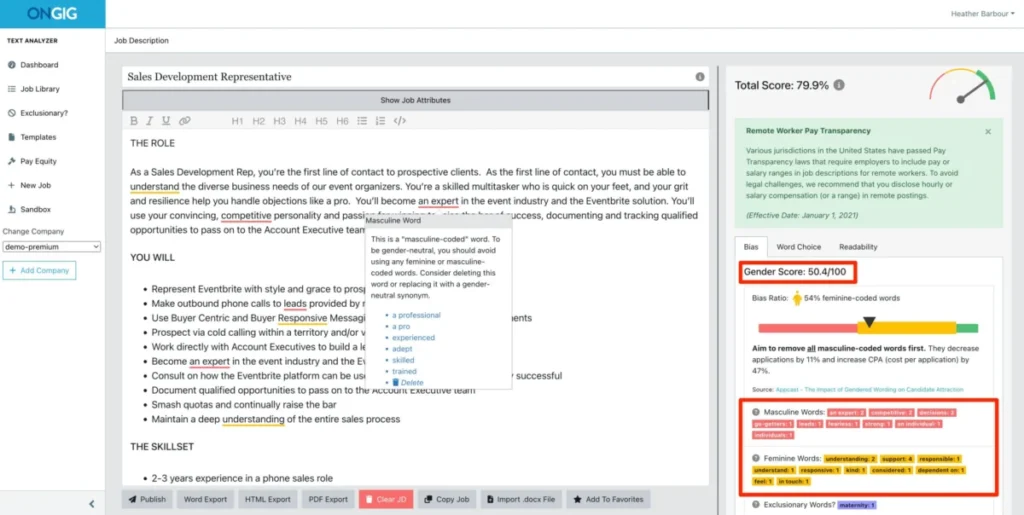
The robustness of Ongig’s findings lies in its unique data collection methodology. Unlike one-time samples or third-party scrapes, this report is based on real edits made to real job postings by actual users of Ongig’s Text Analyzer. This AI-powered tool actively flags gender-biased language and suggests neutral alternatives. Every instance where a user accepted a suggested swap for a masculine-coded word was logged, providing a direct reflection of current employer behavior and their active engagement in de-biasing their recruitment materials. This approach offers an authentic, dynamic view of where linguistic bias is most prevalent and what corrective actions employers are taking in real-time. The data covers the first half of 2026, specifically from January 1 to July 13, offering up-to-date insights into contemporary hiring challenges.
Top 10 Masculine-Coded Words and Their Impact
The Ongig analysis identified the following top 10 masculine-coded words that users most frequently swapped out during the first half of 2026, along with their swap counts:
| Rank | Word | 2026 Swaps |
|---|---|---|
| 1 | Strong | 42 |
| 2 | Lead | 26 |
| 3 | Independently | 13 |
| 4 | Strengthen | 12 |
| 5 | Competitive | 10 |
| 6 | Leaders | 10 |
| 7 | Analyze | 9 |
| 8 | Champion | 8 |
| 9 | Analysis | 7 |
| 10 | Independent | 7 |
Let’s delve deeper into each of these terms, exploring why they are considered masculine-coded and offering a broader range of gender-neutral alternatives.
1. "Strong" (42 swaps)
Often used to describe desired skills or qualities like "strong communication" or "strong written skills," the word "strong" carries connotations of dominance, power, and assertiveness, traits traditionally associated with masculinity. While not inherently negative, its overuse can subtly signal an environment where such traits are prioritized above others, potentially alienating candidates who identify with more collaborative or empathetic attributes.
- Examples: "Strong communication skills," "Strong desire to succeed," "Strong analytical abilities."
- Gender-Neutral Alternatives: Effective, excellent, solid, proficient, capable, robust, well-developed, advanced, impactful, keen.
2. "Lead" (26 swaps)
Frequently appearing in phrases such as "Lead sales," "Lead projects," or "Project Lead," this word evokes command and direct authority. Leadership itself is not gendered, but the way "lead" is often used in job descriptions can emphasize hierarchical, directive forms of leadership over collaborative or facilitative styles. This can be less appealing to individuals, particularly women, who may associate success with teamwork and shared responsibility.
- Examples: "Lead sales initiatives," "Lead status review meetings," "Lead projects and teams."
- Gender-Neutral Alternatives: Guide, manage, direct, oversee, coordinate, facilitate, spearhead, drive, develop, influence.
3. "Independently" (13 swaps)
When employers describe the ability to work without constant oversight, terms like "Must be able to work independently" or "Manages priorities independently" are common. This word, like its root "independent," often implies solo achievement and autonomy. Research suggests that while self-reliance is valued, an overemphasis on "independence" can inadvertently de-emphasize collaboration and teamwork, attributes often seen as more feminine-coded, thereby potentially reducing interest from female candidates.
- Examples: "Must be able to work independently on multiple projects," "Manages priorities independently and reliably," "Comfortable making decisions independently."
- Gender-Neutral Alternatives: Autonomously, self-sufficiently, proactively, with initiative, self-directed, without close supervision, on one’s own initiative.
4. "Strengthen" (12 swaps)
As a verb used to describe improving processes, teams, or outcomes (e.g., "Strengthen our client relationships"), "strengthen" carries the same masculine-coded root as "strong." It implies building robustness and resilience, which, when overused alongside other masculine-coded terms, contributes to an overall tone that may not appeal to a diverse range of candidates.
- Examples: "Strengthen our client relationships," "Strengthen internal reporting processes," "Strengthen the sales pipeline."
- Gender-Neutral Alternatives: Enhance, improve, develop, bolster, reinforce, optimize, fortify, elevate, expand, refine.
5. "Competitive" (10 swaps)
This word frequently appears when describing compensation ("competitive salary") or the desired candidate’s drive ("highly competitive individual"). While it aims to attract top talent or highlight an attractive offer, "competitive" can be perceived as aggressive or confrontational, characteristics more traditionally aligned with masculine stereotypes. This can deter candidates who prefer collaborative environments or who do not identify with an overtly competitive mindset.
- Examples: "Competitive compensation package," "Seeking a highly competitive individual," "Thrives in a competitive market."
- Gender-Neutral Alternatives: Excellent, outstanding, attractive, compelling, robust, top-tier, industry-leading, high-performing, results-oriented, ambitious.
6. "Leaders" (10 swaps)
Similar to "lead," using "leaders" (e.g., "We’re looking for future leaders," "Join a team of industry leaders") can emphasize a top-down, hierarchical structure. While aspirational, this term, especially when used without balancing collaborative language, can suggest a culture that rewards traditional, often masculine, leadership styles.
- Examples: "We’re looking for future leaders," "Join a team of industry leaders," "Leaders in this role set the tone for the department."
- Gender-Neutral Alternatives: Innovators, pioneers, visionaries, experts, influencers, key contributors, high-achievers, strategists, role models, mentors.
7. "Analyze" (9 swaps)
The verb form of "analysis," "analyze" is pervasive in job descriptions, particularly for roles requiring critical thinking and data interpretation. While a neutral action, its frequent appearance can contribute to a subtle masculine coding when presented within a larger context of other masculine-coded words. It can subtly emphasize a detached, objective approach over more holistic or interpretive methods.
- Examples: "Analyze quarterly performance data," "Analyze customer feedback trends," "Analyze and report on campaign results."
- Gender-Neutral Alternatives: Evaluate, assess, interpret, review, examine, investigate, scrutinize, dissect, explore, process.
8. "Champion" (8 swaps)
Used as a verb to describe advocating for something (e.g., "Champion our DEI initiatives"), "champion" is a competition-coded word. It implies a strong, often assertive, defense or promotion, which can align with masculine stereotypes of winning and fighting for a cause. This may not resonate with candidates who prefer more consensus-driven or supportive approaches to advocacy.
- Examples: "Champion our DEI initiatives," "Champion best practices across teams," "Champion change management efforts."
- Gender-Neutral Alternatives: Advocate for, promote, support, uphold, foster, drive, advance, encourage, facilitate, sponsor.
9. "Analysis" (7 swaps)
Tied for last place, "analysis" is the noun form of "analyze" and is used in myriad ways, such as "detailed analysis" or "data analysis." Like its verb counterpart, "analysis" itself is neutral. However, its consistent use within a text saturated with other masculine-coded terms can contribute to an overall impression that values purely objective, rational approaches, potentially overlooking other valuable perspectives.
- Examples: "Make recommendations based on detailed analysis," "Provide qualitative analysis," "Conduct data analysis."
- Gender-Neutral Alternatives: Evaluation, assessment, interpretation, review, examination, investigation, scrutiny, insights, findings, report.
10. "Independent" (7 swaps)
Also tied for last, "independent" describes a candidate who works well alone or without supervision. This word, and its adverb form "independently," can be interpreted as masculine-coded because it emphasizes solo achievement and autonomy, potentially at the expense of teamwork and collaborative skills. For many women, who are often socialized to value interpersonal connections and collective success, an overemphasis on "independent" work might suggest a less appealing work environment.
- Examples: "Seeking an independent, driven individual who works well alone," "You must be able to work independently and assertively," "Be comfortable working independently."
- Gender-Neutral Alternatives: Self-reliant, autonomous, self-starter, proactive, resourceful, capable, self-directed, enterprising, innovative, adaptable.
The Broader Context: Gender Bias in Hiring and Its Consequences
Gender bias in job descriptions is but one facet of a larger, systemic problem of gender inequality in employment. From unconscious biases held by hiring managers to disparities in parental leave policies, numerous factors contribute to an uneven playing field. While employers cannot single-handedly dismantle all forms of gender inequality, addressing bias in the hiring process, particularly in job descriptions, is a critical and actionable step. A job description is often the first point of contact between an organization and a potential candidate. If this initial interaction contains language that subtly discourages specific demographics, it can significantly narrow the talent pipeline before qualified individuals even have a chance to apply.
The subtle nature of masculine-coded words means they often go unnoticed during initial reviews. Words like "strong" or "competitive" might appear neutral or even desirable. However, when these terms are clustered together, they create a cumulative effect, constructing a linguistic environment that implicitly favors certain personality traits or work styles over others. This "death by a thousand cuts" approach can inadvertently communicate that an organization does not prioritize an inclusive workplace, making it less attractive to a diverse range of candidates.
Empirical Evidence: The Research Backing Bias Detection
The insights from Ongig’s 2026 data are not isolated; they are supported by a growing body of academic and industry research.
- Lightcast and UNESCO Collaboration: Labor market data provider Lightcast, in partnership with UNESCO, analyzed job postings across six countries. Their findings revealed a direct correlation between masculine-coded language and lower female employment, especially in senior and STEM roles. Notably, two of the terms flagged by Lightcast as most common, "lead" and "independent," also feature prominently in Ongig’s top 10 list, reinforcing the pervasive nature of these specific biases. This research provides a macro-level validation of the micro-level word swaps observed by Ongig.
- 2025 PNAS Study: Further strengthening the case, a significant 2025 study published in the Proceedings of the National Academy of Sciences (PNAS) examined nearly 38,000 applicants across four distinct studies. This research demonstrated conclusively that swapping masculine-coded words for gender-neutral alternatives measurably increased application rates among women. Crucially, it also boosted applications from men who do not strongly identify with traditional masculine traits, indicating a broader appeal of inclusive language to a wider, more diverse talent pool.
These studies collectively underscore a clear message: the language used in job descriptions is not merely descriptive; it is prescriptive, influencing who feels invited to apply and who does not. Ignoring this linguistic dimension of hiring can lead to self-inflicted talent shortages and missed opportunities for innovation.
Implications for Talent Acquisition and Organizational Success
The ramifications of gender-biased language extend far beyond simply reducing the number of female applicants.
- Shrinking the Talent Pool: By alienating a significant portion of the potential workforce, organizations inadvertently shrink their available talent pool. In today’s competitive labor market, limiting access to qualified candidates due to biased language is a strategic disadvantage.
- Impact on Diversity and Innovation: Diverse teams are proven to be more innovative, productive, and financially successful. When biased language hinders the recruitment of diverse talent, companies miss out on the varied perspectives, problem-solving approaches, and creativity that such teams bring.
- Employer Branding and Reputation: In an era where corporate values and DEI commitments are scrutinized, an organization’s job postings serve as a public declaration of its culture. Companies perceived as having gender-biased language risk damaging their employer brand, making it harder to attract top talent across all demographics.
- Economic Performance: Ultimately, the inability to attract and retain diverse talent can impact a company’s bottom line. Studies consistently show that companies with higher gender diversity outperform their less diverse counterparts in terms of profitability and value creation.
Expert Perspectives and Proactive Strategies
"The findings from Ongig’s Text Analyzer are a stark reminder that unconscious bias is deeply embedded in our language," states Dr. Anya Sharma, a leading DEI strategist. "While awareness of gender bias has grown significantly, the practical application of inclusive language remains a challenge for many organizations. Tools like Ongig are invaluable in translating that awareness into actionable change, offering immediate, data-backed solutions."
HR leaders are increasingly recognizing the imperative to address linguistic bias. "As an HR professional, I’ve seen firsthand how subtle word choices can unintentionally exclude qualified candidates," comments Marcus Thorne, Head of Talent Acquisition at a global tech firm. "The 2026 data provides clear guidance on where to focus our efforts. It’s about more than just fairness; it’s about optimizing our talent strategy to secure the best minds, regardless of gender."
To effectively combat job description gender bias, organizations should adopt a multi-faceted approach:
- Leverage AI Tools: Integrating AI-powered text analyzers, like Ongig’s, into the recruitment workflow can provide real-time feedback and suggestions, making it easier for recruiters and hiring managers to identify and correct biased language.
- Training and Awareness: Regular training sessions on unconscious bias and inclusive language are essential for all individuals involved in the hiring process, from job description creation to interviewing.
- Standardized Templates and Guidelines: Developing standardized, gender-neutral job description templates and providing clear linguistic guidelines can help ensure consistency and reduce individual bias.
- Regular Audits and Reviews: Periodically auditing existing job descriptions and recruitment materials can help identify persistent biases and measure the effectiveness of de-biasing efforts.
- Focus on Competencies and Outcomes: Shifting the language to focus on specific competencies, skills, and desired outcomes rather than vague, personality-driven traits can naturally lead to more inclusive language.
The Road Ahead: Continuous Improvement Through Technology and Awareness
The 2026 data from Ongig provides a crucial mid-year benchmark, demonstrating that while progress is being made, the challenge of linguistic gender bias in job descriptions remains significant. The continued development and adoption of AI tools like Ongig’s Text Analyzer will be pivotal in assisting organizations to systematically identify and rectify these biases. By making it easier for employers to write job descriptions that are genuinely inclusive, these technologies empower companies to tap into a broader, more diverse talent pool, fostering environments that are not only equitable but also more innovative and successful.
In conclusion, removing gender-biased language from job descriptions is not merely a matter of political correctness; it is a strategic imperative. It makes sound financial sense by expanding the talent pool, streamlines the hiring process by attracting more qualified applicants, and, most importantly, it is simply the right thing to do. By promoting job titles and listings written with inclusive language, organizations signal their commitment to fairness, challenge gender stereotypes, and demonstrate their readiness to hire the best-qualified individuals from all backgrounds. The 2026 findings serve as a powerful call to action for every organization committed to building a truly diverse and equitable workforce.