
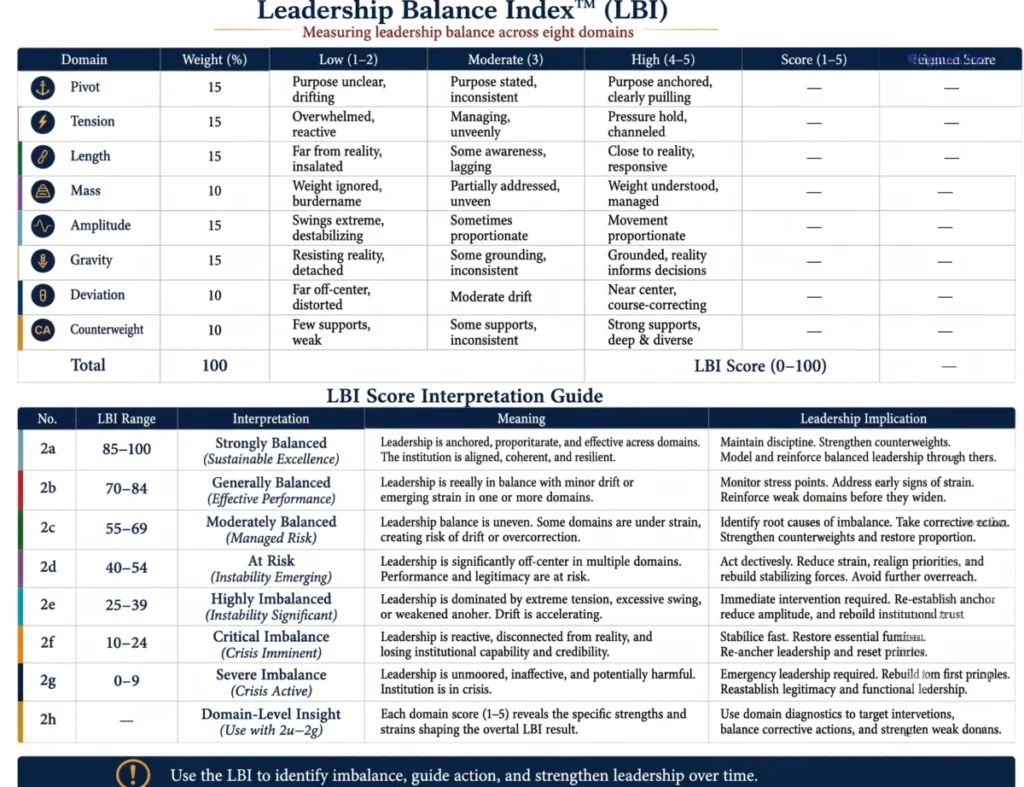
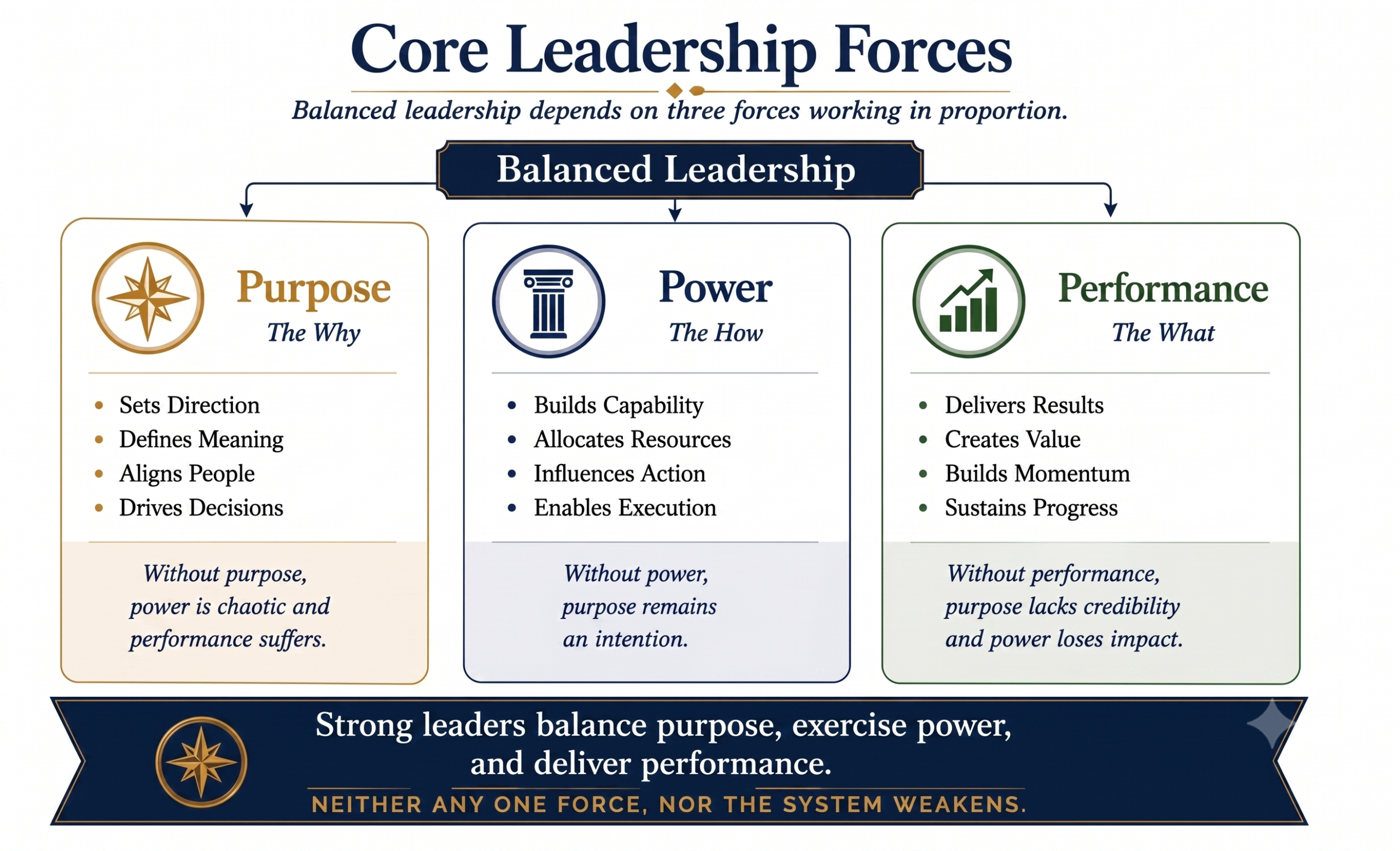
In an era defined by rapid technological disruption and geopolitical instability, the failure of institutional leadership is rarely the result of stagnation; rather, it is increasingly driven by the phenomenon of overcorrection. Modern leadership fails not because leaders stop moving, but because they respond to one extreme with another, substituting raw force for nuanced judgment and confusing visible, frenetic action with disciplined, strategic direction. Institutions drift into irrelevance or crisis when their leaders fail to maintain the delicate proportion between purpose, power, and performance, leading to a loss of legitimacy and organizational endurance.
The core challenge for the contemporary executive is navigating the "paradox of choice." While leaders today have access to more data streams, stakeholder demands, and strategic alternatives than any of their predecessors, this abundance often weakens the discipline required to decide what is institutionally necessary. When every option appears both possible and urgent, choice creates an illusion of control while simultaneously widening the "swing" of the leadership pendulum. This increased tension weakens the organizational pivot, making decisive, sustainable movement nearly impossible to maintain.
The Leadership Pendulum: A Diagnostic Framework
To address these systemic vulnerabilities, organizational theorists have introduced the Leadership Pendulum Integrated Model. This framework moves beyond the abstract metaphors of "balance" and "charisma" to provide a diagnostic tool for assessing how leadership loses proportion. The model posits that leadership balance is not a fixed personality trait or a stable temperament, but a contextual calibration. A behavior that appears decisive in a turnaround scenario may be viewed as destabilizing in a period of steady growth; an empathetic response in one context may be dismissed as weak in another.

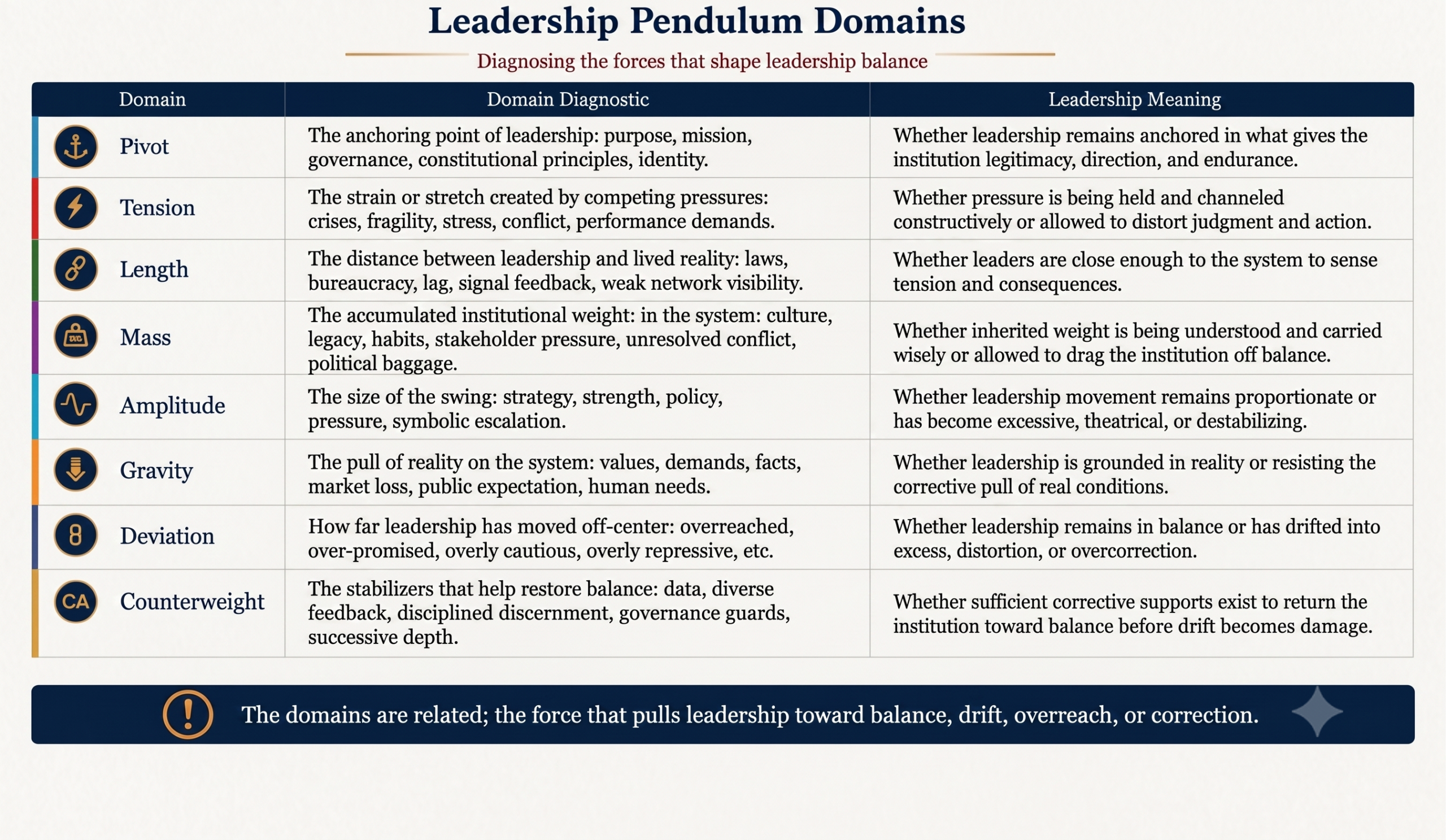
The model identifies seven critical domains that dictate the movement and stability of the leadership pendulum:
- The Pivot: The strength of the organization’s mission and governance structures.
- Tension: The accumulation of internal and external pressures from stakeholders.
- Length: The structural distance between decision-makers and the lived reality of the organization’s front lines.
- Mass: The inherited weight of past decisions, legacy systems, and institutional culture.
- Amplitude: The scale and frequency of strategic shifts or "swings."
- Gravity: The pull of real-world constraints and market forces.
- Deviation: The measurable gap between a leader’s intentions and the actual institutional needs.
When these domains are managed effectively, leadership remains "centered." However, when the anchor weakens or the distance from reality grows, the pendulum swings into "distortion." This results in overreach, reactive corrections, or symbolic actions that erode trust and deplete results.
Quantifying Balance: The Leadership Balance Index (LBI)
In a significant departure from traditional qualitative leadership assessments, the Pendulum Model introduces the Leadership Balance Index (LBI). This quantitative approach seeks to reduce the reliance on intuition by applying a regression-based formula to leadership performance. The index is expressed as:
LBI = β0 + β1(Pivot) − β2(Tension) − β3(Length) − β4(Mass) − β5(Amplitude) − β6(Gravity) − β7(Deviation) + β8(Counterweights) + ε
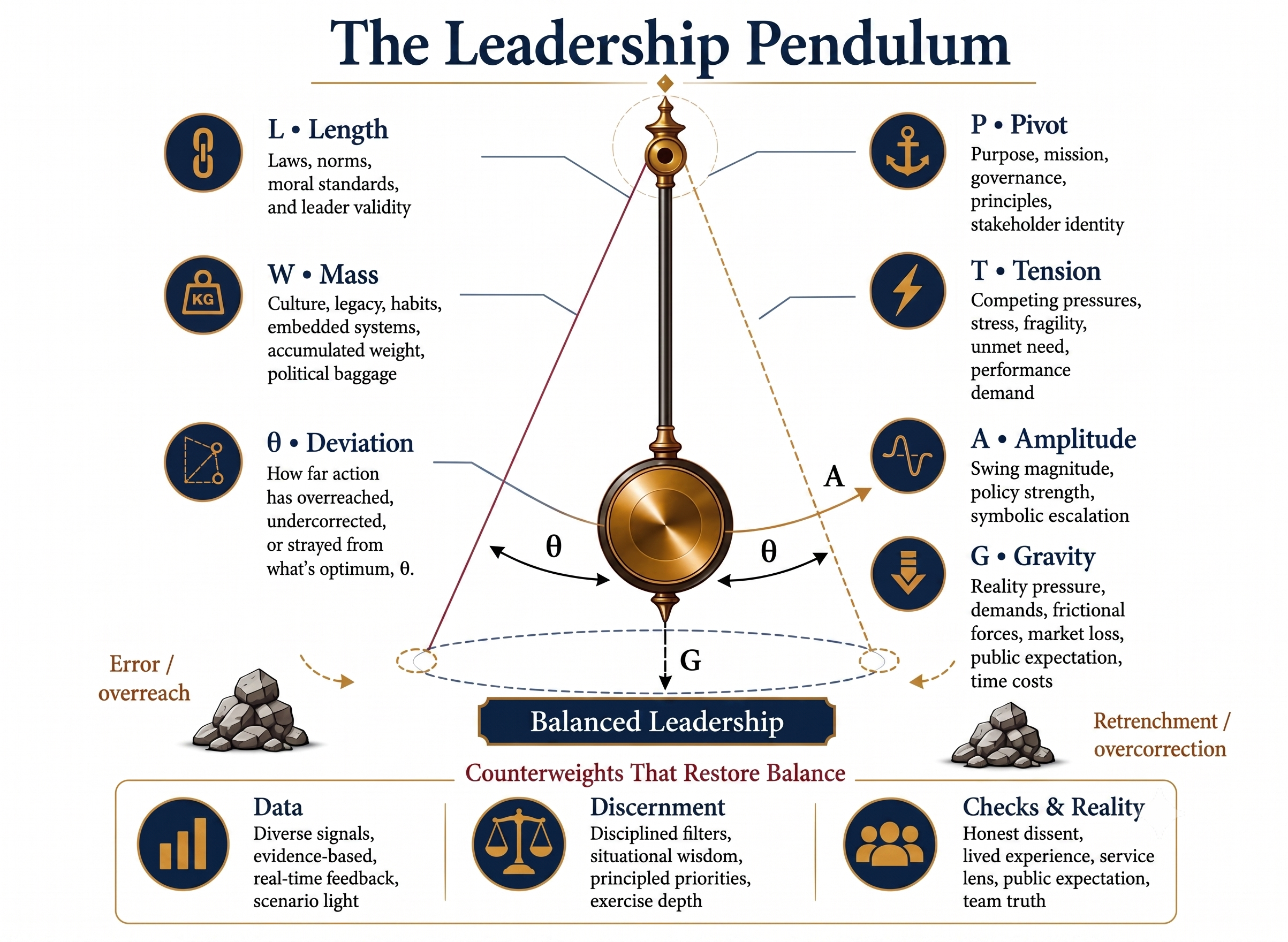
While the equation does not claim absolute mathematical precision, it serves as an analytic tool to show that leadership balance is the result of interacting forces. By assigning values to stabilizing forces (Counterweights) and destabilizing forces (Tension, Mass, Deviation), organizations can move toward an evidence-based assessment of executive health.
According to recent data from global consultancy firms, nearly 70% of organizational transformations fail due to "strategic drift"—a state where the leadership pendulum has swung so far from the center that the "Counterweights" (such as independent board oversight or rigorous internal feedback loops) can no longer restore balance. The LBI provides a mechanism to identify this drift before it results in permanent institutional damage.
The Evolution of Leadership Theory: A Chronology of Balance
The emergence of the Leadership Pendulum Model represents the latest stage in a century-long evolution of management theory. Understanding this chronology provides context for why "balance" has become the primary concern for the modern C-suite.
- 1900s–1950s: The Era of Command and Control. Leadership was viewed as a linear exercise of authority. Balance was rarely discussed; the focus was on the "Great Man" theory and the efficient application of power.
- 1960s–1980s: Situational Leadership. Theorists like Paul Hersey and Ken Blanchard argued that leadership styles must change based on the maturity of the followers. This introduced the idea of "calibration" but remained focused on interpersonal dynamics.
- 1990s–2010s: Emotional Intelligence and Charisma. The focus shifted to the leader’s internal state. Daniel Goleman’s work emphasized self-awareness, but critics argued this often led to an over-prioritization of "style" over "systemic health."
- 2020s–Present: The Pendulum and Systems Thinking. The current era recognizes that leadership is systemic. In a VUCA (Volatile, Uncertain, Complex, Ambiguous) world, the leader is no longer a solo actor but a component in a mechanical system of forces. The Pendulum Model reflects this shift toward physics and systems engineering.
Stakeholder Reactions and Industry Impact
The shift toward a more disciplined, mechanical view of leadership has drawn significant attention from Chief Learning Officers (CLOs) and institutional investors. Dr. Elena Rodriguez, a senior fellow at the Institute for Organizational Endurance, suggests that the model’s greatest value lies in its honesty.
"For too long, we have treated leadership as a performance art," Rodriguez stated in a recent symposium. "The Pendulum Model forces us to look at the mechanics. If a leader is too far removed from the ‘lived reality’—what the model calls ‘Length’—no amount of charisma can save the organization from a disastrous swing. Investors are starting to look at these structural metrics when evaluating long-term risk."
Similarly, feedback from Fortune 500 HR executives indicates a growing interest in "Leadership Muscle Memory." This concept, integral to the Pendulum Model, suggests that balance is maintained through the purposeful repetition of habits, such as seeking disconfirming evidence and testing decisions against the core mission. These habits act as "stabilizers" that prevent the pendulum from reaching a point of no return during a crisis.
Supporting Data: The Cost of Overcorrection
Data from the 2023 Corporate Governance Report indicates that companies experiencing "extreme strategic swings"—defined as major pivots in core business models twice within a three-year period—saw a 22% higher turnover rate in middle management compared to companies with "centered" leadership. Furthermore, these "high-amplitude" organizations saw a 15% decrease in long-term shareholder value, as the costs of overcorrection often outweighed the benefits of the new direction.
The "Paradox of Choice" also has a quantifiable impact. A study of 400 global CEOs found that those who reported feeling "overwhelmed by optionality" were 40% more likely to engage in "symbolic action"—initiatives that look good in press releases but do not address the institutional needs—than those who utilized disciplined decision-making frameworks like the LBI.
Broader Implications: Discipline in Motion
The ultimate test of the Leadership Pendulum Model is not whether it creates a more self-aware leader, but whether it allows an institution to rebalance without stalling. In the current economic climate, stalling is as dangerous as overreaching. The work of balanced leadership is not to freeze the pendulum in place; institutions require movement to survive. Leaders remain the stewards of that motion.
Effective leadership still requires energy, speed, and risk-taking. However, the discipline of the modern era is to keep that motion from drifting out of proportion. Leadership endures when purpose, power, and performance remain in a state of disciplined tension. By building the habits and counterweights necessary to recover balance before a swing becomes destructive, leaders can ensure their organizations move forward with both clarity and legitimacy.
As markets continue to fluctuate and the "Paradox of Choice" intensifies, the ability to diagnose and correct leadership drift will become the defining competitive advantage of the 21st century. Balance is not stillness; it is the mastery of discipline in motion.






