Following a challenging July that saw the year-ahead outlook for manufacturing CEOs plummet to its lowest point of 2026, the sector is demonstrating encouraging signs of recuperation as August commences. A palpable sense of guarded relief has settled among U.S. manufacturers, with improving demand and easing geopolitical tensions offering a much-needed reprieve after months of turbulence. This shift in sentiment suggests that many chief executives believe the most difficult period of the year may now be behind them, according to the latest Chief Executive CEO Confidence Index survey.
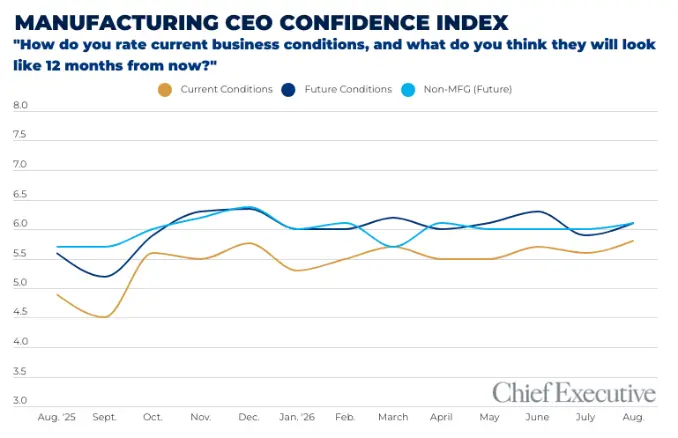
The survey, conducted on August 4th and 5th among 285 U.S. CEOs, reveals that manufacturers have rated current business conditions at an average of 5.8 out of 10. This score, on a scale where 1 signifies "Poor" and 10 represents "Excellent," marks a significant 4 percent improvement over July’s figures. Crucially, this uptick pushes current confidence beyond the 5.5-5.7 range where it had stagnated since February, indicating a potential turning point for the industry.
Furthermore, manufacturers’ outlook for the upcoming year has also seen a positive ascent. The forecast for the year ahead climbed to 6.1 out of 10, recovering from July’s 5.9 – a reading that had previously represented the lowest year-ahead forecast on record for 2026. This gain effectively offsets a substantial 7 percent decline experienced in July and aligns the sentiment of manufacturing CEOs with that of their non-manufacturing peers, who also provided an identical 6.1 out of 10 forecast.
Key Drivers of Renewed Confidence
When probed about the factors contributing to this surge in optimism, manufacturers overwhelmingly cited improved demand as a primary catalyst. One CEO of a small-sized industrial manufacturing firm headquartered in Ohio articulated this sentiment, stating, "Demand is increasing; we are an automation company positioned well for success, and geopolitics is settling down." This quote encapsulates a dual benefit: a strengthening market for their products and a more stable global environment.
Echoing this sentiment, other executives are anchoring their future confidence in the expectation that domestic volatility will soon subside. Andrew Ly, CEO of the large-sized consumer manufacturing firm Ly Brothers Corp., expressed a widely held view: "Political noise will calm down either way after [the] midterm elections. Politicians will need to get back to focus on the real issues." This anticipation of a more focused and less contentious political landscape post-elections suggests a desire for policy predictability.
Beyond demand and geopolitical calm, several executives pointed to reshoring initiatives and robust order backlogs as significant contributors to their renewed confidence in investment and long-term planning horizons. The trend of bringing manufacturing operations back to U.S. soil, coupled with a healthy pipeline of existing orders, provides a tangible foundation for future growth and stability. Additionally, a notable portion of leaders indicated improving profit margins, a welcome development after an extended period of significant pressure on their bottom lines.
However, despite these positive developments, the persistent burdens of tariff policies and inconsistent regulatory frameworks continue to be a source of concern for many CEOs. Dan Nibe, CEO of LBS Bookbinding, a mid-sized industrial manufacturer, highlighted this dichotomy: "Tariffs are holding the economy back, inflation is squashing the U.S. consumer – but the job market remains strong." This statement underscores the complex and sometimes contradictory economic forces at play, where a robust labor market coexists with headwinds from trade policy and inflation.
Economic Outlook: A Mixed Picture
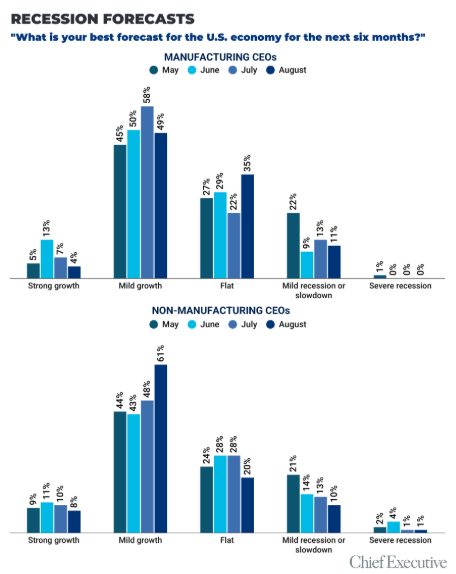
While overall CEO confidence has seen an improvement, manufacturing CEOs’ bullish expectations for the broader U.S. economy have cooled in August. Only 53 percent now forecast some form of economic growth over the next six months, a notable decrease from 65 percent in July. This decline is largely attributable to a sharp increase in the proportion of manufacturers anticipating flat economic conditions. This segment grew by a significant 59 percent month-over-month, rising from 22 percent to 35 percent.
This hesitancy to predict robust growth is, in part, attributed to ongoing inflationary pressures. Tim Zimmerman, CEO of Mitchell Metal Products, a mid-sized industrial manufacturing firm, detailed the impact: "Inflationary factors are leading to rapid and sustained price increases, which are squeezing our margins severely and pricing some of our products out of the market." The sustained rise in input costs and the subsequent pressure on consumer pricing power are clearly weighing on forward-looking economic assessments.
Conversely, fears of a widespread recession continue to recede within the manufacturing sector. Only 11 percent of manufacturers now forecast any type of recessionary conditions, a slight decrease from 13 percent in July. This indicates a diminishing concern about a sharp economic downturn, even as optimism for strong growth moderates.
In a contrasting trend, non-manufacturing sectors have shown increased optimism regarding economic growth. 69 percent of non-manufacturers forecast growth over the next six months, a substantial jump from 58 percent in July, reaching the highest share recorded since May. Their recession fears have also eased, with the same proportion forecasting a slowdown. This divergence highlights potential sector-specific challenges and opportunities within the broader economy.
International Exposure and Trade Policy’s Impact
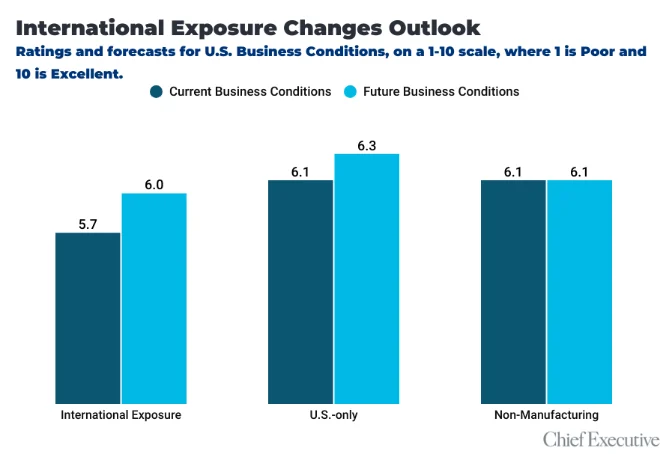
A persistent divergence in outlook continues to shape the manufacturing sector, particularly between companies with significant international operations and those focused exclusively on the domestic market. Manufacturers with global footprints reported current business conditions at an average of 5.7 out of 10. In contrast, their domestic-exclusive counterparts offered a considerably more optimistic rating of 6.1.
This disparity is, in some instances, attributed to a phenomenon referred to as "trade inversion." Chris Boyd, CEO of Antebellum Manufacturing, a mid-sized consumer firm with U.S.-exclusive operations, provided a clear explanation: "Tariffs on primary aluminum have driven the cost for aluminum more for domestic manufacturers than the 50 percent tariff on derivative products… imports are winning." In essence, some domestic manufacturers are finding themselves penalized more by tariffs on essential raw materials and components than they are protected by tariffs on finished goods. This scenario can lead to a competitive disadvantage against imported products.
Looking ahead to the next 12 months, both groups anticipate improvement. However, U.S.-exclusive CEOs remain more optimistic, forecasting business conditions to reach 6.3 out of 10 by this time next year, compared to a 6.0 rating for internationally exposed firms. This domestic-global gap has been a consistent theme throughout much of 2026, reflecting the disproportionate impact of uncertainty surrounding trade policy, geopolitical volatility, and supply chain disruptions on companies with extensive global supply chains and markets.
Corporate Forecasts: A Landscape of Fluctuation
At the individual company level, manufacturers’ forecasts in August presented a mixed and fluctuating picture, underscoring the ongoing challenges CEOs face in formulating consistent, long-term strategic plans amidst an unpredictable economic environment. The month-to-month variability in these corporate forecasts suggests a cautious approach to investment and expansion, with leaders likely adapting their strategies based on evolving market conditions and policy shifts.
The underlying data from the CEO Confidence Index, compiled by Chief Executive Group since 2002, tracks the pulse of U.S. business leaders across various sectors. The index aims to provide a barometer of confidence in both current and future business environments by aggregating CEOs’ observations on key economic and business components. This continuous polling allows for the identification of trends, shifts in sentiment, and the impact of external factors on the corporate landscape. For more in-depth analysis and historical data, resources are available on ChiefExecutive.net.
Broader Implications and Future Outlook
The August CEO Confidence Index data suggests that while the manufacturing sector is showing resilience and a potential for recovery, the path forward is not without its complexities. The improvement in demand and a slight easing of geopolitical tensions are significant positives, offering a much-needed boost to CEO morale. However, persistent inflationary pressures, the impact of trade policies, and the ongoing recalibration of global supply chains continue to present challenges.
The divergence between domestic and international manufacturers highlights the nuanced effects of current economic policies and global events. For companies heavily reliant on imported components or engaged in complex international trade, navigating fluctuating tariffs and geopolitical uncertainties remains a primary concern. Conversely, domestic-focused firms, while potentially shielded from some international volatility, are still grappling with the direct impact of tariffs on their input costs.
The cautious optimism observed in August can be seen as a tentative step towards stabilization. The fact that recession fears are diminishing is a positive indicator, suggesting that widespread economic collapse is not the dominant concern. However, the moderation in expectations for robust growth, coupled with the rise in forecasts for flat conditions, points to a period of sustained, but perhaps less dynamic, economic activity.
Moving forward, the manufacturing sector’s trajectory will likely depend on several key factors: the evolution of inflation and interest rates, the clarity and consistency of trade policies, the resolution of geopolitical conflicts, and the sustained strength of consumer demand. The ability of CEOs to adapt their strategies to these evolving dynamics will be crucial in determining the pace and nature of the sector’s recovery in the latter part of 2026 and beyond. The underlying strength of the U.S. job market, as noted by several CEOs, provides a foundational support, but its long-term impact will be intertwined with the resolution of other economic pressures.