
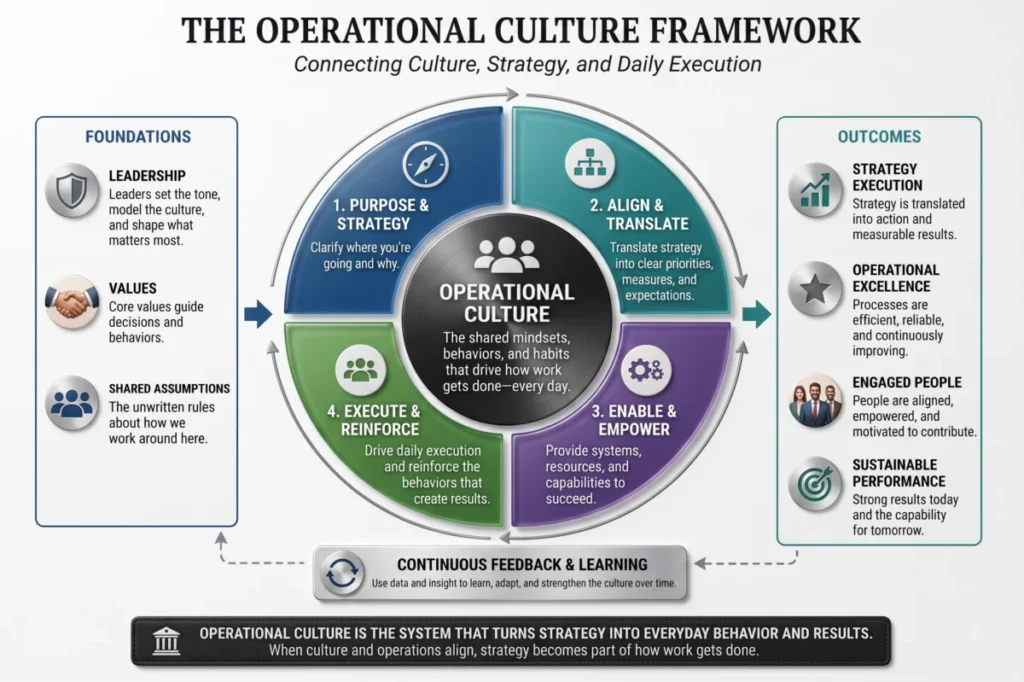
The modern executive suite is frequently haunted by a specific recurring phenomenon: the breakdown of a well-crafted strategy. In boardrooms across the globe, significant capital and cognitive energy are invested in developing strategic plans, articulating vision statements, and aligning resources. Yet, data suggests that the vast majority of these initiatives fail to reach their full potential. While leadership teams often diagnose these failures as a "culture problem," emerging management theory suggests this perspective is incomplete. Strategy is not executed by abstract cultural values, but by the thousands of discrete decisions made by employees every day.
The gap between strategic intent and operational reality is a documented crisis in global business. Research by Robert Kaplan and David Norton, architects of the Balanced Scorecard, indicates that as many as 90 percent of organizations fail to execute their strategies successfully. This failure rarely stems from a lack of intelligence or effort; rather, it arises from an inability to translate high-level objectives into coordinated, day-to-day actions. When departments move in disparate directions, meetings prioritize updates over decisive action, and new initiatives lose momentum, the root cause is often an environment that inadvertently constrains effective decision-making.
The Fallacy of the Mission Statement
For decades, the prevailing corporate wisdom has treated organizational culture as a collection of shared values, beliefs, and norms. This has led to a proliferation of mission statements and core value lists displayed in corporate lobbies. However, employees do not experience culture through what an organization says; they experience it through what an organization consistently does. Culture is the byproduct of leadership decisions, reinforced through systems of evaluation, priority setting, and recognition.
Edgar Schein and Peter Schein, pioneers in organizational development, define culture as the shared assumptions that evolve as groups solve problems together. These assumptions are shaped by the tangible systems leaders choose to build. When an organization boasts a "culture of innovation" but utilizes a performance review system that punishes any failure, the system—not the mission statement—dictates the culture. Consequently, even the most talented workforces will struggle to execute a strategy if the organizational conditions are not designed to support that execution.
The Operational Culture Framework
To bridge the gap between strategy and results, leaders are increasingly moving toward an "operational culture" framework. This approach treats culture not as a soft outcome of success, but as a hard operational capability that can be designed and refined. This framework is built upon four foundational pillars: clarity, accountability, collective intelligence, and adaptability.
1. Clarity as a Strategic Driver
Clarity serves as the primary compass for execution. Employees perform at their peak when they possess a granular understanding of what success looks like, how priorities are ranked, and how their individual contributions feed into the broader mission. According to Gallup research, only about half of employees strongly agree that they know what is expected of them at work. This lack of clarity is a significant drain on productivity. When clarity is absent, uncertainty thrives, leading to hesitation and misalignment. True operational clarity reduces the cognitive load on employees, allowing them to make faster, more accurate decisions without constant upward referral.
2. Accountability and Ownership
Accountability in a high-performing organization is often misunderstood as a mechanism for compliance or punishment. In an operational culture, accountability is the process of transforming expectations into psychological ownership. This requires leaders to not only establish clear responsibilities but also to provide the necessary authority and resources for employees to act. When accountability is integrated into the daily operating rhythm rather than reserved for annual reviews, it fosters a sense of agency. This shift ensures that execution is not dependent on "heroic leadership" from the top, but on distributed ownership across the hierarchy.
3. Leveraging Collective Intelligence
The complexity of the modern business environment means that the best decisions rarely originate from a single source of authority. Collective intelligence is the intentional structuring of an organization to leverage expertise across functional boundaries. This capability relies heavily on "psychological safety," a term popularized by Harvard Professor Amy Edmondson and validated by Google’s "Project Aristotle." Google’s multi-year study found that the highest-performing teams were not necessarily those with the smartest individuals, but those where members felt safe to take risks and voice dissent. An operational culture creates formal structures for surfacing this expertise, ensuring that critical information reaches decision-makers before it is too late.

4. Adaptability and Continuous Learning
Adaptability is the capability of an organization to learn faster than the rate of change in its environment. This is distinct from mere "change management," which often treats change as a discrete, one-time event. John Kotter, a leading authority on leadership and change, argues that sustainable success requires an organization structured for continuous evolution.
The historical example of Kodak provides a stark illustration of this principle. Kodak’s own engineers invented the digital camera in 1975. The company did not lack the technology, the talent, or the market foresight. It lacked the organizational capability to act on that knowledge because doing so threatened its legacy film business. Adaptability is not about seeing the future; it is about having the systemic readiness to act on what is seen, even when it disrupts the status quo.
Case Study: The Conflict of Silos in Academic Redesign
The practical implications of the operational culture framework are evident in a recent course-redesign initiative within a large educational institution. Instructional designers (IDs) were tasked with assisting faculty in meeting new digital quality standards. Initially, the project stalled. The IDs produced support materials in isolation, while faculty viewed the new requirements as a burdensome compliance exercise.
The breakthrough occurred only when leadership intervened to clarify the shared goal. By shifting the focus from "enforcing a standard" to "supporting faculty success," the relationship was redefined. Once the operational conditions were adjusted—clarifying roles and fostering collaboration—the redesign work accelerated. Both parties stopped working past each other and began solving the same problem. This instance highlights that strategy (the redesign) failed not because of a lack of commitment, but because the organization had not initially built the conditions for collaborative execution.
The Impact of Artificial Intelligence on Execution
The urgency of building an operational culture has been magnified by the rapid integration of artificial intelligence (AI) in the workplace. As AI automates routine tasks, the human element of work shifts toward high-stakes decision-making, creative problem-solving, and cross-functional leadership. Technology can process data, but it cannot navigate the nuances of organizational culture or provide the ethical oversight required for strategic pivots.
In an AI-driven economy, the speed of business increases, leaving less room for the friction caused by silos or unclear priorities. Organizations that thrive in this new era will be those that use technology to enhance their human capabilities, rather than replace them. Leaders must champion an environment where people can perform at their highest potential, supported by systems that are as agile as the software they utilize.
Diagnostic Questions for Leadership
To determine if an organization is prepared for successful execution, leaders should move beyond abstract cultural assessments and ask five specific, system-focused questions:
- Clarity: Do employees across the organization know the top three priorities for the current quarter, and do they understand how their work directly impacts those goals?
- Accountability: Are decisions made by the people closest to the work, or are they delayed by unnecessary layers of approval and bureaucratic oversight?
- Collective Intelligence: Is there a formal, safe mechanism for employees to voice dissent or share specialized expertise that contradicts current leadership assumptions?
- Adaptability: Does the organization have a structured process for reviewing failures and successes to extract lessons, or does it simply move to the next initiative without reflection?
- Systems Alignment: Do the organization’s reward and recognition systems reinforce the behaviors required to achieve the current strategy, or do they incentivize legacy behaviors?
Conclusion: Culture as Infrastructure
The symptoms of a stalled strategy—delayed results, fragmented departments, and repetitive messaging—are signals that the organizational infrastructure is failing. Defined as a "culture problem," the issue remains amorphous and difficult to solve. Defined as a lack of operational capability, it becomes a specific, addressable challenge.
The successful organizations of the coming decade will not necessarily be those with the most ambitious plans. They will be the ones that recognize culture as the mechanism by which strategy becomes reality. By intentionally designing for clarity, accountability, collective intelligence, and adaptability, leaders can ensure that their strategic vision is not just a document on a wall, but a lived reality in every decision made throughout the enterprise. Strategy fails when people lack the conditions to succeed; it flourishes when the operational culture makes excellence the path of least resistance.






