A robust employee recognition program is no longer a mere perk but a strategic imperative for organizations aiming for intentional growth. Whether managing a rapidly scaling mid-market enterprise or a sprawling global workforce, HR leaders leverage recognition as a powerful tool to reinforce core values, boost engagement, and retain vital talent amidst escalating demands. This approach transforms a workplace from merely a place of employment into an environment where employees are motivated to contribute their best, as evidenced by the 2026 State of Employee Recognition Report, which found that 32% of global employees directly link recognition to their productivity.
The evolution of employee recognition signifies a shift towards a more strategic business performance approach. A Harvard Business Review Analytic Services survey revealed that a significant 66% of respondents consider their organization’s recognition program crucial for influencing business performance. However, a notable gap exists, with only 33% deeming their programs highly effective. This disparity underscores a critical reality: while the importance of recognition is widely acknowledged, many organizations struggle to implement programs that consistently foster behaviors driving tangible results.
Building an Effective Employee Recognition Framework
The foundation of a successful employee recognition program is not built overnight but rather through a deliberate and repeatable process that integrates strategy, widespread participation, and a commitment to continuous improvement. Organizations seeking to scale recognition with meaningful impact can adhere to a set of core principles:
1. Defining Clear Objectives
The initial step involves clearly articulating what the recognition program aims to achieve. Whether the goal is to enhance employee engagement, solidify company values, or reduce turnover, well-defined objectives ensure the program aligns directly with overarching business outcomes.
2. Aligning Recognition with Behaviors and Values
Effective recognition programs highlight specific actions that contribute most significantly to organizational success. By directly linking moments of appreciation to company values or strategic priorities, employees gain a clear understanding of what constitutes exemplary performance.
3. Fostering Frequent, Peer-to-Peer Recognition
The impact and effectiveness of recognition are amplified when it is timely and inclusive. Empowering employees to recognize each other not only boosts participation rates but also embeds a culture of appreciation into the daily fabric of work.
4. Integrating Social Recognition with Meaningful Rewards
Public recognition fosters a sense of community and enhances visibility across teams, while tangible rewards serve to reinforce the impact of contributions and sustain motivation. A balanced approach, combining both elements, is key to enduring employee engagement.
5. Ensuring Ease and Accessibility
Minimizing friction in the recognition process is paramount. Integrating recognition into the tools employees already use daily streamlines participation and increases the likelihood of consistent engagement.

6. Measuring, Learning, and Optimizing
Continuous evaluation of participation rates, recognition frequency, and program outcomes is essential for understanding effectiveness. Ongoing insights enable organizations to refine their strategies and amplify positive results over time.
When these best practices are consistently applied, employee recognition evolves into a powerful driver of culture, performance, and interpersonal connection. Leveraging a comprehensive platform that unifies recognition, rewards, and data-driven insights can extend this impact across even the most extensive global workforces.
The Significance of Employee Recognition
Employee recognition programs offer a straightforward yet impactful method for organizations to acknowledge and reward the contributions of their workforce, celebrating both significant achievements and the everyday efforts that propel the business forward. These programs provide a reliable mechanism for highlighting exceptional work, demonstrating company values in action, and maintaining employee motivation. A well-rounded program encompasses various forms of recognition, from top-down endorsements to peer-to-peer acknowledgments, and offers a diverse range of reward options suitable for various budgets.
The importance of recognition programs cannot be overstated for any business aiming to cultivate an engaged, productive, and committed workforce. They create consistent opportunities for employees to feel seen and valued for their contributions, thereby motivating the repetition of behaviors that strengthen the organizational culture.
Inclusivity of Employee Recognition Programs
Employee recognition programs are designed for organizations at every stage of their development. Whether it’s a mid-market team establishing consistency for the first time or a large enterprise scaling recognition across multiple regions, the core principle remains the same: establishing a clear, repeatable method for integrating appreciation into daily work. When recognition is consistent and inclusive, it effectively reaches all levels of the organization, including frontline staff, hybrid and remote teams, and global workforces.
The Strategic Placement of Recognition Programs
Ideally, an employee recognition program should be seamlessly integrated into the existing workflows where work naturally occurs. For many organizations, this begins with incorporating recognition into frequently used tools like Slack, Microsoft Teams, or Outlook. However, the program’s reach should extend beyond digital platforms to permeate the broader workplace culture, becoming a visible element in team meetings and company-wide town halls. When appreciation is evident during pivotal moments, it feels authentic, meaningful, and impossible to overlook. The objective is not complexity, but rather making recognition so effortless that it becomes a natural and consistent practice.
Maximizing the Impact of Recognition Programs
Employee recognition programs yield their greatest impact when woven into the everyday flow of work. Research indicates that when recognition occurs on a weekly basis, employees are 2.6 times more likely to be productive and nine times more likely to feel a strong sense of belonging. Recognizing employees in the moment amplifies the power of appreciation; delays can diminish its perceived authenticity and reduce it to a mere footnote rather than genuine acknowledgment.
Factors Influencing Program Success or Failure
The establishment of a recognition program is merely the initial phase; the true challenge lies in ensuring it consistently influences employee behavior and drives meaningful business outcomes. Harvard Business Review Analytic Services research highlights that while 66% of respondents believe recognition programs are crucial for business performance, only 33% find them highly effective. This significant gap suggests that many organizations understand recognition’s potential but falter in its execution to achieve measurable impact.
The Execution Gap: Why Recognition Programs Fall Short
Effective recognition programs do more than simply celebrate good work; they actively reinforce behaviors that contribute to organizational goals. Research has identified a clear distinction between organizations that achieve strong business results from recognition and those that do not. Among organizations with highly effective programs, 88% intentionally design recognition to drive specific employee behaviors, contrasting sharply with only 28% of organizations with less effective programs that adopt a similar strategic approach.

This distinction is critical because recognition directly influences employee focus and energy. As economist Robert Dur notes, "A reward and recognition system is a bit like a compass that directs people’s attention, time, and energy." When recognition is tied to strategic priorities, employees develop a clearer understanding of what success entails and which contributions are most valued by the organization.
Furthermore, effective recognition is timely, meaningful, and specific. While generic praise can create a fleeting positive moment, specific and meaningful recognition helps employees understand the significance of their actions, encouraging the repetition of those behaviors. Dur emphasizes, "Recognition is powerful but tends to be underestimated by people in practice. For recognition to be powerful, it needs to be meaningful."
Organizations that bridge this execution gap treat recognition as an ongoing business practice rather than an intermittent human resources initiative. They strategically align recognition with company values, objectives, and the desired behaviors that foster a high-performing workforce.
The Business Impact of Effective Recognition
While recognition is often associated with improvements in engagement, morale, and culture, the most impactful programs also deliver measurable business results. The Harvard Business Review research found that organizations with highly effective recognition programs are significantly more likely to report improvements across key performance indicators. Compared to their less effective counterparts, these leading organizations report higher instances of:
- Increased revenue growth: A 13% higher likelihood of experiencing revenue growth.
- Higher profitability: A 9% greater likelihood of achieving higher profitability.
- Improved customer satisfaction: A 6% greater likelihood of seeing improvements in customer satisfaction.
- Enhanced innovation: A 15% greater likelihood of fostering innovation.
- Better talent retention: A 7% higher likelihood of retaining talent.
The impact extends beyond financial and operational metrics, with organizations demonstrating effective recognition programs also reporting gains in innovation, collaboration, problem-solving, and talent development. Conversely, nearly one-third (31%) of organizations with less effective programs reported no business improvements from their recognition efforts, compared to a mere 2% of leading organizations.
These findings reinforce a fundamental principle: recognition is most effective when designed to support business priorities, not solely to enhance engagement scores. For HR leaders, the key takeaway is that the most successful recognition programs are not measured by participation rates or reward redemptions alone, but by their capacity to reinforce behaviors that elevate performance, strengthen culture, and enable the business to execute its strategy effectively.
Establishing an Employee Recognition Program
Embarking on the creation of an employee recognition program necessitates a clear vision of the desired company culture and the takeaways employees should derive from it. Meaningful recognition programs are not developed instantaneously; they require careful thought, structured planning, and iterative refinement.
Budgeting for Employee Recognition
Developing a budget for employee recognition begins with aligning investment with specific business goals, such as improving engagement, reducing turnover, or reinforcing company values. The most effective programs view recognition not as an expenditure but as a strategic driver of performance and retention. A practical budgeting approach involves allocating resources for both program structure and sustained participation.
To maximize impact, organizations should prioritize frequency and accessibility, ensuring employees can recognize each other regularly, not just during major milestones. Platforms like the Achievers employee experience platform optimize budget utilization by increasing participation and linking recognition activities to measurable business outcomes.
Developing a Recognition Strategy
An effective employee recognition strategy connects daily behaviors to overarching company goals, transforming appreciation into a consistent, data-informed driver of performance and culture. The process begins with defining success metrics and identifying the specific behaviors to be reinforced. Key strategic principles include:
- Alignment with business objectives: Ensuring recognition efforts directly support strategic priorities.
- Reinforcement of desired behaviors: Clearly identifying and celebrating actions that contribute to organizational success.
- Inclusivity and accessibility: Making recognition available and easy for all employees to participate in.
- Data-driven insights: Utilizing metrics to understand program effectiveness and identify areas for improvement.
- Integration into workflows: Embedding recognition into the daily tools and processes employees already use.
A robust strategy transcends one-off programs or annual awards, fostering a culture where employees feel consistently seen, heard, and appreciated. Leveraging the right platform allows organizations to scale recognition, personalize experiences, and continuously enhance their approach through real-time data and insights.
Program Design Steps
-
Design the Program: Craft a recognition program that is adaptable and easily integrates into employees’ daily routines.
- Set Objectives: Clearly define the program’s purpose, whether it’s to boost engagement, retain talent, or reinforce values. Establish Key Performance Indicators (KPIs) such as participation rates and recognition frequency, and consider linking recognition to broader business outcomes to facilitate ROI calculation.
- Align with Culture: Ensure the recognition program reflects and amplifies the organization’s unique culture and core values, making appreciation more resonant and reinforcing the desired workplace environment.
- Allocate Budget: Develop a thoughtful budget that prioritizes value and sustainability over short-term impact, considering investments in software, rewards, and communications.
- Outline Policies: Establish clear, concise policies defining what gets recognized, who can provide recognition, and how rewards are administered, ensuring fairness and setting clear expectations.
- Determine Global Scale: Select a platform that supports a consistent and inclusive global recognition experience, accommodating diverse languages and time zones for workforces worldwide.
-
Introduce the New Program: A successful launch requires intention, clarity, and momentum. Develop an engaging rollout plan, educate employees, secure leadership involvement, and clearly articulate the importance and integration of recognition into daily work. Tracking metrics like recognitions sent, active users, and team participation empowers managers to lead by example. Key KPIs to monitor include:
- Recognition frequency
- Participation rates
- Employee sentiment related to recognition
- Impact on retention and engagement metrics
-
Measure the Results: Continuously track program performance, analyzing changes in retention, engagement, and customer satisfaction. Compare pre- and post-launch data to identify trends and use employee feedback from surveys and focus groups to make ongoing improvements. When employees feel heard, they are more likely to remain engaged, underscoring the importance of listening and adapting.
The Role of Recognition Platforms
The effectiveness of an employee recognition program is intrinsically linked to the strength of the underlying platform. Leading recognition platforms seamlessly integrate into employees’ daily tools, simplifying the recognition process without disrupting workflows. Key features to consider include user-friendliness, scalability, insightful analytics, and robust support. A flexible platform can adapt to evolving organizational needs, ensuring sustained recognition efforts.
Best Practices for High-Impact Recognition
To ensure an employee recognition program consistently delivers value, adherence to proven best practices is crucial:
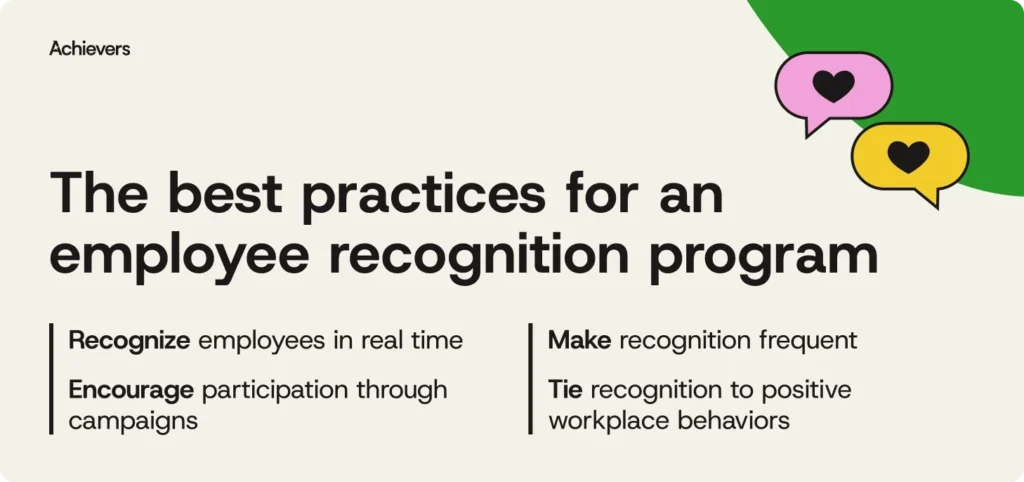
- Recognize Employees in Real Time: Prompt recognition is significantly more impactful, reinforcing desired behaviors the moment they occur and making the acknowledgment feel genuine and memorable.
- Encourage Participation Through Campaigns: Injecting energy and excitement into recognition through creative campaigns tied to holidays or company milestones transforms it from an obligation into a celebration. A monthly recognition calendar playbook can aid in consistent planning.
- Make Recognition Frequent and Impactful: Regular recognition is vital for embedding it into company culture. Consistent acknowledgment of contributions significantly boosts engagement, morale, and retention, potentially increasing engagement and productivity by up to 400% when employees feel a strong sense of belonging.
- Tie Recognition to Specific Behaviors: Moving beyond generic praise, specific and thoughtful recognition detailing the action and its impact is more personal and effective in reinforcing desired behaviors.
Types of Employee Recognition
A comprehensive recognition strategy employs a variety of approaches to resonate with diverse employees:
- Social Recognition: Public appreciation shared across work platforms, ranging from quick shout-outs to company-wide highlights. This visible acknowledgment reinforces positive habits and spreads appreciation throughout teams, fostering a positive culture.
- Monetary Recognition: Tangible rewards such as points, gift cards, or options from a global rewards marketplace. These rewards provide lasting value and can be scaled according to the achievement’s magnitude, offering employees choice and flexibility.
- Peer-to-Peer Recognition: Acknowledgment directly from colleagues, reflecting how teammates value each other’s contributions. Regular peer recognition cultivates a more connected and collaborative environment, with monthly peer-recognized employees being twice as likely to feel a strong sense of belonging and trust.
Challenges in Existing Recognition Programs
Several common challenges hinder the effectiveness of current employee recognition programs:
- Infrequent Recognition: Recognition reserved for annual awards or infrequent milestones diminishes its impact and relevance.
- Limited Participation: Over-reliance on manager-led recognition overlooks valuable peer contributions and limits broader engagement.
- Perceived as Extra Work: Recognition processes that are cumbersome or require leaving primary workflows lead to decreased adoption.
- Lack of Visibility: Private or team-specific recognition fails to showcase successes across the organization, missing opportunities for broader learning and reinforcement.
- Misaligned Rewards: Rewards that do not align with employee preferences can undermine their motivational impact, highlighting the need for flexibility and choice.
- Difficulty in Measurement: Without tracking participation, frequency, and outcomes, it is challenging to assess program effectiveness and identify areas for improvement.
Preventing Bias in Recognition Programs
Ensuring equity in recognition programs is paramount:
- Shared Responsibility: Distributing recognition responsibilities beyond managers broadens perspectives and reduces reliance on individual biases.
- Behavior-Based Criteria: Tying recognition to clear, observable behaviors provides consistent evaluation criteria, minimizing subjective influence.
- Training on Meaningful Recognition: Educating employees on specific, value-aligned recognition fosters a shared understanding and standard.
- Technology Support: Leveraging recognition platforms provides visibility into recognition patterns, helping to identify and address potential inequities across the workforce.
The Business Case for Recognition Programs
The quantifiable benefits of employee recognition programs are undeniable:
- Enhanced Business Results: Recognition directly correlates with business performance. Valued employees are more motivated, leading to increased revenue growth, profitability, customer satisfaction, innovation, and talent retention, as evidenced by research showing a higher likelihood of achieving these outcomes with effective programs.
- Improved Organizational Culture: A culture where employees feel connected to their work, colleagues, and leadership fosters peak performance. Gallup data indicates clear incentives for leaders to prioritize culture, with engaged employees contributing significantly to business success.
- Executive Buy-In: Demonstrating recognition’s role as a strategic driver of business results is crucial for securing executive support, moving it beyond a mere HR initiative. Research indicates that leaders who understand this link are more likely to invest in recognition programs.
Global Recognition Program Best Practices
Successful international recognition programs balance a unified global foundation with localized relevance:
- Shared Global Foundation: Establish clear expectations, shared values, and a consistent system that translates across all regions.
- Culturally Relevant and Locally Meaningful Recognition: Incorporate regional voices in design and execution, adapt messaging and celebration styles, and offer locally relevant rewards.
- Equity and Access: Ensure accessible tools and channels, provide in-time-zone, in-language support, and maintain transparency for fairness.
- Empower Leaders and Local Champions: Train managers on intentional recognition, provide simple in-the-flow tools, and leverage regional advocates.
- Launch with Local Activation: Pilot programs, create localized rollout plans, make launches visible and easy to engage with, equip managers, and provide localized support.
Increasing Program Participation
To boost employee recognition program participation:
- Make Recognition Easy: Remove friction by integrating recognition into existing workflows.
- Enable Peer-to-Peer Recognition: Expand recognition opportunities beyond managers to leverage peer interactions.
- Recognize Frequently: Regular recognition keeps participation active and builds momentum.
- Tie to Company Values: Meaningful connection to values increases engagement.
- Make Recognition Visible: Public acknowledgments reinforce program value and encourage participation.
- Train Leaders Consistently: Managerial role-modeling sets the tone for the organization.
- Utilize Campaigns: Themed campaigns provide timely reasons for engagement.
Creating Lasting Impact
Whether building a new program or refining an existing one, clarity regarding desired behaviors and an approach aligned with the organization’s current state are paramount. A thoughtfully planned, creative, and people-centric program that seamlessly integrates into daily work can spark excitement and drive measurable impact. Platforms like Achievers offer award-winning solutions designed for scalability, integrating recognition, rewards, and insights into a unified experience that supports employees wherever they work.