Impactful employee recognition programs transcend mere celebration of achievements; they are instrumental in fostering a profound understanding among individuals about the significance of their contributions. When recognition is delivered consistently and genuinely, it cultivates clarity. Employees gain insight into how their daily tasks connect to a larger organizational purpose, moving beyond a simple to-do list mentality. This vital connection is not an incidental outcome. Research conducted by the Achievers Workforce Institute (AWI) indicates that employees who receive recognition at least monthly are 3.9 times more likely to perceive the connection between their work and the broader organizational objectives. Recognition serves as a bridge, linking effort to tangible impact, thereby nurturing engagement, motivation, and ultimately, performance. In essence, recognition acts as the critical link between people and their performance.
This article delves into seven exemplary employee recognition programs implemented by Achievers customers, each offering actionable insights that can be readily adopted. These case studies highlight how strategic recognition initiatives can be tailored to diverse organizational needs, from frontline operational improvements to global cultural alignment.
The Pillars of Effective Recognition Programs
Leading recognition programs distinguish themselves by not merely increasing the frequency of appreciation, but by ensuring each instance of recognition is meaningful and impactful. A study by Harvard Business Review Analytic Services revealed that organizations with the most effective recognition strategies are significantly more deliberate in their approach. A striking 88% of "leader organizations" design their recognition programs to reinforce specific employee behaviors, in stark contrast to only 28% of "laggard" organizations.
This intentionality is crucial because impactful recognition does more than acknowledge commendable work. It illuminates the definition of success for employees and guides their focus and efforts. Leading organizations leverage recognition as a strategic tool to underscore behaviors that underpin business objectives, strengthen organizational culture, and advance strategic imperatives.
The most effective programs share several common characteristics: they are intentional, consistently applied, and directly linked to desired outcomes. As the examples below demonstrate, no two programs are identical. Some are tailored to enhance customer experience, while others prioritize operational excellence, growth, or cultural cohesion. What unites them is a clear, demonstrable link between recognition initiatives and tangible business results. These are not simply celebratory gestures; they are strategic reinforcements of the behaviors that empower employees, teams, and entire organizations to perform at their peak.
Seven Exemplary Employee Recognition Programs Shaping Today’s Workforce
1. Cineplex: Driving Frontline Performance Through Integrated Recognition
Cineplex, a prominent name in the entertainment industry, exemplifies how employee recognition can evolve from a feel-good initiative into a potent performance driver. Operating thousands of frontline roles across its theaters and experiential venues, Cineplex sought a scalable method to maintain team motivation, alignment, and a sharp focus on guest experience, all without disrupting its fast-paced, shift-based work environment.
By embedding recognition into daily leadership practices, Cineplex integrated it seamlessly into routines, incentives, and ongoing campaigns. Recognition was not merely encouraged; it was directly tied to the behaviors most critical on the front lines. The results were significant: heightened employee motivation, substantial improvements in Net Promoter Score (NPS) across various locations, and nearly $400,000 in incremental revenue generated through recognition-powered campaigns.
- Takeaway for HR Leaders: Integrate recognition into the core of leadership practices, rather than treating it as an ancillary activity. When recognition is frequent, visible, and directly linked to performance-driving behaviors, it becomes a scalable mechanism for improving outcomes, not just morale.
2. Sobeys: Enhancing Operations Through a Synergy of Feedback, Learning, and Rewards
Sobeys, one of Canada’s largest grocery retailers employing over 131,000 individuals, required an adaptable strategy that could effectively reach hourly workers and support teams while remaining aligned with overarching business priorities. Through its "Bring It!" recognition program, Sobeys established a unified system where recognition, feedback, and learning converge to reinforce performance.
A particularly noteworthy initiative from Sobeys involved its retail support centers. Here, the team utilized feedback surveys and gamified learning modules to optimize cube truck utilization – a key logistics metric for the company. Employees engaged with quizzes directly related to operational goals, earned points for exemplary performance, and provided valuable feedback for process improvements. This integrated approach led to a notable increase in cube utilization, rising from 77.3% to 86.2%, thereby fostering enhanced team cohesion and driving impactful results.
- Takeaway for HR Leaders: The potency of recognition is amplified when it is complemented by feedback and learning opportunities. By rewarding employees for knowledge acquisition and idea generation, not solely for achieving predefined outcomes, organizations can drive operational enhancements while simultaneously maintaining team engagement and focus on critical objectives.
3. General Motors: Unifying a Global Workforce Through Values-Based Recognition
During a period of significant cultural and business transformation, General Motors (GM) aimed to unite its global workforce of over 160,000 employees across six continents through a cohesive recognition strategy. In alignment with its vision of "zero crashes, zero emissions, and zero congestion," GM aligned its recognition efforts with seven core behaviors that define its operational ethos. This ensured that employees worldwide were recognized for shared values, not solely for their immediate results.
GM’s strategic shift to a single global recognition program fostered clarity, consistency, and organizational momentum. Employees gained the ability to recognize peers in real-time, celebrate milestones publicly, and witness recognition being shared across the organization. Within months of implementation, program participation surged, recognition emerged as one of the most significantly improved areas in engagement surveys, and employees reported feeling more appreciated and more aligned with the company’s overarching vision and core behaviors.
- Takeaway for HR Leaders: When recognition is firmly rooted in shared values and consistently delivered across diverse teams and locations, it becomes a powerful catalyst for breaking down silos and driving cultural transformation, even within highly complex, global organizations.
4. Seattle Children’s: Strengthening Engagement via Patient-Led Recognition
Seattle Children’s Hospital recognized an opportunity to create a more inclusive recognition framework that extended beyond clinicians to encompass the entire care team, acknowledging everyone involved in a patient’s experience. While families were eager to express gratitude, this feedback was often informal, delayed, or narrowly directed at a few visible roles. The organization identified a strategic advantage in transforming patient appreciation into a more timely, visible, and meaningful gesture for staff across all functional areas.
Recognition efforts were further enhanced by integrating patient commendations directly into the hospital’s recognition platform via the Achievers API. This enabled patients and families to submit recognition in real-time, ensuring that contributions from custodial, administrative, and support staff received the same acknowledgment as clinical care. During a pilot phase, patient-submitted recognitions correlated with a 10% increase in employee engagement and helped cultivate a "pay it forward" culture, where patient gratitude spurred increased peer-to-peer recognition.
- Takeaway for HR Leaders: Recognition does not need to originate solely from within the organization. By implementing external recognition tools that facilitate gratitude from customers or patients, organizations can elevate engagement, foster inclusion, and enhance a sense of belonging across roles that are often less visible.
5. Scotiabank: Scaling Global Recognition Across a Diverse Workforce
With a global presence encompassing nearly 90,000 employees across 30 countries, Scotiabank faced the challenge of deploying a recognition program that could scale effectively worldwide without compromising consistency or relevance. Its previous platform lacked the capabilities to support cross-team recognition, mobile access, or robust analytical insights, hindering momentum and visibility at scale. The objective was clear: establish a unified, enterprise-wide recognition experience that reinforced core values, engaged leadership, and operated seamlessly across all regions.
Scotiabank’s approach transformed recognition into a daily habit rather than an infrequent event. Leaders were mobilized as recognition champions, peer-to-peer recognition was actively encouraged through initiatives like "Pay It Forward," and recognition was integrated directly into daily workflows via Microsoft Teams. The results were compelling: 93% of employees actively utilize the platform, recognitions sent per employee increased by nearly 60%, and a single campaign achieved a 40% month-over-month surge in active user participation.
- Takeaway for HR Leaders: Global recognition initiatives are most effective when they are simple, highly visible, and integrated into everyday tools. When leaders actively model the desired behavior and employees can recognize each other irrespective of their work location, recognition evolves into a shared language rather than an isolated program.
6. Kellanova: Boosting Recognition Frequency to Foster Pride and Connection

Kellanova identified a critical need to enhance its recognition strategy when a global survey revealed that only approximately half of its employees felt regularly appreciated for their work. With over 30,000 employees across four regions, many in manufacturing and frontline roles, recognition practices were inconsistent, siloed, and predominantly top-down. The company sought a more accessible and inclusive method to ensure employees felt acknowledged for both their daily contributions and significant achievements.
Kellanova’s transformation involved making recognition a daily, peer-driven habit. By launching a mobile-first, global recognition platform, Kellanova simplified the process for employees to recognize one another across teams, regions, and roles. Recognition was directly linked to company values, supported by meaningful rewards, and expanded into a broader engagement hub, thereby fostering increased pride, connection, and participation worldwide.
- Takeaway for HR Leaders: If recognition feels infrequent or unevenly distributed, prioritize frequency and accessibility. When recognition is easy to implement, inclusive, and integrated into daily work routines, it effectively strengthens pride, connection, and loyalty across the entire organization.
7. Rogers: Doubling Sales by Rethinking Frontline Rewards
Rogers sought a more effective method to motivate its fulfillment representatives in upselling and cross-selling during customer activation processes, as commission-based approaches had repeatedly fallen short of expectations. The company required a simpler, more engaging, and sustainable solution that could still deliver a clear return on investment.
Rogers introduced a non-cash, points-based rewards program that provided instant recognition to representatives for each additional service sold. Within six months, program participation reached nearly 70%, significantly exceeding industry benchmarks. More importantly, the program drove a 93% increase in sales of additional services, demonstrating the direct impact of recognition-powered rewards on frontline performance.
- Takeaway for HR Leaders: Immediate, visible recognition tied to specific, desired behaviors can effectively drive participation, foster healthy competition, and yield measurable business outcomes.
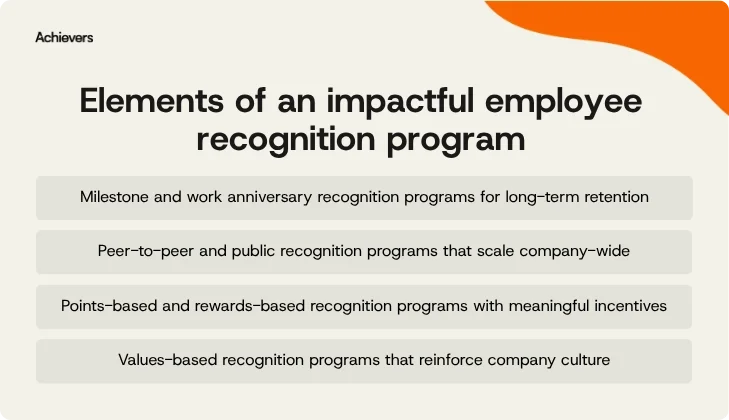
Essential Elements of an Impactful Recognition Program
The most successful recognition programs integrate several core components that work in concert to cultivate clarity, consistency, and sustained momentum. These elements include:
-
Milestone and Work Anniversary Recognition Programs for Long-Term Retention: Robust milestone programs are crucial for ensuring that significant career moments are not overlooked. They move beyond generic acknowledgments by contextualizing an individual’s learning, contributions, and progress. When executed thoughtfully, milestone recognition quietly reinforces loyalty without the need for elaborate speeches or ostentatious gifts. Automation plays a key role in ensuring these moments are captured, but genuine appreciation stems from acknowledging the individual’s journey and impact.
-
Peer-to-Peer and Public Recognition Programs that Scale Company-Wide: Peer-to-peer recognition programs empower employees to acknowledge each other’s contributions, fostering a culture of appreciation for everyday efforts, collaboration, and achievements beyond major wins. By decentralizing recognition beyond managerial oversight, these programs increase the frequency of appreciation and provide a more authentic reflection of how work is accomplished. The visibility of peer recognition amplifies its impact. Research from the State of Recognition Report indicates that 33% of employees who receive peer recognition report increased productivity and a stronger sense of belonging, underscoring that recognition not only acknowledges effort but also cultivates a sense of community.
-
Points-Based and Rewards-Based Recognition Programs with Meaningful Incentives: Points-based and rewards-based programs combine appreciation with tangible incentives that employees can select and utilize. These programs enable organizations to acknowledge contributions in a concrete, consistent, and scalable manner without conflating recognition with direct compensation. When rewards are strategically employed, they enhance recognition rather than overshadowing it. Clear guidelines, equitable budgets, and the flexibility for employees to choose their preferred reward type contribute to high participation rates and foster trust within the workplace.
-
Values-Based Recognition Programs that Reinforce Company Culture: Values-based recognition programs focus on acknowledging employees for the manner in which work is executed, not solely for the outcomes achieved. These programs directly align recognition with an organization’s stated values, providing employees with a clear understanding of the behaviors that are expected, encouraged, and rewarded. Transparent categories, a shared language, and visible acknowledgment of how and why individuals are being recognized empower leaders to identify successful practices and areas for improvement. Over time, these values transition from abstract concepts in presentations to tangible drivers of everyday decision-making.
The Business Impact of Strategic Recognition Programs
The diverse organizations featured in this article, spanning various industries, workforce models, and business challenges, share a common strategic philosophy: recognition is purposefully employed to reinforce behaviors that are critical to organizational success.
Research conducted by Harvard Business Review Analytic Services confirms that organizations with the most effective recognition programs consistently outperform their peers across a spectrum of business outcomes. Compared to their "laggard" counterparts, these organizations are more likely to report higher levels of employee engagement, increased customer satisfaction, improved employee retention rates, and enhanced innovation. Conversely, nearly one-third (31%) of organizations with ineffective recognition programs report no discernible business improvements, a stark contrast to the mere 2% of organizations with highly effective programs.
The fundamental difference lies in the intentionality of leadership. Leaders in highly effective programs understand that recognition is not merely about making employees feel valued. It is about providing a clear compass that directs employees’ attention, time, and energy toward the actions, behaviors, and contributions that drive organizational success. When recognition consistently guides employees toward behaviors that support customers, teams, and business objectives, performance improvements are a natural consequence.
The organizations highlighted herein serve as compelling examples that a singular, universally applicable formula for recognition success does not exist. What is paramount is the development of a recognition strategy that intrinsically links appreciation with purpose, empowering employees to understand how their individual efforts contribute to a larger, meaningful whole.
Achievers’ Recognition Platform: Bridging People and Performance
The collective experiences presented underscore a clear principle: the most impactful employee recognition programs are not about fulfilling a procedural requirement or distributing rewards. They are about enabling individuals to understand that their work holds significance and that this significance is recognized by others.
This ethos is precisely what underpins Achievers’ approach to recognition. The Achievers employee recognition platform is designed to connect people and performance by making appreciation frequent, visible, and an integral part of the daily work experience. When recognition occurs in pivotal moments – tied to genuine behaviors and tangible impact – it transcends a perfunctory gesture and actively shapes how work is conducted. Recognition, therefore, is not solely about celebrating success; it is about actively shaping it.
Frequently Asked Questions About Impactful Recognition Programs
What are the core benefits of implementing a robust employee recognition program?
A well-structured recognition program significantly boosts employee morale, engagement, and retention. It clarifies expectations, reinforces desired behaviors, and fosters a positive company culture, ultimately leading to improved productivity and business outcomes.
How frequently should recognition be provided?
While the ideal frequency can vary, research suggests that monthly recognition is a strong baseline. However, incorporating daily and weekly informal recognition, alongside more formal monthly or quarterly acknowledgments, creates a consistent and pervasive culture of appreciation.
What are the key differences between transactional and transformational recognition?
Transactional recognition often involves one-off rewards for specific achievements (e.g., a bonus for meeting a sales target). Transformational recognition, on the other hand, focuses on reinforcing behaviors aligned with company values and long-term goals, fostering deeper engagement and cultural alignment.
Can recognition programs be effectively implemented in remote or hybrid work environments?
Absolutely. Digital recognition platforms, virtual team-building activities, and regular communication channels are essential for maintaining recognition in distributed workforces. Peer-to-peer recognition and public shout-outs through digital channels are particularly effective.
How can organizations measure the ROI of their recognition programs?
Measuring ROI can be achieved by tracking key performance indicators (KPIs) such as employee engagement survey scores, retention rates, productivity metrics, customer satisfaction scores (e.g., NPS), and the direct impact of recognition-linked campaigns on revenue or cost savings.