
In the current era of global volatility, leadership failure is rarely a consequence of total inertia; rather, it is frequently the result of leaders responding to one extreme with another. Institutions do not typically drift when their leaders hesitate, but when those leaders overcorrect, substitute raw force for nuanced judgment, or mistake visible, frenetic action for disciplined guidance. The fundamental challenge for modern executives is to maintain a strict proportion between purpose, power, and performance, ensuring the organization moves forward with legitimacy, clarity, and long-term endurance.
This challenge is significantly exacerbated by the "paradox of choice." Modern leaders operate within an environment saturated with more data streams, stakeholder demands, and strategic alternatives than can be productively processed. When every objective appears both possible and urgent, the abundance of choice creates a dangerous illusion of control while simultaneously eroding the discipline required to decide what is institutionally necessary. In the mechanics of a pendulum, excessive choice serves to widen the swing by increasing systemic tension, weakening the central pivot, and making decisive, sustainable movement increasingly difficult to maintain.
The Shift from Personality to Contextual Balance
Leadership balance is not an inherent personality trait, a fixed style, or a matter of instinct. It is a contextual discipline. Its efficacy depends on the leader’s ability to accurately read and interpret the demands of a specific moment and then calibrate their judgment and behavior accordingly. The same action—such as a swift executive order—can appear decisive in a crisis but destabilizing in a period of growth. Similarly, an empathetic approach may be viewed as vital in one context and dismissive in another. Therefore, the metric for success is not whether a leader possesses an abstractly "balanced" style, but the extent to which their leadership fits the practical requirements of the moment.

To address this, the Leadership Pendulum Integrated Model moves the conversation from metaphorical observation to rigorous diagnosis. It provides a framework for understanding the conditions under which leadership loses proportion: when the anchor of purpose weakens, strain accumulates, distance from reality grows, and stabilizers fail to restore balance. In this framework, deviation represents the degree to which leadership has moved away from institutional needs, creating a visible misalignment between intention and results.
The Quantitative Turn: The Leadership Balance Index (LBI)
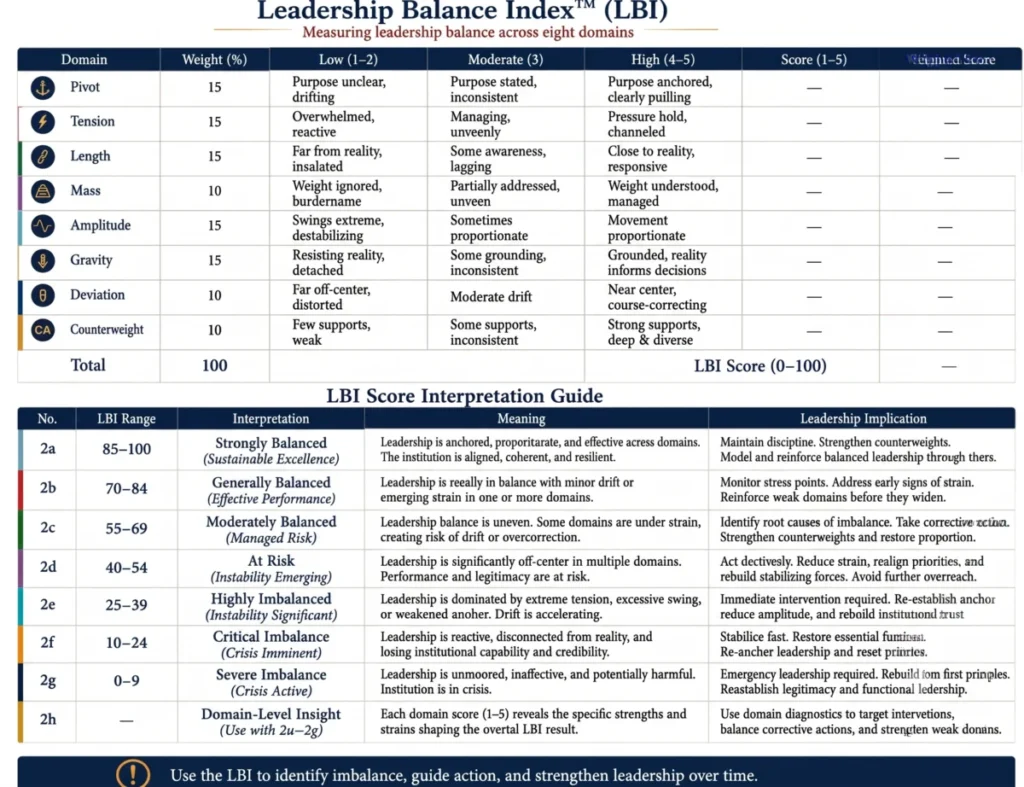
Historically, leadership quality has been assessed through subjective impressions or stylistic preferences. To move toward a more objective standard, the Leadership Pendulum Model introduces the Leadership Balance Index (LBI). The LBI is an analytic tool designed to determine whether leadership is being anchored by mission and corrected by reality, or if it is being undermined by structural strain and widening swings of indecision or overreach.
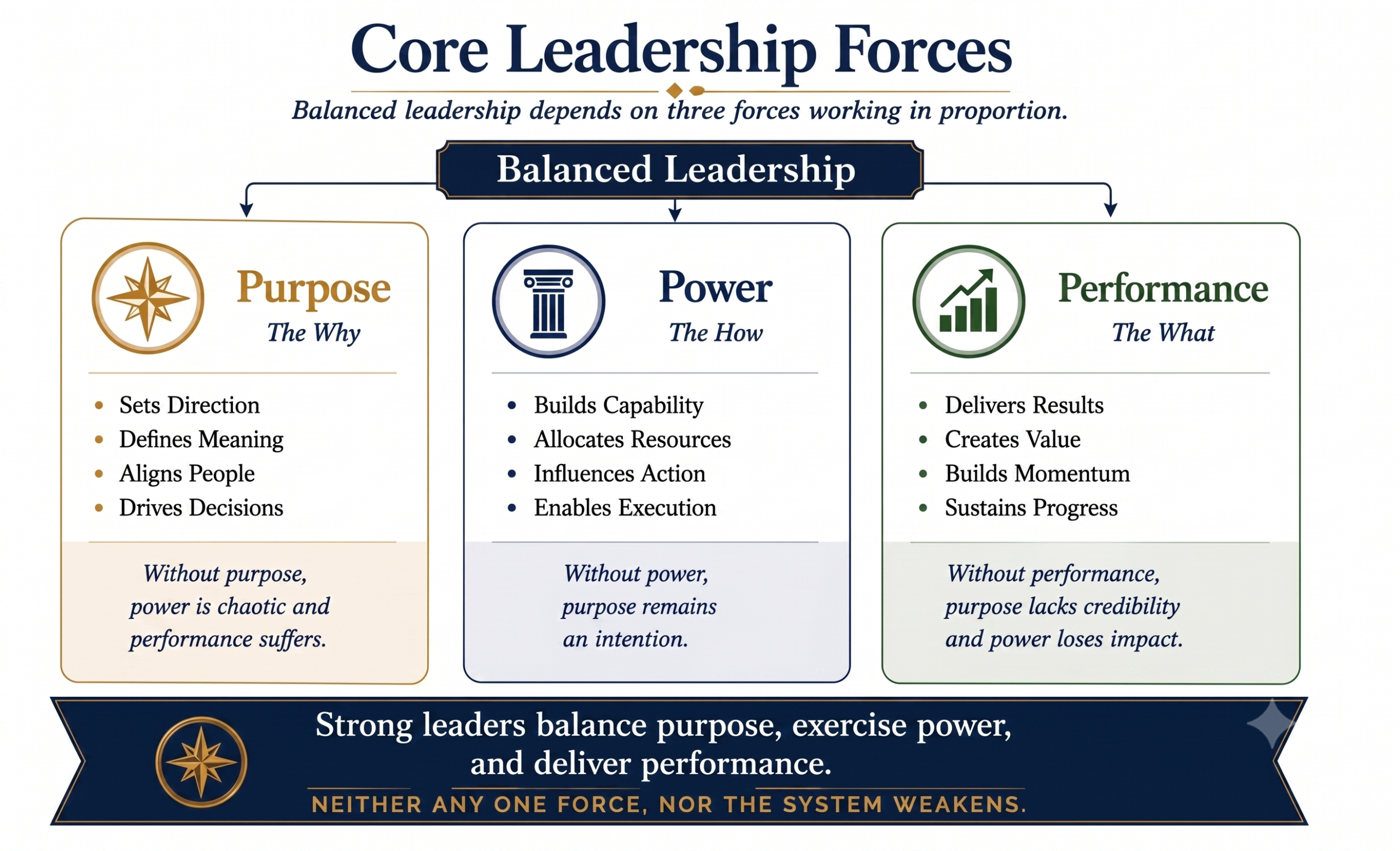
The model identifies three core forces at the center of the leadership function:
- Purpose: The moral rationale and strategic reason for every action.
- Power: The capacity to decide, direct, allocate resources, and exert influence.
- Performance: The disciplined execution required to convert intention into measurable results.
When these three forces remain in proportion, leadership gains legitimacy and traction. Purpose guides judgment, power drives behavior, and performance produces institutional impact. If any one of these forces becomes disproportionate—for example, power exerted without purpose, or performance demanded without the power to execute—the pendulum begins to swing erratically, leading to institutional drift.
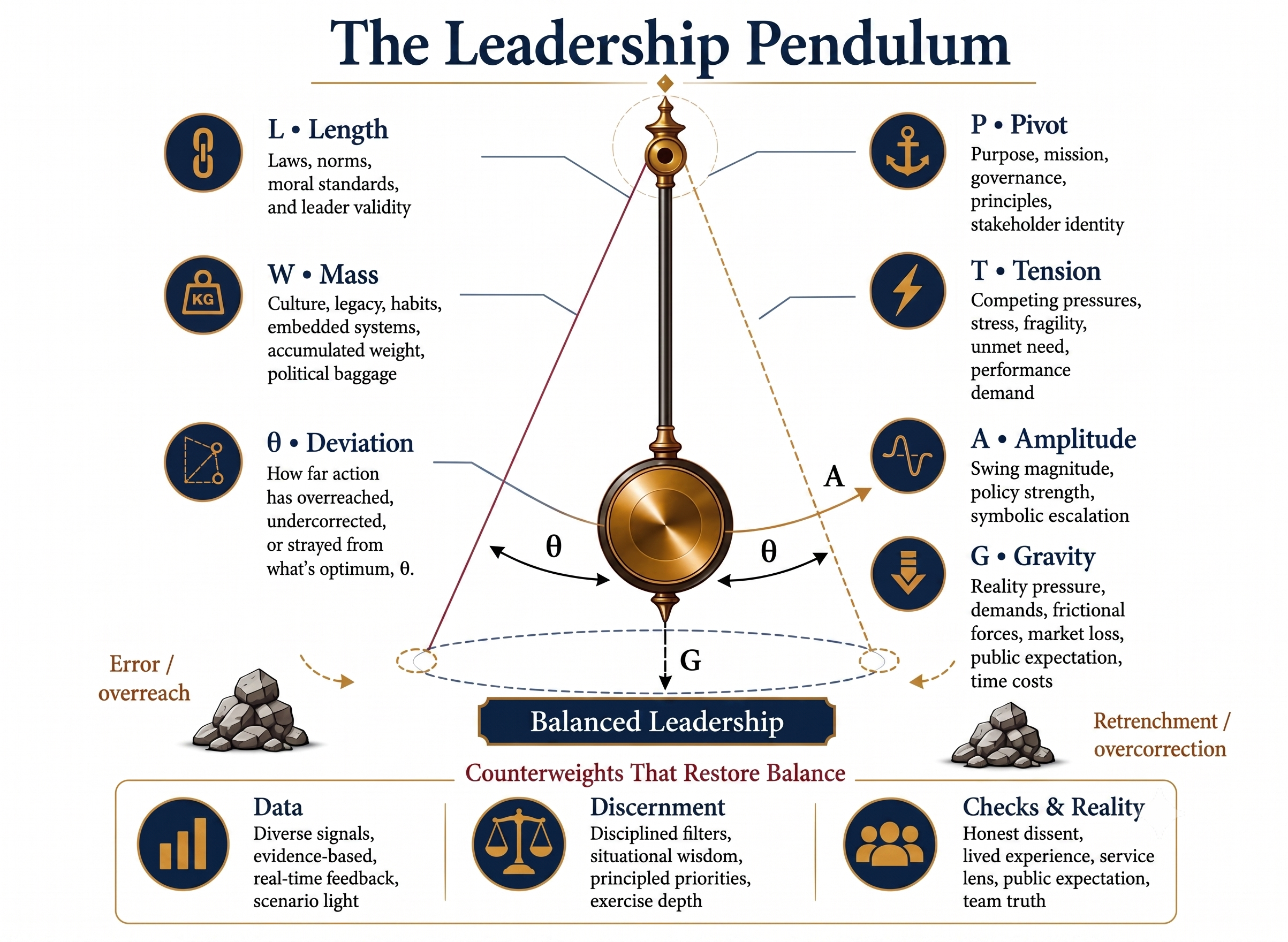
The Seven Domains of Diagnostic Assessment
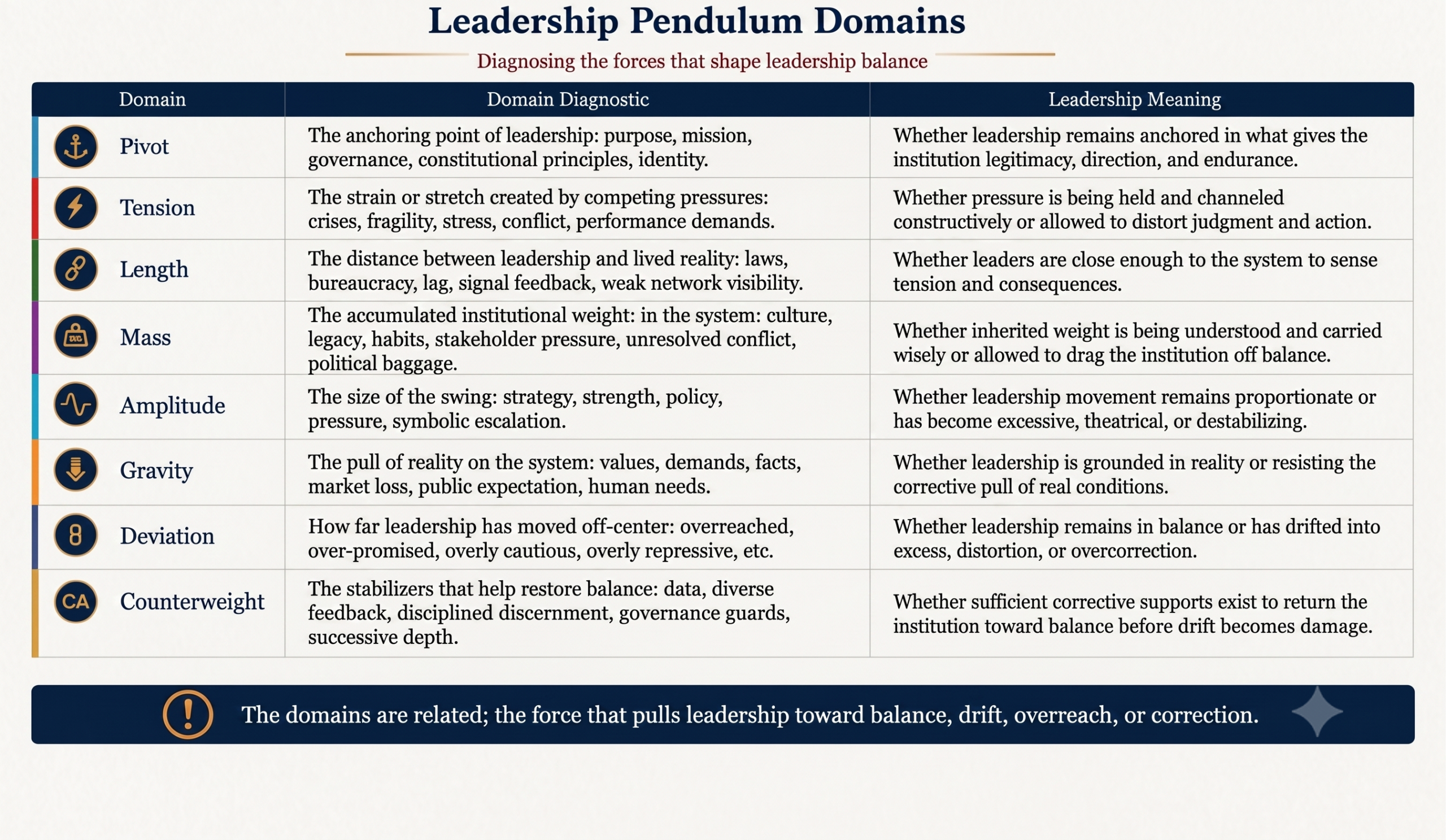
The Leadership Pendulum Model utilizes seven specific domains to diagnose the health of an organization’s leadership. These domains allow boards and executives to distinguish between temporary turbulence and structural failure:
- Pivot: The central point of stability, often represented by governance and core values.
- Tension: The pressure exerted by competing stakeholder demands.
- Length: The distance between leadership and the "lived reality" of the organization’s frontline.
- Mass: The inherited weight of institutional history, culture, and past decisions.
- Amplitude: The range of the leadership swing, or the degree of variation in decision-making.
- Gravity: The real-world constraints and market forces that pull a leader back toward reality.
- Deviation: The measurable gap between what the moment requires and what the leader provides.
Mathematically, the LBI can be expressed as a regression:
Leadership Balance Index = β0 + β1(Pivot) − β2(Tension) − β3(Length) − β4(Mass) − β5(Amplitude) − β6(Gravity) − β7(Deviation) + β8(Counterweights) + ε.
This equation serves to demonstrate that leadership balance is the result of the interaction between stabilizing and destabilizing forces. It highlights that the paradox of choice does not exist outside the model but operates through it—increasing tension and widening amplitude while weakening the pivot.
Chronology of Institutional Drift
The process of leadership failure often follows a predictable chronological pattern. Understanding this timeline allows organizations to intervene before the "swing" becomes destructive:
- The Weakening of the Anchor: The organization loses sight of its primary mission (Purpose) in favor of short-term gains or reactive measures.
- Accumulation of Strain: External pressures (Tension) increase, but the leader fails to adjust the "counterweights" of the system.
- Structural Distance: Decision-makers become insulated from the reality of their operations (Length), leading to choices that are strategically sound on paper but practically impossible.
- Widening Swings: The leader begins to oscillate between extremes—such as aggressive expansion followed by sudden, deep retrenchment.
- Failure of Stabilizers: Internal governance or board oversight (Counterweights) fails to check the deviation, leading to a loss of institutional legitimacy.
Inferred Reactions and Stakeholder Impact
Industry analysts and human resource experts suggest that the adoption of the Leadership Pendulum Model represents a significant shift in executive development. Boards of Directors are increasingly seeking "proportionality" over "charisma."
"We are seeing a move away from the ‘heroic leader’ archetype toward the ‘balanced steward,’" notes a hypothetical consensus among corporate governance experts. "The LBI provides a language for boards to discuss leadership performance without it becoming a personal attack on the CEO’s character. It turns the conversation toward mechanics and systemic health."
Furthermore, middle management and frontline employees are often the first to feel the "length" and "amplitude" of a swinging pendulum. When leadership is distant or erratic, employee engagement scores typically plummet, and turnover in key roles increases. Rebalancing the pendulum is therefore not just an executive exercise but a vital requirement for talent retention and operational stability.
Broader Impact: Building Leadership Muscle Memory
The ultimate value of the Leadership Pendulum is not merely to provide a snapshot of current performance, but to help institutions rebalance without stalling or fragmenting. This requires more than just reflection; it requires the development of "leadership muscle memory."
Muscle memory in this context refers to the learned capacity to think, decide, and act under pressure through patterns that are strengthened by active repetition. In healthy organizations, leaders return to the center by habitually asking for disconfirming evidence, testing every major decision against the core mission, and surfacing risks early through transparent governance. These habits make corrections earlier, steadier, and less theatrical.
The work of balanced leadership is not to freeze the pendulum in place. Movement is necessary for growth, and leaders are the stewards of that motion. Effective leadership requires energy, speed, and the courage to take risks. However, the discipline of leadership is to ensure that this motion does not drift out of proportion. Leadership endures when purpose, power, and performance remain in disciplined tension, and when leaders build the counterweights necessary to recover balance before a swing becomes a crisis.
In conclusion, the Leadership Pendulum Model asserts that balance is not a state of stillness. It is discipline in motion. By shifting the focus from individual style to systemic proportion, organizations can navigate unstable times with a level of clarity and endurance that "visible action" alone can never provide. The future of leadership lies in the ability to measure, diagnose, and correct the forces that shape institutional movement.






