
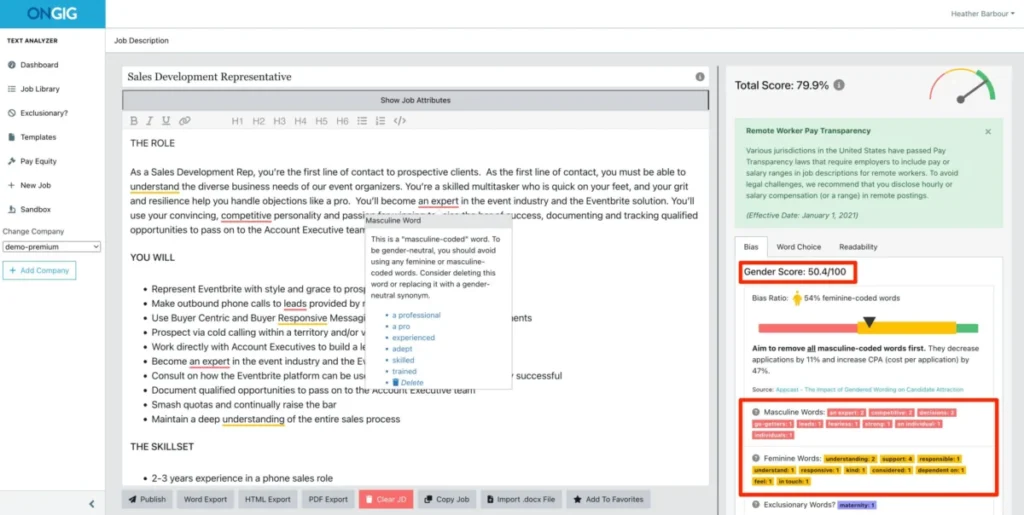
A groundbreaking analysis of job descriptions from January 1 to July 13, 2026, conducted by Ongig’s AI-powered Text Analyzer, has revealed a persistent pattern of implicit gender bias in hiring language. The study pinpoints a critical area for improvement in attracting a more diverse talent pool, identifying the top ten masculine-coded words that employers are actively editing out of their job postings. This real-world data underscores the pervasive nature of unconscious bias and highlights tangible steps organizations can take to foster more inclusive recruitment practices.
The Methodology: Tracking Real-World Bias Remediation
The findings are not based on theoretical models or static datasets but on the actual behavior of users employing Ongig’s Text Analyzer. This sophisticated AI tool is designed to flag gender-biased language within job descriptions and recommend gender-neutral alternatives. Each instance where a user accepted a suggested swap for a masculine-coded word was logged, creating a dynamic and authentic record of linguistic bias in action. This methodology provides an unparalleled insight into the words that hiring professionals are consciously choosing to remove, reflecting a growing awareness of their impact. The data represents edits made to live job postings, offering a transparent glimpse into the immediate efforts of companies to de-bias their recruitment materials in 2026.
The implications of this analysis are significant. Job descriptions serve as the initial point of contact between an employer and a potential candidate. When these descriptions contain an imbalance of gendered language—specifically, a preponderance of masculine-coded terms—they can subtly, yet effectively, deter qualified female applicants. This phenomenon is often attributed to "implicit bias" or "unconscious bias," meaning that the individuals crafting these descriptions may not intentionally seek to exclude women, but their word choices inadvertently create a less welcoming environment for diverse candidates. Rectifying this linguistic imbalance is identified as one of the most accessible and impactful levers employers can pull to increase female representation in their applicant pools. Indeed, research suggests that addressing just a handful of these commonly used masculine words can eliminate a significant portion of job description gender bias.
The 2026 Snapshot: Ongig’s Top 10 Masculine-Coded Words
The comprehensive data collected by Ongig’s Text Analyzer from January to July 2026 identified the following words as the most frequently swapped masculine-coded terms, listed by the number of times users replaced them:
| Rank | Word | Number of 2026 Swaps |
|---|---|---|
| 1 | Strong | 42 |
| 2 | Lead | 26 |
| 3 | Independently | 13 |
| 4 | Strengthen | 12 |
| 5 | Competitive | 10 |
| 6 | Leaders | 10 |
| 7 | Analyze | 9 |
| 8 | Champion | 8 |
| 9 | Analysis | 7 |
| 10 | Independent | 7 |
These words, while seemingly innocuous, often carry connotations of dominance, aggression, individual achievement, and assertiveness—traits historically and culturally associated with masculinity. While these qualities are valuable, an overreliance on such terminology can unintentionally alienate candidates who may associate more with collaborative, supportive, or communal work environments, often stereotyped as feminine traits.
Deconstructing the Bias: A Deeper Look at Each Word
1. "Strong" (42 swaps):
As the top offender, "strong" frequently appears in phrases like "strong communication," "strong written skills," or "strong desire." Its masculine coding often stems from associations with physical power or unwavering assertiveness. While intended to convey competence, its repeated use can contribute to an overall tone that may not resonate with all candidates.
- Examples of original usage: "Seeking a candidate with strong leadership skills." "Must possess strong analytical capabilities."
- Gender-neutral alternatives: Capable, effective, excellent, advanced, proficient, robust, solid, proven, impactful.
- Why they work: These alternatives focus on the quality of the skill or attribute rather than implying a potentially gendered characteristic. For instance, "proven communication skills" is objective and inclusive.
2. "Lead" (26 swaps):
Used to describe managing, directing, or spearheading initiatives, as in "Lead sales," "Lead projects," or "Project Lead." The term "lead" can imply a hierarchical, top-down approach to management, often perceived as masculine-coded in contrast to more collaborative leadership styles.
- Examples of original usage: "Lead a team of engineers." "Lead the strategic development of new products."
- Gender-neutral alternatives: Guide, manage, oversee, direct, coordinate, facilitate, spearhead, drive, develop, responsible for.
- Why they work: These terms emphasize various aspects of leadership beyond mere command, such as guidance, coordination, and development, appealing to a broader range of leadership styles.
3. "Independently" (13 swaps):
This adverb describes the ability to work without oversight, such as "Must be able to work independently on multiple projects." Its masculine coding arises from an emphasis on solo achievement over teamwork, which can be less appealing to candidates who value collaboration.
- Examples of original usage: "Manages priorities independently and reliably." "Comfortable making decisions independently."
- Gender-neutral alternatives: Autonomously, self-directed, self-reliant, with initiative, proactively, on one’s own initiative.
- Why they work: These alternatives convey self-sufficiency and proactivity without implicitly devaluing collaborative work.
4. "Strengthen" (12 swaps):
A verb used to describe improving a process, team, or outcome, like "Strengthen our client relationships" or "Strengthen the sales pipeline." It carries the same masculine-coded root as "strong."
- Examples of original usage: "Strengthen internal reporting processes." "Strengthen brand presence in the market."
- Gender-neutral alternatives: Enhance, improve, bolster, optimize, fortify, reinforce, build, develop.
- Why they work: These words maintain the meaning of improvement without the gendered connotations of "strength."
5. "Competitive" (10 swaps):
Often used to describe compensation ("competitive salary") or the desired candidate’s nature ("competitive drive"). Its masculine coding comes from an emphasis on rivalry and winning, which can deter candidates who prefer a more cooperative environment.
- Examples of original usage: "Seeking a competitive individual to grow market share." "We offer a highly competitive benefits package."
- Gender-neutral alternatives: Driven, ambitious, high-performing, market-leading (for compensation), challenging (for environment).
- Why they work: These terms describe positive attributes or benefits without evoking potentially off-putting aggressive connotations.
6. "Leaders" (10 swaps):
Similar to "lead," "leaders" describes desired hires or team structures: "We’re looking for future leaders" or "Join a team of industry leaders." This term, in its plural form, still emphasizes a hierarchical structure that can be less appealing to those who prefer flatter, more inclusive team dynamics.
- Examples of original usage: "Our organization is composed of thought leaders." "Develop the next generation of leaders."
- Gender-neutral alternatives: Innovators, visionaries, experts, trailblazers, pioneers, mentors, role models, key contributors.
- Why they work: These alternatives highlight the positive attributes of influential individuals without exclusively leaning on the traditionally masculine connotation of "leader."
7. "Analyze" (9 swaps):
The verb form of "analysis," "analyze" appears frequently: "Analyze quarterly performance data" or "Analyze customer feedback trends." While a neutral action, its frequent use in male-dominated fields (like STEM or finance) can subtly contribute to a masculine-coded perception, especially when combined with other similar terms.
- Examples of original usage: "Analyze and report on campaign results." "Analyze complex datasets to identify trends."
- Gender-neutral alternatives: Evaluate, assess, examine, review, interpret, scrutinize, investigate, study, dissect.
- Why they work: These synonyms maintain the precision of the action without the subtle gendered leanings, offering a broader, more inclusive vocabulary.
8. "Champion" (8 swaps):
Used as a verb to describe advocating for something, e.g., "Champion our DEI initiatives" or "Champion best practices across teams." As a competition-coded word, it evokes a sense of winning or fighting for a cause, which can be seen as masculine.
- Examples of original usage: "Champion change management efforts." "Champion the voice of the customer within the organization."
- Gender-neutral alternatives: Advocate, promote, support, uphold, foster, drive, advance, encourage.
- Why they work: These alternatives convey support and promotion without the competitive undertones, appealing to a wider range of candidates.
9. "Analysis" (7 swaps):
The noun form, "analysis," is used in various contexts: "Make recommendations based on detailed analysis" or "Conduct data analysis." Similar to "analyze," its frequent appearance in traditionally masculine-coded fields can subtly contribute to an overall gendered tone.
- Examples of original usage: "Provide qualitative analysis for strategic planning." "Perform deep dive analysis on market trends."
- Gender-neutral alternatives: Evaluation, assessment, examination, review, interpretation, scrutiny, investigation, study, breakdown.
- Why they work: These synonyms offer diverse ways to express the concept of detailed examination, broadening the appeal of the job description.
10. "Independent" (7 swaps):
Similar to "independently," "independent" describes a candidate who works well alone or without supervision. It’s perceived as masculine-coded due to its emphasis on solo achievement over collaborative effort, which can be less attractive to candidates who prioritize teamwork and interpersonal dynamics.
- Examples of original usage: "Seeking an independent, driven individual who works well alone." "You must be able to work independently and assertively."
- Gender-neutral alternatives: Autonomous, self-reliant, self-motivated, proactive, resourceful, capable of working solo, takes initiative.
- Why they work: These alternatives highlight desirable traits of self-sufficiency without implying a lack of collaborative spirit, appealing to a more diverse candidate pool.
The Broader Impact: Why Inclusive Language Matters
The elimination of gender-biased language from job descriptions is not merely a matter of political correctness; it is a strategic imperative with profound implications for talent acquisition, organizational culture, and business performance. Research consistently demonstrates that diverse teams lead to greater innovation, better decision-making, and improved financial outcomes. Yet, the initial gateway to building such teams—the job description—often inadvertently erects barriers.
Job descriptions are the first impression a candidate has of an organization’s values and culture. When these documents subtly signal a preference for masculine traits, they can deter women and individuals who do not strongly identify with traditional masculine characteristics. This narrows the applicant pool, potentially excluding highly qualified candidates and limiting an organization’s access to top talent.
The Research Underpinning the Findings
The insights from Ongig’s 2026 data are corroborated by a growing body of academic and industry research on linguistic bias. Labor market data provider Lightcast, in partnership with UNESCO, conducted a significant study analyzing job postings across six countries. Their findings clearly indicated that masculine-coded language correlates with lower female employment, particularly in senior and STEM roles. Notably, "lead" and "independent," two terms prominently flagged in Ongig’s analysis, were also identified by Lightcast as highly prevalent masculine-coded terms impacting female application rates. This convergence of findings from different analytical approaches underscores the robustness of the claim that specific words create real-world barriers.
Further reinforcing these conclusions, a seminal 2025 study published in the Proceedings of the National Academy of Sciences (PNAS) provided empirical evidence of the direct impact of de-biasing language. Covering nearly 38,000 applicants across four separate studies, the research found that swapping masculine-coded words for gender-neutral alternatives measurably increased application rates among women. Crucially, it also boosted applications from men who do not strongly identify with traditional masculine traits, indicating a broader appeal of inclusive language. This suggests that the benefits extend beyond gender, attracting a wider array of personalities and working styles.
A Call to Action for Equitable Hiring
The persistent presence of gender bias in job descriptions, as evidenced by Ongig’s 2026 data, serves as a powerful reminder of the ongoing need for vigilance and proactive measures in recruitment. While gender inequality is a multifaceted issue with systemic roots, the language used in hiring materials represents an easily actionable point of intervention for employers.
By consciously adopting gender-neutral language, organizations can signal their commitment to an inclusive workplace, dismantle subtle barriers, and significantly broaden their talent pool. This approach not only aligns with ethical hiring practices but also makes sound business sense, streamlining the hiring process by ensuring more qualified and diverse applicants feel encouraged to apply. The adoption of AI-powered tools like Ongig’s Text Analyzer empowers human resources professionals and hiring managers to easily identify and rectify these biases, making inclusive hiring a practical reality rather than an aspirational goal.
The journey toward truly equitable hiring is continuous, but the insights gleaned from real-time data and advanced analytical tools provide a clear roadmap. By focusing on the words we choose, we can unlock a wider world of talent and build organizations that are stronger, more innovative, and genuinely representative of the diverse world we live in. As the 2026 data clearly shows, the power to create change often lies in the seemingly small details of our language.






