
The global market for professional development, encompassing training, certification, and upskilling, is a colossal sector valued at over $400 billion. A significant portion of this, nearly one-third, is dedicated to topics and technologies that transcend specific company needs. For decades, this demand has been predominantly met by a diverse array of training providers, including online course libraries, video platforms, simulations, expert assessments, and various forms of professional certification, testing, and accreditation. This market has historically been viewed as recession-proof, as continuous skill enhancement is an enduring necessity for individuals seeking career advancement and for companies aiming to foster a culture of growth and innovation.
However, the landscape of online learning is undergoing a rapid and transformative evolution. Prominent players that once defined the sector, such as Udacity (acquired by Accenture), Coursera, Udemy (recently acquired by Coursera), LinkedIn Learning, SkillSoft, and Pluralsight, are now navigating a fundamentally altered environment. Even platforms focused on broader educational content, like Masterclass, TEDx, and BigThink, are feeling the pressure of this paradigm shift. Recent market movements, including the reported "merger" of Coursera and Udemy and the observable decline in stock prices of publicly traded learning companies, underscore this disruption. This recalibration is not attributed to a lack of managerial acumen but rather to a fundamental change in both the underlying technology and the way learning content is consumed.
The Evolution of Learning: From Packaged Courses to Personalized Growth
The enduring demand for professional skills development is undeniable. Every working individual possesses aspirations for career progression, creating a perpetual need for skill acquisition across all job families – from IT and sales to marketing, finance, support, and human resources. This demand can be broadly categorized into five distinct levels of professional growth:
Level 1: Foundational Knowledge Acquisition
This level caters to individuals new to a profession, role, or career. The primary objective is to gain foundational knowledge and often achieve basic certifications. While organizations like SHRM and HCI offer such certifications, their perceived value in the job market can fluctuate. For example, the author notes a decline in the perceived value of certain HR certifications, suggesting a shift in employer priorities. At this stage, learners require an understanding of fundamental concepts, industry jargon, and an overview of relevant tools.
Level 2: Expanding Expertise
Professionals with two to three years of experience typically fall into this category. They possess a grasp of the basics but require deeper insights and practical application. This level demands case studies, advanced use-case scenarios, and training that challenges existing thinking. For instance, a recruiter aiming for a senior role would need to acquire knowledge in advanced sourcing techniques, skills assessment, candidate marketing, and the integration of artificial intelligence in recruitment.

Level 3: Broadening Specialized Skills
Individuals at this level have deep expertise in a specific area but lack breadth. A tech-recruiting specialist, for example, might need to develop skills in executive search or sales team recruitment. The demand here is for exposure to global practices, multi-industry experiences, or diverse technological applications. Professionals often seek out this training to transition from specialized roles to leadership positions, such as moving from a Senior Recruiter to a Head of Recruiting role, which necessitates leadership development.
Level 4: Advancing World-Class Proficiency
This tier comprises individuals with extensive experience who aim to remain at the forefront of their fields. They seek to identify emerging technologies, adopt advanced approaches, and often broaden their industry exposure. Senior leaders, for instance, may find their expertise limited by their industry background. Transitioning to new sectors can provide invaluable perspectives, enhance confidence, and increase value creation. This level also includes those moving into executive roles, transitioning between large corporations and startups, or delving into entirely new technological or scientific domains. The principle of "T-shaped" professionals—possessing deep expertise in one area and broad knowledge in others—is particularly relevant here, driving a need for access to deep skills, experts, research, and parallel topic training.
Level 5: Mastery and Knowledge Dissemination
At the apex are highly experienced professionals, akin to "10X engineers" or C-suite gurus, who have demonstrably impacted their fields. Their pursuit of further growth often involves teaching, mentoring, coaching, or writing. Their engagement with professional communities, deep research, and global peers stems from a desire to share knowledge and collaborate rather than solely for personal recognition.
The AI Revolution: Redefining Content Delivery
Traditionally, the professional development market has offered solutions that are often "packaged" without adequately addressing the nuanced needs of professionals at different growth stages. A course labeled "advanced" might introduce new topics, but it may not align with the specific learning trajectory of a Level 3 or Level 4 professional. This disconnect highlights the difficulty of mapping generic training programs to the dynamic requirements of advancing careers.
Artificial Intelligence (AI) is emerging as the pivotal technology to address this challenge by enabling the custom assembly of learning experiences tailored to individual goals. The dramatic surge in the usage of AI tools like ChatGPT, with an estimated 900 million weekly users, is particularly telling. Reports indicate that over 40% of these interactions involve users seeking to learn, acquire skills, or solve problems. This statistic suggests that in a remarkably short period, AI platforms have attracted a learner base that rivals or surpasses established Learning and Development (L&D) platforms.
This phenomenon is driven by two core factors:

- Intuitive Learning through Inquiry: AI facilitates a natural, child-like approach to learning—asking questions and exploring curiosity. Interacting with an AI agent feels organic, allowing users to delve into subjects and explore information dynamically.
- Holistic Information Interconnection: AI’s underlying content models, such as those powering platforms like Galileo, interconnect information through sophisticated embeddings. This allows for non-linear learning pathways, enabling users to ask for explanations, delve deeper into specific areas, or skip content as needed, significantly enhancing the speed and quality of learning.
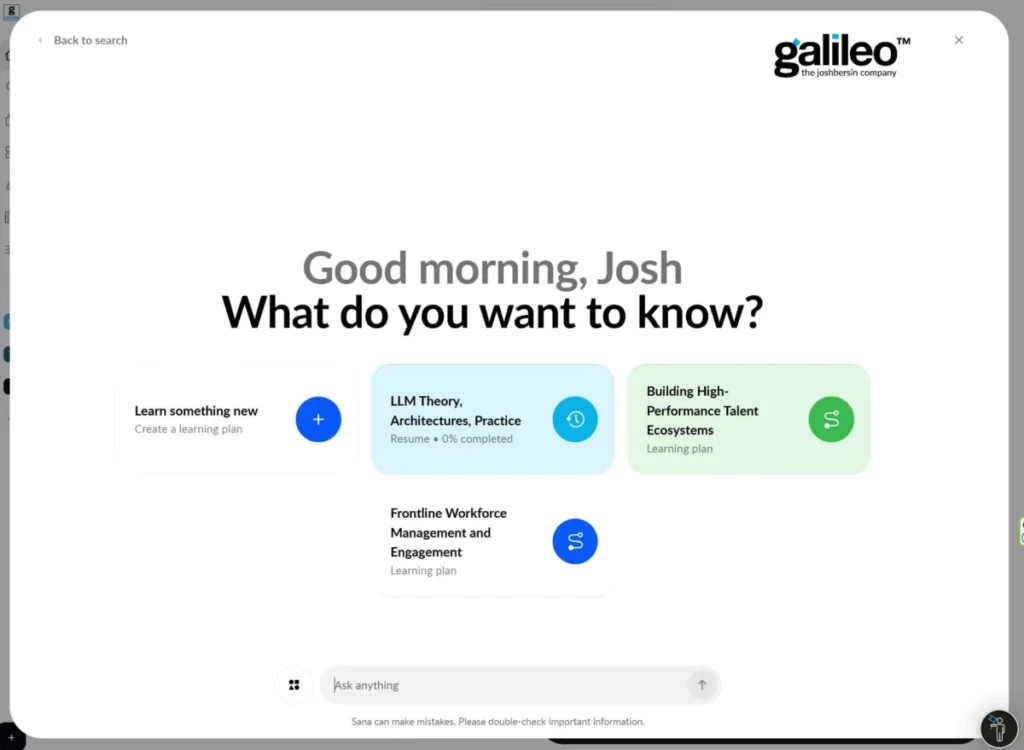
Platforms like Galileo exemplify this shift by offering dynamic learning experiences. Users can opt for structured courses or engage with an AI "Supertutor" that provides personalized information and experiences based on their role, past interactions, and other contextual data. This adaptive approach transforms the learning process from a static delivery of information to an interactive, evolving dialogue.
Market Disruption: From Publishing to Dynamic Delivery
This fundamental shift from "publishing courses" to "dynamically delivering content" is profoundly reshaping the professional development market. The industry, previously segmented into learning platforms (LMS, LXP), learning content (courses, programs), content development tools, certifications, and consulting services, is now compelled to adapt to an AI-native infrastructure. This is not a gradual evolution but a rapid, discontinuous transformation.
The traditional model, often referred to as a "publishing paradigm," involved identifying needs, gathering subject matter experts, designing content (courses, simulations, assessments), and then "publishing" it to a learning management system for distribution. While this web-based publishing model was revolutionary in the early 2000s, disrupting hundreds of traditional classroom training companies, its efficacy is now being challenged. While high-touch, premium offerings will likely persist, the majority of professional development is pivoting.
The emerging AI-First or AI-Native model leverages AI for content collection, generation, translation, and delivery. Platforms like Galileo integrate extensive research and case studies with a company’s internal content, creating a personalized learning journey. Users can access formal courses, request simulations, engage in role-playing exercises, or query the AI for instant answers. This interactive, question-driven approach mirrors a classroom setting, providing immediate clarification and deeper understanding.
This AI-driven experience offers a significant disruption to the traditional courseware business model. The user experience becomes inherently more personalized, as the AI adapts to individual needs and progress. Furthermore, complex and costly processes like instructional design, translation, and video generation are increasingly automated. AI-native platforms can generate new learning experiences daily as new content is integrated, and when combined with a company’s proprietary information, they create a hybrid learning environment that blends external expertise with internal processes, technical knowledge, and cultural practices.
Elements such as career pathways, learning paths, skills taxonomies, and assessments, which were once labor-intensive to create, are now largely machine-generated. This shift compels professional development vendors to offer not just content but also a highly personalized, user-friendly, and valuable experience optimized by AI. The rapid advancements in AI video generation, such as Sora, and the integration of AI features into platforms like YouTube (e.g., auto-generated chapters) further illustrate the accelerating pace of change. AI’s capacity to understand reading levels, learning preferences, and technical interests means that learning platforms are becoming deeply attuned to individual users.
Opportunities for Innovation and Strategic Realignment
The online learning industry, which some observers felt was experiencing a stagnation in innovation, is now brimming with possibilities thanks to AI. This period of reinvention presents numerous opportunities:
- AI-Powered Personalized Learning Paths: AI can dynamically curate learning journeys based on an individual’s current skills, career aspirations, and preferred learning styles. This moves beyond static, one-size-fits-all curricula.
- Immersive Learning Environments: AI can generate realistic simulations, role-playing scenarios, and virtual environments that allow learners to practice skills in a safe, controlled setting.
- Intelligent Content Creation and Curation: AI tools can assist in generating diverse content formats, translating materials into multiple languages, and identifying the most relevant and up-to-date information from vast knowledge bases.
- Predictive Skill Gap Analysis: AI can analyze workforce data and industry trends to proactively identify emerging skill gaps and recommend targeted development interventions.
- AI-Driven Coaching and Mentorship: AI-powered agents can provide personalized coaching, feedback, and guidance, supplementing or even augmenting human mentorship.
- Enhanced Assessment and Credentialing: AI can facilitate more sophisticated and adaptive assessments, providing more accurate measures of competency and potentially leading to new forms of micro-credentialing.
Implications for Professionals, HR, and L&D Buyers
The seismic shift in the professional development market necessitates a strategic re-evaluation for all stakeholders. Training, certification, and professional education providers must adapt to AI-native infrastructure. While established course libraries and subscriptions will not disappear overnight, the emergence of personalized, AI-centric providers could lead to the acquisition of legacy vendors.
The increasing prevalence of AI agents on personal and professional devices, integrated by major tech companies, signifies a future where employee access to information and support will be seamless. This presents an unprecedented opportunity for L&D departments to integrate learning directly into workflows. For instance, an hourly worker could be prompted by their AI agent about upskilling opportunities that could lead to higher-paying shifts.
Companies are already exploring AI-powered solutions for leadership coaching, assessments, content creation (videos, audio, tests, courses), and more. The recommendation for the coming year is to develop a "re-engineered view" of L&D strategy. Evidence from recent corporate engagements suggests that traditional L&D functions, involving extensive work in translation, skills architecture, LMS publishing, metadata management, and the creation of job aids, can be significantly automated. This automation can lead to substantial cost reductions—potentially up to 40% in L&D spending—while simultaneously delivering a more personalized and effective employee experience.
For vendors and consultants, the message is clear: embrace the change. Boldly explore new market entrants, and consider partnerships, acquisitions, or internal development of AI platforms. This is an opportune moment to reimagine how individuals are developed and supported in the workplace, with an ever-growing demand for effective solutions. As major research reports on future workforce imperatives and L&D maturity models are released, the integration of AI into professional development is poised to become a defining characteristic of the modern learning landscape. Exploring immediate AI-fueled professional development platforms like Galileo can offer a tangible experience of this transformative future.







