
The rapid integration of artificial intelligence (AI) into human resources (HR) decision-making processes is presenting a complex challenge for organizational leadership, particularly concerning accountability. As AI tools become more sophisticated and embedded in critical HR functions, the question of who bears ultimate responsibility for the outcomes of these technologies looms large. Marc Rodriguez, co-founder and CEO of Green Leaf Business Solutions, emphasized in a recent piece for HR Executive that a plea of "the software did it" is unlikely to be accepted by regulators. This assertion immediately raises a fundamental question: when HR and IT collaborate on technological rollouts, especially those involving AI, who shoulders the accountability – the Chief Human Resources Officer (CHRO) or the Chief Information Officer (CIO)? This ambiguity is poised to escalate significantly in the coming years.
Gartner, a leading research and advisory firm, projects a substantial shift in organizational structures by 2029, forecasting that 30% of organizations will establish blended HR-IT teams. This strategic formation is driven by the imperative to accelerate AI enablement and harness its transformative potential across the enterprise. This trend signals a growing recognition of the intertwined nature of human capital management and technological infrastructure in the age of AI.
The Imperative of Shared Ownership: CHRO and CIO Collaboration
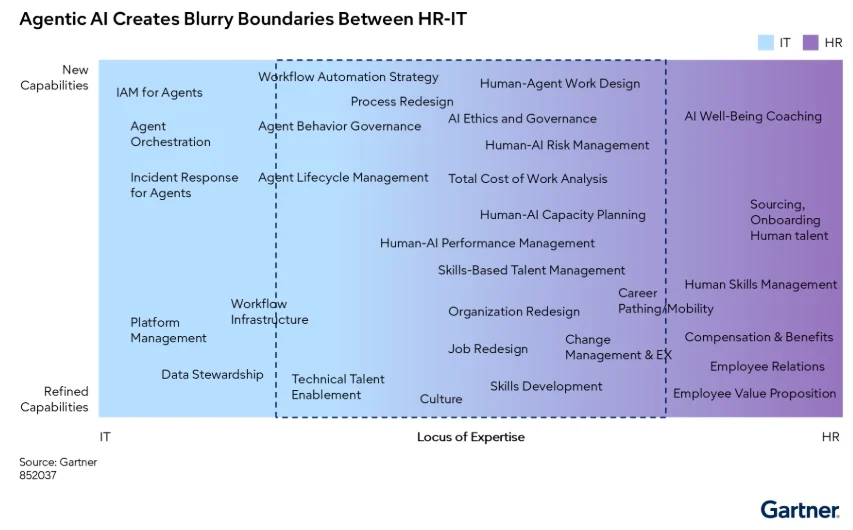
Mark Whittle, VP Analyst in Gartner’s HR practice, has been a prominent voice in articulating the evolving leadership landscape. He asserts that a crucial element for navigating the AI-driven workplace is the joint responsibility of the CHRO and CIO. According to Whittle, these two leaders must "jointly help shape the capabilities, standards and guardrails needed to support the human-machine workplace." This collaborative approach is not necessarily about merging the HR and IT departments into a single monolithic entity. Instead, Whittle suggests that most organizations will likely maintain their distinct HR and IT functions. However, the increasing overlap in areas where "work, talent, and technology overlap" will necessitate a far more integrated and strategic partnership between these departments.
While some organizations have explored more radical integrations, such as bringing HR and IT under common leadership or even outright merging the functions, the prevailing expert consensus leans towards a model of shared governance. This model emphasizes joint accountability and the establishment of common metrics that focus on workforce impact. This approach allows each function to leverage its core expertise: HR maintaining its critical role in fostering culture, driving change management, and understanding employee dynamics, while IT continues to excel in systems architecture, technological implementation, and ensuring scalability and security.
Deconstructing the Silos: A Framework for Joint Accountability
The growing reliance on AI in HR decision-making necessitates a proactive strategy to prevent the formation of functional silos. Whittle outlines several key areas where CHROs and CIOs must "intentionally share ownership" to foster effective collaboration and avoid confusion. These critical domains include:
- AI Governance and Ethics: Both leaders must jointly establish frameworks for the ethical deployment and oversight of AI in HR. This involves defining acceptable uses, identifying potential biases, and ensuring compliance with evolving regulations. The CHRO brings a deep understanding of employee rights and ethical workplace practices, while the CIO understands the technical underpinnings and risks associated with AI algorithms.
- Talent Acquisition and Management: AI is increasingly used in resume screening, candidate matching, and even performance prediction. Shared ownership ensures that these tools are designed and implemented in ways that promote fairness, diversity, and accurate skill assessment, rather than inadvertently perpetuating existing biases or overlooking qualified candidates.
- Workforce Planning and Development: AI can offer powerful insights into future skill needs and workforce trends. Joint leadership ensures that these insights are translated into actionable development programs and strategic talent acquisition initiatives that align with both business objectives and employee growth opportunities.
- Employee Experience and Engagement: AI-powered tools can personalize employee communications, training, and benefits. Collaborative oversight ensures that these technologies enhance, rather than detract from, the overall employee experience, maintaining a human-centric approach.
- Performance Management and Feedback: AI can assist in tracking performance metrics and providing feedback. Shared responsibility guarantees that these systems are implemented fairly, transparently, and in a manner that supports continuous improvement and development, rather than solely focusing on punitive measures.
- HR Technology Strategy and Integration: The selection, implementation, and ongoing management of HR technology, particularly AI-driven solutions, require close partnership. The CHRO ensures that the technology meets HR needs and aligns with workforce strategy, while the CIO ensures technical feasibility, integration with existing systems, and robust data security.
Whittle further elaborates on the disruptive potential of "agentic AI," a type of AI that can perform tasks autonomously. As this advanced AI increasingly operates in the space where HR and IT intersect, traditional departmental boundaries become blurred. Capabilities such as skills-based talent management, sophisticated human-AI performance management, and dynamic human-AI capacity planning no longer fit neatly within either the HR or IT silo. This lack of clear ownership can lead to fragmented oversight, diffused accountability, and a misalignment with overarching business objectives.

The Peril of Role Confusion and "One-Sided Transformation"
The absence of clear, shared leadership in AI adoption can lead to significant "role confusion" for HR leaders, as Whittle points out. CHROs might find themselves grappling with the unintended workforce consequences of AI deployments that they did not actively help shape. Conversely, CIOs could inadvertently become the custodians of complex workforce challenges that arise from AI implementations, simply because they manage the underlying technology.
Whittle characterizes this scenario as "one-sided transformation," where HR and IT operate with distinct, often competing, priorities. This can result in valuable shared opportunities and responsibilities being overlooked. When each function focuses solely on its own domain, the organization risks remaining in a perpetual state of AI experimentation without ever achieving enterprise-scale impact. This can lead to wasted resources, missed opportunities for innovation, and a failure to fully realize the strategic benefits of AI.
Broader Implications and the Path Forward
The evolving landscape of AI in HR is not merely a technological or operational concern; it has profound implications for organizational strategy, culture, and legal compliance. As AI tools become more pervasive in hiring, promotion, compensation, and performance evaluation, the potential for systemic bias and discriminatory outcomes increases. This underscores the critical need for robust governance and ethical considerations, areas where shared CHRO-CIO ownership is paramount.
The regulatory environment surrounding AI is still in its nascent stages, but it is clear that organizations will be held accountable for the decisions made by their AI systems. The expectation is not for AI to bear responsibility, but for the human leaders who deploy and oversee it. This reinforces the importance of establishing clear lines of accountability and ensuring that AI systems are developed and implemented with human oversight and ethical principles at their core.
The upcoming HR Executive Strategy Summit at HR Tech will feature Valerie Workman, CHRO of Empower Pharmacy, who will share practical frameworks for managing AI risk, ethics, and workforce outcomes. Drawing from her experience at Empower Pharmacy and Tesla, Workman’s insights will likely offer valuable guidance to HR leaders navigating this complex terrain. Her participation highlights the growing recognition within the HR community of the need for strategic leadership in AI governance and enterprise technology strategy.
In conclusion, the integration of AI into HR decision-making demands a fundamental rethinking of leadership roles and responsibilities. The days of siloed departmental operations are rapidly drawing to a close. The future success of organizations in leveraging AI for talent management and workforce optimization hinges on the ability of CHROs and CIOs to forge a strong, collaborative partnership, characterized by shared ownership, clear accountability, and a unified vision for a human-machine workplace. The ability to effectively navigate this blurred landscape will be a key differentiator for organizations aiming to thrive in the AI-driven era.







