
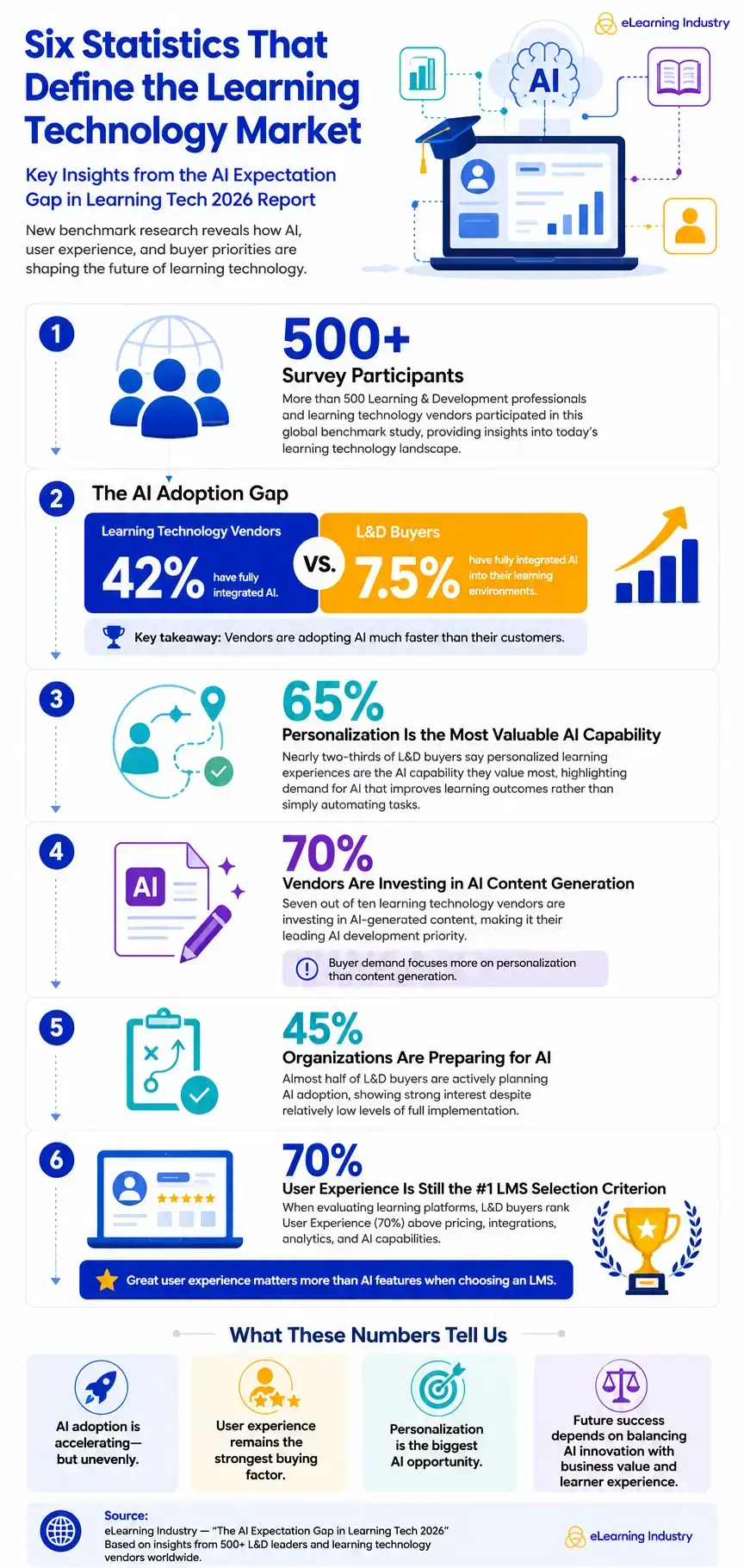
The global corporate training landscape in 2026 has reached a critical inflection point, defined by a widening "expectation gap" between the technological ambitions of software vendors and the pragmatic requirements of Learning and Development (L&D) professionals. While Artificial Intelligence (AI) continues to be the primary engine of innovation within the sector, recent data suggests that the market is shifting away from a fascination with raw technical capability toward a demand for measurable business outcomes and superior user experiences. According to a comprehensive benchmark report from eLearning Industry, which surveyed over 500 L&D buyers and technology vendors worldwide, the industry is witnessing a significant misalignment: vendors are aggressively pushing fully integrated AI environments, yet only a small fraction of organizations have successfully implemented these tools into their daily operations.
The Emergence of the AI Expectation Gap
The "AI expectation gap" serves as the defining narrative for the learning technology market in 2026. This phenomenon describes the disconnect between the rapid-fire release of AI-driven features by developers and the actual adoption rates and priorities of the organizations purchasing them. For several years, the narrative surrounding Learning Management Systems (LMS) and Learning Experience Platforms (LXP) was dominated by the promise of generative AI and automated content creation. However, as these technologies have matured, buyers have become more discerning, moving past the initial "hype cycle" to focus on integration, usability, and data privacy.
The research indicates that while 42% of technology vendors claim their platforms now feature full AI integration, a mere 7.5% of L&D buyers report that AI is fully integrated into their existing learning ecosystems. This discrepancy highlights a fundamental truth about the current market: technological availability does not equate to organizational readiness. Instead of chasing the latest algorithmic breakthroughs, 45% of buyers are still in the planning and evaluation phases of AI adoption, signaling a cautious, strategic approach to digital transformation.
Historical Context: The Path to 2026
To understand the current state of the market, one must look at the trajectory of learning technology over the last decade. The mid-2010s were defined by the transition from legacy LMS platforms to more agile LXPs that prioritized learner engagement. By 2023, the explosion of large language models (LLMs) shifted the focus toward automated content production and chatbots.
However, by 2025, many organizations realized that an over-reliance on AI-generated content led to "content bloat"—a surplus of generic training materials that lacked institutional context. Consequently, the 2026 landscape is one of correction. Buyers are no longer impressed by the mere presence of AI; they are demanding that AI solve specific problems, such as skill gap analysis and administrative automation, without compromising the human elements of instruction.
Data Analysis: Priorities and Purchasing Drivers
The eLearning Industry benchmark report provides a stark statistical breakdown of what truly drives the market today. When asked to rank their primary reasons for selecting a new learning platform, the responses from L&D leaders were revealing:

- User Experience (UX) First: 70% of buyers cited UX as the most critical factor in their purchasing decision.
- AI as a Secondary Concern: Only 30% of buyers placed AI features at the top of their priority list.
- The Integration Hurdle: Seamless integration with existing HRIS (Human Resources Information Systems) and communication tools like Slack or Microsoft Teams remains a top-three requirement for over 60% of organizations.
- Price and ROI: In an era of tightened corporate budgets, clear evidence of Return on Investment (ROI) and transparent pricing structures were listed as more influential than "innovative" technology by 55% of respondents.
These figures suggest that for vendors, the competitive advantage has shifted. In previous years, being an "AI-first" company was a differentiator. In 2026, AI is viewed as a baseline utility—a standard feature that is expected but not sufficient on its own to win a contract.
Seven Key Trends Reshaping the 2026 Market
1. User Experience as the Ultimate Differentiator
The data confirms that no amount of advanced technology can compensate for a poor interface. L&D leaders are increasingly focused on "frictionless learning." If a platform is difficult to navigate or requires extensive training just to use, it is viewed as a liability. Vendors that prioritize intuitive design and accessibility are outperforming those that focus solely on backend automation.
2. The Commoditization of AI
AI has moved from being a "shiny new toy" to a standard component of the modern tech stack. Buyers now assume a platform will have some level of smart recommendation or automation. Because it is expected, it no longer serves as a primary selling point. Vendors must now demonstrate how their AI specifically improves learning outcomes rather than just listing it as a feature.
3. The Resilience of the LMS
Despite perennial predictions of the "death of the LMS," the Learning Management System remains the dominant architecture in corporate education. Rather than being replaced by AI platforms, the LMS is absorbing AI. Organizations still value the centralized control, compliance tracking, and robust reporting that a traditional LMS provides, provided it is updated with modern, AI-enhanced capabilities.
4. The Investment-Adoption Mismatch
Vendors are currently investing in R&D at a pace that far exceeds the average corporation’s ability to implement change. This has created a surplus of features that many L&D teams do not yet have the bandwidth or the internal expertise to use. The report suggests that vendors who offer "change management" support and educational resources alongside their software will find more success than those who simply deliver a complex toolset.
5. The Demand for Deep Personalization
While vendors have focused heavily on AI-generated content (the "supply" side of learning), buyers are more interested in the "demand" side: personalization. L&D professionals want AI that can map out individual career paths, identify specific skill deficiencies, and suggest content that is relevant to a user’s current project or role.
6. The Rise of "Trust Tech"
As AI becomes more pervasive, concerns regarding data ethics, algorithmic bias, and privacy have moved to the forefront. In 2026, "Trust" is a marketable asset. Buyers are asking for transparency in how AI models are trained and how learner data is protected. Platforms that offer robust governance frameworks and "explainable AI" (XAI) are gaining a significant edge in highly regulated industries like finance and healthcare.
7. The Human-Centric Learning Requirement
There is a notable resurgence in the demand for human-led training. The report found that 48% of buyers still prioritize virtual classrooms and live, instructor-led training (ILT) tools. Interestingly, only 18% of vendors are highlighting these features in their marketing. This indicates a "blind spot" in the vendor community, where the rush to automate has led some to overlook the enduring value of social and collaborative learning.
Industry Reactions and Expert Perspectives
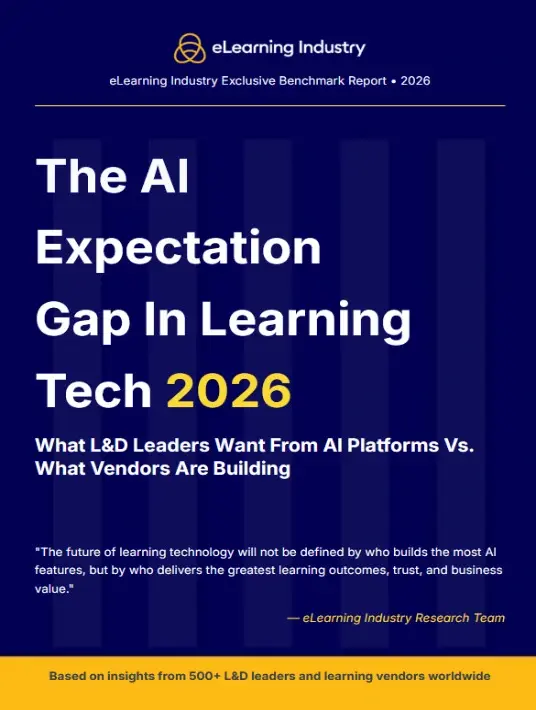
The findings of the 2026 report have prompted a wave of reflection among industry leaders. Christopher Pappas, CEO and founder of eLearning Industry, emphasized that the industry’s future depends on a return to fundamentals. "The next generation of learning platforms won’t be defined by how much AI they include, but by how effectively they help organizations develop people, solve real business challenges, and earn users’ trust," Pappas stated. "Innovation only matters when it delivers meaningful outcomes."
Inferred reactions from the broader L&D community suggest a growing "AI fatigue." Many Chief Learning Officers (CLOs) are reporting that their primary challenge is not a lack of technology, but the difficulty of proving that such technology leads to better employee performance. This has led to a call for "practical AI"—tools that automate boring administrative tasks (like grading or scheduling) so that L&D teams can focus on high-level strategy and coaching.
Broader Implications and the Road Ahead
The implications of this expectation gap are profound for the vendor ecosystem. We are likely to see a period of consolidation where smaller vendors that cannot provide a holistic, integrated, and user-friendly experience are acquired by larger players who have the resources to bridge the gap.
Furthermore, the focus on "Trust" and "Responsible AI" will likely lead to new industry standards. We may see the emergence of third-party certifications for "Ethical AI in Education," similar to ISO standards, which will become a prerequisite for government and enterprise contracts.
For organizations, the message is clear: the focus of 2026 and beyond should be on alignment. Technology should serve the strategy, not the other way around. Companies that succeed will be those that use AI to enhance the human experience of learning, ensuring that training remains relevant, engaging, and, above all, effective in driving business growth.
Conclusion
As we navigate the remainder of 2026, the learning platform market is maturing. The initial frenzy of AI implementation is giving way to a more stable era of "Value-Driven Innovation." Vendors who can close the expectation gap by focusing on User Experience, building trust through transparent AI practices, and supporting the enduring need for human interaction will lead the market. In the end, the most successful platforms will not be the ones with the most complex algorithms, but the ones that most effectively empower people to learn and grow within an increasingly digital workspace.






