
The rapid proliferation of generative artificial intelligence has forced two historically disparate sectors—corporate America and higher education—into a shared crisis regarding the nature of human cognition. As Chief Learning Officers (CLOs) and academic administrators struggle to integrate Large Language Models (LLMs) into their workflows and curricula, a growing body of neuroscientific evidence suggests that current strategies of either total prohibition or uncritical adoption are fundamentally flawed. At the center of this debate is a burgeoning phenomenon known as "cognitive debt," a term used to describe the long-term neurological cost of outsourcing critical thinking to automated systems.
In response to these challenges, a new pedagogical framework called the Bot Check Method is emerging as a middle path. Developed by Christyl L. Murray in collaboration with the Columbia University School of Professional Studies Pedagogical Lab, the method prioritizes human agency through a sequenced, four-phase approach to AI interaction. By moving away from "abstinence-only" policies and "adoption-at-all-costs" mandates, the method seeks to preserve the neural pathways associated with independent thought while leveraging the analytical power of AI.
The Neural Cost of Automation: The MIT Media Lab Findings
The foundational evidence for the risks of AI over-reliance comes from recent research conducted at the MIT Media Lab. In a study titled "Your Brain on ChatGPT: Accumulation of Cognitive Debt when Using an AI Assistant for Essay Writing Task," lead researcher Nataliya Kosmyna and her team utilized electroencephalogram (EEG) technology to monitor the brain activity of 54 university students.
The study compared three distinct conditions: students writing essays using ChatGPT, those using a standard search engine, and those using no digital tools. The results provided a stark contrast in cognitive engagement. Students utilizing LLMs exhibited the weakest brain connectivity across regions associated with memory and active problem-solving. Conversely, those working without tools showed the most robust and distributed neural networks.
Most concerning to educators and corporate trainers was the "withdrawal" phase of the study. When students who had previously relied on ChatGPT were asked to write a subsequent essay without the tool, their neural engagement remained significantly depressed. Researchers described this as a state of "underengagement," suggesting that the habit of deferring to AI creates a lingering cognitive deficit that persists even after the tool is removed. Furthermore, behavioral data showed that LLM users reported lower levels of "intellectual ownership" and struggled to accurately quote or explain the logic behind their own AI-assisted work.

A Chronology of the AI Integration Crisis (2022–2025)
The current tension in learning design is the result of a rapid technological shift that caught both academic and corporate institutions unprepared.
- November 2022: The public launch of ChatGPT marks the beginning of the "Generative AI Era," leading to immediate concerns regarding academic integrity and white-collar job displacement.
- Early 2023: Many leading universities and public school districts implement total bans on AI tools, viewing them primarily as engines for plagiarism. In the corporate sector, companies like Samsung and Apple restrict internal use of ChatGPT due to data security concerns.
- Late 2023: The "Abstinence Error" becomes apparent. Despite prohibitions, "Shadow AI"—the use of unsanctioned AI tools on personal devices—proliferates in both classrooms and offices, creating significant data leaks and pedagogical gaps.
- 2024: The pendulum swings toward "fluency." Corporate organizations launch aggressive AI upskilling programs, focusing on adoption metrics and prompt engineering. Simultaneously, researchers begin to observe the first signs of "cognitive atrophy" in professional settings.
- 2025: Emergent research, including the MIT Media Lab study, provides empirical data on the neurological impacts of AI. The focus shifts from "how to use AI" to "how to think alongside AI," leading to the development of frameworks like the Bot Check Method.
The Failure of Current Institutional Responses
The journalistic consensus among industry analysts is that both the academic and corporate responses to AI have been reactionary rather than design-led. In academia, the "abstinence" approach mirrors historical failures in public health education. By prohibiting the tool, educators do not stop the behavior; instead, they ensure it happens outside of a supervised, scaffolded environment. This deprives students of the opportunity to develop the judgment required to use AI ethically and effectively.
In the corporate world, the "adoption" approach often prioritizes speed over capability. When organizations push for higher AI usage rates without specifying the sequence of engagement, they risk eroding the very human expertise they seek to augment. If an analyst uses AI to generate a report before they have independently synthesized the data, they lose the "cognitive stake" in the outcome. This leads to what experts call "accountability blur," where it becomes impossible to determine where human judgment ends and machine hallucination begins.
The Bot Check Method: A Strategic Framework for Agency
The Bot Check Method offers a structured alternative to these extremes. It is built on the Community of Inquiry (CoI) framework, which identifies cognitive presence as a sequence of triggering events, exploration, integration, and resolution. The method mandates a strict sequence to ensure that the "triggering" and "exploration" phases are handled by the human brain before AI is introduced.
Phase 1: Think Human (Individual Reflection)
Before any digital consultation, the individual must work through the problem alone. This creates the "cognitive stake" necessary for deep learning. By forcing the brain to grapple with the raw data first, the learner builds the neural pathways that the MIT study found were bypassed in LLM-first scenarios.
Phase 2: Think Human Together (Social Exploration)
Participants share their individual findings in small groups. This phase leverages "social presence" to challenge assumptions and refine logic. Because this happens before AI intervention, the group develops a collective human perspective that they are prepared to defend.
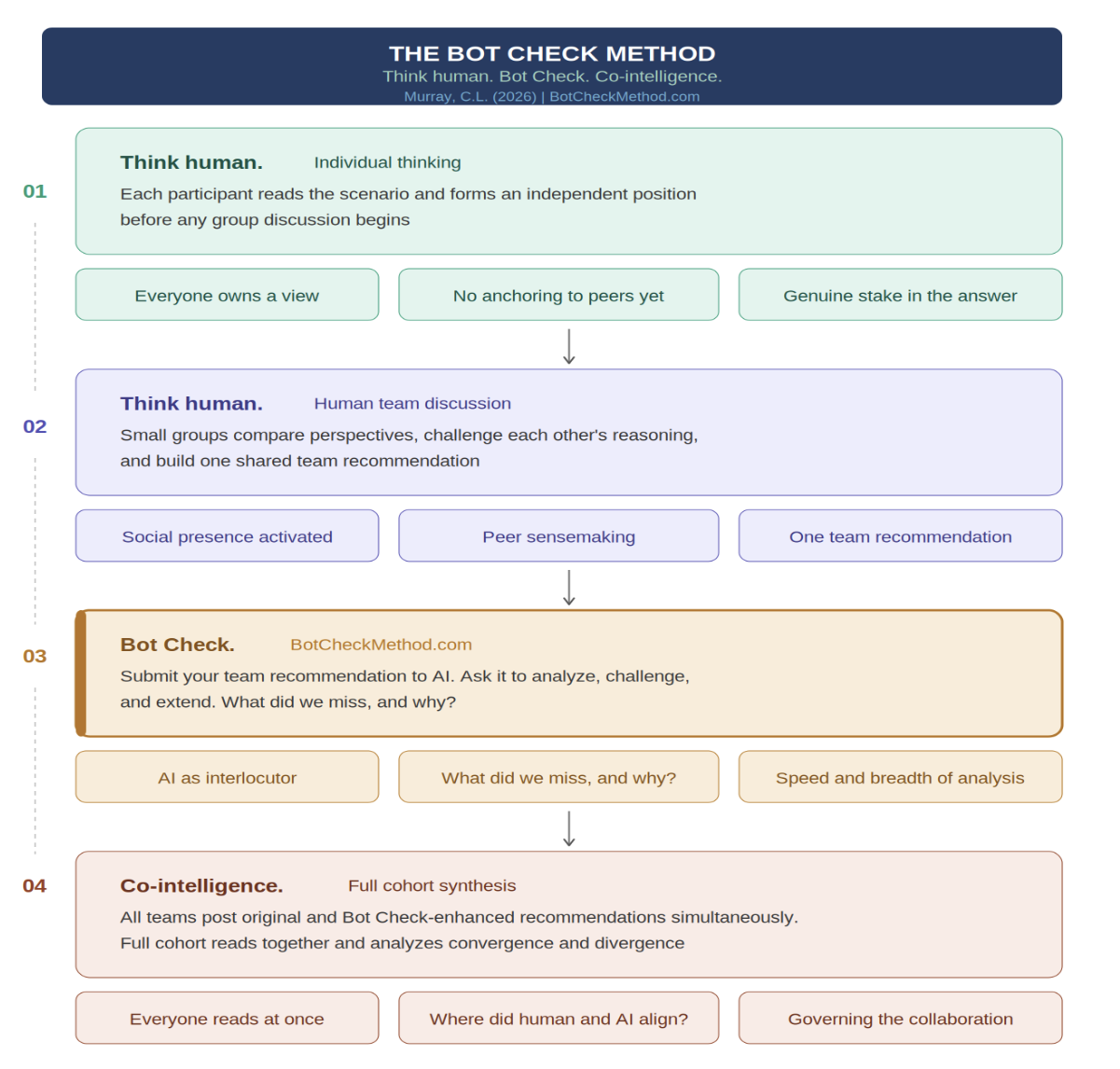
Phase 3: Bot Check (AI as Interlocutor)
Only after a human recommendation is formed is the AI consulted. The tool is used not as an oracle, but as a "bot check"—a rigorous critic designed to find gaps, identify missed perspectives, or challenge weak assumptions. In this phase, the human remains the authority, using the AI to sharpen the existing argument rather than generate a new one.
Phase 4: Co-Intelligence (Synthesis and Resolution)
The final phase involves a transparent comparison of the human-only work and the AI-enhanced work. The group analyzes where the two perspectives diverged and why. This meta-analysis builds "agentic capability," allowing the team to understand the limitations of both their own thinking and the AI’s logic.
Scaling Through the SHINE Framework
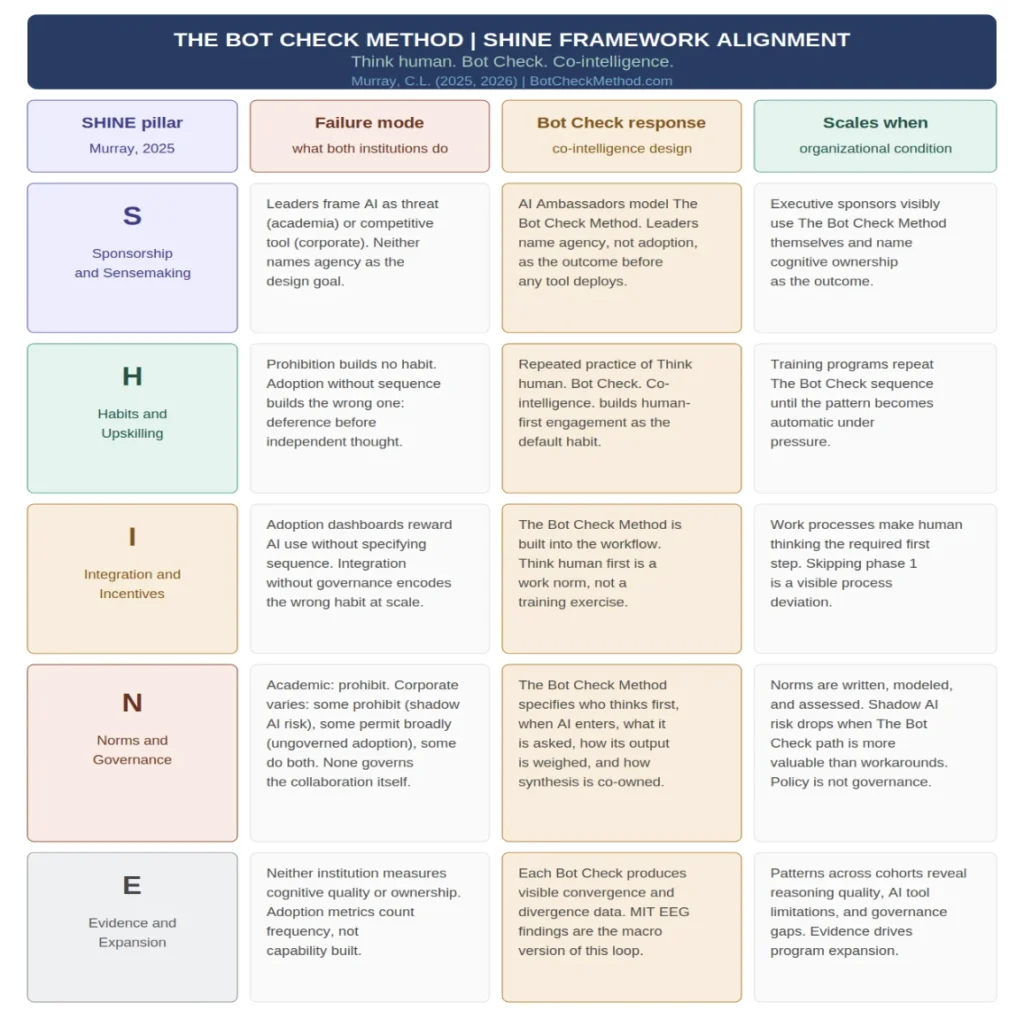
For organizations to move from individual sessions to enterprise-wide capability, the Bot Check Method must be supported by a robust governance architecture. The SHINE framework (Sponsorship, Habits, Integration, Norms, Evidence) provides this structure:
- Sponsorship and Sensemaking: Leaders and "AI Ambassadors" must model the Bot Check Method, demonstrating that "thinking human first" is a valued corporate norm.
- Habits and Upskilling: Training must move beyond "prompt engineering" to focus on the behavioral habit of sequenced engagement. The goal is to make the Bot Check Method the default workflow.
- Integration and Incentives: Workflows must be redesigned to reward the process of human synthesis. If a performance review only measures output speed, it incentivizes the very cognitive debt that the method seeks to avoid.
- Norms and Governance: Organizations must establish clear guidelines for "Co-intelligence by Design." This moves AI policy from a list of "don’ts" to a design for how humans and machines collaborate.
- Evidence and Expansion: Companies should build internal "evidence loops" to monitor the quality of AI-human collaboration, identifying areas where the tool is providing genuine value versus where it is eroding human expertise.
Broader Implications and Industry Analysis
The shift from AI adoption to AI agency has significant implications for the future of the global workforce. As AI tools become more "agentic"—capable of performing complex tasks with minimal human intervention—the risk of cognitive debt increases exponentially. If entry-level employees outsource the "grunt work" of analysis to AI, they may fail to develop the foundational expertise required for senior leadership roles.
Industry experts suggest that the most successful organizations of the next decade will not be those with the highest AI adoption rates, but those with the highest "intellectual ownership." By implementing methods like Bot Check, these organizations can ensure that their human capital remains sharp, critical, and capable of independent thought.
The neuroscience is clear: deferring to AI is a choice that carries a neurological price. However, the solution is not to retreat from technology, but to design the encounter with intentionality. The journey from "abstinence" to "agency" requires a fundamental shift in how we view the role of the human in the loop. It is a transition from using AI as a replacement for thinking to using it as a catalyst for deeper, more rigorous human inquiry. The success of this transition will determine whether the AI era leads to a renaissance of human creativity or a steady accumulation of cognitive debt that the next generation may be unable to repay.






