
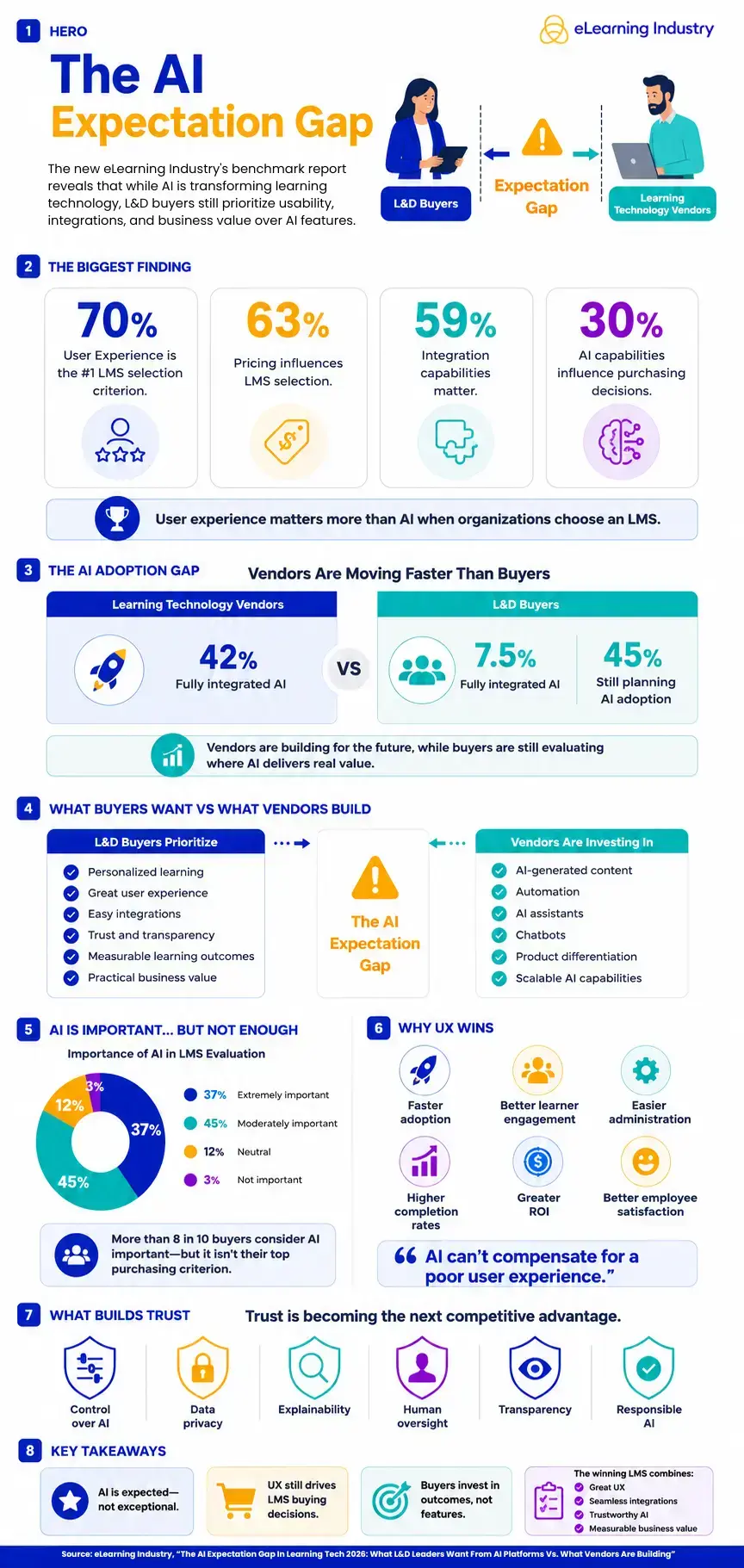
The landscape of corporate education is undergoing a fundamental transformation as the initial hype surrounding Artificial Intelligence (AI) matures into a demand for operational stability and tangible business outcomes. According to the eLearning Industry’s 2026 benchmark report, "The AI Expectation Gap In Learning Tech," the criteria for selecting a Learning Management System (LMS) have shifted away from experimental technology toward foundational usability. While AI features dominate marketing materials and industry headlines, they remain a secondary consideration for the majority of Learning and Development (L&D) buyers. The report reveals that User Experience (UX) remains the primary driver for 70% of organizations, followed by pricing at 63% and seamless integration with existing technical ecosystems at 59%. In a surprising contrast, specific AI capabilities were cited as a top priority by only 30% of respondents, signaling a "back-to-basics" movement among procurement officers who prioritize how a system functions over what it promises for the distant future.
The Evolution of LMS Procurement: A Three-Year Chronology
To understand why 2026 marks a turning point in LMS selection, it is necessary to examine the trajectory of the market over the last several years. In 2023, the sudden rise of Large Language Models (LLMs) triggered a gold rush among learning technology vendors. The primary focus was on generative AI—tools that could draft course outlines or summarize content. By 2024, the market saw a proliferation of "AI-first" platforms, with many legacy providers rushing to add "wrappers" around existing AI engines to remain competitive.
However, 2025 served as a year of reckoning. Many organizations that rushed into AI-heavy contracts discovered that these tools often lacked the necessary data privacy protections or failed to integrate with their existing Human Resources Information Systems (HRIS). This led to the current state of the market in 2026, where the "AI Expectation Gap" has become the defining characteristic of the industry. Buyers have moved from a phase of curiosity to one of caution, demanding that AI prove its value through the lens of traditional software requirements: usability, cost-effectiveness, and interoperability.
Analyzing the 2026 Selection Hierarchy
The data from the 2026 benchmark report provides a clear hierarchy of what L&D leaders value most when evaluating a new platform. The dominance of User Experience (70%) suggests that the "engagement crisis" in corporate learning remains the most significant hurdle. If an employee cannot navigate the platform or find relevant content quickly, the most sophisticated AI recommendation engine in the world becomes irrelevant.
1. User Experience and Administrative Efficiency
UX in 2026 is no longer just about a clean interface; it encompasses accessibility, mobile responsiveness, and the "frictionless" nature of the learning journey. Organizations are increasingly looking for platforms that require zero training for the end-user. Simultaneously, administrative UX has gained importance. L&D teams are often understaffed, and they require automated workflows for enrollment, compliance tracking, and content updates. A system that saves an administrator five hours a week is currently viewed as more valuable than one that generates AI-authored quizzes.
2. The Economic Reality: Pricing and ROI (63%)
Economic pressures in 2026 have forced a more rigorous analysis of the Total Cost of Ownership (TCO). Buyers are looking beyond the initial licensing fee, scrutinizing implementation costs, maintenance fees, and the cost of third-party integrations. The report indicates that 63% of buyers prioritize pricing, but specifically through the lens of Return on Investment (ROI). There is a growing refusal to pay "AI premiums" for features that do not directly contribute to skill acquisition or employee retention.

3. Integration and Ecosystem Compatibility (59%)
The modern corporate tech stack is more crowded than ever. An LMS must now function as a spoke in a larger wheel that includes CRMs like Salesforce, collaboration tools like Microsoft Teams or Slack, and ERP systems. The 59% of buyers prioritizing integration are seeking to eliminate data silos. They want learning data to flow automatically into performance reviews and talent management pipelines without manual intervention.
The AI Expectation Gap: Vendors vs. Buyers
A critical finding of the 2026 report is the disconnect between what vendors are selling and what buyers are ready to implement. While 42% of LMS vendors claim to have "fully integrated" AI into their core architecture, only 7.5% of buyers report that AI is a fully functional part of their current learning environment. This discrepancy highlights a significant implementation lag.
Market analysts suggest several reasons for this gap. First, data governance remains a massive hurdle. Many organizations are hesitant to feed proprietary corporate data into AI models due to fears of data leakage or lack of compliance with evolving global AI regulations. Second, change management is often overlooked. Introducing an AI-powered coach or mentor requires a shift in company culture that many organizations are not yet prepared to lead. Consequently, 45% of buyers remain in the "planning" stage for AI, preferring to wait for the technology to stabilize before committing to a full-scale rollout.
The Shift Toward "Trustworthy AI" and Personalization
Despite the cautious approach to AI, it is not being ignored. When buyers do look at AI, they are focusing on two specific areas: personalization and trust. The report found that 65% of buyers who value AI are specifically looking for "Personalized Learning Paths." This reflects a desire to move away from the "one-size-fits-all" training models of the past. AI that can analyze an employee’s current skill set and suggest a bespoke curriculum is seen as a legitimate value-add.
Furthermore, "Trust" has emerged as a competitive advantage for vendors. In 2026, the most successful LMS providers are those that offer transparency in their algorithms. Buyers are asking: How was this recommendation made? Is there bias in the AI’s selection process? Can we turn these features off if they don’t meet our standards? Vendors who provide clear documentation on AI ethics and data security are outperforming those who treat their AI as a "black box."
Business Outcomes over Feature Lists
The overarching theme of the 2026 market is the transition from feature-counting to outcome-mapping. In previous years, an LMS RFP (Request for Proposal) might have included hundreds of line items for specific technical features. Today, the process is more strategic. Decision-makers are focusing on:
- Skill Gap Analytics: 46% of buyers demand advanced reporting that identifies which skills the workforce lacks and how the LMS is closing those gaps.
- Content Flexibility: 31% of buyers want to ensure they aren’t locked into a single provider’s library, favoring platforms that support a "bring your own content" (BYOC) model.
- Scalability: As companies grow or pivot, they need a platform that can handle a global workforce with varying language and regulatory requirements.
Practical Framework for LMS Evaluation in 2026
For organizations looking to navigate this complex market, the 2026 report suggests a practical evaluation framework that prioritizes long-term stability over short-term innovation.
Phase 1: Foundations (UX and Integration)
Before looking at any advanced features, organizations must verify that the platform is easy to use for all demographics of their workforce. This includes rigorous testing of mobile accessibility and ensuring the API (Application Programming Interface) can talk to existing HR software.
Phase 2: Operational Fit (Analytics and Scalability)
The second phase involves testing the reporting engine. A platform must be able to prove its own worth through data. If the analytics dashboard cannot show a direct correlation between training and performance, it fails the 2026 standard for business value.
Phase 3: Innovation (AI and Personalization)
Only after the foundations are secure should an organization evaluate AI. The focus should be on "Utility AI"—features that automate boring tasks for admins or provide genuinely useful recommendations for learners.
Phase 4: Trust and Security (Governance)
The final gate is a security and ethics review. Vendors must be able to explain their data handling practices and provide guarantees regarding the "hallucination" rates of any generative AI tools included in the package.
Implications for the Future of Learning Technology
The findings of the 2026 benchmark report suggest a maturing industry that is no longer easily swayed by technical jargon. The "AI Expectation Gap" is likely to persist until vendors can demonstrate that AI is not just an add-on, but a tool that makes the core functions of an LMS—usability, integration, and reporting—more effective.
For vendors, the message is clear: innovation must be grounded in utility. For L&D leaders, the 2026 criteria offer a roadmap to making smarter, more resilient investments. By prioritizing User Experience and business outcomes over the latest technological trends, organizations can ensure that their learning platforms serve as a bridge to the future rather than a costly experiment. As the market continues to evolve, the most successful platforms will be those that use AI to invisibly enhance a rock-solid user experience, proving that in 2026, the "best" technology is the one that simply works.






