The human resources technology sector is witnessing a significant shift with the emergence of AI agents, and Gloat, a recognized leader in skills intelligence and talent marketplaces, has made a bold entry into this burgeoning field. The company’s launch of Gloat Agentic HR underscores a rapidly evolving competitive landscape for core HR technology, as organizations increasingly seek intelligent solutions to manage their workforces.
Gloat’s new offering, Gloat Agentic HR, provides a comprehensive toolset designed to leverage existing business rules and security protocols embedded within major HR systems such as Oracle, Workday, and SuccessFactors. This platform enables organizations to rapidly develop and deploy AI agents that can operate seamlessly across familiar communication and collaboration tools like Microsoft Copilot, Teams, and Slack. This move positions Gloat as a key player in the race to integrate advanced AI capabilities into the daily workflows of HR professionals and employees.
The Evolving Architecture of Agentic AI in HR
To understand the significance of Gloat’s offering, it’s crucial to examine the underlying architectural layers that define the current state of AI agents. This framework, comprising approximately five distinct levels, illustrates the complex ecosystem of modern enterprise technology.
At the foundational level reside the "systems of record." These are the robust Human Capital Management (HCM) applications and Enterprise Resource Planning (ERP) systems, including giants like Workday, SAP, Oracle, and UKG. These platforms are the custodians of an organization’s most critical data, housing comprehensive details on financials, customers, employees, inventory, and products, and are built upon intricate database structures.
The second layer encompasses "cross-system applications." In today’s sprawling enterprise environments, no single vendor provides a complete solution. Consequently, organizations deploy a multitude of specialized applications for functions such as time tracking, learning management (LMS), applicant tracking (ATS), and IT provisioning. Large enterprises often manage hundreds of such applications, with over a hundred directly impacting employee experience. Over the past two decades, as businesses have migrated their operations to the cloud, an intricate ecosystem of integrated solutions has developed. Companies like ServiceNow, a $13.5 billion enterprise, have become dominant in this space, offering platforms that bridge various systems. Employee experience platforms, including Microsoft Viva, Zoom’s Workvivo, Firstup, Staffbase, and tools built on Google and Slack, also operate within this layer, though many were not originally designed with agentic capabilities in mind.
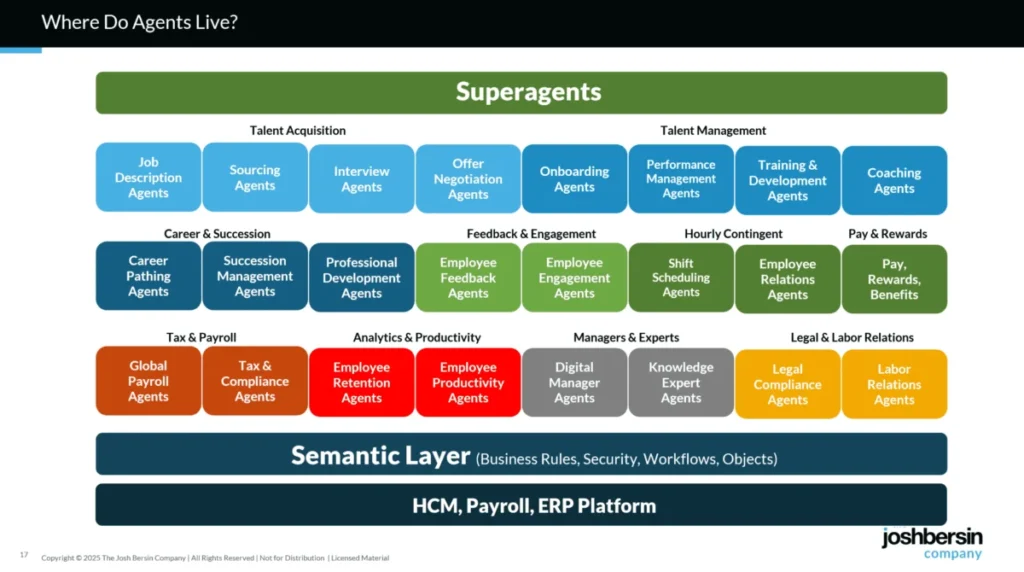
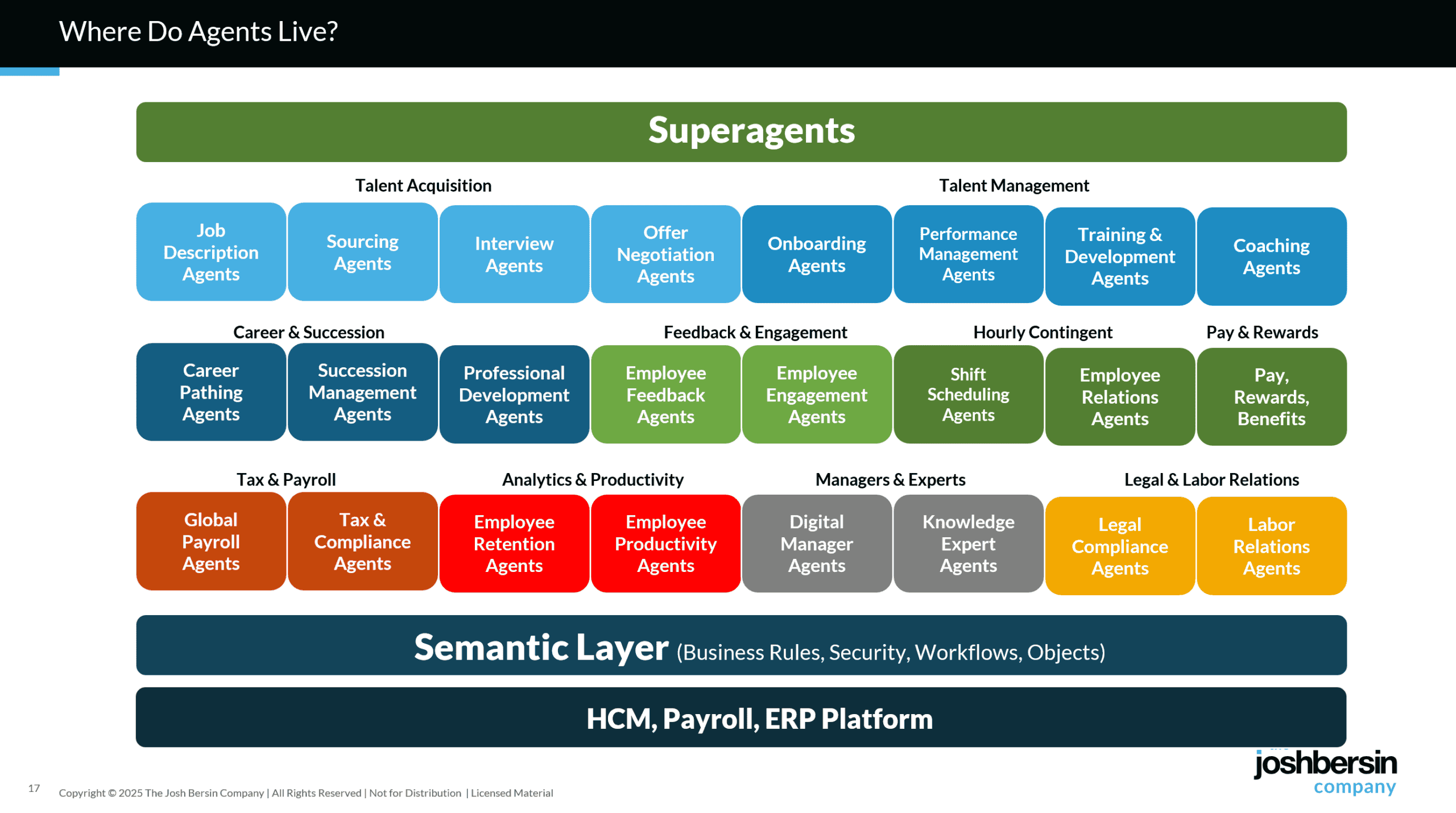
The third layer represents the new generation of AI "Agents." These are far more than mere portals or workflow automation tools. Agents possess an understanding of the user and can proactively perform tasks on their behalf. The HR technology market is now seeing a proliferation of agent tools, ranging from those offered by nimble startups to functionalities embedded within established enterprise systems. These agents are enabling the creation of cross-functional solutions specifically tailored for workforce management.
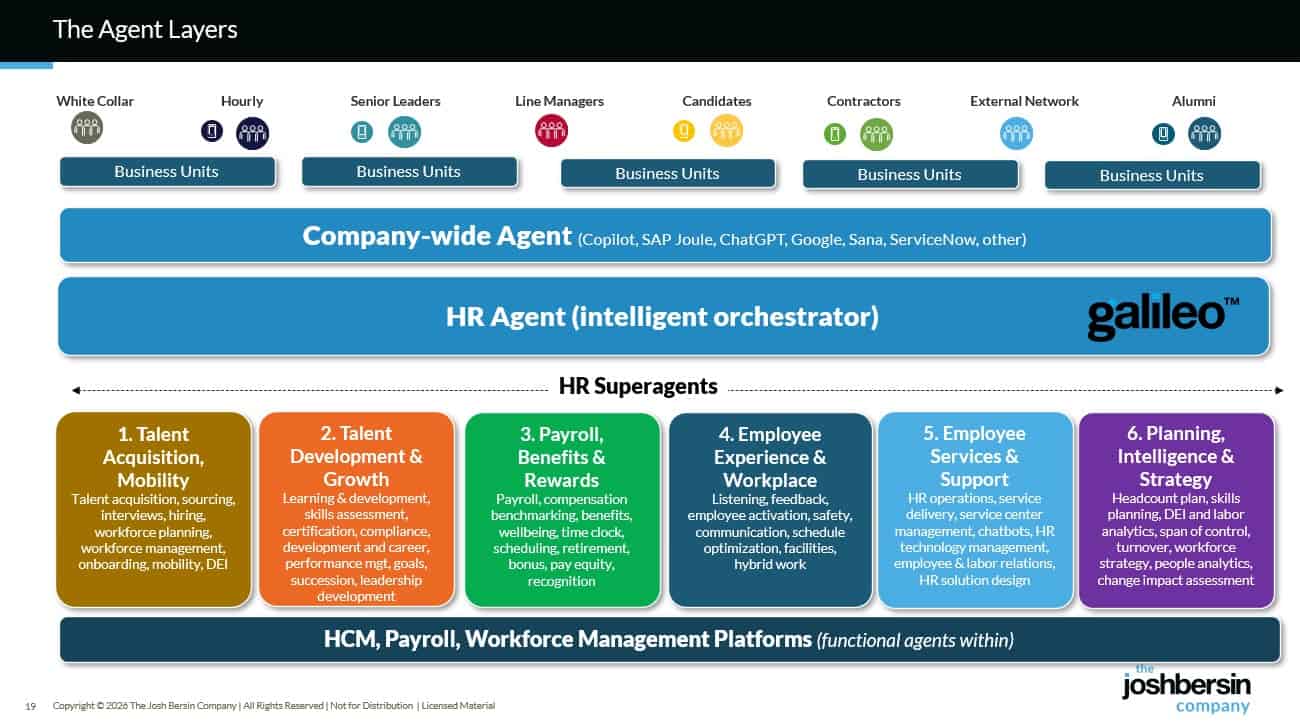
Above these agents lies the fourth layer, characterized by "Superagents." These sophisticated tools are designed to orchestrate and access various functional agents, providing users with an even more intuitive and seamless "walk-up-and-use" experience.
The proliferation of these agentic tools is creating a dynamic and competitive market. Prominent examples include Sana (integrated with Workday), Oracle Agent Studio, Microsoft Copilot Studio, Leena.ai, and agents being developed by ServiceNow, following its acquisition of MoveWorks. SAP’s Joule Studio and foundational AI models from Anthropic, OpenAI, and Google are also contributing to this rapid expansion. The development of tools like Galileo, which acts as an AI advisor for HR, further exemplifies this trend by providing employees with a conversational interface to access information and interact with underlying agents.
Navigating the Complexity of Business Rules and Legacy Systems
While the advent of agentic AI in HR presents exciting possibilities, its practical implementation is heavily influenced by the existing landscape of business rules, security protocols, and legacy systems. For instance, a payroll reconciliation agent from a major vendor, designed to monitor transactions, reconcile taxes, and manage employee status changes, requires extensive "training" with a company’s specific rules and security configurations before it can function effectively. Furthermore, to address complex scenarios like pay equity or performance-based adjustments, these agents must be able to communicate and integrate with other specialized agents.
This interconnectedness highlights the critical importance of "agent architecture." Consider a scenario where an organization aims to redeploy 5,000 employees from existing roles to new positions. An agent designed for this task would need to assess job fit, identify skill gaps, and predict potential for career progression. To achieve this, the agent must interface with a multitude of other systems and agents, gaining insights into skill requirements, available training programs, geographical considerations, licensing, union agreements, and compensation structures. Building such a sophisticated "Superagent," as demonstrated by Galileo’s capabilities, involves intricate coordination and a deep understanding of diverse data points.
Common use cases for these advanced agents extend across various HR functions, including global onboarding, career development, annual performance reviews and compensation cycles, talent acquisition, employee certification management, and time and schedule optimization.
The Strategic Battleground: Securing and Orchestrating Business Rules
The race to develop and deploy AI agents in the enterprise is intensifying, with every major HR vendor actively building agent functionalities. While some offerings are basic coaching tools, others delve into more complex operational capabilities. Leading vendors, including Workday, Oracle, SAP, and ServiceNow, are developing dedicated "AI studios" to simplify agent creation and deployment.
However, the primary challenge transcends simply acquiring or building agents. The critical battle lies in the ability to effectively "stitch them together." This integration is intrinsically linked to managing an organization’s unique business rules, security frameworks, existing workflows, and specific business "objects"—custom-defined entities like career frameworks or performance review models. These rules and rubrics are fundamental to a company’s business model and evolve with organizational changes. The goal is to avoid hard-coding these dynamic elements into agents, instead enabling agents to access a "semantic layer" that accurately reflects and maintains this critical information.
Major HCM vendors, with their established semantic layers (such as Workday’s Business Process Framework), are integrating these capabilities into their agent development tools. This makes the ability of any HR agent or development platform to tap into this crucial layer a significant differentiator. This trend may also challenge earlier predictions of a "SaaSpocalypse," suggesting a continued reliance on robust, integrated enterprise platforms.
Gloat’s Strategic Move: Loomra and the Agentic HR Platform
Gloat’s new Agentic HR platform, powered by its "Loomra" semantic layer, aims to liberate organizations from the constraints of legacy approaches. Loomra is described as an agent-driven, auto-discovery "injector" that meticulously mines an organization’s entities, workflows, and business rules, maintaining them in sync with ongoing HCM system updates. This technology effectively replicates the core rules and objects of an HCM system, providing a foundation for easier application development.
Gloat’s platform further includes an intuitive agent builder, allowing users to visually construct custom agents that integrate directly into platforms like Microsoft Teams, Copilot, and Slack. The company has already developed pre-built agents for critical areas such as workforce redeployment, career development, internal talent sourcing, succession planning, and learning and reskilling—domains where Gloat possesses significant existing expertise.
Workforce Context as the Differentiating Factor
What distinguishes Gloat’s Agentic HR platform is the underlying "workforce context layer" provided by Loomra. This engine is built upon nearly a decade of accumulating and modeling enterprise-scale workforce data. It analyzes skill adjacencies, career trajectories, organizational patterns, and workforce relationships across millions of employees globally.
This deep contextual understanding enables Gloat’s agents to perform sophisticated reasoning, moving beyond simple information retrieval. Instead of merely answering "show me employees who know Python," these agents can proactively identify individuals capable of transitioning into AI engineering roles, pinpoint teams most vulnerable to future skill gaps, and recommend talent redeployment strategies aligned with shifting business priorities.
Competitive Landscape and Gloat’s Position
Gloat’s approach offers a compelling proposition: organizations can potentially bypass lengthy development cycles within their legacy HCM systems by leveraging Gloat’s platform to build and deploy AI agents. The open nature of the Gloat platform facilitates integration with other internal systems, and its context engine is noted as a unique asset, with no comparable system readily apparent among other major HCM vendors.
However, the market for agent tools is exceptionally competitive. Organizations deeply invested in specific HCM ecosystems are likely to gravitate towards vendor-native solutions: Workday customers may opt for Sana, Oracle users for Oracle AI Studio, and SAP clients for Joule Studio. Gloat faces the challenge of demonstrating that its tools are not only user-friendly and fully integrated but also offer superior context-aware capabilities compared to their competitors. As the enterprise transitions from "systems of record" to "systems of context," Gloat’s ability to lead in this new paradigm will be crucial.
The Future of Agentic HR Development
The evolution of application development tools, from early platforms like PowerBuilder to modern AI development environments such as Microsoft GitHub Copilot, demonstrates a consistent trend: organizations tend to adopt toolsets that align with their existing technological infrastructure. Gloat’s innovative platform is undoubtedly pushing the boundaries of the agent industry forward. As early customer adoption unfolds, the real-world impact and strategic advantages of Gloat’s approach will become clearer, offering valuable insights into the future of AI-driven HR management.