
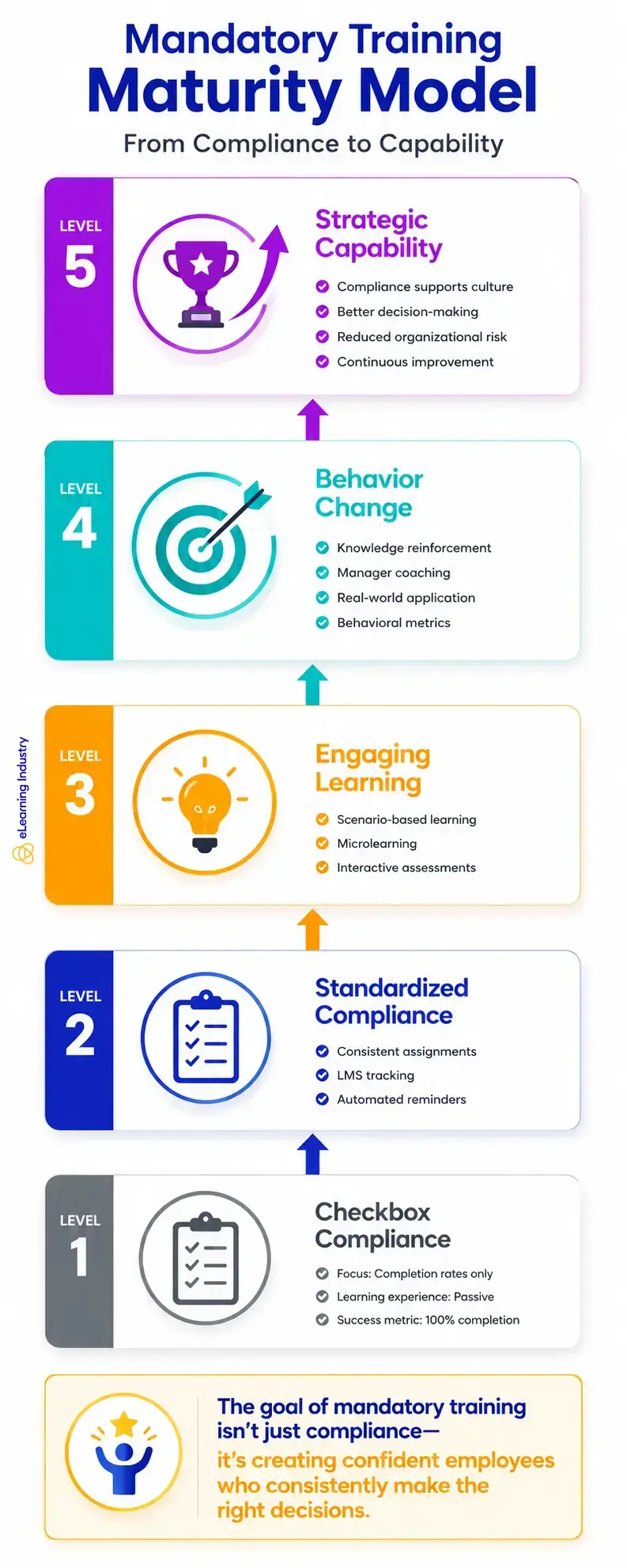
Mandatory training has transitioned from a peripheral administrative requirement to a cornerstone of modern corporate governance, serving as the primary mechanism through which employers ensure legal, regulatory, and ethical standards are met across a diverse workforce. Unlike professional development or elective courses, which are designed for career advancement and skill acquisition, mandatory training is strictly defined by its role in risk mitigation, workplace safety, and institutional responsibility. Often referred to as compulsory training, this pedagogical framework is no longer viewed as a mere "check-the-box" exercise; rather, it is an essential component of operational resilience in an increasingly litigious and regulated global market.
Industry analysts observe that the definition of success in mandatory training has shifted significantly over the last decade. Historically, completion rates were the primary metric of success for human resources (HR) and Learning and Development (L&D) departments. However, as workplace complexities grow—ranging from sophisticated cybersecurity threats to nuanced social dynamics—organizations are realizing that simple completion does not equate to competence. Ineffective training leads to a "compliance gap," where employees possess certificates of completion but lack the practical ability to navigate real-world crises. This disconnect exposes organizations to severe liabilities, including workplace accidents, massive data breaches, multi-million dollar fines, and irreparable damage to brand reputation.
The Strategic Shift: Beyond Legal Obligations
While the foundational purpose of mandatory training remains legal protection, leading organizations are leveraging these programs to foster specific behavioral changes and strengthen internal cultures. By reframing compliance as a strategic asset, companies can move from a defensive posture to a proactive one.
Legal and Regulatory Safeguards
The primary driver for mandatory training remains the necessity to comply with local and international laws. For instance, in the United States, the Occupational Safety and Health Administration (OSHA) mandates specific safety training for various industries, while the Equal Employment Opportunity Commission (EEOC) emphasizes the importance of anti-harassment training. Documentation is a critical subset of this requirement; in the event of a lawsuit or a regulatory audit, an organization’s ability to produce detailed training records can serve as a primary defense, demonstrating that the company took "reasonable care" to prevent misconduct or injury.
Risk Mitigation and Workplace Safety
Effective training serves as an early warning system. By educating employees on how to identify and report hazards—whether they are physical risks on a manufacturing floor or ethical red flags in a financial transaction—organizations can resolve issues before they escalate into catastrophes. Data from the National Safety Council often highlights that companies with robust safety training programs see a significant reduction in Workers’ Compensation claims and lost workdays, directly impacting the bottom line.
Cultivating Ethical Environments
Beyond the "hard" risks of safety and law, mandatory training addresses the "soft" risks of corporate culture. Programs focused on Diversity, Equity, and Inclusion (DEI), business ethics, and conflict resolution establish a baseline for acceptable behavior. This transparency builds internal trust and psychological safety, which are increasingly cited by employees as key factors in retention and productivity.
A Chronological Framework of Regulatory Training Evolution
To understand the current state of mandatory training, one must look at the historical trajectory of workplace regulations:
- 1970s – The Safety Era: The establishment of OSHA in 1970 marked the beginning of standardized safety training requirements, focusing on physical hazards in industrial settings.
- 1990s – The Harassment and Ethics Era: Landmark legal cases led to a surge in mandatory sexual harassment prevention training and the formalization of corporate "Codes of Conduct."
- 2010s – The Data Privacy Era: The introduction of the General Data Protection Regulation (GDPR) in Europe and similar laws globally forced companies to implement mandatory data handling and privacy training for all staff.
- 2020s – The Digital and Social Responsibility Era: The rise of remote work, sophisticated AI-driven cyber threats, and a heightened focus on social justice have expanded mandatory training into the realms of cybersecurity hygiene and inclusive leadership.
Quantifying the Impact: The Cost of Ignorance
The financial implications of failing to implement effective mandatory training are staggering. According to the 2023 "Cost of a Data Breach Report" by IBM, the average global cost of a data breach reached $4.45 million. A significant portion of these breaches is attributed to human error, such as falling for phishing scams—a risk that cybersecurity awareness training is specifically designed to mitigate.
Furthermore, OSHA announced that for 2024, the maximum penalty for "willful or repeated" violations would increase to over $161,000 per violation. For an organization with multiple sites, a failure to provide mandatory safety training can quickly lead to millions of dollars in penalties, not including the potential for private litigation and increased insurance premiums.
Core Pillars of Modern Mandatory Programs
To build a resilient workforce, L&D professionals generally categorize mandatory training into several critical domains:
1. Compliance and Ethics
This includes training on anti-bribery (such as the Foreign Corrupt Practices Act), anti-money laundering (AML), and general business ethics. The goal is to move beyond memorizing rules to understanding the "why" behind them, using real-life scenarios to illustrate how a single unethical decision can trigger a chain reaction of legal and financial consequences.

2. Workplace Health and Safety
Safety training is tailored to the specific environment. While an office worker might focus on ergonomics and fire safety, a field engineer requires training on high-voltage equipment, fall protection, and hazardous material handling. Modern safety training increasingly utilizes Virtual Reality (VR) to simulate dangerous scenarios without putting the employee at risk.
3. Cybersecurity Awareness
As digital threats evolve, so must the training. Current programs emphasize the dangers of generative AI-based scams and deepfakes. Continuous learning is the standard here; rather than an annual seminar, companies use monthly "micro-learning" modules and simulated phishing attacks to keep employees vigilant.
4. Human Resources and DEI
HR-led training focuses on the social contract within the workplace. This includes training on leave policies, performance management for supervisors, and inclusive hiring practices. By standardizing these processes, organizations reduce the risk of discrimination claims and foster a more equitable environment.
Industry Perspectives: The Shift to Behavioral Metrics
Christopher Pappas, CEO and founder of eLearning Industry, emphasizes that the value of training lies in its application. "Organizations that benefit most from mandatory training aren’t just those with high completion rates, but the ones whose employees make better decisions as a result," Pappas notes. "While compliance is necessary, building skills is what truly leads to safer workplaces, stronger cultures, and better overall business performance."
This sentiment is echoed by legal experts who argue that "check-the-box" training provides a false sense of security. In many jurisdictions, courts are beginning to look at the quality and frequency of training when determining corporate liability. If training is found to be outdated or poorly delivered, it may not satisfy the legal requirement for "effective" training.
Designing for Retention: The L&D Revolution
For mandatory training to be effective, L&D professionals must overcome the "boredom barrier." Traditional long-form lectures are being replaced by more engaging methodologies:
- Scenario-Based Learning: Instead of reading a policy, employees are presented with a dilemma and must choose a course of action. Branching scenarios allow them to see the consequences of their choices in a controlled environment.
- Micro-learning: Breaking complex topics into 5-to-10-minute modules improves retention and allows employees to fit training into busy schedules without disrupting productivity.
- Relevance Mapping: Training is customized based on the employee’s role. A software developer receives different data privacy training than a customer service representative, ensuring the content is immediately applicable to their daily tasks.
- Behavioral Analytics: Modern Learning Management Systems (LMS) track more than just completion. They analyze how long an employee spent on a module, where they struggled in assessments, and how their performance improves over time.
Addressing Non-Compliance: Risks and Remedies
The failure to complete mandatory training creates a significant vulnerability. Organizations must have clear protocols for addressing non-compliance.
Individual and Corporate Risks
For employees, the consequences of missing training can range from administrative reminders to the suspension of system access. In highly regulated sectors, such as healthcare or aviation, missing a mandatory certification can lead to immediate removal from duty. For the employer, the risks are systemic: a single untrained employee can be the entry point for a ransomware attack or the cause of a catastrophic safety failure.
Best Practices for Enforcement
Before resorting to disciplinary action, HR and L&D teams should investigate the root causes of non-completion. Often, the barriers are logistical rather than behavioral. Providing "protected time" for training, ensuring mobile accessibility, and using automated nudges can significantly increase completion rates. However, when non-compliance persists, it must be treated as a performance issue to maintain the integrity of the organization’s risk management strategy.
The Future of Mandatory Training
As we look toward the future, mandatory training is expected to become even more integrated into the flow of work. The rise of "just-in-time" training—where an employee receives a brief safety reminder or a data handling tip exactly when they are about to perform a relevant task—is set to replace the traditional annual training cycle. Furthermore, as ESG (Environmental, Social, and Governance) standards become a priority for investors, mandatory training on sustainability and social responsibility will likely become standard across all industries.
In conclusion, mandatory training has evolved into a sophisticated tool for organizational health. When executed with a focus on engagement, relevance, and behavioral change, it does more than satisfy a regulator; it builds a resilient, ethical, and high-performing workforce capable of navigating the challenges of the modern business landscape. The transition from "compliance for the sake of compliance" to "learning for the sake of safety and culture" marks the next frontier in corporate excellence.






