The modern hiring landscape is characterized by a persistent challenge: the agonizingly slow pace of filling open positions. For many organizations, the journey from posting a job to securing a signed offer letter stretches between 36 and 44 days, a figure that can balloon significantly for technical, specialized, or high-volume hourly roles. This extended timeline is not merely an inconvenience; it represents a substantial drain on resources, a bottleneck for business growth, and a critical competitive disadvantage in the war for talent. However, a paradigm shift is underway, driven by the strategic integration of artificial intelligence, promising to compress this arduous process into a matter of days, not weeks, without compromising the quality of hires.
Unpacking the Hiring Timeline: Where Do the Weeks Go?
While hiring managers often point to the interview process itself as the primary culprit for lengthy recruitment cycles, a closer examination reveals a more complex truth. Interviews, though visible and resource-intensive, are frequently outpaced by the less apparent, yet more impactful, delays inherent in coordination and scheduling.
A typical 30-to-40-day hiring cycle can be broken down into several key stages, each contributing to the overall duration:
- Initial Application Review and Screening: This phase involves sifting through resumes, identifying qualified candidates, and conducting initial assessments. While crucial, it can be prolonged by manual processes and the sheer volume of applications.
- Scheduling and Coordination: This is arguably the most significant, yet often overlooked, time sink. Arranging interviews involves synchronizing the availability of multiple interviewers, often across different departments and time zones, with the limited windows of candidates who may be currently employed. This process can involve extensive back-and-forth via email and internal messaging systems.
- Interview Rounds: This encompasses all stages of candidate interviews, from initial screenings to final panel discussions. While these are the most direct evaluations of a candidate’s fit, the preceding and subsequent delays often dwarf the actual time spent in conversation.
- Debriefs and Decision Making: After interviews conclude, teams need time to consolidate feedback, discuss candidates, and reach a consensus. This can be further delayed by competing priorities among decision-makers.
- Reference Checks and Background Verifications: These essential steps, while critical for due diligence, can add several days to the process if not managed efficiently.
- Offer Extension and Negotiation: The final stage involves extending an offer and navigating any negotiations. Delays here can lead to a candidate accepting another offer.
The friction points are evident: the waiting periods to secure interview slots, the time spent chasing calendars, and the subsequent delays in receiving feedback and making decisions. These cumulative "dead times" represent the most fertile ground for optimization.
The "Scheduling and Coordination Tax": A Silent Drain on Efficiency
The act of scheduling a single interview loop is a microcosm of the broader inefficiency plaguing hiring processes. It demands the meticulous alignment of calendars belonging to candidates and multiple interviewers. This often involves navigating time zone differences, accommodating urgent business priorities that lead to rescheduled meetings, and accommodating candidates with limited availability due to their current employment.
Recruiters find themselves entangled in a web of Slack threads and email chains, chasing down responses and attempting to find elusive pockets of overlapping availability. For candidates, especially those actively employed, finding a 45-minute window that aligns with several interviewers’ schedules can feel like an insurmountable hurdle.
Research into remote hiring practices has highlighted the stark contrast between manual scheduling and automated systems. The transition from a candidate expressing interest to completing an interview can stretch from mere hours with automated scheduling to days when reliant on manual coordination. Each day of delay provides a valuable window for competitors to engage with the same talent pool, increasing the risk of losing desirable candidates.
When this scheduling gap is multiplied across every round of interviews in a typical multi-stage hiring process, it’s not uncommon for weeks to evaporate before a hiring decision is even close to being made. This "scheduling tax" is a silent killer of efficiency, and its impact is keenly felt by hiring managers across industries.
Compressing the Interview Stage: The AI-Powered Revolution
The most transformative opportunities for reducing time-to-hire lie in re-engineering the interview stage itself. Artificial intelligence, specifically through AI-assisted interviewing platforms, offers a powerful solution by fundamentally decoupling the interview process from the constraints of shared calendars.

Instead of requiring candidates to find a mutual slot with live interviewers, AI interviewers allow candidates to complete structured, role-relevant assessments at their own convenience. This could be during evenings, weekends, or even during short breaks throughout their workday. This asynchronous approach eliminates the back-and-forth of scheduling, the frustration of reschedulings, and the risk of candidates dropping out of the pipeline due to logistical challenges.
For interviewers, the shift is equally profound. Rather than dedicating hours to conducting numerous similar first-round interviews, recruiters and hiring managers receive concise, structured summaries and scored evaluations shortly after each AI-conducted interview concludes. These insights are often available within hours, not days, providing a clear and consistent basis for decision-making.
The questions posed by AI interviewers are standardized, ensuring that every candidate is assessed against the same criteria and at the same depth, irrespective of their position in the application queue. This uniformity enhances fairness and objectivity.
The impact of AI-assisted interviewing on time savings is substantial. Organizations that have implemented AI for early and mid-stage interviews have reported dramatic reductions in their overall time-to-hire, compressing it from an average of six weeks down to approximately one week. In some instances, the time-to-interview stage has seen a reduction of up to 99%, as the interview no longer waits for calendar availability. This singular change, by eliminating a significant dependency, makes the achievement of a compressed hiring timeline a tangible reality rather than an aspirational goal.
The Transformed Timeline: From Requisition to Offer in Days
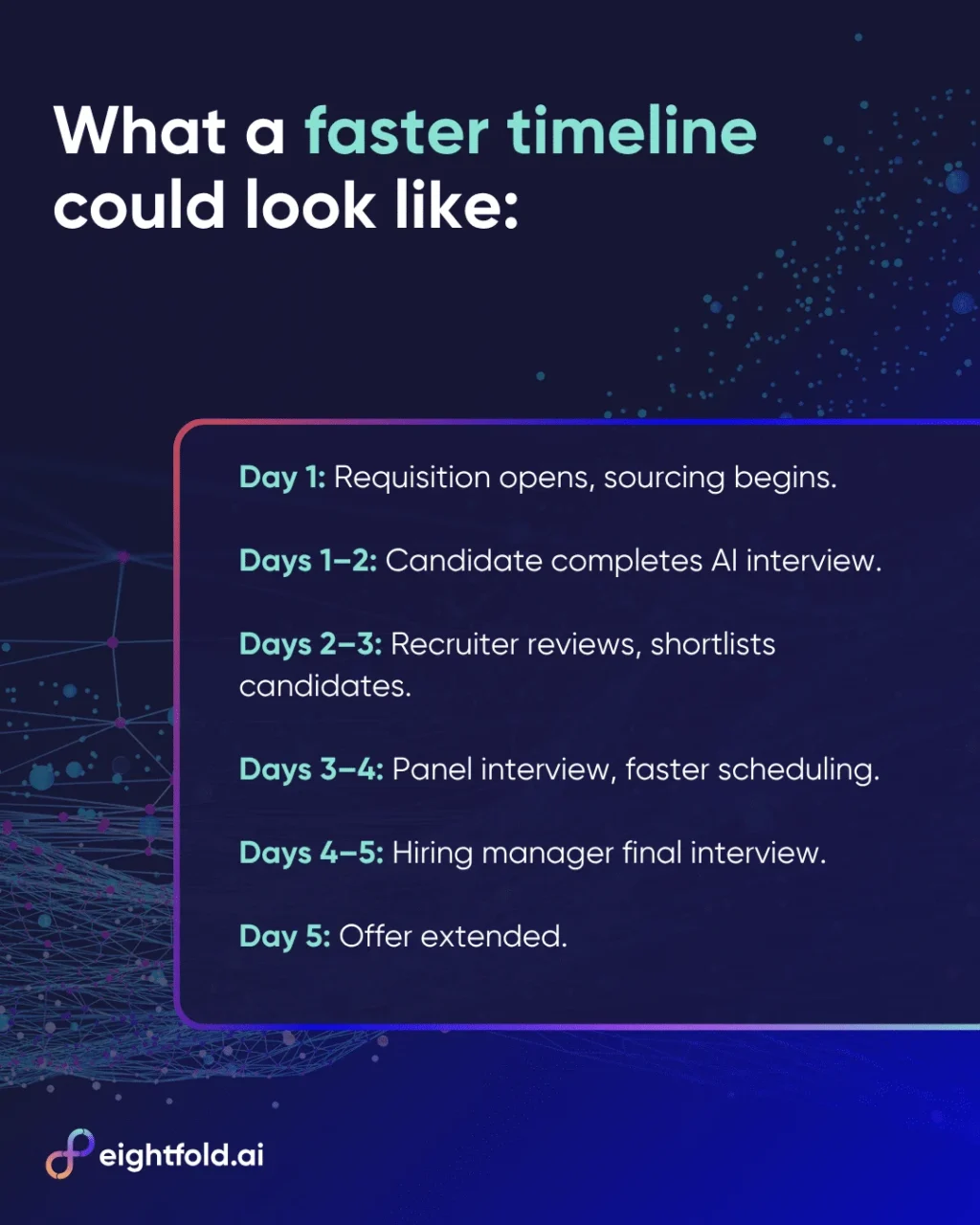
By strategically addressing the bottlenecks of scheduling and coordination, and by leveraging AI to streamline interviews, a realistic and achievable hiring timeline can be dramatically compressed. Consider a scenario where the friction points are systematically removed:
- Day 1: Requisition Opened & AI Screening Initiated: As soon as a role is approved, AI tools can begin screening incoming applications based on predefined criteria, identifying the most promising candidates. Simultaneously, candidates can be invited to complete AI-driven initial interviews.
- Day 2: AI Interviews Completed & Initial Assessments Received: Candidates complete their AI interviews, and the system provides immediate, structured feedback and scores to the hiring team. This allows for rapid identification of top prospects.
- Day 3: In-Depth Interviews & Candidate Engagement: Candidates who pass the initial AI screening proceed to more in-depth interviews, which can still involve human interaction for crucial behavioral and cultural assessments. These can be scheduled more efficiently due to the initial filtering.
- Day 4: Decision Making & Offer Preparation: With comprehensive feedback from both AI and human interviews, decision-makers can convene for a debrief and reach a consensus. The offer package can be prepared concurrently.
- Day 5: Offer Extended & Accepted: The final offer is extended to the chosen candidate, allowing for a swift acceptance and the initiation of onboarding processes.
This five-day model is not about rushing candidates or compromising on evaluation standards. Instead, it represents a process where no time is wasted. The critical human touchpoints—final interviews, offer conversations, and moments requiring nuanced judgment and relationship-building—remain firmly in human hands. What disappears is the unproductive "dead time" that has historically characterized the hiring journey.
The Ripple Effects: Beyond the Dashboard
The benefits of a significantly reduced time-to-hire extend far beyond an improved recruiting dashboard. They translate into tangible improvements across the entire business:
- For Hiring Managers: Open positions are filled more rapidly, preventing workloads from becoming unmanageable for existing team members. Crucial projects that were on hold due to staffing shortages can finally commence, driving business momentum.
- For Candidates: The candidate experience is vastly enhanced. They encounter a process that respects their time, characterized by swift communication and transparency. The anxiety of prolonged silence after a promising conversation is eliminated, and the fear of being "ghosted" is significantly reduced. Candidates consistently report higher satisfaction with hiring processes that are fast, consistent, and transparent, regardless of the technologies employed.
- For Competitive Advantage: In today’s competitive talent market, strong candidates rarely wait. If one organization takes three weeks to reach a hiring decision while a competitor engages the same candidate and extends an offer within five days, the outcome is often predetermined before the slower organization even completes its internal debrief. Compressing the hiring timeline is not just an internal efficiency gain; it’s a proactive defense against losing top talent to more agile competitors.
The Takeaway: Less Waiting, More Hiring
The hiring timeline that many organizations have come to accept as standard is not an immutable law of nature. It is, in fact, the cumulative result of numerous small, addressable delays, most of which have little to do with the actual assessment of a candidate’s job-related capabilities. The most significant improvements in time-to-hire are not achieved by cutting corners on critical evaluation steps. Instead, they are realized by systematically eliminating the "scheduling tax" and the "coordination drag" that have historically burdened the hiring process.
Ultimately, reducing time-to-hire by half is not about working faster; it’s about waiting less. By embracing intelligent automation and re-evaluating traditional processes, organizations can transform their hiring from a protracted ordeal into a streamlined, efficient, and highly competitive function.
For organizations seeking to understand how this accelerated hiring process could be implemented for their specific needs, exploring tailored solutions through demonstrations is the next logical step. The future of talent acquisition is here, and it’s faster, smarter, and more effective than ever before.