
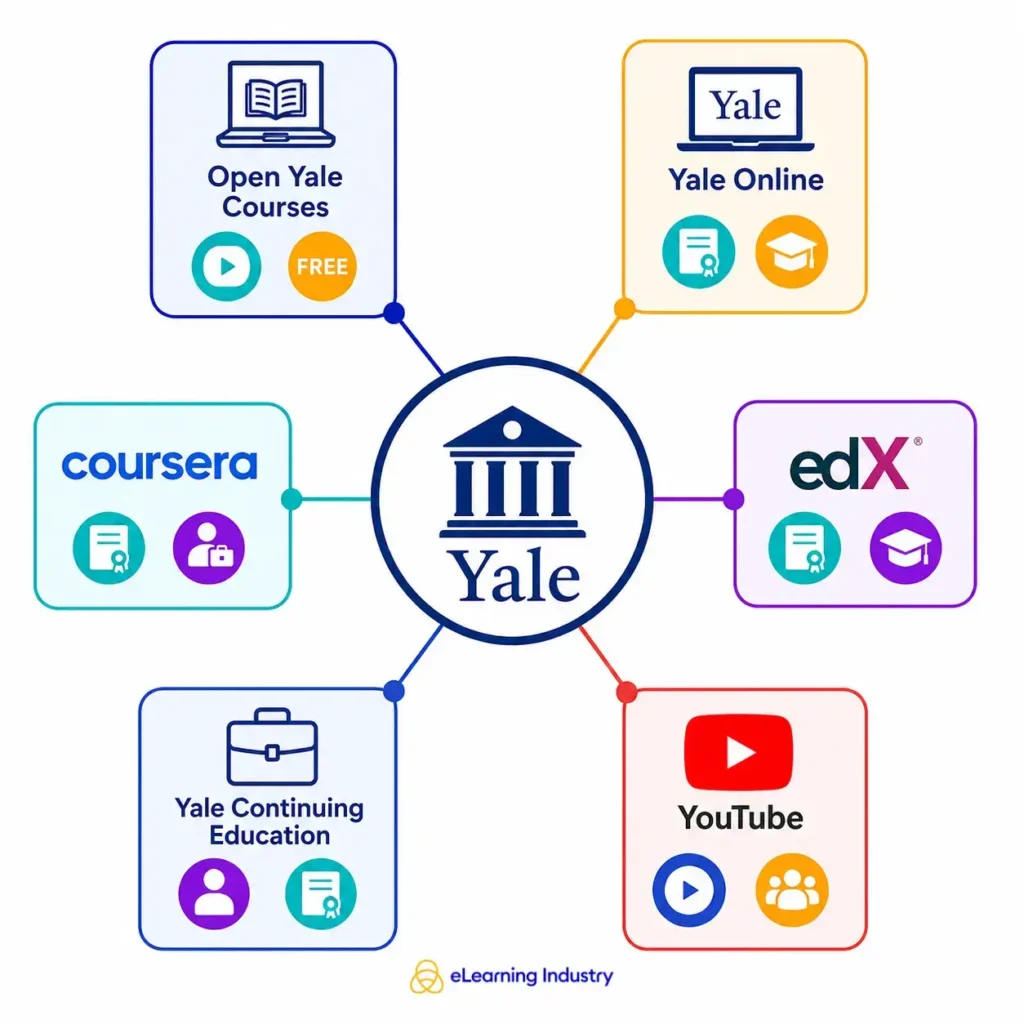
Yale University, a cornerstone of the American Ivy League, has fundamentally altered the landscape of global education by expanding its digital footprint through various open-access initiatives. By leveraging platforms such as Open Yale Courses, Coursera, and edX, the institution has effectively dismantled the traditional barriers of high tuition and geographical limitations. This strategic move allows professionals, students, and lifelong learners to engage with the same rigorous curricula offered to on-campus students, covering a diverse spectrum of disciplines including behavioral economics, theoretical physics, and political philosophy.
The university’s commitment to "Lux et Veritas" (Light and Truth) now extends beyond the gates of New Haven, Connecticut, reaching millions of learners worldwide. As the global workforce increasingly prioritizes continuous upskilling, Yale’s free online offerings have become a vital resource for career development and intellectual enrichment. While the core academic content is available at no cost, the university maintains a clear distinction between auditing a course for personal knowledge and earning a verified certificate, the latter of which typically requires a financial investment through third-party providers.
The Evolution of Open Yale Courses and Digital Pedagogy
The current ecosystem of Yale’s online education is the result of a deliberate, decade-long expansion. The journey began in December 2007 with the launch of Open Yale Courses (OYC), funded initially by a grant from the William and Flora Hewlett Foundation. The goal was to provide free, non-credit introductory-level courses to the public. Unlike the more interactive Massive Open Online Courses (MOOCs) seen today, OYC focuses on high-quality video and audio recordings of actual classroom lectures, accompanied by syllabi and reading lists.
In the years following, Yale expanded its reach by partnering with Coursera and edX. This transition introduced a more structured learning environment, featuring automated assessments, peer-graded assignments, and the opportunity for learners to earn digital credentials. According to internal university data and platform statistics, Yale’s online courses have reached over 10 million enrollments collectively, with "The Science of Well-Being" alone accounting for more than 4 million students since its digital debut.
Understanding the Financial and Academic Structure
For prospective students, navigating the different platforms is essential for aligning their educational goals with the available resources.
- Open Yale Courses (OYC): This platform offers the most direct access to the university’s intellectual property. It is entirely free and does not require registration. However, it does not offer certificates or instructor interaction.
- Coursera and edX: These platforms follow a "freemium" model. Learners can "audit" the majority of Yale courses for free, gaining access to all video lectures and most reading materials. If a learner requires a verified certificate to bolster a LinkedIn profile or a CV, they must pay a fee—typically ranging from $49 to $99—and pass all graded requirements.
- Yale Online: This serves as the university’s central hub, directing students to both free MOOCs and paid professional certificate programs designed specifically for executive education and leadership.
A Detailed Analysis of 15 Essential Yale Online Courses
The following courses represent the pinnacle of Yale’s digital catalog, selected for their academic rigor, instructor reputation, and professional relevance.
1. Financial Markets
Taught by Nobel Laureate Robert Shiller, this course is a foundational pillar for anyone entering the finance sector. It provides a broad overview of the ideas, methods, and institutions that permit human society to manage risks and foster enterprise. Shiller emphasizes behavioral finance, exploring how human psychology drives market fluctuations.
- Best for: Finance professionals, economists, and retail investors.
- Focus: Risk management, insurance, and the future of banking.
2. The Science of Well-Being
Originally designed as an on-campus course titled "Psychology and the Good Life," Professor Laurie Santos created this series to address the high levels of stress among students. It has since become the most popular course in Yale’s 318-year history. It utilizes psychological science to debunk myths about happiness and provides practical "rewirement" challenges to improve mental health.
- Best for: HR leaders, managers, and individuals focused on mental health.
- Focus: Positive psychology and habit formation.
3. Introduction to Psychology
Professor Paul Bloom offers a comprehensive dive into the human mind. This course covers everything from the foundations of the brain to social behavior, mental illness, and the development of language. It is highly regarded for its accessibility and its ability to connect complex neurological functions with everyday human experiences.
- Best for: Educators, marketers, and social workers.
- Focus: Cognitive science and clinical psychology.
4. Introduction to Political Philosophy
This course, led by Professor Steven B. Smith, examines the great texts of the Western political tradition. By studying thinkers like Plato, Aristotle, Machiavelli, and Hobbes, students gain a deeper understanding of the concepts of justice, statehood, and individual liberty—essential knowledge for navigating modern political landscapes.
- Best for: Policy analysts, legal professionals, and historians.
- Focus: Political theory and ethics.
5. Introduction to Classical Music
Professor Craig Wright aims to provide listeners with the "musical tools" necessary to appreciate Western classical music. The course moves chronologically from the Gregorian chant to the modern era, focusing on the listening skills required to distinguish between different styles and historical periods.
- Best for: Creative professionals and arts enthusiasts.
- Focus: Musicology and cultural history.
6. Moral Foundations of Politics
Ian Shapiro explores the major political theories of the modern West, including utilitarianism, Marxism, and the social contract tradition. The course is designed to help students think critically about the legitimacy of political power and the ethical obligations of citizens.
- Best for: Executives and government officials.
- Focus: Ethical reasoning and public policy.
7. A Law Student’s Toolkit
This course is not just for aspiring lawyers but for anyone who needs to understand the logic behind legal systems. Professor Ian Ayres introduces students to the "tools" used in legal analysis, such as the Coase Theorem, agency costs, and the difference between rules and standards.

- Best for: Compliance officers and business owners.
- Focus: Legal reasoning and economic analysis.
8. Financial Theory
Building upon the concepts in Financial Markets, Professor John Geanakoplos provides a more mathematical and theoretical approach to the subject. The course focuses on equilibrium theory, the role of leverage, and the causes of financial crises, offering a rigorous academic perspective on global money flows.
- Best for: Quantitative analysts and MBA candidates.
- Focus: Asset pricing and portfolio theory.
9. Game Theory
Game theory is the study of strategic decision-making. Professor Ben Polak introduces the basic concepts of "games" (situations where the outcome for one person depends on the actions of others). The course covers Nash equilibrium, backward induction, and asymmetric information.
- Best for: Strategic planners, negotiators, and data scientists.
- Focus: Competitive strategy and logic.
10. Introduction to Ancient Greek History
Donald Kagan, one of the world’s foremost historians of the Peloponnesian War, leads this survey of Greek civilization from the Bronze Age to the death of Socrates. The course provides vital context for understanding the origins of democracy and Western philosophy.
- Best for: History enthusiasts and writers.
- Focus: Classical civilizations and military history.
11. Roman Architecture
Professor Diana E. E. Kleiner uses a virtual tour approach to explore the grandeur of the Roman Empire. The course analyzes how architecture was used as a tool of political propaganda and urban planning, influencing city design for centuries to come.
- Best for: Architects and urban planners.
- Focus: Art history and engineering.
12. Philosophy and the Science of Human Nature
Tamar Gendler bridges the gap between ancient philosophy and modern cognitive science. By pairing the works of Plato and Aristotle with contemporary psychological research, the course examines the nature of the soul, the pursuit of happiness, and the foundations of morality.
- Best for: Coaches, educators, and leaders.
- Focus: Interdisciplinary ethics.
13. Fundamentals of Physics I
Ramamurti Shankar provides a rigorous introduction to Newtonian mechanics, special relativity, and thermodynamics. Known for his clarity and humor, Shankar makes one of the most challenging subjects in the university curriculum accessible to a global audience.
- Best for: STEM students and engineers.
- Focus: Physics and mathematical problem-solving.
14. Frontiers of Biomedical Engineering
W. Mark Saltzman introduces the application of engineering principles to the fields of biology and medicine. The course covers the development of artificial organs, drug delivery systems, and genetic engineering, highlighting the ethical and technical challenges of modern medicine.
- Best for: Healthcare innovators and biotech professionals.
- Focus: Medical technology and bioengineering.
15. Frontiers and Controversies in Astrophysics
Professor Charles Bailyn explores the "cutting edge" of space science. Instead of focusing only on settled facts, the course dives into ongoing debates regarding black holes, the search for exoplanets, and the nature of dark energy, teaching students how scientific consensus is formed and challenged.
- Best for: Science enthusiasts and researchers.
- Focus: Cosmology and scientific reasoning.
Institutional Impact and the Future of Open Education
The decision by Yale to offer these courses for free has had a profound impact on the "prestige economy" of higher education. By making its most popular lectures available to anyone with an internet connection, Yale has challenged the notion that an elite education must be exclusive.
Industry experts suggest that this movement is a response to the growing "skills gap" in the global economy. As traditional degrees struggle to keep pace with the rapid evolution of technology and business practices, short-form, high-quality digital courses provide a flexible alternative. For employers, a candidate who has completed a Yale-level course in Game Theory or Financial Markets demonstrates not only subject matter expertise but also a high degree of self-discipline and intellectual curiosity.
Broader Implications for Learning and Development (L&D)
For Learning and Development (L&D) professionals and HR leaders, Yale’s open-access model provides a blueprint for corporate training. Rather than investing in generic, low-engagement training modules, organizations are increasingly curating "learning paths" using MOOCs from prestigious universities. This "blended learning" approach combines the credibility of an Ivy League institution with the practical application of the modern workplace.
Furthermore, the data suggests that free online courses serve as a powerful tool for social mobility. Learners in developing nations, who may never have the opportunity to set foot on a US campus, are utilizing these resources to gain competitive skills in the global marketplace.
In conclusion, Yale’s free online courses represent more than just a philanthropic gesture; they are a transformative force in the democratization of knowledge. Whether a learner is seeking to understand the intricacies of the Roman Empire or the mathematical modeling of financial risk, the doors of Yale are now open to all, provided they have the curiosity and commitment to enter.






