In an era defined by unprecedented technological advancement, leaders are inundated with more data and potential solutions than ever before. The ability to generate answers rapidly has become a hallmark of modern leadership. However, this surge in information has created a parallel challenge: discerning which answers truly warrant action, understanding their ripple effects across an organization, and establishing clear lines of accountability once decisions are made. The sheer volume of data does not automatically translate into enhanced knowledge or effective strategy.
Organizations today operate within complex ecosystems where technical expertise alone is no longer sufficient. Leaders are compelled to simultaneously manage ambiguity, balance competing priorities, and foster collaboration across diverse functional and hierarchical boundaries. Under these demanding conditions, leadership wisdom emerges not as a vague aspirational ideal, but as a critically learnable and essential capability. Without this foundational wisdom, leaders often fall back on the crutches of speed or an illusion of certainty, neither of which can withstand the pressures of genuine uncertainty and high stakes. The development of wisdom not only strengthens individual leaders but also profoundly shapes the efficacy with which teams and entire organizations respond to situations characterized by both uncertainty and urgency.
Our evolving understanding of leadership wisdom posits that it is not an innate trait reserved for a select few, nor is it detached from the practical realities of leadership. Instead, wisdom is a tangible leadership capability that can be understood, cultivated, and actively employed. This process begins with its most commonly associated elements: sound judgment and effective decision-making.
The Interplay of Decision-Making, Judgment, and Wisdom
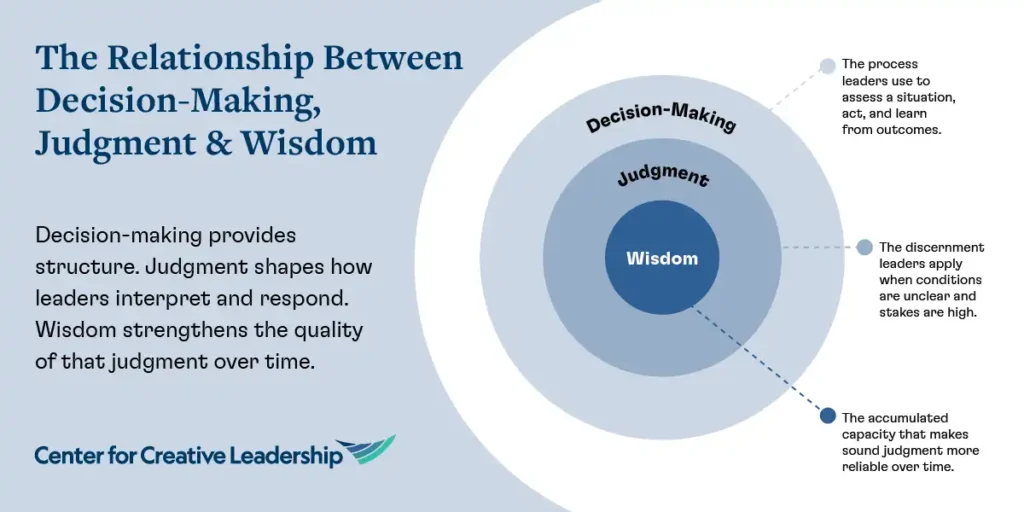
Leadership’s navigation through complexity hinges on the distinct yet interconnected roles of decision-making, judgment, and wisdom. Decision-making is the procedural framework leaders utilize to dissect a challenge and arrive at a conclusion. Judgment, on the other hand, is the critical discernment applied within this process, particularly when faced with ambiguity or when the stakes are exceptionally high. Wisdom is the overarching quality that refines and solidifies this judgment, rendering it more reliable and effective over time.
The advent of Artificial Intelligence (AI) is already profoundly reshaping one facet of this dynamic. AI excels at processing vast datasets, identifying patterns, and generating potential solutions at a speed and scale previously unimaginable. For instance, according to a recent report by McKinsey & Company, generative AI has the potential to automate tasks equivalent to 400 million to 800 million full-time jobs globally by 2030, significantly altering the landscape of information generation. This capability allows leaders to explore a wider array of options and analyze scenarios with greater depth.
However, AI fundamentally lacks the capacity to replicate human leadership judgment and wisdom. It cannot introspectively review past decisions, extracting lessons learned from successes and failures. It cannot empathize with the human impact a decision might have on individuals or teams, nor can it integrate this emotional and social intelligence into its calculations. Furthermore, AI is incapable of engaging in the nuanced, collective sensemaking process that imbues raw data with deeper meaning and context. This is where human leadership, enriched by wisdom, remains indispensable. While AI can amplify analysis and present possibilities, it is leadership wisdom that dictates how these possibilities are interpreted, prioritized, and applied within a specific organizational and human context. When AI floods the landscape with answers, it is wisdom that allows leaders to discern the most impactful and appropriate path forward.
Wise leaders and their teams exhibit the capacity to deconstruct intricate challenges, drawing upon a rich tapestry of knowledge and insights gleaned from lived experiences. They actively engage in mutual sensemaking, a collaborative process that transforms information into actionable intelligence, leading to sound judgments that forge pathways for progress and contribute to the greater good.

The Escalating Urgency of Wisdom in Leadership
A confluence of powerful forces is rapidly increasing the imperative for leadership wisdom. AI is fundamentally altering the information landscape available to decision-makers. Simultaneously, the very nature of the decisions themselves is becoming more demanding. These decisions increasingly involve a greater number of interacting variables, present fewer clear-cut trade-offs, carry higher stakes, and offer less time for deliberation. Leaders are under immense pressure to move with speed, a directive that often stands in direct opposition to the deliberate, considered approach required for wise decision-making.
Compounding this complexity is a multi-generational workforce, with each generation bringing a unique perspective shaped by their experiences with technology, risk, and professional development. This diversity, while a significant asset, also adds layers to the challenge of achieving organizational consensus and driving unified action.
While individual leaders may possess strong judgment, achieving consistent, wise decision-making across an entire organization, beyond a small cadre at the top, presents a formidable hurdle. This challenge is vividly illustrated in the realm of succession planning. Extensive research, including studies by the Center for Creative Leadership (CCL), consistently highlights wisdom transfer as one of the most critically overlooked factors in successful leadership transitions. The departure of a seasoned leader’s accumulated wisdom can represent a far greater loss to an organization than the vacancy of their formal role. A 2022 report by Deloitte, for example, found that organizations with effective succession planning were 1.5 times more likely to outperform their peers financially, underscoring the tangible benefits of foresight and experienced guidance.
The Multifaceted Nature of Leadership Wisdom
Leadership wisdom is not an exclusive domain of the most senior executives, nor is it a fixed attribute that individuals either possess or lack. Our extensive research and experience collaborating with global organizations reveal several critical characteristics that define leadership wisdom:
- Contextual Understanding: The ability to grasp the nuances of a situation, recognizing that solutions effective in one context may be inappropriate in another. This involves understanding the historical, cultural, and organizational factors at play.
- Holistic Perspective: The capacity to see the "big picture," considering the long-term implications of decisions and their impact on various stakeholders, not just immediate outcomes.
- Emotional Intelligence and Empathy: A deep understanding of human emotions and motivations, enabling leaders to connect with others, build trust, and foster an environment where diverse perspectives are valued and heard. This aligns with findings that organizations with high levels of psychological safety experience 21% greater innovation, according to a study by Google’s Project Aristotle.
- Ethical Compass: A strong moral framework that guides decision-making, ensuring actions are aligned with organizational values and societal good.
- Self-Awareness and Humility: The ability to recognize one’s own strengths and limitations, and to be open to learning from others, even those with less formal authority.
- Resilience and Adaptability: The capacity to navigate setbacks and change with grace, learning from challenges and adjusting strategies accordingly.
- Long-Term Orientation: A focus on sustainable success rather than short-term gains, understanding that true progress often requires patience and sustained effort.
- Generative Learning: The inclination to actively seek out new knowledge, challenge assumptions, and continuously evolve one’s understanding.
Cultivating Wisdom in Leaders
Similar to creativity and other complex human attributes, leadership wisdom is more effectively nurtured than directly taught. The development process involves creating an environment that fosters its growth, providing support as individual and collective wisdom takes shape, and offering guidance throughout the journey.
At its core, developing leadership wisdom is facilitated by a three-pronged approach:
- Meaningful Experience: Leaders must be exposed to a variety of challenging situations that stretch their capabilities and provide opportunities for learning. This includes not only successes but also failures, providing critical feedback loops. A study by the Center for Creative Leadership found that 70% of development occurs through on-the-job experiences, emphasizing the importance of diverse assignments and challenging projects.
- Deliberate Reflection: After experiencing situations, leaders need dedicated time and structured processes to reflect on what happened, why it happened, and what could have been done differently. This can involve journaling, peer coaching, or formal debriefing sessions.
- Supportive Relationships and Feedback: Access to mentors, coaches, and trusted peers who can offer honest feedback, challenge assumptions, and provide different perspectives is crucial. This network helps leaders gain insights they might not uncover on their own.
These three dimensions are mutually reinforcing. Experience alone does not automatically lead to wisdom. Leaders also require reflection, constructive feedback, the ability to see situations from multiple viewpoints (perspective-taking), and developmental challenges to effectively translate raw experience into refined discernment.
The Transformative Impact of Leadership Wisdom
The presence of leadership wisdom delivers profound and lasting impact, extending from individual leaders to the broader societal landscape.
For individuals, wisdom acts as a compounding force. With each decision, richer insights are gained, judgment becomes stronger, and a clearer sense of purpose emerges. This cumulative effect leads to increasingly effective leadership over time.
For teams, shared wisdom fosters collective judgment that surpasses the capabilities of any single individual. This enhanced collective intelligence enables more effective navigation of complex challenges, particularly vital for global and cross-functional teams where the integration of diverse perspectives is paramount for achieving optimal, long-term outcomes. Research by Gallup indicates that teams with highly engaged members are 21% more profitable, a testament to the power of cohesive and insightful collaboration.
At the organizational level, wisdom cultivated at scale supports environments characterized by psychological safety, open dialogue, and continuous renewal. These conditions are the bedrock of sustained high performance. Wise organizations elevate collective wisdom to the status of institutional wisdom, leveraging it to confidently and competently navigate crises and periods of disruption. A 2023 survey by PwC revealed that 60% of CEOs believe their company’s ability to innovate is critical for growth, a capacity directly fueled by wise leadership that fosters experimentation and learning.
On a broader societal scale, wisdom is not a panacea for all persistent challenges. However, it equips societies to address complex issues with the maturity, foresight, and momentum required for genuine and sustainable progress.
The future of leadership will not be defined by those who merely possess more data, operate at breakneck speed, or project an unshakeable certainty. Instead, it will be shaped by leaders who possess the profound ability to discern what truly matters, to make sense of complexity collaboratively with others, and to exercise sound, ethical judgment when the stakes are highest.
Charting the Path Forward
As organizations grapple with the accelerating pace of change and the ever-increasing volume of information, the cultivation of leadership wisdom is no longer a desirable attribute but a strategic imperative. It is the essential quality that enables leaders to translate data into insight, challenges into opportunities, and potential into tangible progress for their organizations and the world.
To explore how AI is reshaping decision-making and the critical role of human judgment in this new landscape, consider viewing our webinar, "How AI Is Changing Decision-Making." For ongoing research and insights into AI, wisdom, and effective leadership, we invite you to subscribe to our newsletters.