
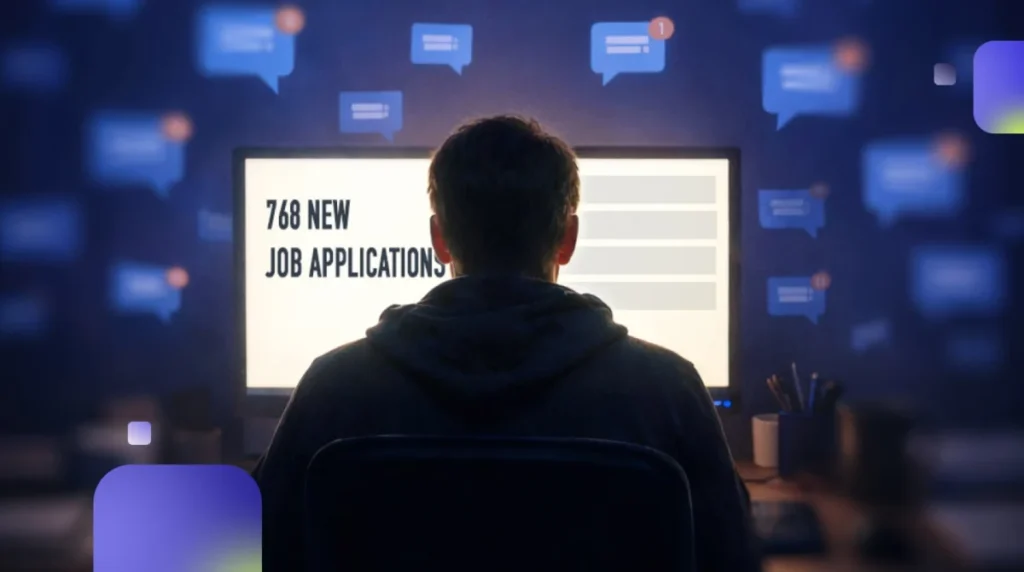
A significant transformation is rapidly reshaping the landscape of talent acquisition, driven primarily by the burgeoning adoption of artificial intelligence by job seekers. This profound shift is increasingly evident across recruitment platforms, with Workable reporting that approximately 10% of all job applications processed through its extensive system are now submitted via AI mass-apply tools. This development prompts critical questions for employers and human resources professionals: Is this a genuine, disruptive evolution in candidate behavior, or merely a transient trend? Workable CEO Nikos Moraitakis offers a crucial perspective, emphasizing that these applicants are far from "fake"; instead, "The vast majority are real people with real resumes," underscoring the authenticity of candidates utilizing these advanced tools.
The Inexorable Rise of AI in Candidate Tools
The journey of online job applications has evolved dramatically since the late 1990s, moving from rudimentary email submissions to sophisticated Applicant Tracking Systems (ATS) and professional networking platforms like LinkedIn. The current era marks another pivotal inflection point with the widespread accessibility of generative AI. Initially, AI tools assisted job seekers in refining resumes, crafting personalized cover letters, and optimizing their profiles for ATS compatibility. However, the latest wave introduces AI-powered mass-application tools, which automate the submission process across multiple job boards and company career pages simultaneously.
This technological leap is fueled by several factors. For job seekers, the job market can often feel like a "black hole," where applications disappear without a trace. The sheer volume of applicants for desirable positions often means individual applications receive minimal human attention in the initial screening stages. AI mass-apply tools promise to significantly increase a candidate’s reach and efficiency, allowing them to apply to hundreds, if not thousands, of roles with minimal manual effort. A recent survey by a prominent career counseling service indicated that over 30% of job seekers had already experimented with AI tools for their applications, with an additional 45% planning to do so within the next year. This data highlights a growing comfort and reliance on AI among the candidate pool, signaling a permanent change in job search strategies.
The underlying motivation for candidates is clear: maximize opportunities in a competitive environment. While some critics argue this approach lacks personalization, proponents counter that in a world where initial screenings are often automated, optimizing for volume and keyword matching becomes a pragmatic strategy. This paradigm shift necessitates a re-evaluation of traditional recruitment methodologies and a proactive response from employers and HR technology providers.
The Employer’s Dilemma: Separating Signal from Noise
For many recruiters, the sudden surge in AI-assisted applications has initially been met with apprehension, sometimes even described as "pollution" of the applicant pool. The instinctive reaction for some has been to implement measures to block or automatically filter out these applications. However, Workable CEO Nikos Moraitakis issues a powerful caution against such a restrictive approach, drawing a historical parallel: "Refusing AI-assisted applications in 2025 is a little like refusing applications that came from the web in 1997." This analogy highlights the futility and potential harm of resisting inevitable technological progress. Just as companies that ignored the internet in the late 20th century were left behind, those who outright reject AI-assisted applications risk alienating a significant segment of qualified, proactive candidates.
The core challenge for employers lies in discerning genuine intent and quality from the sheer volume of applications. With an average corporate job opening attracting hundreds of applicants, and a significant percentage now utilizing AI for submission, the task of sifting through resumes to identify the most suitable candidates becomes exponentially more complex. Data from leading HR analytics firms indicates that recruiters spend, on average, less than 10 seconds reviewing a resume during the initial pass. The increased volume, irrespective of submission method, further compresses this already tight timeframe, making the identification of "signal" amidst the "noise" a paramount concern.
Beyond the volume, concerns also arise regarding the authenticity and accuracy of AI-generated content within applications. While Moraitakis asserts that these are "real people with real resumes," the possibility of AI tools subtly altering or enhancing candidate profiles beyond factual representation is a valid point of discussion. This introduces a layer of complexity for recruiters tasked with evaluating skills, experience, and cultural fit. Furthermore, privacy advocates have raised questions about data handling and algorithmic fairness, urging HR technology providers to ensure transparency and ethical considerations are embedded in their AI solutions. The risk of inadvertently excluding highly qualified individuals who are simply embracing new technology is substantial, potentially leading to a narrowing of talent pools and missed hiring opportunities.
Workable’s Strategic Response: Adapt, Don’t Resist
Recognizing the irreversible nature of this technological shift, Workable has adopted a proactive strategy centered on adaptation rather than resistance. The company understands that AI tools for candidates are not a fleeting trend but are becoming deeply embedded in the contemporary job search process. As such, Workable is committed to evolving its platform to empower employers to navigate this new landscape effectively.
The primary focus of Workable’s approach is to enhance the clarity of identity and intent signals within the inbound application funnel. This involves leveraging advanced data analytics and behavioral pattern recognition, capabilities that are only truly effective at Workable’s extensive operational scale. By analyzing how candidates interact with job postings, the frequency of their applications, and other nuanced digital footprints, Workable aims to provide recruiters with a more granular understanding of each applicant’s genuine interest and suitability. This goes beyond simple keyword matching, delving into a more holistic assessment of candidate engagement.
Workable’s investment in these sophisticated tools is designed to help recruitment teams achieve several critical objectives: more accurately identify serious candidates, streamline the initial screening process, and ultimately reduce the time-to-hire for quality talent. As Nikos Moraitakis succinctly states, "The winners will be the employers with tools that can separate signal from noise." This philosophy underpins Workable’s ongoing development efforts, ensuring that their platform remains at the forefront of recruitment innovation. The goal is not to eliminate AI-assisted applications but to provide the intelligence needed to make informed decisions within an AI-driven environment.
AI as an Essential Countermeasure for Recruiters
The paradox of the current hiring landscape is that the very technology creating the challenge—AI used by candidates—also offers the most potent solution for recruiters. As application volume continues its upward trajectory, driven partly by the ease of AI-assisted submissions, the human capacity for processing and evaluating each application reaches its limits. Therefore, the necessity of equipping recruiters with advanced AI screening tools becomes not just an advantage, but a fundamental requirement.
Workable is actively developing and integrating such screening capabilities into its platform. These tools are meticulously designed to ensure several critical outcomes:
- Efficiency: Automating the initial review of high-volume applications, flagging those that best match job requirements, and filtering out irrelevant submissions. This frees up recruiters’ valuable time to focus on deeper engagement with promising candidates.
- Fairness and Objectivity: Utilizing AI to reduce unconscious bias in initial screening, ensuring that candidates are evaluated based on predefined, objective criteria rather than subjective human interpretations. This promotes a more equitable hiring process.
- Accuracy: Employing sophisticated algorithms to identify critical skills, experience, and qualifications that might be overlooked in a rapid manual review, thereby improving the quality of the candidate shortlist.
- Intent Detection: Going beyond surface-level data to infer a candidate’s genuine interest and likelihood of success, potentially by analyzing application patterns, engagement metrics, and consistency across applications.
Moraitakis articulates this necessity with striking clarity: "We’re going to need AI as a countermeasure to AI." This statement encapsulates the adaptive strategy required in modern talent acquisition. Recruitment AI is no longer a luxury but an operational imperative, allowing organizations to manage increased applicant volume without compromising on quality or fairness. These AI-powered screening tools are evolving rapidly, incorporating capabilities such as semantic matching, behavioral analytics, and anomaly detection to provide a more nuanced and intelligent initial assessment of candidates.
Broader Implications for Talent Acquisition
The pervasive integration of AI into both candidate and recruiter workflows has profound implications across the entire talent acquisition ecosystem.
For Job Seekers: While AI tools offer unprecedented efficiency in applying for jobs, they also introduce new strategic considerations. Candidates must understand that while mass applications can increase visibility, personalization and tailored messaging remain crucial for progressing beyond initial AI screens. There’s a growing need for candidates to differentiate themselves not just through volume but through quality and genuine engagement, perhaps by leveraging AI to personalize at scale rather than simply mass apply. This could involve using AI to quickly customize resumes and cover letters for specific roles, demonstrating a deeper understanding of the job requirements.
For Employers: The increased volume of applications necessitates a robust and intelligent Applicant Tracking System (ATS) that can handle the influx and provide meaningful insights. Companies that fail to invest in advanced HR technology risk being overwhelmed, leading to slower hiring cycles, missed talent, and a degraded candidate experience. The focus shifts from simply receiving applications to efficiently processing, evaluating, and engaging with potential hires. Furthermore, employers must critically assess their job descriptions and evaluation criteria to ensure they are AI-friendly, allowing their own AI tools to effectively identify relevant skills and experience.
For HR Technology Providers: The demand for more sophisticated, ethical, and integrated AI solutions will only intensify. This includes tools for identity verification, intent analysis, predictive analytics for candidate success, and advanced interview scheduling. The market for HR tech is projected to grow significantly, with innovation focused on creating seamless, intelligent experiences for both candidates and recruiters. Ensuring data privacy, mitigating algorithmic bias, and maintaining transparency will be paramount for these providers to build trust and drive adoption.
The Evolving Role of the Human Recruiter: Far from being made redundant, the role of the human recruiter is evolving into a more strategic and nuanced function. With AI handling the initial, high-volume screening tasks, recruiters can dedicate more time to qualitative assessments, building relationships with top candidates, conducting in-depth interviews, and focusing on cultural fit. Their expertise will be crucial in interpreting AI-generated insights, making final hiring decisions rooted in human judgment, and ensuring a positive candidate experience throughout the process. The shift allows recruiters to move away from administrative burdens towards becoming strategic talent advisors.
Looking Ahead: The Future Landscape of Hiring
The trajectory of AI in talent acquisition indicates a future where processes that once felt deeply human and intimate will be significantly augmented, if not transformed, by technology. Candidate tools will undoubtedly become even smarter, offering hyper-personalized application strategies and potentially even AI-driven interview preparation. Consequently, application volume is expected to continue its upward trend.
However, amidst this technological acceleration, Workable’s fundamental mission remains steadfast: to empower employers to find and hire exceptional individuals. The company understands that while AI provides unparalleled efficiency, the ultimate goal of recruitment is to connect talent with opportunity, fostering growth for both individuals and organizations.
As Nikos Moraitakis concludes, encapsulating the imperative for forward-thinking adaptation: "The job market isn’t going back. It’s time to build the infrastructure that lets great hires rise to the top – no matter how they knock on the door." This statement serves as a clarion call for the entire industry to embrace innovation, invest in intelligent tools, and redefine recruitment strategies to thrive in an increasingly AI-powered world. The future of hiring demands a proactive, adaptive, and human-centric approach, where technology serves as an enabler, not a barrier, to discovering the best talent.






