
The global market for professional development, encompassing training, certification, and upskilling, represents a colossal economic force, valued at over $400 billion annually. A significant portion of this expenditure, nearly a third, is dedicated to skills and knowledge that transcend specific company loyalties, focusing instead on universally applicable competencies and emerging technologies. For decades, this demand has been predominantly met by a diverse ecosystem of training providers, including extensive online course libraries, video repositories, sophisticated simulations, expert assessments, and a wide array of professional certifications and accreditations. This sector has historically demonstrated remarkable resilience, often described as recession-proof, due to the continuous need for career advancement, skill acquisition, and staying competitive in a rapidly evolving professional landscape.
However, the very foundations of the online learning business are undergoing a seismic shift, driven by the relentless pace of technological advancement. Prominent players that once dominated the scene, such as Udacity (now part of Accenture), Coursera, Udemy (recently acquired by Coursera), LinkedIn Learning, SkillSoft, and Pluralsight, alongside broader content creators like Masterclass, TEDx, and BigThink, are finding their established models challenged. The recent consolidation of Udemy into Coursera, coupled with notable plunges in the stock prices of publicly traded learning companies, signals a fundamental change. This downturn is not attributed to a lack of capable management but rather to a profound evolution in both the underlying technology and the way individuals consume learning content.
From Course Catalogs to Continuous Growth: The AI Imperative
The enduring demand for professional development remains robust. Every individual, regardless of their field—be it information technology, sales, marketing, finance, human resources, or customer support—harbors aspirations for career growth, necessitating the continuous acquisition of new skills. This ongoing need can be broadly categorized into five distinct levels of professional development, a framework that helps elucidate the evolving landscape:
Level 1: Foundational Knowledge for Newcomers
This tier addresses entry-level training, crucial for individuals new to a profession, role, or career path. The primary objective here is often to achieve foundational certifications that validate basic understanding. Historically, organizations like SHRM (Society for Human Resource Management) and HCI (Human Capital Institute) have offered such certifications. However, the perceived value of some traditional certifications is diminishing as employers increasingly prioritize demonstrable skills over formal accreditation. At this stage, learners require an introduction to fundamental concepts, industry jargon, core principles, and an overview of essential tools.
Level 2: Deepening Expertise for the Experienced Professional
Professionals with two to three years of experience often find themselves at Level 2. While possessing a grasp of the fundamentals, they encounter complexities and nuances that require further exploration. This level calls for exposure to real-world case studies, advanced application scenarios, and training designed to broaden their analytical and problem-solving capabilities. For instance, a recruiter aiming to advance to a senior role would need to acquire proficiency in areas such as advanced sourcing strategies, sophisticated skills assessment techniques, candidate marketing, and the integration of artificial intelligence in recruitment processes.
Level 3: Expanding Horizons for the Niche Expert
At Level 3, professionals possess deep expertise in a specific area but lack breadth across related domains. A recruiter specializing in technology hiring, for example, might lack experience in executive search or sales recruitment. Similarly, an individual focused on building product organizations might need to learn about hiring and assessing diverse talent pools. This stage often involves gaining exposure to global markets, multi-industry best practices, or diverse technological landscapes. Professionals at this juncture may seek new opportunities by transitioning from specialized roles to broader leadership positions, such as moving from Senior Recruiter to Head of Recruiting, which inherently involves leadership development—a form of training akin to embarking on a new career path.
Level 4: Pushing Boundaries for World-Class Performers
Individuals at Level 4 are seasoned professionals with decades of experience, driven by a desire to remain at the forefront of their fields. They seek to identify and master advanced technologies, innovative approaches, and often aim to expand their industry or geographical reach. For many senior leaders, industry-specific knowledge can become a limiting factor. Transitioning to new industries can provide invaluable exposure to novel methodologies, thereby enhancing wisdom, perspective, confidence, and value creation. This level also encompasses executives moving between large corporations and startups or venturing into vast new technological or scientific frontiers. The inherent human drive for continuous learning often leads professionals to explore adjacent domains, necessitating access to in-depth expertise, research, and training in complementary "T-shaped" skill sets.

Level 5: The Pinnacle of Mastery and Knowledge Sharing
Level 5 represents a select group of highly accomplished, tenured experts—the innovators and thought leaders who have demonstrably proven their expertise and impact. Their motivation shifts towards teaching, mentoring, and contributing to the collective knowledge base. These individuals are not driven by fame but by a desire to connect with peers, collaborate, and foster professional communities. They seek opportunities for deep research, engagement with global counterparts, and the exchange of best practices through advanced case studies.
The Traditional Training Model Under Pressure
Historically, training and professional development companies have attempted to address these diverse needs through standardized, packaged solutions. However, many offerings fail to align with the nuanced requirements of advancing professionals. An "advanced" course, for instance, might introduce unfamiliar topics, but its suitability depends heavily on whether the learner is at Level 3 or Level 4, making it difficult to effectively map generic training to individual career trajectories.
This is precisely where Artificial Intelligence (AI) is poised to revolutionize the professional development landscape by enabling the custom assembly of learning experiences tailored to specific goals and developmental stages.
The AI Revolution in Learning
The widespread adoption of AI tools, exemplified by the 900 million weekly active users of ChatGPT, underscores a significant shift in how individuals seek knowledge. Reports indicate that a substantial portion, 40% or more, of these interactions involve users attempting to learn something—whether it’s acquiring information, developing a skill, or solving a problem. In just a few years, AI platforms like OpenAI have attracted a learner base that surpasses that of any traditional Learning and Development (L&D) platform in history.
This rapid uptake can be attributed to two fundamental factors:
-
Intuitive Inquiry-Based Learning: AI facilitates a natural, curiosity-driven approach to learning, mirroring the way children naturally explore and acquire knowledge. The ease of asking questions and receiving immediate, tailored responses makes learning an engaging and exploratory process.
-
Holistic Information Interconnection: The underlying AI content models, such as those employed in platforms like Galileo, interconnect information through advanced embeddings in a systemic and holistic manner. This allows for non-linear learning paths, enabling users to delve deeper into topics, request explanations, skip sections, or explore tangential subjects at their own pace. This flexibility significantly enhances both the speed and quality of learning.
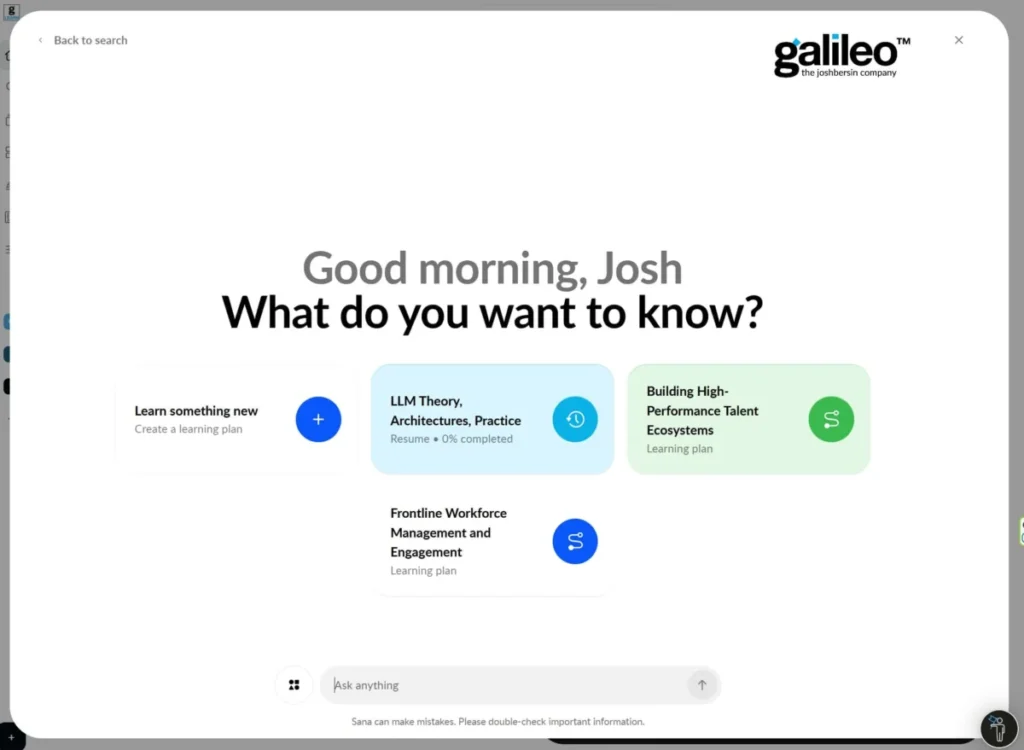
Platforms like Galileo are designed to offer dynamic learning experiences, providing examples, scenarios, challenges, and simulations on demand. Users can opt for structured courses or engage with an AI "Supertutor" that intelligently curates new information and experiences based on the user’s role, past interactions, and other contextual data. This adaptive and personalized learning environment represents a groundbreaking advancement.

Market Disruption: From Publishing to Dynamic Delivery
This paradigm shift from static "publishing courses" to dynamically delivering personalized content fundamentally reshapes the professional development market. The industry, traditionally segmented into learning platforms (LMS, LXP), content (course libraries, executive education), content development tools, certifications, and consulting services, now faces an imperative to adapt to AI-native infrastructures. This is not merely an incremental improvement but a discontinuous leap forward, occurring at an accelerated pace.
The historical "publishing paradigm" involved identifying knowledge gaps, engaging subject matter experts, designing courses, and then "publishing" them onto learning management systems for user consumption. This model, while revolutionary in the early days of the internet and successful for many online bootcamps and executive education programs, is now being eclipsed by an AI-First or AI-Native approach.
AI-native platforms leverage artificial intelligence to collect, generate, translate, and deliver content in a highly personalized manner. Galileo, for instance, integrates extensive research and case studies with a company’s proprietary internal content, creating a bespoke learning environment. Users can engage with formal courses, request simulations, participate in role-playing exercises, or simply ask the AI Supertutor for guidance. When a learner has a question, the system provides an immediate, contextually relevant answer, much like in a traditional classroom setting.
This AI-driven experience presents a significant disruption to the traditional courseware business model. Not only does it offer a far more personalized user experience—with AI remembering past interactions and adapting to individual needs—but it also automates complex and costly processes such as instructional design, translation, and video generation. The system’s ability to generate new learning experiences daily as new content is added, and to seamlessly blend external expertise with internal company knowledge, represents a significant cost-efficiency and effectiveness gain.
Features that were once labor-intensive and expensive, such as the creation of career pathways, learning paths, skills taxonomies, and assessments, can now be machine-generated. Consequently, professional development vendors are increasingly offering not just content but also a highly optimized, personalized, and user-friendly learning experience. The potential for AI to automate tasks like content summarization and chapter generation in videos, as seen in platforms like YouTube, further illustrates the expansive capabilities emerging.
Future of Learning: Personalization and Predictive Development
The integration of AI into learning platforms goes beyond content delivery. Advanced systems can identify a user’s reading level, preferred learning modalities, and specific technical interests. By analyzing user interactions, including professional communications and meetings loaded into the platform, AI can develop a deep understanding of an individual’s cognitive style, current projects, and communication patterns. This enables highly personalized and predictive learning pathways, anticipating future skill needs before they become critical.
The online learning industry, which had shown signs of stagnation in terms of innovation, is now experiencing a renaissance driven by AI. Hundreds of new possibilities are emerging, promising to redefine professional development.
Implications for Professionals, HR, and L&D Buyers
The ongoing transformation necessitates that all training, certification, and professional education providers adapt to the AI-driven landscape. While established course libraries and subscription services will not disappear overnight, the emergence of personalized, AI-centric providers is likely to lead to consolidation and acquisitions of legacy vendors.
The increasing ubiquity of AI agents on personal devices and corporate networks—whether through operating system providers like Microsoft and Apple or third-party applications—means that reaching employees will become more streamlined. The crucial factor will be the availability of robust back-end offerings that can effectively feed these agents with relevant and personalized learning content.
This shift mirrors the revolution brought about by Google Search, which fundamentally altered the need for traditional website portals. Similarly, as employees increasingly utilize internal AI agents for queries related to benefits, payroll, and career progression, they will naturally ask questions such as, "What is my path to promotion?" This presents an unprecedented opportunity to reimagine the deployment of learning within organizations. Consider an hourly worker seeking to increase their income; an AI agent could inform them, "By upgrading your skills in X, you can qualify for shifts in Y position, earning an additional $5 per hour." Such sophisticated use cases are now within reach.
Organizations are actively exploring AI-powered leadership coaching agents, AI-driven assessment tools, and AI-powered content creation platforms capable of generating videos, audio, tests, and courses. The imperative for the coming year is to develop a re-engineered L&D strategy. Research indicates that many traditional L&D functions, characterized by manual tasks in translation, skills architecture, LMS publishing, metadata management, and the creation of job aids and role-based learning paths, are ripe for automation. Companies that have successfully re-engineered their L&D programs have reported significant cost reductions—up to 40%—while simultaneously enhancing the personalization and effectiveness of the employee experience.
For vendors and consultants, the message is clear: embrace innovation, explore emerging players, and consider strategic partnerships, acquisitions, or in-house development of AI platforms. This presents a compelling opportunity to fundamentally redesign how individuals are developed and supported, with demand for effective solutions expected to soar.
As the industry navigates this transformative period, continued research into L&D maturity models and in-depth case studies will provide invaluable insights. The future of professional development is undoubtedly AI-powered, personalized, and continuously evolving, promising a more effective and engaging learning journey for all.







