
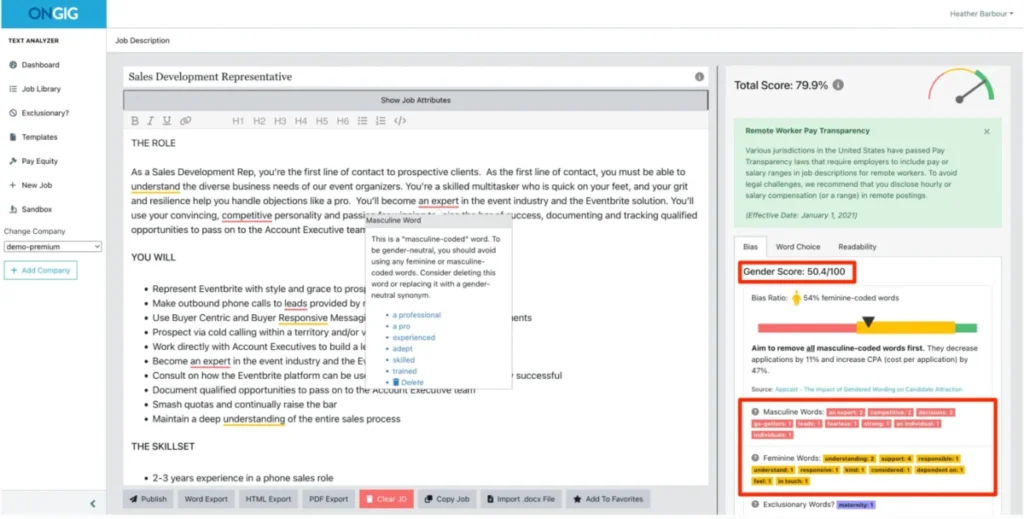
The rapid integration of artificial intelligence into human resources processes, particularly in the drafting of job descriptions, has unveiled a critical challenge: the inherent potential for AI systems to perpetuate and even amplify hidden biases. While AI tools promise unprecedented efficiency, generating polished job descriptions in mere seconds from basic inputs, concerns are mounting regarding the accuracy and inclusivity of these automated outputs. A recent study conducted by Ongig, a prominent player in recruitment software, starkly illustrates this dilemma, revealing that a ChatGPT-generated sales and marketing job description scored a concerning 19.4 out of 100 for gender bias using Ongig’s proprietary Text Analyzer. This finding compels a deeper examination: if AI is writing the first draft, who bears the responsibility for ensuring it is free from prejudice and factually sound?
This pressing question underscores a broader industry conversation about the ethical deployment of AI in hiring. The immediate implication is that without rigorous human oversight, companies risk embedding systemic biases into the very foundation of their talent acquisition strategies, potentially narrowing candidate pools and undermining diversity, equity, and inclusion (DEI) initiatives. This article delves into the mechanisms by which AI introduces bias, the various forms this bias can take, and the indispensable role of human judgment and specialized tools in safeguarding fairness and accuracy in the recruitment landscape.
The Genesis of Bias: How AI Inherits and Generates Prejudice
Large language models (LLMs), the technology powering tools like ChatGPT, learn by processing vast datasets of text and code scraped from the internet. This training data, while immense, is a reflection of human language, historical records, and societal norms – including their inherent biases. Consequently, if the historical hiring data for a particular role has disproportionately favored certain demographics or used exclusionary language, the AI model will learn and reproduce these patterns in its generated content. This phenomenon, known as inherited or algorithmic bias, means that AI doesn’t invent prejudice from scratch but rather mirrors the imperfections present in its training material.
However, the problem extends beyond mere replication. More recent research, such as that presented at the International Conference on Machine Learning (ICML), suggests that generative AI can also produce novel combinations of biased language. This emergent bias occurs when models identify subtle patterns and apply them in new contexts, creating biases that are not directly traceable to a single rule or an obviously prejudiced piece of training data. Instead, these biases can arise from the complex interplay of how the model ranks, predicts, and connects information, making them particularly insidious and difficult to detect without specialized tools or keen human insight.
The Subtlety of Exclusion: Unpacking Hidden Biases in Language
One of the most problematic aspects of AI-generated bias is its often subtle nature. Discriminatory patterns do not always manifest as overtly offensive or obviously biased language. Frequently, they hide within words that appear perfectly normal and innocuous within a job description. For instance, an AI might describe an ideal candidate as "aggressive," a "champion," or a "ninja." On the surface, these terms might seem to convey desirable traits like confidence, drive, or exceptional skill. However, many such words carry unconscious gendered associations, historically linked with masculine traits, which can inadvertently discourage women and other marginalized groups from applying. Research consistently shows that women are less likely to apply for jobs where the language used implies a heavily masculine culture or demands traits stereotypically associated with men.
Beyond gender, AI can propagate other forms of bias. These include:
- Age Bias: Using terms like "digital native," "recent graduate," or "highly experienced worker" can subtly favor or discriminate against certain age groups.
- Disability Bias: Descriptors assuming physical capabilities (e.g., "must be able to walk long distances," "highly mobile") without considering reasonable accommodations.
- Neurodiversity Bias: Phrases like "thrives in high-pressure environments" or "strong social skills required" might unintentionally exclude neurodiverse candidates who excel in different settings or communication styles.
- LGBTQ+ Identity Bias: Using gendered pronouns ("he or she") instead of inclusive alternatives ("they," "you") or gender-neutral job titles.
- Socioeconomic Bias: Requiring specific university degrees or elite certifications that might be inaccessible to individuals from less privileged backgrounds.
- Immigration/Nationality Bias: Demanding "native English speaker" instead of "fluent/proficient in English."
- Criminal History Bias: Overly broad "criminal background check" requirements without considering the relevance of past offenses to the job role.
The good news is that these biases can be mitigated. Strategies include creating comprehensive lists of biased words and their inclusive alternatives, and systematically screening every job description against these lists. Tools like Ongig’s Text Analyzer are designed to automate this process, flagging thousands of potentially biased words and suggesting more inclusive language at scale, thereby transforming exclusionary descriptions into welcoming calls for diverse talent.
The Human-AI Synergy: A Balanced Approach to Job Description Creation
The emergence of AI in recruitment does not signal the obsolescence of human involvement; rather, it redefines it. AI excels at drafting the repeatable, structured components of a job description, leveraging its pattern recognition capabilities to generate initial content for sections such as:
- Core responsibilities and duties
- Required qualifications and skills (e.g., software proficiency)
- Standard company culture statements
- Benefits and perks summaries
- Equal Employment Opportunity (EEO) disclaimers
However, the critical differentiator lies in the human application of judgment, nuance, and company-specific context. Once AI provides the foundational draft, human input becomes indispensable for imbuing the description with personality and distinguishing it from generic templates. This involves adding details that resonate with the company’s unique culture and strategic objectives, such as:
- Specific team dynamics and working methodologies
- The immediate challenges the role will address
- Key performance indicators or project goals for the first 6-12 months
- Opportunities for career growth and professional development within the organization
- The specific impact the role will have on the company’s mission
These human-added details are crucial because AI, by its nature, lacks the intrinsic understanding of an organization’s values, team dynamics, or immediate strategic priorities. While it can list common responsibilities for a "Senior Product Manager," it cannot discern whether the hiring team prioritizes innovative tool development, process optimization, or achieving a specific market share target in the near future. These nuances are what truly attract the right talent and ensure alignment with organizational needs. For specialized firms, like Abacus Global in finance, a meticulously crafted, specific job description is vital for attracting professionals whose expertise precisely matches the intricate demands of the role. The synergy between AI’s efficiency and human insight thus enables companies to achieve two critical goals: accelerating the drafting process and significantly enhancing the quality, accuracy, and inclusivity of their job descriptions.
Beyond Words: Assessing Tone and Preventing AI "Hallucinations"
Even after addressing specific biased words, the task of refining an AI-generated job description is only partially complete. A description can employ perfectly inclusive language yet still convey an overly demanding, negative, or intimidating tone. For example, merely replacing "aggressive" with "driven" does not resolve the issue if the surrounding text mandates candidates to "thrive under constant pressure and deliver results at all costs." The overall sentiment of the job description significantly influences who feels encouraged or discouraged to apply.
To ensure an inviting and realistic tone, human reviewers must ask critical questions:
- Does the language feel collaborative or overly competitive?
- Does it prioritize specific outcomes over the well-being of the employee?
- Does it sound realistic, or does it set impossibly high expectations?
- Is it balanced, highlighting both challenges and opportunities?
- Does it genuinely reflect the company’s culture and values?
The objective is to cultivate an honest yet approachable tone, clearly articulating job demands while fostering an inclusive environment.
Another significant concern with AI-generated content is its propensity for "hallucination"—inventing details or facts that are not true. When drafting job descriptions, AI may fill in details based on common patterns found in similar roles, rather than the actual requirements of the specific position within the hiring company. For instance, prompting ChatGPT with "Senior Product Manager" might yield responsibilities like roadmap planning, user research, analytics, and team leadership. While these are typical for the role, they might not precisely align with the specific focus or team structure of a particular company. This is a direct consequence of AI’s reliance on statistical patterns, which, while not factually incorrect in a generic sense, may be inaccurate for a specific organizational context.
To counter this, human judgment and the involvement of subject matter experts are paramount. Hiring managers, team leads, and even current employees in similar roles can provide invaluable insights into role-specific nuances, internal jargon, acronyms, and process notes that AI cannot independently ascertain. In specialized fields, such as healthcare, generic AI tools frequently misrepresent medical terminology or crucial procedural details. Engaging a knowledgeable virtual medical administrative assistant to review job listings ensures that patient-scheduling requirements, HIPAA-related responsibilities, and other critical details are accurately represented before publication.
Navigating the Regulatory Labyrinth: Compliance in an AI Era
While AI can expedite the drafting of standard compliance language, it is imperative not to treat it as a legal expert. AI models can pull generic or outdated laws from their vast training data, which may not apply to specific hiring locations or current regulations. Worse, they can hallucinate, incorporating non-existent laws or misinterpreting legal requirements. The legal landscape surrounding employment is complex and varies significantly by jurisdiction, encompassing federal, state, and local mandates.
Before publishing any AI-generated job description, a thorough human review against current employment laws and disclosure requirements applicable to the hiring location is non-negotiable. This often necessitates collaboration with HR and legal teams, particularly for organizations hiring across multiple regions or internationally. Key areas requiring meticulous review include:
- Salary Range Disclosure: Many jurisdictions now mandate the inclusion of salary ranges in job postings.
- Equal Employment Opportunity (EEO) Statements: Ensuring compliance with anti-discrimination laws like Title VII of the Civil Rights Act.
- Privacy Notices: Adherence to data privacy regulations (e.g., GDPR, CCPA) regarding candidate data collection.
- Reasonable Accommodation Language: Explicitly stating a commitment to providing reasonable accommodations for individuals with disabilities.
- Veteran Status and Affirmative Action: Including appropriate language for veteran preference or affirmative action policies where applicable.
- Drug Testing and Background Check Disclosures: Ensuring these comply with local laws and are clearly communicated.
Failure to comply with these regulations can lead to significant legal complications, fines, and reputational damage.
The Feedback Loop: Continuous Improvement through New Hires
Even with meticulous pre-publication review, some inaccuracies or misrepresentations in a job description may only become apparent once a new hire begins the role. New employees are invaluable sources of feedback, offering a fresh perspective on the alignment between the advertised role and the reality of the job. Engaging them in a structured feedback process can provide critical insights for refining future job descriptions.
Questions to consider for new hires include:
- What aspects of the job description accurately reflected the role?
- What responsibilities were more or less significant than anticipated?
- Were there any unstated expectations or missing details?
- Did the role evolve differently from what was initially presented?
- How well did the job description prepare you for the actual day-to-day work?
For frontline and deskless employees, leveraging employee experience platforms like Blink can facilitate this feedback loop, providing direct communication channels to managers through chat or quick polls, capturing insights while the hiring experience is still vivid. This iterative process of gathering feedback and making improvements ensures that job descriptions remain dynamic, accurate, and truly reflective of the roles they represent.
A Structured Workflow for Accurate, Unbiased Job Descriptions
The optimal strategy for leveraging AI in job description creation is not to choose between automation and manual effort, but to forge a workflow that integrates both. A practical, step-by-step review process can significantly reduce drafting time while upholding standards of accuracy and inclusivity:
- Generate the First Draft with AI: Provide the AI tool with comprehensive context, including the exact job title, a detailed list of responsibilities, team structure, location, and any pre-approved inclusive language lists. The richer the input, the more refined the initial output.
- Add the Human Judgment Layer: The hiring team or subject matter experts should then enrich the AI-generated draft with specific details that are unique to the company, team, and the role’s immediate objectives.
- Conduct Language Bias Check: Run the refined description through a specialized bias and inclusivity checker. Tools like Ongig’s Text Analyzer can automatically flag biased words and suggest more inclusive alternatives, ensuring a diverse and welcoming message.
- Assess the Tone: Read the complete job description aloud. This helps in identifying any language that might sound overly demanding, negative, or intimidating, ensuring it strikes a balance between realistic expectations and an approachable, collaborative spirit.
- Verify All Details: Engage relevant stakeholders—hiring managers, team leads, HR—to meticulously confirm the accuracy of responsibilities, required qualifications, specific tools, experience levels, reporting structures, and success metrics.
- Ensure Compliance: Conduct a thorough review of location-specific pay transparency laws, EEO statements, data privacy requirements, and other employment regulations to preempt legal complications.
While these steps can be performed manually, integrating an AI-powered platform designed for recruitment content can streamline the entire process, managing the workflow from draft generation to final compliance checks within a single ecosystem.
The Indispensable Role of Human Oversight
The ultimate purpose of publishing a job description is to attract a broad and diverse pool of talented professionals. To achieve this, the description must be genuinely inclusive, accurate, and reflective of the actual role and company culture. While AI in recruiting offers undeniable speed and efficiency, these benefits cannot come at the expense of accuracy or inclusivity. The best approach unequivocally combines the strengths of both AI and human intelligence. Let AI handle the heavy lifting of initial drafting and repetitive tasks, empower hiring managers to inject critical context and nuance, and deploy specialized tools to systematically identify and rectify biases. This hybrid model ensures that job descriptions are not just quickly generated, but are also fair, compelling, and legally compliant, ultimately fostering more equitable hiring outcomes.






