The landscape of recruitment for critical sectors like military, defense, and public safety is undergoing a profound transformation, driven by the necessity to balance speed with unwavering rigor. Historically, these fields have grappled with a seemingly insurmountable trade-off: the imperative for meticulous vetting and thorough background checks often clashed with the urgent need to fill vital positions. However, emerging artificial intelligence technologies, particularly AI-powered interviewing, are beginning to dismantle this long-standing dichotomy, offering a pathway to dramatically accelerate candidate throughput without compromising the foundational standards of security, consistency, and accountability that these roles demand.
This shift is not merely an operational enhancement; it directly addresses systemic challenges that have plagued defense contractors and public safety agencies for years. The consequences of slow hiring in these environments extend far beyond administrative frustration. They translate into critical vacancies that strain existing personnel, disrupt essential operations, and, in the most severe cases, can pose tangible risks to national security and community well-being.
The Critical Crossroads: Speed vs. Rigor
For organizations operating within the military, defense, and public safety domains, the cost of a miscalculation in hiring is exceptionally high. A single ill-suited individual in a cleared defense analyst role, for instance, could compromise sensitive intelligence. Similarly, understaffed fire departments or police departments stretch their existing resources to the breaking point, potentially delaying critical emergency response times. The urgency to fill these roles is often a matter of operational effectiveness and public safety.
Historically, the emphasis has leaned heavily towards rigor. The belief has been that it is better to hire slowly and deliberately, ensuring a perfect fit, than to rush the process and potentially bring in an unqualified or even detrimental candidate. This approach, while prioritizing security, often led to prolonged hiring cycles, sometimes stretching for months. The cascade effect of these delays included the loss of highly qualified candidates who found opportunities with faster-moving private sector employers, and increased pressure on the dedicated professionals already on the front lines.
The advent of AI interviewing is fundamentally altering this paradigm. By automating and standardizing the initial stages of the hiring process, these technologies enable organizations to move candidates through screening at an unprecedented pace. Crucially, this acceleration is achieved while maintaining and even enhancing the structured, consistent, and meticulously documented evaluation processes that these sensitive roles necessitate. AI interviewers are proving that speed and rigorous standards are not mutually exclusive but can, in fact, be synergistic when powered by the right tools.
Shared Challenges Across Mission-Critical Sectors

Despite their distinct operational mandates, military, defense civilian roles, and public safety positions share a striking commonality: they operate within a demanding recruitment ecosystem characterized by high expectations for candidate quality, a shrinking talent pool, and the absolute necessity for a defensible hiring process.
Elevated Candidate Quality Standards:
Both sectors require individuals with a specific and often highly specialized skill set, coupled with a high degree of integrity and judgment. For a defense contractor supporting a complex national security program, or a paramedic responding to a life-threatening emergency, there is minimal room for on-the-job learning. The necessary competencies – be it intricate analytical skills, crisis management under duress, or sound decision-making in high-stakes situations – must be present from day one. This inherent demand for seasoned professionals narrows the applicant pool significantly.
Shrinking Applicant Pools and Intense Competition:
The competition for talent is fierce across both domains. Defense and security employers find themselves vying with lucrative private sector opportunities for individuals possessing security clearances and specialized technical expertise. Concurrently, public safety agencies are confronting a well-documented recruiting crisis. Many departments report a significant decline in the number of qualified applicants, exacerbated by the demanding nature of the work and increasing competition for a limited pool of candidates. Every day a position remains unfilled represents a lost opportunity to secure a top candidate who may accept an offer from a competitor.
The Imperative for a Defensible Hiring Process:
Beyond the need for qualified personnel, these sectors are held to an exceptionally high standard of procedural integrity. Inconsistent interview practices, undocumented hiring decisions, and variations in how candidates are assessed by different evaluators are not just poor HR practices; they represent significant liabilities. Audits, union grievances, and public records requests are commonplace. Therefore, the hiring process must be demonstrably fair, consistent, and auditable, providing a clear and defensible rationale for every hiring decision, both in real-time and retrospectively.
It is precisely within this confluence of challenges that AI interviewing emerges as a potent solution. It is engineered to compress the timeline of the hiring process without sacrificing the essential elements of rigor and integrity.
AI Interviewing in Action: Military and Defense
Defense-adjacent civilian roles, encompassing positions such as intelligence analysts, program managers, logistics specialists, and various cleared contractor roles, exist at a critical intersection of speed and scrutiny. These positions are vital for maintaining the continuity and effectiveness of defense programs, yet they are subject to stringent compliance requirements and rigorous oversight.
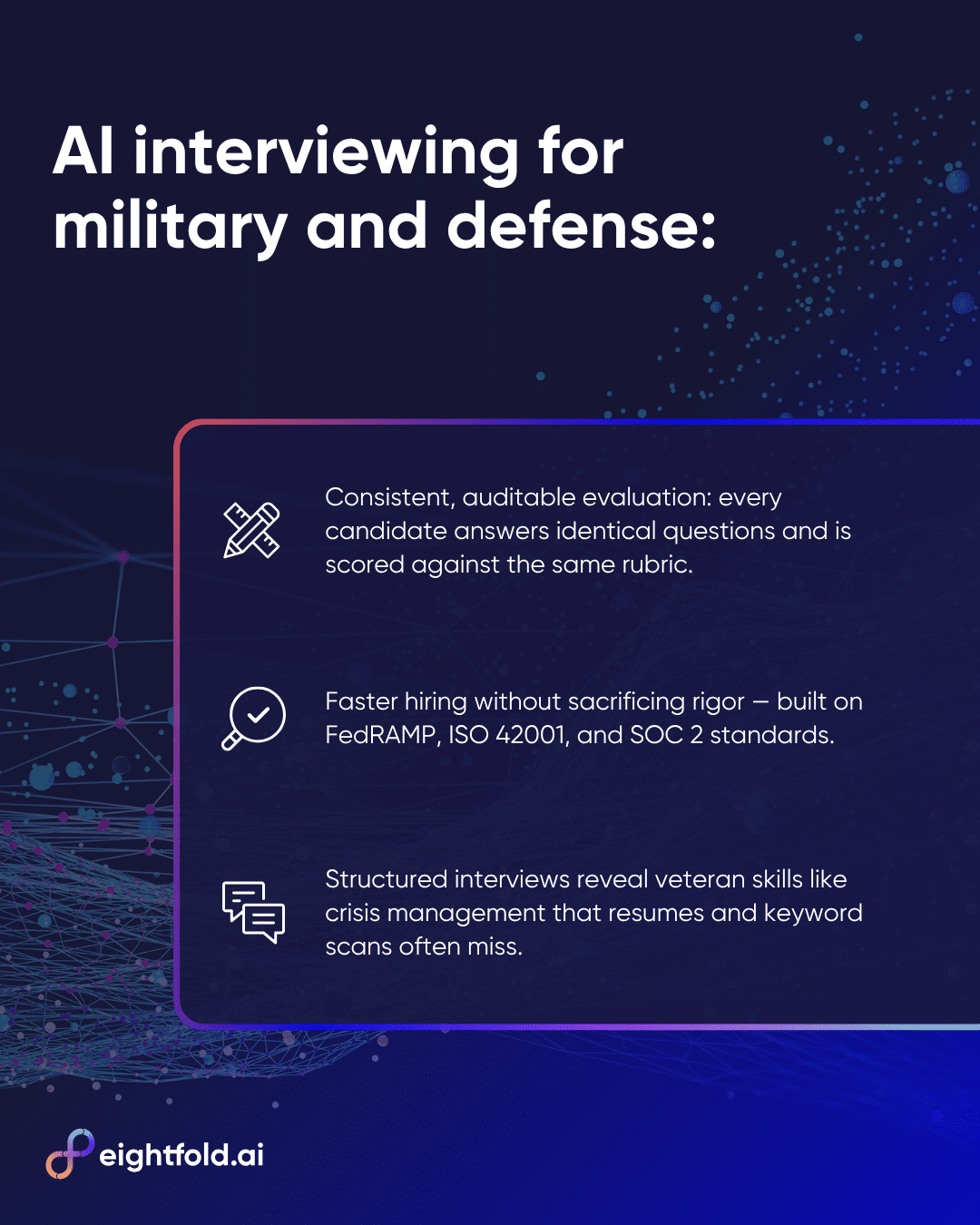
A lack of consistency in candidate evaluation can quickly become a red flag during an audit, undermining the integrity of the hiring process. AI interviewing directly addresses this by ensuring that every candidate is subjected to the same set of structured, role-relevant questions and assessed against a standardized rubric. This eliminates the variability that can arise from different interviewers’ subjective interpretations or biases. The result is a more equitable and objective evaluation.

Furthermore, AI interviewers can significantly compress the timeline of the early hiring stages. Instead of candidates waiting for an interviewer’s availability, they can complete a standardized AI-driven interview almost immediately after applying. Recruiters then receive structured summaries and objective scores within hours, rather than days or weeks, enabling them to identify top talent far more rapidly.
Case Study: Constellis Leverages AI for Scale and Compliance
Global defense and security services provider Constellis exemplifies the successful implementation of AI interviewing in this sector. Faced with the need to fill a high volume of security roles while adhering to the strict compliance and audit trail requirements of their industry, Constellis turned to Eightfold.ai’s AI Interviewer. This enabled them to maintain their rigorous standards while accelerating their hiring process.
Eightfold’s platform is built on a foundation of robust security and compliance infrastructure, meeting stringent standards such as FedRAMP Moderate, ISO 42001, and SOC 2 certification. This is a crucial factor for organizations that must account for the secure handling of candidate data and the transparency of their hiring methodologies. The U.S. Department of Defense itself is a testament to the trust placed in Eightfold’s Talent Intelligence Platform, underscoring that this is not a generalized tool being adapted but a platform designed with the demanding requirements of government and defense hiring in mind from its inception.
Beyond process integrity, AI interviewing also offers a unique advantage in recognizing and translating military experience into valuable civilian skill sets. Core competencies honed during military service, such as crisis management, structured decision-making under pressure, and effective team leadership, can often be obscured by traditional resume formats that prioritize military job titles. A structured AI interview, designed to elicit these transferable skills, can effectively highlight the qualifications of transitioning service members and veterans, transforming them from overlooked candidates into highly competitive applicants.
AI Interviewing in Action: Public Safety
Public safety agencies, including police departments, fire departments, and emergency medical services (EMS), are grappling with a profound and escalating hiring crisis. Chronic understaffing is a widespread issue, directly impacting the ability of these agencies to meet community needs. The demanding nature of the work, both physically and emotionally, significantly narrows the pool of individuals willing and able to serve. Moreover, each unfilled position places an immense strain on the existing workforce, potentially leading to burnout and reduced operational effectiveness.
In this context, speed is not merely a desirable attribute but a critical competitive necessity. Public safety agencies are increasingly finding themselves in direct competition with private sector employers for a limited labor pool. A candidate who faces a prolonged waiting period for a preliminary interview is at a high risk of accepting an offer elsewhere.
AI interviewing directly tackles this bottleneck by streamlining the initial screening phase. Candidates can complete structured interviews within days of applying, bypassing the scheduling constraints that often plague traditional recruitment processes. This allows hiring teams to quickly identify and advance qualified individuals, ensuring that promising candidates are not lost to competing opportunities.
The emphasis on consistency is equally vital in public safety. In roles where hiring mistakes can have severe consequences for public trust and physical safety, every candidate must be evaluated against the same objective criteria. AI interviewing provides this standardized assessment, ensuring that decisions are based on merit and qualifications, not on the subjective preferences of individual interviewers. This creates a robust and defensible foundation for hiring decisions, allowing the limited HR and recruiting resources within these agencies to focus on higher-value activities such as final-round interviews and the nuanced human judgment that cannot and should not be automated.
The Bottom Line: A New Era of Recruitment
For decades, organizations in the military, defense, and public safety sectors have operated under the unyielding constraint that they cannot afford to compromise between speed and accuracy in their hiring processes. This often translated into accepting the inherent slowness and manual inefficiencies of traditional recruitment as the unavoidable cost of ensuring rigor and security.
However, this perceived trade-off is rapidly becoming obsolete. AI interviewing technology is fundamentally reshaping recruitment by enabling these critical sectors to screen candidates faster, more consistently, and with greater transparency than manual processes ever could. The choice between speed and maintaining high standards is no longer a zero-sum game.
The organizations that embrace this technological evolution and integrate AI interviewing into their talent acquisition strategies will be the ones best positioned to fill their essential roles efficiently and effectively. They will gain a significant competitive advantage, securing the talent needed to fulfill their missions while their slower-moving counterparts continue to navigate the complexities of traditional, time-consuming hiring cycles.
For agencies and organizations evaluating the potential of AI interviewing within their specific hiring frameworks, a direct engagement with leading solutions can provide invaluable insights. Scheduling a demonstration with platforms like Eightfold.ai, for instance, can illustrate precisely how AI can be tailored to meet the unique demands of mission-critical, high-compliance hiring environments. This proactive approach is key to unlocking the efficiency and effectiveness gains that this transformative technology offers.