Columbia University, a cornerstone of the Ivy League and a global leader in higher education, has significantly expanded its digital footprint to offer high-level academic content to a global audience of professionals and lifelong learners. In an era where the traditional barriers to elite education—namely cost and geography—are being dismantled by digital transformation, Columbia’s suite of free online courses represents a strategic effort to democratize specialized knowledge. These offerings, primarily hosted on the edX platform under the "ColumbiaX" brand and the university’s own "Columbia Plus" portal, provide a practical avenue for individuals to engage with world-class faculty without the financial burden of a full degree program. As the global labor market shifts toward a skills-based economy, the availability of these resources allows professionals in sectors ranging from finance to artificial intelligence to upskill in alignment with current industry demands.
The Evolution of Ivy League Digital Education
The move toward open-access education at Columbia University did not occur in a vacuum. It follows a broader trend within the Ivy League that began in the early 2010s, often referred to as the "MOOC (Massive Open Online Course) revolution." Since joining the edX consortium—a platform founded by Harvard and MIT—Columbia has steadily increased its catalog of online offerings. This evolution reflects a dual mission: to extend the university’s research and pedagogical reach to underserved populations and to provide a "taster" for its more intensive, paid executive education and degree programs.
Data from recent educational technology reports indicate that the market for online micro-credentials and professional certificates is expected to grow by over 15% annually through 2030. Columbia’s participation in this space serves as a powerful validation of the micro-learning model. For Learning and Development (L&D) leaders and Human Resources professionals, these courses serve as a cost-effective solution for employee development, offering a middle ground between informal self-study and expensive corporate retreats.
Understanding the "Freemium" Academic Model
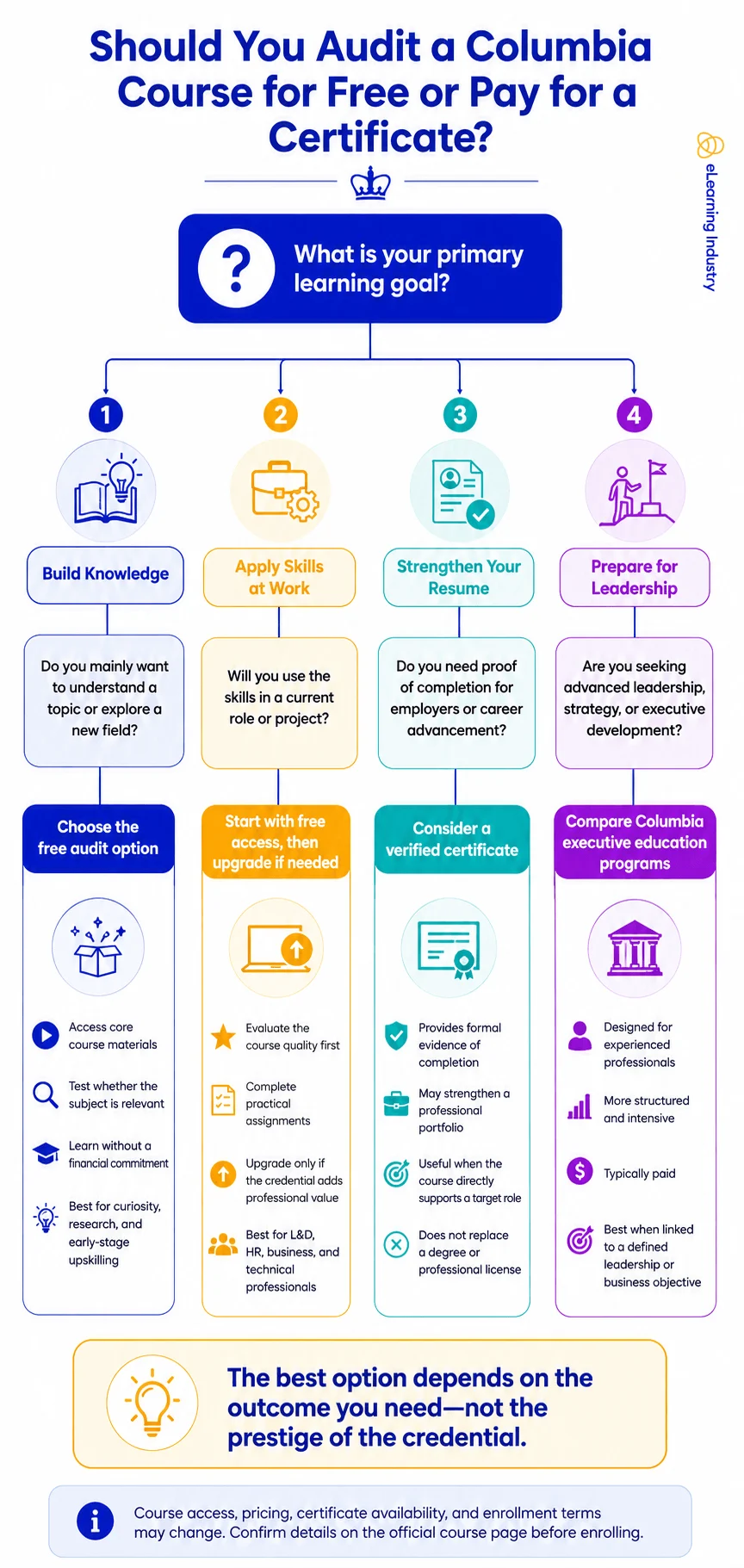
A critical distinction for any prospective learner is the difference between "auditing" a course and earning a "verified certificate." Most of Columbia’s online courses follow a freemium model. Under the audit track, learners can access video lectures, reading materials, and discussion forums at no cost. This provides the core educational value of the course. However, to obtain a verified certificate—a digital credential that can be shared on LinkedIn or added to a resume—a fee is typically required, usually ranging from $50 to $250.
Furthermore, it is important to distinguish between ColumbiaX (the MOOC arm) and Columbia Business School Executive Education. While ColumbiaX focuses on foundational and intermediate skills accessible to the general public, the Executive Education programs are high-touch, instructor-led, and significantly more expensive, often costing thousands of dollars. The 10 courses highlighted below represent the accessible entry points into the Columbia ecosystem.
Top 10 Columbia University Online Courses for Professionals
1. Introduction to Corporate Finance
This course serves as a foundational pillar for anyone involved in business management or entrepreneurship. It covers the mechanics of how corporations make financial decisions, focusing on the time value of money, capital budgeting, and the valuation of assets. In a volatile economic climate, understanding these principles is essential for making data-driven decisions that ensure long-term organizational viability.
- Target Audience: Entrepreneurs, MBA candidates, and mid-level managers.
- Relevance: Critical for understanding corporate health and investment viability.
2. Free Cash Flow Analysis
Moving beyond basic accounting, this course dives into the specifics of cash flow—the lifeblood of any business. It teaches learners how to forecast future performance and utilize discounted cash flow (DCF) models. This is a high-demand skill in investment banking and corporate strategy roles.
- Target Audience: Financial analysts and CFOs.
- Relevance: Provides the tools necessary for precise company valuation.
3. Risk and Return
In the world of investment, the relationship between risk and reward is the fundamental trade-off. This course explores modern portfolio theory and asset allocation. As individual and institutional investors navigate fluctuating markets, the ability to quantify risk becomes a competitive advantage.
- Target Audience: Wealth managers and finance students.
- Relevance: Essential for building resilient investment portfolios.
4. Essential Math for Artificial Intelligence
The rapid rise of Generative AI has created a surge in demand for technical literacy. This course addresses the "black box" of AI by teaching the underlying mathematics, including linear algebra, probability, and optimization. It is designed to bridge the gap between theoretical computer science and practical AI application.
- Target Audience: Aspiring data scientists and software engineers.
- Relevance: Foundational for anyone looking to transition into machine learning roles.
5. Programming and Data Structures
As software continues to "eat the world," basic programming literacy is no longer optional for technical leadership. This course introduces the core concepts of algorithms and data structures, which are the building blocks of efficient software development.
- Target Audience: Career-switchers and technical project managers.
- Relevance: A prerequisite for advanced coding and system design.
6. Crisis Resource Management
Originally developed for the high-stakes environment of healthcare, the principles of this course are remarkably applicable to corporate crisis management. It focuses on communication, teamwork, and decision-making under extreme pressure.

- Target Audience: Operations managers and emergency responders.
- Relevance: Vital for leadership during organizational transitions or external crises.
7. Inclusive Teaching: Supporting All Students in the College Classroom
Diversity, Equity, and Inclusion (DEI) remains a top priority for modern organizations. This course provides evidence-based strategies for creating inclusive environments. While framed for the classroom, the pedagogical strategies for engagement and accessibility are directly transferable to corporate training and management.
- Target Audience: Corporate trainers, educators, and HR leaders.
- Relevance: Supports the creation of psychologically safe and inclusive workplaces.
8. Learning Success
Based on cognitive psychology and learning science, this course teaches individuals how to learn more effectively. In a fast-paced world where "learning to learn" is a meta-skill, this course provides strategies for memory retention, note-taking, and time management.
- Target Audience: Lifelong learners and students.
- Relevance: Maximizes the ROI of time spent on professional development.
9. Frontiers of Science: Climate and Us
As Environmental, Social, and Governance (ESG) criteria become standard in corporate reporting, understanding the science of climate change is essential for business strategy. This course examines the social and economic implications of environmental shifts.
- Target Audience: Sustainability officers and policymakers.
- Relevance: Informs long-term strategic planning regarding climate risk.
10. INSPIRE: Seven Strategies for Ending Violence Against Children
This course, hosted on Columbia Plus, focuses on public health and social intervention. It introduces the World Health Organization’s INSPIRE framework. For those in the non-profit and public sectors, it provides a data-driven approach to community welfare.
- Target Audience: NGO leaders and public health practitioners.
- Relevance: Essential for those working in social impact and community development.
Strategic Implications for the Modern Workforce
The availability of these courses signifies a shift in how prestige and knowledge are distributed. Historically, an Ivy League education was a scarce commodity reserved for a select few. Today, Columbia University is essentially "unbundling" its expertise. For the individual, this means the ability to stack "micro-credentials" to create a bespoke educational profile that is often more relevant to their specific career path than a traditional, broader degree.
Industry analysts suggest that the "shelf life" of a technical skill is now approximately five years. Consequently, the "once-and-done" model of university education is being replaced by a "continuous learning" model. Columbia’s free courses provide a low-risk entry point into this lifecycle. By auditing a course in AI or Corporate Finance, a professional can determine if they have the aptitude or interest for a more intensive (and expensive) certificate program or degree.
Official Perspective and Educational Impact
While Columbia University has not issued a single definitive statement on this specific list, the university’s Office of the Provost has consistently emphasized the importance of "global reach" and "digital innovation." University leaders have noted in various academic forums that online education is not a replacement for the on-campus experience but rather a vital extension of it. By offering these courses for free, the university strengthens its brand as a global thought leader while simultaneously building a pipeline of potential students for its more advanced, paid offerings.
The impact on global equity is also noteworthy. Learners in developing economies, who may never have the opportunity to visit New York City, can still gain insights from the same professors who teach in the Morningside Heights classrooms. This global classroom dynamic enriches the discussion forums and provides a diversity of perspectives that benefits all participants.
Conclusion: Navigating the Path Forward
For professionals looking to advance, the path forward involves a strategic selection of these resources. Rather than enrolling in multiple courses simultaneously, experts recommend a targeted approach: identifying a specific skill gap and completing the corresponding Columbia course with the intent of applying those skills immediately in a professional context.
Whether the goal is to master the intricacies of free cash flow, understand the mathematical foundations of the AI revolution, or develop more inclusive leadership strategies, Columbia University’s free online courses offer a high-caliber starting point. In the modern economy, the most valuable asset is not just what you know, but your ability to adapt and learn. Through these digital offerings, Columbia provides the tools for that ongoing evolution, making the "Ivy League experience" more accessible than ever before.