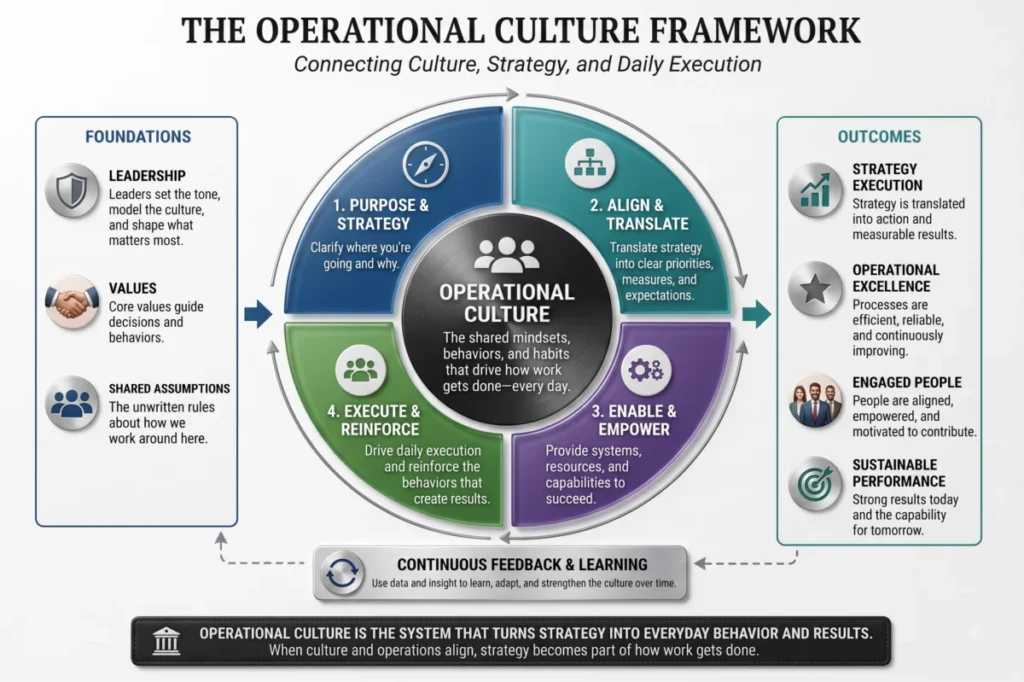
The persistent gap between strategic intent and operational reality remains one of the most significant hurdles for modern executives. Despite the investment of substantial resources into strategic planning, communication, and resource alignment, many organizations find their initiatives stalling within six months of launch. This phenomenon is characterized by departments moving in divergent directions, meetings that prioritize status updates over decisive action, and a gradual loss of momentum that prevents new initiatives from delivering measurable results. While leadership often diagnoses these failures as "culture problems," emerging organizational theories suggest this assessment is incomplete. Strategic execution is not a function of culture in the abstract; it is a direct result of the conditions leaders create to facilitate consistent, mission-aligned decision-making at every level of the hierarchy.
The Execution Gap and the Limitations of Traditional Culture
For decades, organizational culture has been defined as a collection of shared values, beliefs, and norms. This has led many corporations to focus heavily on "soft" cultural elements, such as crafting mission statements, defining core values, and implementing employee engagement perks. However, data suggests that these efforts frequently fail to impact the bottom line. According to seminal research by Robert Kaplan and David Norton, as many as 90 percent of organizations fail to execute their strategies successfully. The primary cause is not a lack of commitment or talent, but an inability to translate high-level strategic objectives into the coordinated, day-to-day actions of the workforce.
Employees do not experience an organization’s culture through what is written on the walls; they experience it through what the organization consistently does. Culture reveals itself in the mechanics of decision-making, the priorities established by senior leadership, and the systems used to evaluate and reward performance. Edgar Schein and Peter Schein, leading authorities on organizational psychology, describe culture as the shared assumptions that develop as groups solve problems over time. These assumptions are shaped by leadership decisions and reinforced through organizational systems. When these systems are misaligned with the stated strategy, even the most talented individuals find their efforts constrained by the environment.
A Chronology of Strategic Evolution and the Kodak Case Study
To understand the necessity of an operational culture, one must look at the history of corporate adaptation. The evolution of strategy execution has moved from the rigid "command and control" models of the mid-20th century to the more fluid, data-driven approaches of the digital age. However, history is replete with examples of organizations that possessed the right strategy and technology but lacked the operational culture to act.
A quintessential example is the trajectory of the Eastman Kodak Company. In 1975, a Kodak engineer named Steve Sasson invented the first digital camera. At the time, Kodak was the dominant force in the film photography market. Despite having the technology and the foresight to recognize the digital shift decades before it became a market standard, Kodak’s leadership was unable to transition the organization’s operational focus. The organizational systems were so deeply entrenched in the high-margin film and chemical business that the digital innovation was suppressed to protect existing revenue streams.
By the time the market forced Kodak’s hand in the late 1990s and early 2000s, competitors had already established dominance in the digital space. The Kodak failure was not a failure of strategy or innovation; it was a failure of adaptability and the inability of the organization’s "operational culture" to pivot toward a known future. This historical precedent underscores that strategy succeeds only when people have the environmental conditions—clarity, accountability, and the authority to act—to execute it consistently.
The Four Capabilities of the Operational Culture Framework
Rather than viewing culture as a byproduct of success, forward-thinking leaders are beginning to treat it as an operational capability that can be intentionally designed and refined. This "operational culture framework" is built around four core capabilities: clarity, accountability, collective intelligence, and adaptability.
1. Clarity as a Strategic Compass
Clarity provides the necessary direction for decentralized decision-making. People perform at their peak when they understand what success looks like, how priorities are determined, and how their specific roles contribute to the broader mission. Without clarity, employees are forced to guess which tasks are most important, leading to "priority drift" where effort is expended on low-impact activities. In a journalistic context, clarity functions like a style guide; it ensures that while individual writers have different beats, the final publication remains cohesive and aligned with the editorial mission.
2. Accountability and Ownership
True accountability transforms expectations into ownership. In many organizations, accountability is synonymous with a "blame culture," where the focus is on identifying errors after they occur. In an effective operational culture, accountability is integrated into the daily rhythm. It involves providing employees with the authority needed to act and reinforcing a sense of shared responsibility for outcomes. When accountability is clear, execution becomes less dependent on "heroic leadership" and more dependent on the reliability of the organizational system.
3. Collective Intelligence and Psychological Safety
Collective intelligence acknowledges that the most effective solutions rarely originate from a single source. High-performing organizations intentionally leverage the expertise of individuals across various functions. However, for collective intelligence to thrive, there must be a foundation of psychological safety—the belief that one can speak up with ideas, questions, or dissent without fear of retribution. Research by Amy Edmondson at Harvard Business School has shown that teams with high psychological safety are more likely to catch errors early and innovate more effectively, as they possess the structures necessary for surfacing expertise rather than just following hierarchy.

4. Adaptability and Continuous Learning
Adaptability is the organizational capacity to learn faster than the environment changes. This is distinct from simple "change management," which often treats change as a one-time event with a clear start and end. John Kotter, a professor at Harvard Business School, argues that modern organizations must be structured for continuous change. This requires a culture where learning is treated as an ongoing capability rather than an occasional training event. An adaptable organization does not just see change coming; it is built to act on that information immediately.
Analysis of Sector-Neutral Dynamics: The Case of Instructional Redesign
The dynamics of operational culture are not limited to the corporate sector. These principles apply equally to healthcare, government, and higher education. A notable example can be found in the field of academic instructional design. During a large-scale course-redesign initiative at a major institution, instructional designers (IDs) were tasked with assisting faculty in meeting new quality standards for digital learning.
Initially, the IDs operated in a vacuum, creating support materials based on their own interpretations of the requirements without direct collaboration with the faculty. This led to a significant disconnect: the faculty perceived the IDs as a "compliance checkpoint" rather than partners. The strategy—improving course quality—stalled because the operational conditions for collaboration were absent.
The initiative only regained momentum when the leadership clarified the shared goals and restructured the interaction between the two groups. Once the IDs shifted from enforcing requirements to helping faculty solve specific pedagogical challenges, the relationship transformed. This shift illustrates that strategy stalls not when people lack commitment, but when the organization fails to build the infrastructure for collaborative decision-making.
Leadership as the Architect of Systems
If the workforce executes strategy, then the primary responsibility of leadership is to serve as the architect of the systems that enable that execution. Leaders continuously shape culture through the expectations they establish, the behaviors they recognize, and the questions they ask. Every organizational system—from performance evaluations to team meeting agendas—sends a message about what is truly valued.
To diagnose the health of their operational culture, leaders are encouraged to evaluate their organizations against five critical questions:
- Do people throughout the organization know the three most important priorities for the next six months? (Clarity)
- Do people have the authority to make the decisions required for their roles? (Accountability)
- Is it safe for people to raise concerns or offer dissenting views? (Collective Intelligence)
- Does the organization have a formal process for learning from both success and failure? (Adaptability)
- Do the systems—hiring, rewards, and communication—reinforce the stated strategy? (Systemic Alignment)
A negative response to any of these questions indicates a specific, addressable gap in the organizational infrastructure. By focusing on these tangible elements, leaders can move away from the amorphous "culture problem" and toward a concrete strategy for operational improvement.
Future Implications: AI and the Evolving Workplace
The significance of operational culture is poised to increase as artificial intelligence (AI) continues to transform the workplace. As technology automates routine tasks, the "human" elements of work—complex decision-making, cross-functional collaboration, and ethical judgment—become the primary drivers of value. Organizations that have built a strong operational culture will be better positioned to integrate AI effectively, as their people will have the clarity and adaptability to navigate the transition.
Furthermore, the rise of remote and hybrid work models has weakened the traditional "office-based" cultural cues. In this decentralized environment, the systems and processes that define an operational culture become the primary glue holding the organization together. Without the physical proximity of a traditional office, clarity and accountability become even more essential for maintaining strategic alignment.
In conclusion, the organizations that will thrive in the coming decade are not necessarily those with the most ambitious plans, but those whose leaders understand that strategy is a living process. Execution is the result of thousands of small decisions made every day by employees at all levels. By intentionally designing an operational culture that supports these decisions, leaders can ensure that their strategic vision becomes a reality rather than a stalled initiative. The infrastructure of clarity, accountability, collective intelligence, and adaptability is not a "soft" addition to business strategy; it is the fundamental mechanism by which strategy is realized.