The landscape of corporate education is undergoing a fundamental transformation as Learning and Development (L&D) professionals increasingly pivot toward podcasts as a primary vehicle for continuous improvement and strategic insight. In an era defined by the rapid proliferation of generative artificial intelligence and a global shift toward skills-based organizational models, the traditional reliance on annual conferences and static certification programs is proving insufficient. Today’s learning leaders are operating in an environment where the "half-life" of professional skills is shrinking, necessitating a more agile, high-frequency approach to knowledge acquisition. This shift has elevated the L&D podcast from a casual medium to an essential component of the modern professional development toolkit, providing a conduit for real-time research, expert discourse, and evidence-based practice.
The Strategic Shift Toward Continuous Learning
For decades, the Learning and Development sector relied on a "push" model of education, where information was disseminated through formal, scheduled events. However, the contemporary workplace demands a "pull" model characterized by just-in-time learning. The emergence of podcasts as a critical resource is a direct response to the increasing complexity of the corporate ecosystem. Instructional designers, human resources leaders, and talent development specialists are now tasked with navigating a terrain where new technologies and pedagogical theories emerge almost weekly.
Industry analysts note that the rise of the "knowledge worker" has placed a premium on the ability to synthesize vast amounts of information quickly. Podcasts facilitate this by democratizing access to high-level strategic thinking. They allow professionals to "learn in the flow of work"—a concept popularized by industry analysts to describe the integration of educational content into daily routines. By utilizing commutes, exercise periods, or administrative downtime, L&D practitioners can maintain a constant pulse on industry shifts without sacrificing productive hours.
Technological Catalysts and the Generative AI Revolution
The urgency surrounding L&D podcasts is fueled largely by the disruptive impact of generative AI. As organizations struggle to integrate tools like ChatGPT, Midjourney, and specialized Large Language Models (LLMs) into their workflows, L&D departments have become the frontline of this transition. Podcasts serve as an early-warning system for these technological shifts. Unlike traditional textbooks or peer-reviewed journals, which may take years to publish, a podcast can feature a conversation with a technology pioneer within days of a major release.
The move toward skills-based organizations represents another significant driver. Companies are increasingly moving away from rigid job titles in favor of fluid skill sets. This requires L&D leaders to understand complex topics such as skills mapping, talent marketplaces, and internal mobility. Podcasts that feature interviews with Chief Learning Officers (CLOs) from Fortune 500 companies provide listeners with a blueprint for how these massive organizational shifts are managed in real-time, offering a level of transparency that was previously unavailable to the broader public.
Defining Excellence in Educational Audio
As the market for professional podcasts expands, the ability to discern high-quality content from mere opinion has become a vital skill for L&D professionals. A great L&D podcast is defined by several key pillars: evidence, practicality, diversity of thought, and credibility.
The Requirement for Evidence-Based Insights
In a field often prone to "learning myths"—such as the widely debunked theory of learning styles—the most valuable podcasts are those grounded in learning science. High-quality shows cite empirical research and industry reports, such as those from the Association for Talent Development (ATD) or the LinkedIn Learning Workplace Learning Report. By grounding conversations in data, these podcasts help practitioners avoid fads and focus on strategies that yield measurable returns on investment (ROI).
Practical Application and Frameworks
Theoretical knowledge, while important, must be balanced with practical execution. The most effective corporate learning podcasts utilize case studies and "post-mortem" analyses of learning projects. This allows listeners to understand not just what a successful program looks like, but the specific challenges—budgetary, cultural, or technological—that were overcome during its implementation.

Diversity of Perspectives
The intersectionality of L&D means that insights must come from beyond the learning department. Respected podcasts often invite guests from the fields of behavioral psychology, data science, organizational development, and executive leadership. This multidisciplinary approach ensures that learning strategies are aligned with broader business objectives, such as revenue growth, employee retention, and digital transformation.
Quantifying the Impact: Data and Industry Sentiment
The transition toward audio-based learning is supported by broader trends in digital consumption. According to data from Edison Research, podcast listening among professionals has seen a steady year-over-year increase, with a significant portion of listeners reporting that they use the medium specifically for career-related growth. In the L&D space specifically, the value of this medium is echoed by industry leaders.
"Today, staying informed is a competitive advantage," says Christopher Pappas, CEO and founder of eLearning Industry. "The organizations that learn faster adapt faster. That’s why resources like podcasts have become invaluable, because they connect learning professionals with the ideas, experiences, and industry voices shaping the future of workplace learning."
This sentiment reflects a broader understanding that organizational agility is tied to the speed of information flow. When L&D leaders are well-informed, they can make more confident business decisions, reducing the risk associated with adopting new learning technologies or restructuring training departments.
Integrating Podcasts into Professional Development Plans
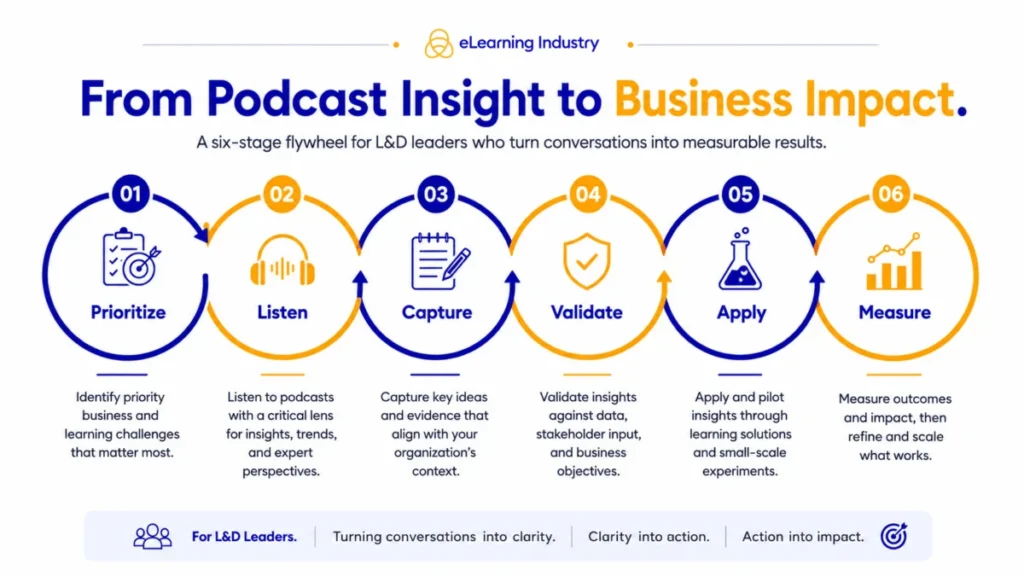
To maximize the utility of podcasts, L&D professionals are encouraged to move beyond passive listening and adopt a more structured, intentional approach. This involves a four-step process: goal alignment, active note-taking, implementation, and knowledge sharing.
- Goal Alignment: Professionals should curate their podcast subscriptions based on active projects. If an organization is preparing to migrate to a new Learning Management System (LMS), the L&D lead should seek out episodes focused on platform implementation, user experience (UX) design, and data migration.
- Active Note-Taking: Capturing key statistics, frameworks, or quotes during a session transforms a podcast from entertainment into a reference document. These notes can serve as the basis for internal proposals or strategy adjustments.
- Implementation: The true value of professional development lies in its application. This might involve piloting a new micro-learning format discussed on a show or adopting a more rigorous analytics framework to measure training effectiveness.
- Knowledge Sharing: One of the most effective ways to build a strong learning culture is to socialize insights. Sharing a relevant podcast episode in a company Slack channel or discussing it during a "lunch-and-learn" session can spark collaborative innovation and ensure that the benefits of the medium extend across the entire team.
Avoiding Common Pitfalls in Content Selection
Despite the benefits, there are risks associated with the consumption of professional audio content. One common mistake is "popularity bias," where listeners assume that the most downloaded shows are the most accurate. In the niche field of L&D, smaller, more specialized podcasts led by practitioners often provide more granular, actionable advice than high-production "celebrity" business podcasts.
Furthermore, "echo chamber" listening can limit a professional’s growth. By only listening to voices that confirm their existing beliefs, L&D leaders may miss out on critical innovations in fields like AI or behavioral economics. A robust professional development strategy requires seeking out dissenting views and challenging long-held assumptions about how people learn and perform.
The Future of L&D Podcasts: Emerging Trends to Watch
Looking ahead, several emerging topics are expected to dominate the L&D podcasting landscape. These include:
- The Ethics of AI in Education: Discussions are shifting from "how to use AI" to the ethical implications of data privacy, algorithmic bias, and the long-term impact of AI on human creativity.
- Learning Analytics and Big Data: As L&D departments face increased pressure to prove ROI, podcasts are focusing on how to move beyond "completion rates" toward sophisticated data modeling that links learning to business performance.
- The Human-Centric Workplace: In an increasingly automated world, there is a growing focus on "soft skills" or "power skills" such as empathy, critical thinking, and leadership.
- Adaptive Learning Technologies: Podcasts are exploring how AI-driven platforms can create personalized learning paths for thousands of employees simultaneously.
Conclusion
Successful learning leaders do not rely on a single source of truth; they cultivate a diverse ecosystem of insights. Podcasts have moved to the center of this ecosystem, offering a unique blend of convenience, expert access, and timely information. By bridging the gap between academic research and corporate practice, these audio resources empower L&D professionals to navigate the complexities of the modern workforce with greater clarity and confidence. As the field continues to evolve at an unprecedented pace, the ability to listen, learn, and adapt will remain the hallmark of the most effective organizations. Regular engagement with high-quality L&D podcasts—such as eLearning Talks or eLearning Unscripted—is no longer just a recommendation; it is a strategic necessity for those who wish to lead the future of workplace learning.